


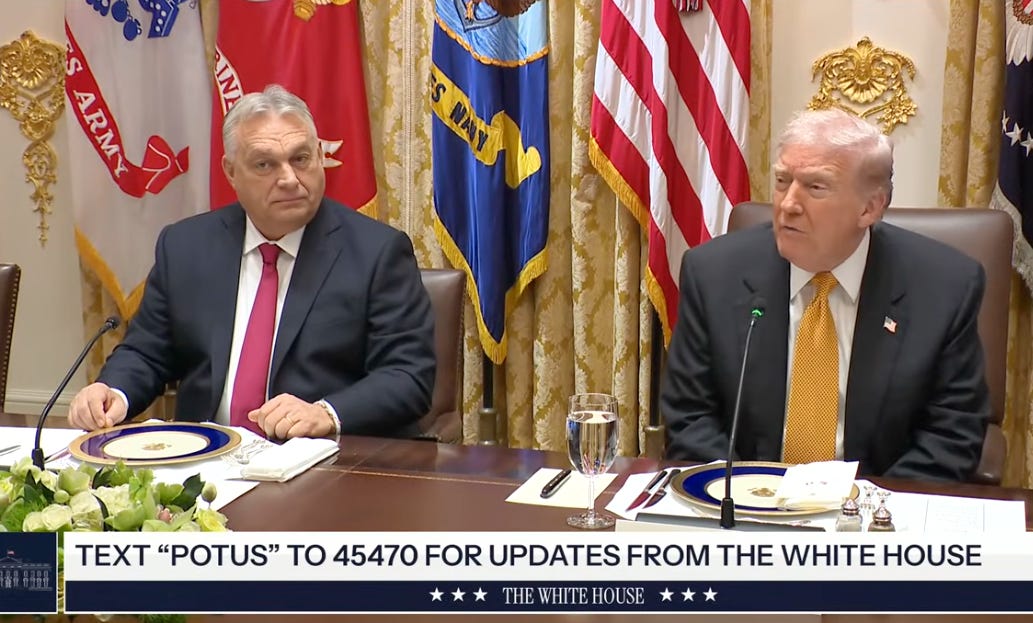
Unable to kick off another taxpayer-funded golf weekend without first begging an appeals court to let him starve Americans, Donald Trump welcomed his “friend” Victor Oruraban, which, yes, is neither how you spell Viktor nor Orbán, but accuracy is for the fake news. Hungary, we’re told, has zero crime, zero problems, and presumably zero vowels left for the prime minister’s name. From there, we speed-run straight into Econ Wonderland: Thanksgiving is 25% cheaper (“because Walmart said so,” perhaps in a dream), gas is “about $2,” and inflation is basically a decorative garnish he keeps around for ambiance. Somewhere, Jerome Powell quietly clutches a spreadsheet and weeps.
Orbán takes the mic to announce that everything was “ruined” by Democrats until Trump returned like a home warranty plan for geopolitics. “After your leaving, President, everything was basically blocked, ruined, cancelled, a lot of harm done by the previous administration,” he laments, practically filing a warranty claim right there in the East Room.
Hungary, he explains, is a “modern Christian government” marooned on a liberal ocean, think Vatican Yacht Club but with border walls. “We are kind of a special island of difference in a liberal ocean in Europe,” Orbán boasts, conveniently skipping over what “difference” means when the rule of law is optional and dissenters are inconvenient.
On energy, he pleads geography: no seaports, only pipelines, therefore pretty please an exemption for Russian oil. “Pipeline is not an ideological, political issue. It’s a physical reality,” he says, channeling a weary physics teacher who’s tired of Brussels’ liberal thermodynamics. Croatia, he adds, has a backup pipe, but it’s the drinking straw to Russia’s firehose. Translation: Budapest would love to quit Moscow, just as soon as Moscow stops being so pipeline-shaped.
Reporters try facts. Trump pivots to Europe’s oil hypocrisy like it’s open mic night for grievance geopolitics. “Many European countries are buying oil and gas from Russia and they have been for years,” he huffs, before asking the rhetorical knockout punch: “I say what’s that all about, right?”
Moments later, he’s back in his comfort zone: self-mythology. “Everyone, as you know, in NATO, they voted to go from 2% to 5%, and you know that nobody thought that was possible,” Trump brags, as if he’d just descended from Mount Olympus with the Article 5 tablets in hand. “And we had just about almost, other than Spain, a unanimous vote,” he adds, because nothing says “unanimous” like an asterisk and an exception clause.
Fact check: NATO has not officially raised its defense-spending target from 2% to 5% of GDP. The alliance’s guideline remains the 2% benchmark adopted in 2014. However, during Trump’s presidency, and again in recent discussions, there has been talk among some allies of encouraging higher national spending, with several hawkish members like Poland and the U.S. suggesting 3–5% as an aspirational goal in response to Russia’s war in Ukraine. In other words, there’s been rhetorical drift, but no formal vote, resolution, or “unanimous” agreement as Trump claimed.
Still, he insists, “They respect him a lot,” referring to Orbán. “They don’t agree with him, but inwardly I think they probably do.” That’s Trump’s worldview in miniature: universal secret admiration, spoken in whispers only he can hear.
He then unveils what he calls the “biggest trade deal ever made with Europe, $950 billion.” A number so specific and round it sounds pulled straight off The Price Is Right wheel. “We just signed it,” he assures the room. “It’s the single biggest trade deal ever signed.” Which is one way to describe an economic mirage made of tariffs, wishful thinking, and applause cues.
Fact check: Trump is gesturing toward the July 2025 U.S.–EU trade “framework,” not a finalized or legally binding deal. Announced at Turnberry, because of course it was, the framework sketched out projections rather than commitments: roughly $750 billion in European purchases of U.S. energy through 2028, mainly liquefied natural gas, oil, and nuclear fuel, alongside $600 billion in new European investments flowing into American industries. These were aspirational targets, not signed obligations, but that hasn’t stopped Trump from selling the outline like it’s already framed and hanging in the Louvre.
Combined, those numbers make for a $1.35 trillion notional total, though only about $950 billion of that was touted by the White House as “realized value.” In exchange, the U.S. imposed a 15 percent tariff on most European imports, half the 30 percent Trump had threatened, and the EU agreed in principle to drop tariffs on U.S. industrial exports and open markets for select agricultural goods.
So yes, there was a framework, but not an actual trade agreement. No binding treaty, no ratified schedule, no measurable implementation. In diplomatic English, it was a handshake, a headline, and a hope. In Trumpian English: “We just signed it.”
On Ukraine, we get the standard alternate timeline, complete with divine foresight and selective memory. “The war would have never happened if I were president,” Trump declares, before adding, “It’s stupid that it happened, but it did happen. I inherited the war and I think we’re going to get it ended in the not too distant future.” Time, in Trump’s retelling, is a Möbius strip, he both prevented the war and inherited it, which is quite a feat for a man who left office years before it began.
Then comes the numbers game: “They’re losing 7,000 soldiers a week,” he claims, a figure that would have erased the Russian army several times over by now. Actual independent estimates from Western intelligence agencies put total Russian combat deaths somewhere around 200,000 to 300,000 since 2022, not per month, per war. But when has math ever survived a Trump presser unscathed?
He also muses about a potential Budapest summit with Putin, saying, “If we have it, I’d like to do it in Budapest… it’d be good.” That’s immediately followed by his own contradiction: “It turned out I didn’t want to do that meeting because I didn’t think anything was going to be happening of significance.” Translation: he both canceled and confirmed the same summit in a single breath. It’s diplomacy by Schrödinger, alive and dead until Fox News checks the ratings.
Immigration? Europe, in Trump’s telling, is drowning in criminals, while Hungary basks in the serenity of total purity, a place where, apparently, nothing bad ever happens because Viktor Orbán personally locked the front door. “They have people flooding Europe all over the place,” Trump warns, “and it’s hurting it. The crime rates are way up… [but] his crime rates are very low. They’re the same as they always were, which is very little crime.” Naturally, because the first step to lowering crime is declaring it illegal to count any.
Orbán nods along, then triumphantly announces that Hungary’s number of illegal migrants is “like that, zero.” He explains, “We have a crystal-clear system. If somebody would like to come to Hungary, first he should ask for that… nobody can step on the territory of Hungary without permission.” It’s less a border policy than a bureaucratic fairy tale: just fill out a form, wait for eternity, and voilà, zero migration.
As a reward for this miracle math, Brussels is punishing Hungary “every day one million euro as a punishment to the Brussels budget because we stop the migrants,” Orbán complains, repeating it so many times you half expect him to forward the invoice to Ursula von der Leyen in all caps: SUBJECT - RE: DAILY SANCTION FOR BEING RIGHT.
Domestic politics interlude: there’s a shutdown, of course, and it’s all the Democrats’ fault, Trump assures us they could end it “in two minutes.” “We’ve approved it 14 times,” he insists, meaning Republicans have apparently discovered a new form of legislative magic where voting becomes wish-granting. The Democrats, he says, “have voted 14 times to hurt the country,” while he’s just trying to keep the lights on.
The solution? Go nuclear, but the good kind. “They call it the nuclear option,” he explains. “This is the second form of nuclear. Very good. Very good. This is a good form. This is not a bad form.” In Trump’s cosmology, nuclear weapons come in flavors like yogurt.
From there he unrolls a parchment of partisan dreams: “Here’s some of the things that we pass if we terminate the filibuster, voter ID, no mail-in voting, no cash bail, no men in women’s sports, no welfare for illegals. You could go on and on.” And he does. It’s democracy, but make it speed-run: abolish the rules, declare victory, and call it governance by executive whim.
A reporter dares to mention affordability, and Trump immediately summons Karoline, his in-house amen chorus, to rescue the narrative. “I just heard this yesterday that Walmart said that Thanksgiving was 25% more expensive under Biden,” he insists, though by this point “Walmart” seems to exist mainly as an oracle that delivers favorable prophecies. Karoline steps up and delivers her monologue with cable-news polish: “You inherited the worst inflation crisis in modern American history, and you are fixing it in ten short months… you signed the largest middle-class tax cut in six months.”
It’s a claim so specific and so untraceable it might as well be printed on a fortune cookie. Trump nods along like a man who’s just heard his own biography read aloud. “We have more investment in our country than any country in history,” he adds, “over $18 trillion as of this moment, maybe 20 or 21 trillion by the time I finish my first year.” Somewhere between the applause lines we also learn the U.S. now leads the world in AI “by a lot” and is “doubling the nation’s electricity” to feed the datacenters, but don’t worry, “the companies themselves are building their own power plants.”
It’s SimCity with executive orders: just click “build,” watch the lights come on, and hope the power grid doesn’t catch fire before the next press conference.
There’s a brief detour to Romania, troops not withdrawn, merely “rotated,” like a mattress you don’t want to admit is sagging. And a drive-by at NBC “fake news,” of course, because what’s a presser without a designated heel?
Closing vibes: Trump vows to “stick up for Victor Obar” (somewhere, a diacritic cries), while Orbán radiates the serene confidence of a man who’s outlasted every EU leader who’s ever rolled their eyes at him. If the Budapest Putin summit happens, it will of course be Trump’s idea all along; if it doesn’t, it was never supposed to.
Officially, this was billed as a bilateral meeting to strengthen U.S.–Hungarian ties, all about trade, energy, and security cooperation. In reality, it played more like a transatlantic support group for illiberal strongmen with persecution complexes. Trump got to posture as global dealmaker and self-anointed peacemaker, “the war would never have happened if I were president”, while Orbán secured a sympathetic ear for his plea to keep buying Russian oil and his insistence that Hungary is “the only modern Christian government in Europe.”
So as they wrap up, what we’re left with is branding. Two men shaking hands across a lectern, each selling the same product: nationalism with a smile and a shared disdain for facts.
How fn dare this creep dictator Orbanana come to the White House and defame 49 million people in an American political party? And everyone sits around and nods and smiles? I cannot wait for that delicious feeling of schadenfreude that will come with Orbaboon's downfall. And I don't care if his downfall is a fall down the steps of his tacky palace, anything that shames, embarrasses or destroys Oraborca will give me a warm fuzzy feeling.
Trump thinks he owns America the same way he owned casinos: all glitz and glam, where he can take money from the till whenever he wants.
As with the casinos, when America falls apart, he'll simply walk away, paying no penalties and leaving the ill-gotten goods to his kids...