


The trouble with naming something the Board of Peace is that you’ve essentially dared reality to pants you in public. And reality, as it turns out, is thrilled to accept the challenge. This week, Poland and Italy became the latest U.S. allies to glance at President Donald Trump’s shiny new international doodad, a body originally pitched as a way to “cement Gaza’s ceasefire,” now apparently auditioning to become the United Nations, but with more executive power and fewer grown-ups, and say, in the polite diplomatic way, we have a dentist appointment for the foreseeable future.
Poland’s Prime Minister Donald Tusk delivered the kind of statement that sounds friendly until you realize it’s basically an email reply that begins “Per my last message.” Poland won’t join “under these circumstances,” he said, but will “analyse it,” which is the international-relations equivalent of telling a salesman you’ll “think about it” as you back slowly into the shrubbery. Still, he added, Poland’s relationship with the U.S. remains a priority, which is a nice way of saying, we still want the security umbrella; we just don’t want to stand under it while you’re doing interpretive dance.
Italy’s foreign minister Antonio Tajani went with a different, more Italian approach: it’s not you, it’s our constitution. Italy, he explained, can only join international organizations on “equal terms with other states.” And the Board of Peace, per Italy, isn’t built that way because it gives Trump “extensive executive powers.” In other words, Rome has read the fine print and discovered that membership apparently requires accepting a structure in which the chairman is also the CEO, the bouncer, and the guy who decides whether you get to speak, plus the guy who “insists” you call him “sir.”
If you are wondering why multiple countries are reacting to Trump’s “Board of Peace” like it’s an email from a Nigerian prince but somehow less credible, consider what the concept sounds like out loud: a U.S.-led peace board, chaired by Donald Trump, pitched as a global conflict-resolution mechanism, which has invited Russia and Belarus. That’s not a diplomatic initiative; that’s a group chat where everyone mutes the admin and then quietly exits.
The branding alone is a miracle of hubris. “Board of Peace” has the same vibes as a middle manager announcing a “Culture Committee” right after eliminating the 401(k) match. It’s a title that screams, We are serious people doing serious things, while the minutes of the meeting consist of “Donald suggested a logo. Donald suggested a bigger logo. Donald suggested putting his face on the logo.”
But it’s the structure that seems to be doing the real damage. The pitch appears to be: the United Nations, but with fewer pesky member states and more… Trump. In theory, it was about Gaza, ceasefire stabilization, reconstruction, postwar governance, the kind of work that requires tedious diplomacy and high-level coordination. In practice, the thing has already evolved into Trump’s favorite genre: the grand televised deal. He sees it taking a “wider role” in resolving global conflicts, which is a phrase that can mean anything from “helping negotiate a settlement” to “announcing you fixed war” in a ballroom full of gold curtains while someone distributes commemorative hats.
The point of most international organizations, the annoying, paperwork-heavy, committee-infested ones, is that power is dispersed on purpose. Nations join because rules apply equally, decisions are constrained by procedures, and legitimacy comes from the fact that no single leader can treat it like a personal brand extension. That’s why Italy is waving around its constitution like a garlic necklace in a vampire movie: it’s basically saying, we do not have legal authority to join a club where the terms are: ‘Trump gets to run everything.’
And Poland’s posture is a perfect case study in modern alliance maintenance: never say no so loudly that Washington gets offended, but also don’t sign anything that might turn into a diplomatic hostage situation. “We will analyse it,” Tusk said, and you can practically hear the subtext: We’ll analyze it the way you analyze a new restaurant someone swears is amazing, then you read the reviews and they’re all ‘I got salmonella but the vibe was immaculate.’
You can also feel the eerie undertone of the Russia-and-Belarus invitations. Even if those invitations are partly performative, a way to claim “inclusivity,” or a gambit to lure adversaries into a forum where the U.S. can exert leverage, the optics are nuclear. Western democracies have spent years building a posture of collective moral seriousness around Russia’s behavior. Joining a brand-new peace body that invites Russia and Belarus is like showing up to an anti-smoking campaign sponsored by Marlboro: sure, you could do it, but you will be answering questions about it for the rest of your natural life.
So, the Board of Peace sits there, gleaming, while America’s allies circle it like cautious housecats around a Roomba. There’s also the deeper, unmistakable Trumpian tell: the need to create a new institution rather than work through existing ones. Trump doesn’t want the UN; the UN has rules, ambassadors, committees, and that one guy who always asks “can we clarify the mandate.” Trump wants an organization that moves at the speed of his attention span and speaks in the language of his self-image: decisive, dominant, and slightly vague on details. The UN is “multilateral.” Trump prefers “I did it.”
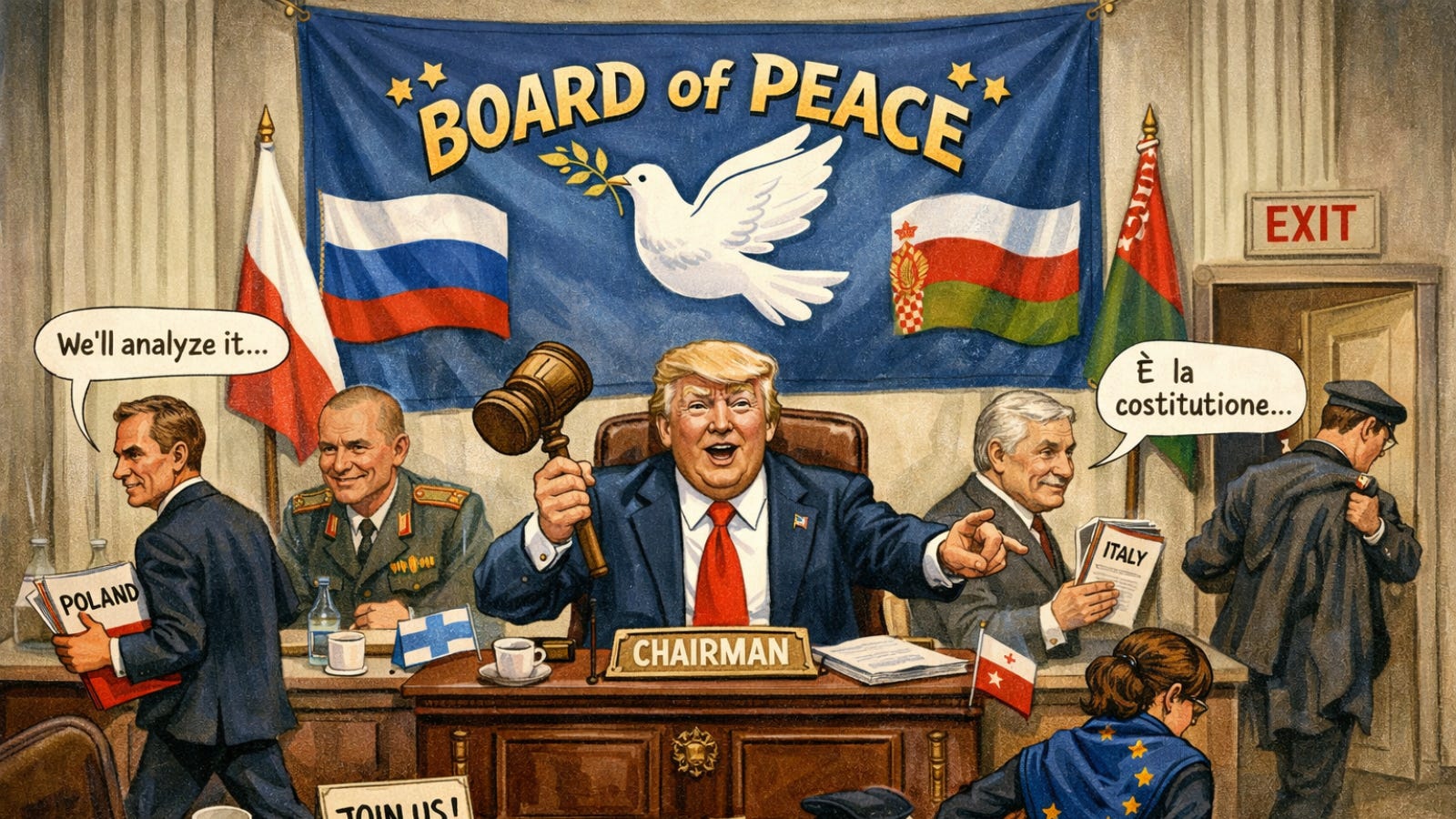
And yet, here comes the punchline: peace is not a real-estate development. You can’t slap your name on it, hire a photographer, and then declare it solved. Peace is boring, peace is paperwork, peace is phone calls at 3 a.m. and uncomfortable compromises and the slow grind of enforcement mechanisms. Peace is, in a word, administrative. Which is why it’s darkly funny that Trump, a man who has treated governance like a reality show with extra lawsuits, has launched something called the Board of Peace as if it’s a premium subscription service: For the low price of $9.99 a month, you too can enjoy fewer wars, plus exclusive behind-the-scenes content.
And it’s not just that allies don’t want to join. It’s the way they don’t want to join: carefully, politely, with big smiles, as if declining a dinner invitation from someone who will definitely subtweet you. Poland insists the relationship remains a priority, Italy insists it’s a constitutional issue, everyone insists they’re open to “working on reconstruction” or “analyzing the proposal.” In diplomatic code, this means: We want to stay friends, but we don’t want our fingerprints on this.
Because joining would mean endorsing a system that looks like a rival to the UN, staffed by whomever Trump decides is “tremendous,” and empowered to wade into global conflicts with all the nuance of a bullhorn. It would mean validating the premise that international legitimacy can be reinvented in a week if your charisma is sufficiently loud. It would mean accepting that peace is something that can be chaired.
Meanwhile, the Board of Peace has already achieved one form of conflict resolution: it has united a diverse set of countries in the shared experience of pretending they didn’t hear the invitation. In a way, that’s a kind of peace. It’s the peace of the group chat where everyone goes silent when the most exhausting person suggests a weekend trip. It’s the peace of the office Slack channel when the CEO announces “Exciting news!” and everyone starts updating their résumés. It’s the peace of a room where the music stops and someone realizes there aren’t enough chairs.
And somewhere, in the great gilded imagination of Donald Trump, the Board of Peace is still destined to be huge, the biggest peace, the best peace, peace like nobody’s ever seen. But peace, unlike a casino, cannot be willed into solvency by force of personality. It requires buy-in. It requires trust. It requires partners who believe you’re building a forum, not a throne. Which is why the Board of Peace is facing the most humiliating obstacle of all: not war, not ideology, not geopolitics, but RSVPs. Apparently, the world has looked at Trump’s “extensive executive powers” peace club and decided the dress code is “no thanks.”
"America’s allies circle it like cautious housecats around a Roomba." What a wonderful image--thank you for a chuckle after being over-run with Bondi today.
You are a brilliant mind and author, I can’t thank you enough for the clarity and the humor you make this trump and maga tragedy out to be. It lifts the danger and the cruelty and the stupidity to a tolerable level…. Just enough to cope…. Keep it up, you are our savior in these very dark times, in a country I will never step foot in again, since the day after you voted this filth into in 2016 and will even never transit thru in my Global traveling lifestyle. You are all spiraling in to the remaining 3rd world existence you have never admitted and have always been the real, racist, dangerous devided states of america. I’m sad for the sane remaining…. Good luck, don’t come to our countries….🇨🇦🇲🇽🇻🇳🇫🇷🇳🇱🇲🇦🇬🇧🏳️🌈