

Good morning! The week in Davos began the way so many Trump-era international moments now do: with an American official lecturing Europe, Europe recoiling, and the rest of the world quietly recalculating how much longer it can pretend this is normal.
At a private World Economic Forum dinner hosted by BlackRock’s Larry Fink, the sort of velvet-rope gathering meant to project calm continuity, Commerce Secretary Howard Lutnick, a man wholly out of his depth, launched into a blistering attack on Europe’s economy, energy policy, and competitiveness. The speech drew heckling. Christine Lagarde, president of the European Central Bank, stood up and walked out. The dinner was abruptly ended before dessert. Nothing says “alliance strength” quite like the head of the ECB leaving mid-speech while dignitaries scatter for the exits.
That walkout became the unofficial overture for Trump’s own Davos appearance the following day, a 90-minute monologue that managed to insult allies, rewrite history, threaten trade wars, propose territorial acquisition, and declare himself the indispensable pillar holding civilization upright.
Trump declared Europe “unrecognizable,” mocked wind energy as a scam for “stupid people,” bragged about bullying Switzerland into higher tariffs because its president “rubbed him the wrong way,” and reiterated his demand to acquire Greenland, referring to it repeatedly as “a piece of ice” the United States was owed for past sacrifices. He rebuked Denmark as ungrateful, accused NATO of freeloading, and warned that if allies didn’t comply, “we will remember.”
By nightfall, after frantic back-channel diplomacy involving NATO Secretary General Mark Rutte and European leaders who finally decided to present a united front, Trump abruptly backed down. He ruled out using force to seize Greenland and called off the threatened tariffs on European nations. When a reporter pressed him on whether Greenland would ultimately become U.S. property under the proposed deal, Trump paused, nodded, and replied, “It’s a very long-term deal,” before walking away, a verbal shrug meant to preserve dominance while conceding the point.
What he announced instead was a vague “framework” that sounded suspiciously like the arrangement Europe had been offering all along: expanded Arctic security cooperation, continued U.S. access to existing bases, a right of first refusal on investments to keep China and Russia out, all without acquiring the territory itself. In other words, the crisis ended where it began, minus the tariffs, minus the threats, and minus the illusion that the United States could simply demand a NATO ally’s land and expect applause.
The episode left behind a familiar odiferous Trumpian residue: aides claiming the crisis proved his negotiating genius, Europeans insisting unity forced the retreat, and markets quietly relieved that another self-inflicted rupture had been postponed rather than detonated.
But Davos wasn’t just about Greenland. It was about something larger and more unsettling: the visible collapse of confidence in Trump’s fitness to lead anything resembling a global order.
That concern crystallized with Trump’s announcement of his so-called “Board of Peace,” an international body he would chair indefinitely, with unilateral authority to set agendas, veto decisions, dissolve the organization outright, and even designate his own successor. Satirist Andy Borowitz summed it up succinctly: calling it the Board of Peace was “the most wildly inaccurate act of branding since Truth Social.”
Among the early signatories were Israel, Saudi Arabia, Egypt, Belarus, and Hungary, a roster heavy on strongmen and security states. Russia and China were invited, but neither has signed on; Vladimir Putin said the proposal required further “analysis,” while hinting Russia might participate only if it could fund its role using frozen assets. France, Norway, and Sweden declined outright, politely but firmly indicating they had no interest in replacing the United Nations with an organization structurally dependent on the will of one man.
Even seasoned observers struggled to process the scope of the proposal. Trump openly suggested the board might replace the U.N., portraying it as necessary because existing institutions had “failed,” and casting himself as the singular figure capable of imposing peace through strength, dealmaking, and personal authority. Peace, apparently, would be achieved by leaders whose recent résumés include mass civilian casualties, authoritarian crackdowns, and regional destabilization, now convened around a table chaired by Donald J. Trump.
As one international law expert put it bluntly: peace requires broad, international consensus. It is not typically built around a charter that reads less like a treaty and more like the corporate bylaws of a personality cult.
If Davos revealed the world’s growing alarm, events back home underscored how that same impulse toward unchecked power is being enforced domestically, with guns, uniforms, and silence where accountability should be.
In Minneapolis, a private autopsy released this week confirmed that Renee Good, a 37-year-old U.S. citizen and mother, was shot three times by a federal immigration officer: once in the arm, once in the breast, and fatally in the head. Video evidence shows Good steering her car away from the officer as she attempted to leave an ICE operation she was observing. At least two shots were fired from the side.
The Trump administration has repeatedly labeled Good a “domestic terrorist,” claimed she attempted to run down the officer, and declared the shooting justified. The Justice Department has cleared the agent without opening a criminal investigation. State officials have been cut out of the inquiry. Federal prosecutors have resigned in protest.
Instead of scrutiny, the response has been escalation. Thousands of federal law enforcement officers have been deployed to Minneapolis. ICE raids have expanded. U.S. citizens and children have been swept up in arrests. Vice President JD Vance is arriving in the city not to call for restraint, but to defend the crackdown. Federal power will be exercised forcefully and unilaterally, and questioning it is grounds for investigation, not accountability.
Against that backdrop, another figure reentered the public stage this morning: Jack Smith. The former special counsel is testifying publicly before the House Judiciary Committee, where Republicans intend to portray him as the embodiment of “lawfare” and political persecution. Smith’s own sworn testimony tells a different story. In closed-door depositions, he stated that his team had proof beyond a reasonable doubt in both Trump prosecutions, election interference and classified documents, and that any defendant, regardless of party, would have been charged on the same facts. He repeatedly denied political pressure from the White House or the attorney general.
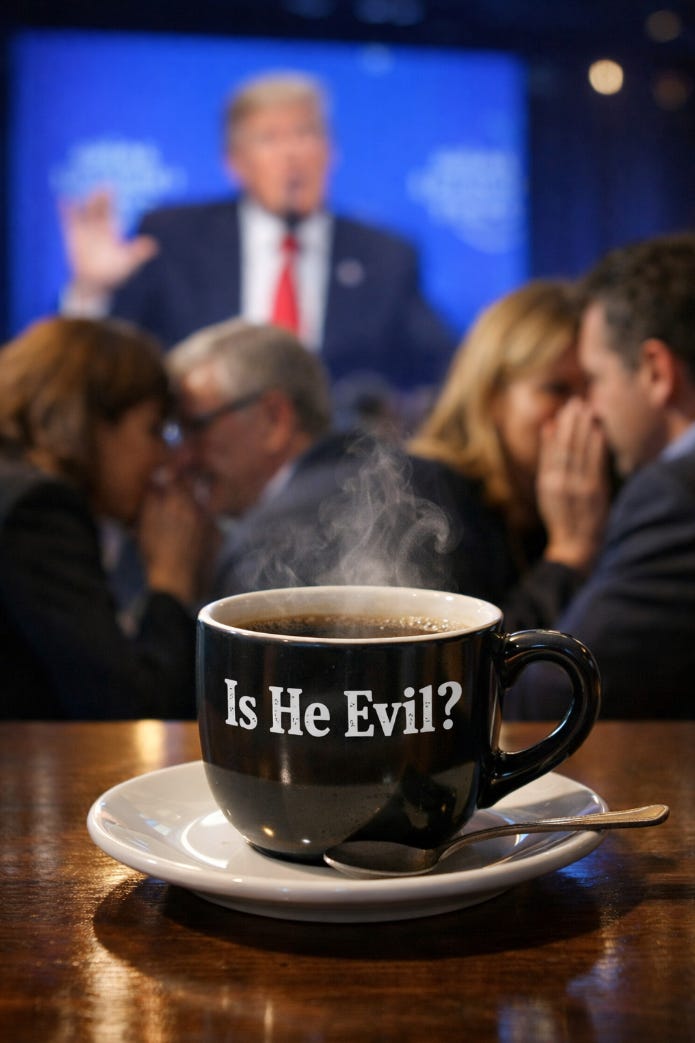
Those cases were dismissed only because Trump returned to office. That distinction matters, especially as Trump dismantles postwar institutions abroad while asserting sweeping, often violent authority at home. When rational explanations for behavior run out, even seasoned analysts begin asking more unsettling questions. One prominent economist’s video thumbnail this week asked it plainly: Is Trump evil? Not because of theatrics, but because when actions consistently defy norms, institutions, and human cost, people start searching for explanations beyond policy.
Davos, Minneapolis, Greenland, Venezuela, the Board of Peace, ICE raids, abandoned prosecutions, these are not disconnected stories. They are symptoms of the same project: a world reordered around power without constraint, loyalty without law, and peace defined not by justice or cooperation, but by submission.
Which leaves us where we so often end these mornings: not with the comforting fiction that institutions will save themselves, but with the uncomfortable truth that they only work when people force them to.
The Constitution does not give Congress a ceremonial role. It gives it a duty to check executive overreach, to demand transparency, to defend the rule of law, and to restrain a president who increasingly speaks and acts as if accountability is optional both at home and abroad. That responsibility does not belong only to Democrats. In fact, it matters most now that Republicans remember they are legislators first, not courtiers, sworn to the country, not to one man.
Pressure matters. Silence is a choice, and history is unkind to those who make it while power consolidates, norms collapse, and violence is excused as governance. If this administration is to be reined in, whether in Minneapolis or the Arctic, in the halls of ICE or the fantasy chambers of a self-appointed Board of Peace, it will not happen by accident. Remind Congress who they really work for before it is too late.
Well reported Mary. To answer the question, the world has judged. Now they weigh options as must. The death of Renee Good continues to galvanize, more so by a government throwing fuel on the fire. Your commentary inspires my comment.
The greatness of our Country is not the power we can wield; rather, it is voluntary constraint of power we impose upon ourselves by the Constitution and international institutions and treaties.
Trump’s strategic view is unfettered sovereignty. Unilateral action whose soul purpose is zero sum dismissing the nobility of America. We see it from Venezuela to Minneapolis. We see it in seized oil from Venezuela to the illegal tariffs. We saw it in his “grab’em” boast, and most likely in the Epstein imbroglio. He seeks power without morality.
The world understands better than us. In Davos, the bullshit met reality. The speech to listen to and understand was Canadian PM Carney’s: America’s benign hegemony of self constraint is no more. In history’s recurring theme the weakness of individual nations integrates into strength as new economic, political, and—perhaps—military relationships emerge.
Have we crossed the Rubicon? Is the rupture irreversible? Hard to say, but we are certainly dipping our toe if that historic river. Our allies are getting insurance if we should continue.
I fear we have a long battle ahead of us.