


It’s the 4th of July, America’s 250th birthday, which felt like the perfect time to talk about another piece of American history.
My mom gave me an American chestnut tree. Which, if you know anything about my mom and me, makes perfect sense. Some mothers and daughters bond over shopping, recipes, or reality television. My mother and I bond over forests, gardens, civic collapse, and whether a sapling can be understood as both a tree and a symbol of cultural unity.
My mom, Mary, started this newsletter, and now I get to co-author it with her, which still feels a little miraculous to me in the way certain late-in-life arrangements do when you realize the person who raised you also became one of the people you build things with. We have always shared a love of the natural world, not in a “look at this cute mug with mushrooms on it” way, although I do enjoy those, but in the deeper way that makes both of us stop and look at bark, soil, moss, roots, shade, weather, and the strange intelligence of living things trying to survive.
So, when she found an American chestnut tree through a foundation working to save the species, she gave one to me. That is the kind of gift that says, “Here is a living thing with a tragic national history, a complicated restoration story, and enough metaphorical weight to ruin your afternoon. You better not let it die.”
Naturally, I loved it. Right now, my little chestnut sapling is healthy. It’s here in the Pacific Northwest, far from the eastern forests where chestnut blight wrote one of the great ecological tragedies of American history. I know enough now to avoid saying any tree is guaranteed anything, because the garden has spent the last several months beating certainty out of me with a trowel, but for the moment, the sapling is alive, promising, and rooted in this little patch of earth my family finally gets to call ours.
I keep looking at it and thinking in generations. Not tomorrow, or next year, or even in the usual political timeline, where everyone is expected to treat four years as a geological epoch because a man in a red hat has once again discovered television.
I mean real time, tree time, and grandchild time. Maybe one day, if the sapling lives, if the soil holds, if the weather is kind, if we care for it well enough and leave enough of ourselves behind in the tending, my grandchildren will stand beneath that American chestnut and look up.
Maybe they will see a canopy where I once saw a gift. Maybe they will know that their grandmother planted something small because she believed in a future large enough to shade people she may or may not meet.
That is where this fifth lesson of the underground republic begins for me, not in the history books, not in the blight reports, not even in the great lost forests of the East, but here, with a small tree from my mother and a hope that is currently only a few feet tall.
Because the American chestnut isn’t just a tree. It’s a wound with leaves, a memory of abundance, and one of those stories nature tells that sounds almost too symbolic to be true, as if the forest itself hired a novelist and told her to please be subtle, then immediately ignored its own advice.
Once, the American chestnut was one of the great trees of the eastern United States. It rose through forests from Maine to Georgia and beyond, feeding wildlife and people, building homes, holding hillsides, making shade, making wood, making mast, making culture, and making a kind of ordinary abundance so reliable that people could live inside its rhythms.
The chestnut was food for deer, bear, squirrels, turkeys, livestock, and families. It was rot-resistant lumber for houses, barns, fences, furniture, and railroad ties. It was a tree so useful that usefulness became part of its identity, which may be the highest compliment a tree can receive and the worst thing humans can notice, because once we decide something is useful, we tend to overuse it until the poor thing needs a congressional hearing and a recovery plan.
Then the blight came. Chestnut blight was first identified in New York City in 1904, and it spread with the efficiency of disaster, moving through the range of the American chestnut and killing billions of trees over the following decades. It was caused by a fungus that American chestnuts had no real defense against. The disease entered through bark wounds or fissures, created cankers, killed the living tissue under the bark, and often girdled the trunk until everything above the infection died.
The tree didn’t always vanish at the root; that’s one of the devastating parts. The root systems could survive underground. Sprouts could rise again from what remained, green and stubborn and heartbreakingly alive. But as those sprouts grew, the blight often found them too, cutting them down before they could mature, flower, bear nuts, and return to the canopy.
This is why people describe the American chestnut as functionally extinct. Not gone in the simplest sense, erased from the earth entirely, or without roots; but unable to perform its old role in the forest. Unable to become what it had been.
And there it is, the line that has been haunting me since I started thinking about this tree and this country at the same time: survival is not the same as restoration.
A root can stay alive underground for generations and still need help becoming a forest again. Which brings me, reluctantly but inevitably, to Donald Trump.
I know, I’m sorry. I didn’t want him near the chestnut either, and I certainly don’t want him near my mother’s gift, where he would likely try to install a plaque, declare himself the father of trees, and accuse the other saplings of being planted by antifa.
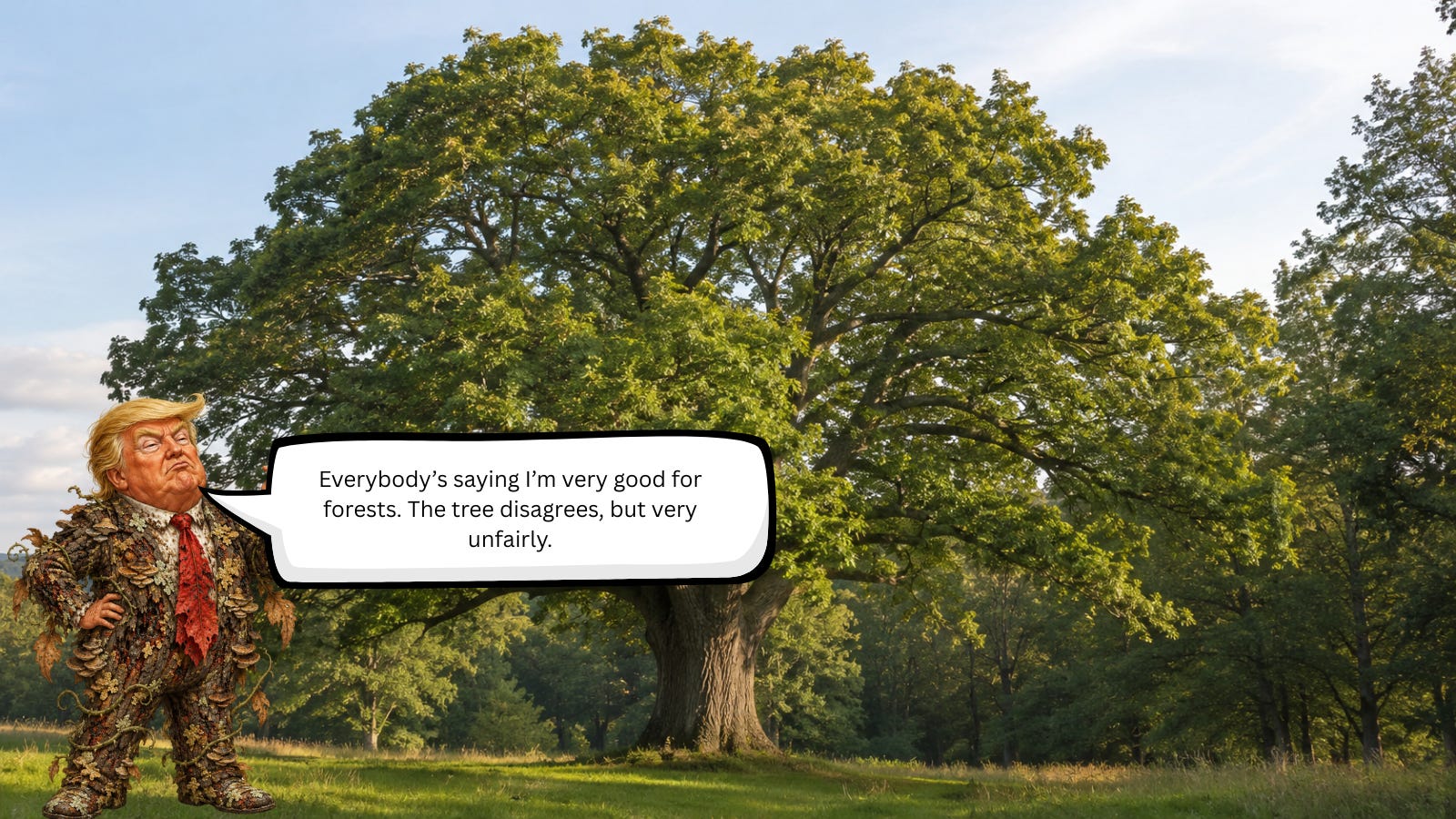
But the metaphor is sitting there in the soil, and at this point the garden has made it clear that I am not in charge of where these things go. The republic is the chestnut; Trumpism is the blight.
Not because the republic was perfect before him, because it wasn’t, and anyone who tells you America was a pristine old-growth forest before Trump arrived is selling nostalgia in a seed packet. This country has always carried rot and violence, exclusion and exploitation, stolen land and broken promises, branches that shaded some while leaving others in the heat.
But the American chestnut wasn’t perfect either; forests aren’t perfect, living systems are never perfect. The point isn’t purity; it’s function. The point is whether a living thing can move nourishment from root to canopy, whether it can feed what depends on it, whether it can survive wounds without becoming a host for the thing that kills its future.
Trumpism behaves like a disease of the civic cambium. It attacks the living tissue that allows a republic to circulate trust, law, memory, accountability, and shared purpose. It doesn’t need to cut down every tree in one dramatic afternoon. It only needs to girdle the channels by which the system feeds itself.
It cuts citizens off from facts, law off from accountability, public service off from public purpose, and it cuts the roots from the canopy and then stands beside the dying branch insisting “the tree has never been healthier, people are saying it is the greenest tree anyone has ever seen, maybe the greenest tree in the history of plants.”
That is the special obscenity of blight politics. It doesn’t merely wound; it calls the wound vitality. It doesn’t merely sever; it calls the severing freedom. It doesn’t merely infect institutions; it forces the infected institution to explain, politely and at length, why the fungus deserves due process, a Sunday show booking, three appeals, a branded hat, and possibly immunity from garden tools.
In a healthy republic, damage can become reform, conflict can become law, failure can become accountability, loss can become memory, and decay can become compost if the living system still has the organisms of repair, the earthworms and fungi and beneficials and careful hands that know how to turn wreckage into something fertile.
But blight interrupts that process, it doesn’t transform rot into life; it prevents the living thing from delivering nourishment to itself. This is the difference between a republic that survives crisis and a republic that keeps sprouting but never reaches canopy. And does that not feel terribly familiar?
We have watched brave sprouts rise again and again. Election workers who kept doing their jobs while being threatened by people who had been fed lies. Teachers who kept teaching while politicians tried to turn classrooms into culture-war mulch. Librarians who kept handing people books while professional panic merchants tried to recast reading as a national emergency. Judges, journalists, organizers, nurses, scientists, union workers, public servants, local officials, students, parents, and ordinary citizens who kept pushing up green growth from the roots of public life. Again and again, the sprouts rise.
Again and again, Trumpism tries to girdle them before they can become canopy. That’s why this metaphor feels different from the others in the underground republic series.
The earthworms gave me repair, the hammerhead flatworms gave me predation, the mycorrhizal networks and beneficial insects gave me connection, and the bindweed gave me entanglement. But the chestnut is special, you see, the chestnut gives me time.
It gives me grief measured in decades, loss too large for one news cycle and restoration too slow for people addicted to spectacle. It gives me the terrible patience of a root system that refuses to die and the humbling truth that refusal is not enough.
A root can live underground and still need help. A republic can keep its name, its flags, its marble buildings, its ceremonies, its courts, its elections, and its anniversary speeches, and still be struggling to become itself again.
That is the part we don’t like to say, because Americans are extremely fond of confusing symbols with health. We see the sprout and assume the forest has returned; but the American chestnut teaches a more demanding lesson.
A living root is not the same as a restored canopy, a republic that survives underground is not the same as a republic that shelters its people, and a country can keep sending up signs of life while still being prevented from maturing into the thing it promises to become.
This is where the restoration story matters. For more than a century, people have been trying to bring the American chestnut back. Scientists, foresters, volunteers, foundations, breeders, orchard keepers, geneticists, and stubborn tree people have spent years working with resistance, backcross breeding, biodiversity, disease science, surviving trees, and the question of how to restore a species without turning it into something unrecognizable.
That last part matters too, restoration is not nostalgia. The goal is not to pretend the blight never happened, or to wander through the woods in a waistcoat sighing about the lost purity of 1897, or to demand that the forest become a museum of itself.
The work is harder than that. Restoration means remembering what was lost without lying about why it was vulnerable. It means protecting what survives, breeding resistance without surrendering identity, accepting that the tree that returns will not be untouched by history, because nothing that survives a wound remains untouched by the wound, and it means building a future strong enough to live with the knowledge of what nearly destroyed it.
If that’s not the work of American democracy now, I don’t know what is. We don’t need a fantasy republic that pretends Trump was an accident unrelated to anything in the soil, a decorative republic with a fresh coat of patriotic paint over the cankers, or a restoration project that consists of moving the same diseased timber around and calling it moderation.
No, we need resistance in the living tissue, public institutions that can’t be so easily captured by one ambitious infection, civic education strong enough to recognize the spores of authoritarianism before they become a forest condition, media ecosystems less willing to carry disease in the name of access, courts that understand delay can be a pathogen when the thing before them is actively eating the law, parties that don’t treat corruption as useful shade until it starts dropping limbs on their own donors, and citizens who understand that democracy is not a tree somebody else planted forever ago so we can sit beneath it without tending the roots. We need to become, in the deepest sense, blight-resistant.
A blight-resistant republic would not be one that abandons mercy, pluralism, law, or democracy in order to defeat the people who threaten them, because that is just letting the pathogen redesign the tree.
A resistant republic would be one with stronger roots, better memory, more accountability, wider civic participation, less worship of charismatic men, deeper local institutions, and a public immune system that doesn’t require every generation to learn the same lesson by watching the canopy die again.
This is where I return to my mother’s tree. Because the sapling is small, and the metaphor is enormous, and the gap between those two things is where hope lives. My mother gave me a tree from a species nearly erased from its old kingdom, and now that little tree is growing here, on land my family fought hard to make our own. There is something almost unbearably tender about that.
A mother gives her daughter a tree, a daughter plants it in new soil, and a family watches it leaf out.
A country keeps trying to decide whether it wants a future or just another man promising to make the past great by strangling the present. The sapling doesn’t know any of this, of course. The sapling is not standing there with a tiny clipboard tracking the downfall of American constitutional order.
It’s not concerned with cable news, court deadlines, federal agencies, or whatever fresh indignity is currently being described as “unprecedented” by people who have been saying “unprecedented” every eleven minutes for a decade. It’s doing what young trees do, it’s trying to root, to grow, and to become large enough to participate in the world.
That simplicity is part of what moves me. The chestnut doesn’t ask whether the future is guaranteed before it grows toward it. It doesn’t require proof that my grandchildren will someday stand beneath it. It doesn’t demand certainty before making leaves. It accepts the only bargain living things are ever really offered, which is to grow anyway.
There is faith in that, though not the loud kind. It’s the faith of a root moving through soil it hasn’t yet mapped, the faith of planting shade for people who may never know the exact shape of your hands. That is the kind of faith Trumpism can’t understand, because Trumpism is incapable of planting without ownership, giving without branding, building without extracting, or imagining a future that doesn’t revolve around the leader’s face appearing somewhere on the merchandise.
A chestnut asks us to think beyond ourselves, while a blight asks only for the next wound. A republic asks whether we are willing to tend something that may not fully shade us, because the people who come after us will still need a canopy.
That is the seriousness at the center of this piece, but because I remain myself, I also have to point out that Donald Trump would absolutely call the American chestnut a loser for getting killed by fungus, then claim he alone could bring it back using tariffs, gold leaf, and a very strong relationship with several important trees.
He would announce the largest chestnut comeback in history, possibly from a golf cart. He would accuse the blight of being both Chinese and somehow created by Joe Biden. He would sell limited-edition nuts. He would insist the cankers were fake news. And then, if a sprout appeared in spite of him, he would point at it and say he had always been very good with forests. The satire writes itself because the blight has no humility, and neither does the man.
But the chestnut is not funny, not really, anyway. The chestnut is grief and persistence standing in the same soil. It’s a reminder that some losses are so large they change the shape of the forest, and some living things are so stubborn that they keep trying anyway.
It’s a warning against complacency, because no canopy is guaranteed, it’s a rebuke to despair, because no root system should be declared dead while it’s still sending up green. That is where I want to leave this fifth lesson of the underground republic.
Not with Trump, who has taken up enough sunlight already. Not with the blight, though we must name it clearly and refuse to pretend it’s just another feature of the bark.
I want to leave it with the sapling. With my mother’s gift, with the small green fact of something living, with the possibility that, on this patch of earth we now get to call ours, a tree once nearly erased from its ancestral canopy may grow tall enough to make shade for children who are not yet here.
Maybe one day my grandchildren will stand beneath it, maybe they will look up through leaves that don’t exist yet, maybe they will know the story, or maybe they will simply feel the coolness beneath the branches and take for granted what took generations of care to restore.
That’s how restoration often works, if it works. The future forgets the terror because the shade did its job. I think about that a lot now. I think about what it means to plant something that will outlive the panic of this moment. I think about what it means to protect roots while blight moves through the bark.
I think about what it means to believe that a damaged republic can still become canopy, if enough people learn how to recognize disease, protect surviving growth, and build resistance into the living tissue.
The American chestnut teaches that survival is not enough, but it also teaches that survival isn’t nothing. The root, the sprout, the sapling, and the people doing the slow restoration work matter. The mother who gives the tree, the daughter who plants it, and the grandchildren who may one day stand beneath it matter.
A republic, like a forest, is not saved by one heroic trunk. It is saved by roots, memory, resistance, repair, and the stubborn human decision to plant shade in a season of blight.
So yes, this installment of the underground republic is about a tree. It’s about a disease, it’s about Trumpism, because apparently every path through my garden now leads to fascism wearing gardening gloves and trying to monetize the mulch. But mostly, it is about what we owe the living things that keep trying, the difference between surviving underground and returning to the canopy, and the kind of hope that doesn’t deny blight, doesn’t excuse rot, doesn’t confuse sprouts with forests, and still says: plant the tree. Protect it fiercely, tend it longer than your own fear, and maybe, someday, someone you love will look up and know shade.
You are such a wonderful and thought-provoking writer; thank you.
Napoleon is said to have ordered trees planted along French roads so future soldiers would march in their shade.
Whether or not the story is true, the best version ends when someone objects that the trees won't mature for at least a century, whereupon Napoleon replies, "Well then, you better get started"