


Good morning! Army Major Stephen Ramsbottom was wounded when an Iranian drone struck an American command post in Kuwait on March 1, killing six of his fellow soldiers. He survived to tell 60 Minutes that the attack might have been prevented.
The soldiers knew they were vulnerable. They had warned their commanders that their position lacked adequate protection against Iranian drones. They raised the issue more than once. The requested counter-drone system never arrived.
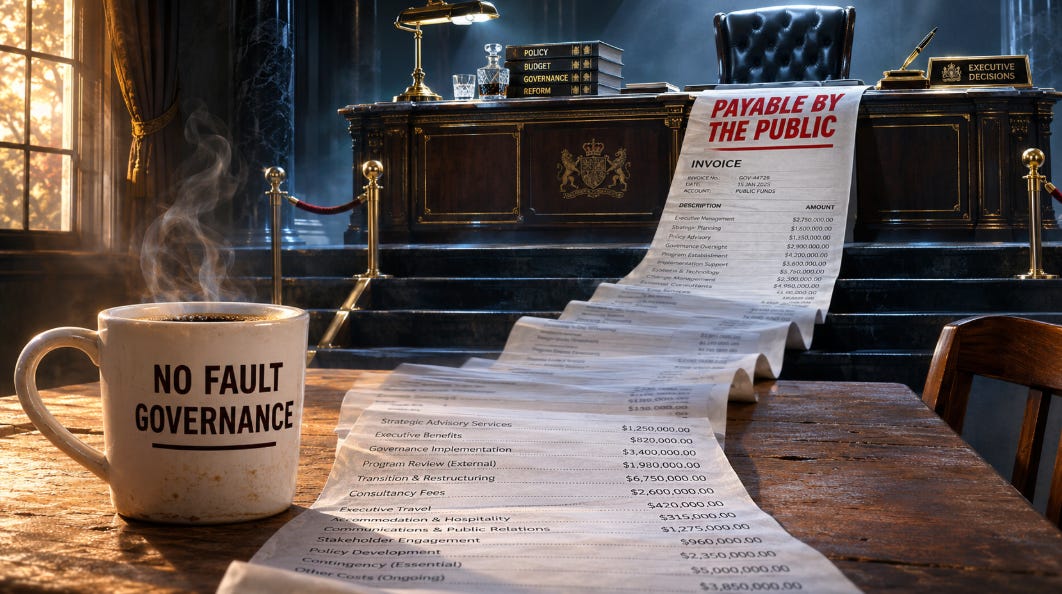
Unlike some other leaders, Ramsbottom isn’t exempting himself.
“I feel this is a tactical failure by the Army, our leadership, and myself all the way down to my level,” he told Norah O’Donnell.
He filed a whistleblower complaint with the House and Senate Armed Services Committees on Friday. His interview aired Sunday night. By Monday morning, the commander-in-chief was standing on the South Lawn, offering a rather different account of presidential responsibility.
Asked about Friday’s nationwide FAA ground stop, which halted most departures and brought some 3,500 airborne aircraft safely to the ground, Trump said, “I don’t take any responsibility.”
In Trump’s telling, the culprits were a piece of “very, very old equipment that had a heart attack,” (he was talking about the FAA, just to be clear,) and a predecessor who left office nearly two years ago. Biden, he explained, “hooked up a lot of copper into glass.”
His own Transportation Secretary tells it differently. Sean Duffy said a preliminary investigation found that an L3Harris contractor at a remote FAA site was replacing old copper connections with fiber when a router began flooding the network with data. So the copper-to-fiber work Trump blamed on Biden was still underway Friday, on this administration’s watch.
The router’s manufacturer has an alibi too: Hewlett Packard Enterprise says its device worked exactly as the installer configured it. Even the equipment won’t take the blame.
Trump was no more receptive to questions about the Iran war. On Monday, he took to Truth Social to attack 60 Minutes over its investigation into the six American deaths, complaining that “the new people running 60 Minutes are even worse than their predecessors.”
Then came the scoreboard: 8,000 to 9,000 Iranian drones, and only two got through to cause American deaths.
“Got through and killed Americans” is not the same as “got through.” BBC Verify documented 20 U.S. military sites damaged across eight countries, with 42 aircraft destroyed or damaged. By late October, the Pentagon’s official count had reached 23 dead, including 11 from enemy fire and 12 from other causes, and 865 wounded.
A major far down the chain of command includes himself in the failure. The president, sitting at the very top, blames the router.
You could chalk that up to Trump being Trump. But it works that way well beyond the White House: someone decides, someone else benefits, and a third party pays.
The tithe. On February 20, 2026, the Supreme Court struck down Trump’s emergency tariffs in Learning Resources v. Trump, leaving the government owing roughly $170 billion in refunds. Customs is returning the money to “importers of record,” the companies that wrote the checks at the border. Shoppers, who covered much of that cost through higher prices, have no automatic right to reimbursement.
ProPublica went through thousands of securities filings to see where the money is going. Stanley Black & Decker raised prices again and again, telling shareholders the tariffs made it necessary. It is now getting at least $298 million back, and part of that is going to “variable incentive compensation,” the company’s term for bonuses.
TJX, which owns TJ Maxx and Marshalls, received $331 million and set aside $112 million for year-end incentive compensation and discretionary bonuses for eligible employees. The company won’t say how much will go to top executives.
A Wisconsin man who bought a leaf blower and a hedge trimmer is suing Stanley Black & Decker, alleging it collected the same tariff twice: once from him at checkout, and again from the Treasury.
Treasury Secretary Scott Bessent predicted this months ago: “I got a feeling the American people won’t see it.” He has since complained that the American people had the money in the Treasury until the courts forced him to give it back.
Bessent knew where the money was going. He just preferred that it stay in the Treasury rather than end up in corporate accounts. Shoppers apparently weren’t part of either calculation.
The access. On May 12, Secretary of State Marco Rubio reportedly briefed President Trump aboard Air Force One on intelligence indicating that Nvidia CEO Jensen Huang was in a relationship with a woman suspected of working for Chinese intelligence. Huang then boarded Air Force One during a refueling stop in Alaska and joined the flight to Beijing.
The woman, Alice Huang, is a former executive at Megaspeed, reportedly one of Nvidia’s largest customers. The Commerce Department had been investigating Megaspeed since 2024 but never put it on the Entity List, the trade blacklist that would have restricted its access to American chips.
Bessent says Treasury, Defense, the U.S. Trade Representative and State all wanted Megaspeed listed “for months,” but Commerce “has the pen.”
Commerce, it seems, also has the cap on the pen.
On Monday, Trump was asked about the delay. “He might have delayed it,” he said of Commerce Secretary Howard Lutnick, “but he was doing that because… you could have a blow up with China.”
So the possibility of delaying action against a company under counterintelligence scrutiny was defended as diplomacy.
In the same gaggle, Trump said he “would not mind” seeing Huang return as CEO. Nvidia’s board, meanwhile, is overseeing an independent investigation by Wachtell Lipton into whether Huang’s conduct compromised national security or company secrets. Reports say the directors aren’t considering bringing him back.
Late Monday, Commerce and Justice issued a joint statement cataloguing their investigative work. Commerce had obtained Nvidia sales records and conducted an inspection in Singapore. Nvidia placed Megaspeed on its own no-sell list in June 2025, and Justice subsequently assumed responsibility for the criminal investigation.
So the government was investigating Megaspeed. What the statement still didn’t explain was why a company that several Cabinet officials reportedly wanted blacklisted never made it onto the Entity List.
The bargaining. Then there are the two real estate developers negotiating Europe’s future.
Steve Witkoff, Trump’s golf partner, and Jared Kushner, his son-in-law, have spent a year working on a Ukraine deal. Last Thursday brought another meeting with Putin in Moscow.
Russia had already arrived at the week’s negotiations with a familiar set of demands: NATO must withdraw troops and military infrastructure from countries admitted after 1997, effectively rolling back the alliance’s military posture to its pre-expansion configuration.
Those demands were presented to the American envoys while European governments were still pressing for direct participation in negotiations about their own security.
Witkoff and Kushner went to Moscow seeking what Kushner called Putin’s “blessing” to bring Europeans into talks about Europe’s future. The Kremlin named its price: Europe would have to stop arming Ukraine first.
The Financial Times’ Ben Hall reported that the envoys complicated negotiations by raising the question of Europe’s security architecture, an expansion of the talks that suited the Kremlin. Kushner, for his part, described the discussions with liberal use of the word “very.”
This was predictable. A year ago, a leaked call caught Witkoff advising Putin’s aide on how to pitch a peace proposal to Trump. In a second leaked conversation, Kremlin envoy Kirill Dmitriev predicted that the American plan would emerge “as close to [Russia’s version] as possible.”
Now Zelensky says American negotiators have raised the possibility of Ukraine surrendering the remaining Donbas territory it controls in exchange for NATO membership.
Not a formal offer, mind you. Washington cannot unilaterally promise NATO membership, which requires the agreement of all 32 members. Nor can two American developers decide what Ukrainian territory should be surrendered.
Instead of starting with what kind of peace Ukraine wanted, the Americans were asking what territory it might give up.
Three different arrangements, same problem: the people bearing the costs have the least say in the decisions.
Arrangements can be challenged, and Ukraine wasn’t about to wait for diplomats to decide its future.
On Monday morning, by Moscow’s own account, Russian air defenses intercepted 1,336 Ukrainian drones overnight, a figure that hasn’t been independently verified. Strikes still reached the Ilsky oil refinery and the Kerch Bridge, Putin’s 2018 monument to his annexation of Crimea.
Ukraine was demonstrating that it still had military options of its own.
It did so while Ukrainian officials continued reporting that Starshield-equipped drones were losing satellite connections when moving at speed, a problem SpaceX calls technical and Kyiv is still trying to get explained. Meanwhile, Elon Musk, whose company operates the system, was preparing to accompany Trump to Shenzhen.
Ukraine was being asked what territory it might surrender while struggling to understand why its American-supplied communications weren’t functioning properly.
Estonia answered too.
Tallinn says Russia’s GRU recruited eight people from neighboring Latvia to attack drone manufacturer Threod Systems, because its own operatives can’t work freely in Estonia. Eight suspects were detained, and Estonia plans to close its road crossings with Russia on December 1.
“We are not going to stop helping Ukraine,” its interior minister told CNN.
We have some domestic resistance as well. Trump’s October deal to bring Russian diesel to American markets ran into two obstacles: a 2022 law restricting Russian energy imports while the war continues, and a bipartisan letter warning banks and port authorities that facilitating the shipments could expose them to legal action.
Tankers initially headed toward American ports changed course toward Egypt and Brazil. As of the latest reporting, none of the promised diesel had reached an American port.
So far, a statute, a letter and some cautious lawyers have outlasted a presidential handshake.
In Britain, the people did the briefing themselves.
More than 138,000 signed naturalist Chris Packham’s petition for a live, nationally televised briefing on climate and nature risks, introduced by the prime minister and delivered by independent experts.
Many didn't wait for an answer. They booked village halls, borrowed projectors, made tea and screened The People's Emergency Briefing, a 50-minute documentary presented by Chris Packham, for their neighbors.
On Monday, their petition reached Parliament. MPs spent nearly three hours discussing the risks, the misinformation surrounding them and the government’s responsibility to prepare the country.
Climate Transition Minister Katie White didn’t promise the televised broadcast, but she did promise to meet the organizers next week.
“A film has become a movement,” she said.
And the movement got the government to show up.
A Ukrainian drone crew, an Estonian border post and an English village hall represent very different struggles. But each involves people refusing to leave their future entirely in someone else’s hands.
We tried that in Coos County, too.
In 2017, our Measure 6-162 sought to give residents the authority to reject unwanted fossil-fuel projects, including Jordan Cove. We lost the vote. Jordan Cove eventually died under the weight of its permitting problems and changing economics, but the legal arrangement that denied our community the authority to say no remained.
Defeating one project isn’t the same thing as changing the rules.
And that brings us to the question running through this morning’s news: who decided that the people who pay the costs don’t get to make the decisions, and what would it take to change that?
Thomas Linzey has spent his career on those questions. A community-rights attorney and pioneer of the rights-of-nature movement, he has helped communities write local laws asserting their authority to protect themselves from corporate harm. His forthcoming book, American Democracy (and Other Fairy Tales): A Call for a New Constitution, examines why corporations so often hold enforceable rights while the people living with the consequences hold so little.
Today at 11 a.m. Pacific, Shanley and I will talk with Linzey live about those questions.
If you’ve ever watched someone make a decision about your community while insisting you had no authority to stop it, bring your questions and your stories.
Because the ability to resist a decision is not the same thing as the authority to make one. Democracy ought to mean more than being allowed to complain afterward.
The ripple effects of Trump’s second term will be felt for many years to come.
The American people can’t lean back, heave a sigh of relief that the midterms were won in a landslide, and take a well-deserved rest.
To paraphrase Churchill, winning the midterms was just the end of the beginning.
We’re now in the middle of the battle for accountability, affordability, and democracy.
Just as the Project 2025 authors provided a blueprint for changing our democracy into an oligarchy, we must develop a blueprint for recovery from their assault.
We can’t just reverse everything Trump did and “go back to the way things were.”
The American people and our elected representatives must assiduously close every loophole, block every quasi-legal workaround, discard every outdated law, codify every essential norm into written law, break up every monopoly, investigate every incident of corruption, and account for every missing dollar that was misallocated or stolen by the Trump administration.
If we don’t attend to this process promptly, we risk allowing the lawless MAGA GOP to continue destroying our country. Even worse, we risk having another Trump-like figure seize power in the future — and that person will probably be more intelligent and less incompetent than Trump.
Our daughter arrived back in the states yesterday afternoon and is now at an army base for debriefing. But when she was first stationed in Baghdad, she said the infrastructure had been destroyed and they had no defenses. If they were outside of the building, they had 60 seconds to get inside if a warning was given. About halfway through her tour of duty, she was moved back to a base in Jordan where they had a few more minutes warning. Both bases had been attacked previously.