

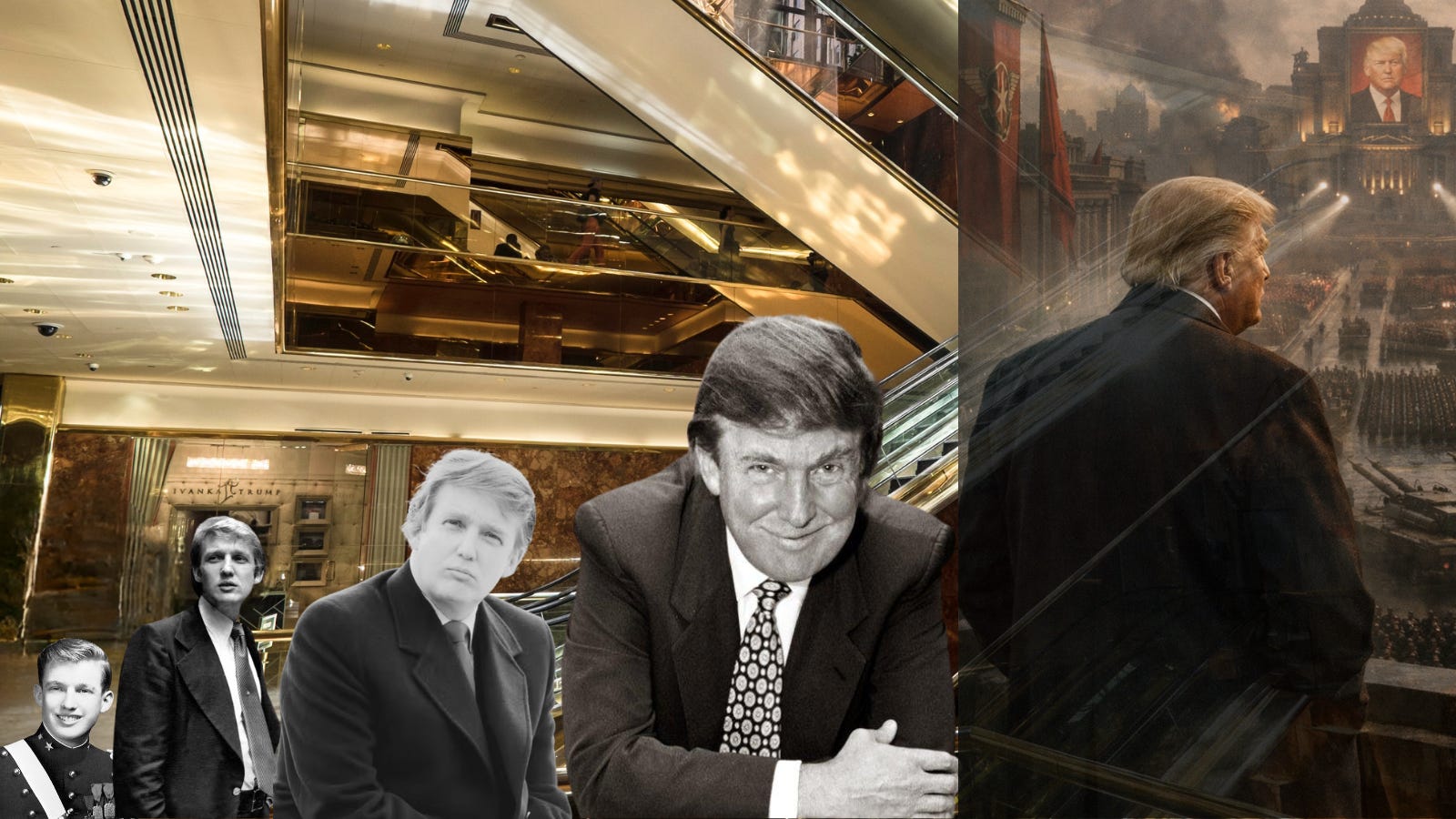
There’s a particular kind of New York childhood that doesn’t so much raise you as install you, like an upgrade you didn’t ask for but will be forced to live with. Donald John Trump was born into that sort of childhood in Queens in 1946, the fourth of five children, in a family where the background noise was construction and the foreground was certainty. His father, Fred Trump, made a business out of apartments and leverage, the reliable magic trick of turning other people’s rent checks into a permanent sense of command. Most autocrats don’t begin as autocrats. They begin as people who learn, very early, what power feels like, and then spend the rest of their lives chasing that feeling the way a gambler chases the exact brightness of the first win. Trump’s story is not the tidy origin myth of ideology. It’s the messy, deeply American story of incentives, a man repeatedly rewarded for spectacle, retaliation, and the insistence that reality is negotiable so long as you have the microphone.
Trump’s early life, as it’s usually told, has the hard edges of a household where discipline and achievement are not soft virtues but requirements, less “be yourself” than “be the best version of yourself that wins.” That kind of environment doesn’t create authoritarian politics on its own; it does something more subtle and, in its own way, more powerful. It teaches a child that hierarchy is natural, and that the people at the top don’t merely enjoy privileges, they set the terms of the world. When Trump was thirteen, his parents sent him to the New York Military Academy. The institution itself has become a kind of shorthand, uniforms, ranks, drills, the public choreography of authority. Frontline reporting has leaned on interviews with biographers and classmates to portray the period as formative for Trump’s taste for competition and ridicule-as-dominance, an early rehearsal for a style in which you control a room by making sure someone else is smaller than you are. He became comfortable in a world where authority is performative and constant, where loyalty, obedience, and winning are not occasional features.
Trump later attended the University of Pennsylvania’s Wharton School. In a more conventional biography, Wharton would be the chapter where a young man becomes a thoughtful student of markets and management.
In the Trump story, Wharton is less about academic formation than about acquiring a credential that functions like armor; a permission slip that grants entry into the rooms where the real deals are made, and where, crucially, the deals are often made under the table, not because anyone is criminal, exactly, but because the table is crowded and the under-table is where you can stretch your legs. This is an early glimpse of a pattern that will define Trump’s public life; institutions are useful when they confer legitimacy, contemptible when they constrain it. The man who can cite elite pedigree when it flatters him can also spend a political career mocking elites as corrupt and decadent, because the real point is not coherence. The point is dominance.
Every story needs a character who crystallizes the protagonist’s method. Roy Cohn, lawyer, fixer, combatant, plays that role with almost embarrassing literary convenience. In October 1973, the federal government sued Fred Trump, Donald Trump, and Trump Management under the Fair Housing Act, alleging discrimination in rental practices. The case is not a rumor; the consent order itself is public, and it opens with the language of what the United States claimed and what the defendants agreed to do going forward. The matter was resolved by a consent decree in June 1975, with the familiar legal choreography; obligations without an admission of wrongdoing. This is where the Trump story becomes something you can frame, credibly, as the early birth pangs of a strongman disposition. Because in the face of institutional accusation, Trump, guided by Cohn, did not adopt the tone of contrition or reform. The ethos Cohn embodied, and that Trump would later perform as second nature, is the ethos of the counterpunch: deny, attack, reframe, and make the accuser the defendant. That stance is not inherently authoritarian in a legal sense, lots of litigants fight. But it becomes authoritarian-adjacent when it evolves into a governing philosophy: the institutions that challenge me are illegitimate; therefore, I am justified in undermining them.
By the time Trump makes his move into Manhattan, he is not simply changing boroughs; he is changing the physics of his ambition. Manhattan real estate isn’t merely an industry. It’s a social system, an ecosystem of tax abatements, zoning fights, publicity, and political permission. Even the success stories are often joint ventures with government, because in New York, the skyline is a public-private autobiography. This is the chapter where Trump learns a lesson that later sits quietly underneath his politics: government is not just a referee; it’s a resource. You negotiate with it, pressure it, flatter it, punish it, bend it, and, when you can, claim credit for outsmarting it. You do not view rules as sacred boundaries. You view them as material. That is not yet autocracy. But it is the psychological soil in which “I alone can fix it” later grows.
Every strongman narrative has a prototype scene, the moment the future leader performs competence in contrast to a humiliated bureaucracy. For Trump, one of the most durable prototypes is the 1980s story of Wollman Rink, a public project in Central Park that became a kind of civic parable, the city had stalled; Trump stepped in; the rink reopened; the headline wrote itself. Whether you treat it as pure competence or as a brilliant publicity conversion, the moral is the same and, for Trump, intoxicating, government is slow; I am fast; therefore, I deserve authority. It’s easy to underestimate how politically potent this moral is. It turns administrative frustration into a personal longing for a savior. It is the emotional grammar of strongman politics.
Then something happens that is so American it borders on performance art; the nation turns authority into entertainment. In 2004, The Apprentice premieres on NBC. Its first season drew huge viewership and ranked high in Nielsen ratings, with reporting and summaries noting an average weekly audience in the tens of millions. It offered a weekly ritual in which Trump, sitting in judgment, tested loyalty, staged humiliation, and delivered punishment, “you’re fired,” as if it were a natural law. The country spent a decade in a seminar on the pleasures of one-man rule, and then acted surprised when the final exam arrived.
Reality television didn’t merely reflect Trump, it manufactured him. It created a mass-market Trump who was not a complicated businessman with a complicated record but a simplified archetype, the decisive patriarch, the unimpeachable boss, the man whose whims become outcomes. It turned dominance into a comforting aesthetic. Trump’s “autocrat energy” becomes a product, and America buys it by the millions.
Before Trump ran for president, he ran a different experiment, could he gain influence by attacking legitimacy itself? In 2011, amid the “birther” controversy, the White House released President Barack Obama’s long-form birth certificate, explicitly describing the issue as a distraction the President wanted to end. Major outlets covered the release in the same frame, an attempt to put to rest persistent claims, largely fueled by Trump, about Obama’s eligibility. Birtherism matters not because it was a policy dispute, but because it was an early, vivid example of a strongman tactic political scientists watch for, deny your opponent’s legitimacy rather than compete with them inside shared rules. In other words, don’t argue that the other side is wrong; argue that the other side is illegitimate. Trump’s later political career would be thick with this move. Birtherism is the prototype.
By the time Trump announces his candidacy in 2015, he is not a politician learning politics; he is a celebrity importing a proven model into a new market. The announcement, staged at Trump Tower, was less the beginning of a campaign than the premiere of a season; a spectacle designed to command attention, divide audiences, and force the media to orbit him like a planet around a star. x
In his 2016 Republican National Convention acceptance speech, Trump declared, “I alone can fix it.” Democracy is built on the premise that no one person can fix it, because the “it” is a plural society, and the fixing is meant to happen through institutions, compromise, and the slow dignity of process. The strongman pitch is the opposite; institutions are weak; opponents are enemies; I am the solution. Trump’s “genius,” if you can stop throwing up in your mouth long enough to call it that, is that he makes this pitch feel not frightening but intimate. The voter is not asked to join a platform. The voter is asked to join a relationship, loyalty in exchange for protection.
Once in office, Trump did not reinvent himself as a quiet steward of norms. He governed like a man who has never found rules emotionally compelling unless they are rules he can enforce on someone else. One way to tell the story, is to focus on the democratic stress points scholars often identify. A leader’s relationship with independent institutions, with the press, with courts, with civil servants, and with elections. You don’t have to insist Trump is a dictator-in-waiting to describe how frequently his style treated independent checks as personal enemies. This era also included the long shadow of the Russia investigation. Special Counsel Robert Mueller submitted his report in March 2019; the Department of Justice publicly released a redacted version in April 2019. However people interpret its implications, the report became part of the first-term atmosphere: investigation as weather, outrage as climate. A presidency experienced less as governance than as a continuous argument about legitimacy; who is real, who is corrupt, who counts, and who gets to say.
The great stress test of democratic temperament is not how a leader behaves when he wins; it is how he behaves when he loses. After the 2020 election, Trump’s refusal to accept the legitimacy of the outcome, helped create a new political reality; not a disagreement over policy, but a rupture over the basic premise that elections can settle power. The House Select Committee’s final report on the January 6 attack was released on December 22, 2022, with extensive supporting materials, transcripts, videos, documents, published for the record. Whatever your politics, the existence of that archive is a reminder that this period is not merely memory; it is documented history. Trump was impeached a second time on January 13, 2021, for “incitement of insurrection,” and the Senate later voted to acquit him. The strongman impulse, I am the only legitimate winner, collides with the democratic requirement, I can lose and still accept the system that allowed me to win in the first place.
Then comes the phase where Trump’s story migrates from rallies and cable news into courtrooms, and the country begins to argue not only about what Trump says but about what juries and judges find. In May 2023, a jury found Trump liable to E. Jean Carroll for sexual abuse and defamation, awarding damages. This was a civil case, not a criminal conviction, an important distinction that matters legally and rhetorically, especially in a nation that now treats courtroom outcomes as political symbols.
And in July 2024, the Supreme Court decided Trump v. United States, holding that a former President has absolute immunity for certain core official acts, presumptive immunity for other official acts, and no immunity for unofficial acts. The Court’s reasoning, and the dissents’ warnings, quickly became part of the larger national debate over whether the modern presidency is drifting toward a kind of elective monarchy. In January 2025, Trump was sentenced to an “unconditional discharge” in the New York hush money case, meaning the conviction stands but the sentence imposed no further penalty. For Trump’s opponents, the courts are evidence of accountability; for Trump’s supporters, the courts become evidence of persecution. Either way, the legal system, traditionally the place where disputes are resolved, becomes another stage on which identity is performed and hardened.
History has a taste for the dramatic flourish, and 2024 supplied one. The National Archives’ official Electoral College results page lists Trump as the winner of the 2024 election with 312 electoral votes to Kamala Harris’s 226. On January 20, 2025, Trump was sworn in as the 47th President of the United States, beginning a second, nonconsecutive term. Sealing Trump as not merely a person; but an answer, an answer many Americans, for many different reasons, chose again. Some chose him for policy. Some chose him as disruption. Some chose him because they were tired and wanted the world to feel less complicated, and a man promising certainty, however performative, can feel like relief. In the logic of a strongman story, the return completes the arc; a figure who treats politics as dominance and legitimacy as personal possession proves, again, that he can outlast scandal, impeachment, investigation, indictment, conviction, and defeat; because the central skill is not governing. It is survival through spectacle.
So, was an autocrat born? Did Trump become a dictator in the classic sense? The uniformed coup, the abolished elections, the answer is obviously more complicated than this story wants it to be. America remains a system with courts, elections, federalism, and friction. But in subtler terms, did Trump’s life shape him into a leader who routinely exhibits autocrat instincts? Delegitimizing opponents, attacking referees, treating loyalty as virtue, treating restraint as weakness, and treating institutions as obstacles, these realities give the story an unnerving coherence. Queens gave him the grammar of status, military school gave him the comfort of hierarchy, Roy Cohn gave him the theology of retaliation, Manhattan gave him the habit of bending systems, television gave him a mass audience trained to applaud the boss. Birtherism gave him proof that delegitimization is rocket fuel, and 2016 gave him a line that would eventually lead to those 2024 results, “I alone can fix it.” The post-2020 years tested the system, and proved how many people were willing to treat political defeat as illegitimate. The legal era turned courtrooms into cultural battlegrounds. And the return, certified in the Electoral College record and sealed by a second inauguration, made the story less a cautionary tale than a national self-portrait.
Trump did not only change the country; he revealed it. He revealed how thin the line can be between democratic impatience, “why can’t anything get done?” and democratic surrender, “fine, let one man do it.” And he revealed how easily a society that prides itself on freedom can grow sentimental about the pleasures of being ruled by someone who promises, with the swagger of a man who has always confused volume for truth, that he can fix everything alone, a sentiment that many who lived under authoritarian regimes look back on and wonder, how they could have fallen for such a trope.
Oh Shanley that piece was so awesome. How do we help cult members to think for themselves ?
If Trump had grown up ten blocks in any direction from where he did, he would have been in prison a *long* time ago. Rich kids from Jamaica Estates never pay the prices for their behavior like the rest of us from other neighborhoods always have.
My parents worked for a major general contractor; Mom as an executive secretary in the front office, Pop as chief field accountant. The company they worked for built the Seagram Building, the CBS Building, the Exxon Building in Rockefeller Center, the Meadowlands stadium and racetrack in New Jersey - and those were just the projects my father was CFA on from just before I was born until he passed in 1980. The famous Flatiron Building on 23rd Street in New York? That was the company's original NYC headquarters. (I had a for-real construction hardhat for when I visited my dad on job sites before I was a Brownie Scout.)
With both parents in the construction industry, and reading three newspapers every day, I was fully aware of what immoral, greedy rat bastards both Donald Trump and Fred Trump were before I was out of eighth grade. It is absolutely beyond my comprehension how Donald Trump got himself a TV show, much less became the president of the United States.