


There is a kind of American trick where the government sets something on fire, calls the smoke “policy,” and then asks working families to admire the mood lighting. This week, the trick has been especially busy.
We have war talk and peace talk happening at the same time, which is always how you know the adults are in a conference room somewhere using words like “framework” while everyone else checks gas prices with the grim little face of a person doing math against their will. We have the administration reportedly inching toward a tentative deal with Iran to extend the ceasefire and reopen a path toward nuclear negotiations, with the Strait of Hormuz sitting there like the world’s most expensive throat. One bad move, one mine, one drone, one insult translated poorly in a room full of men who all believe history is improved by their presence, and suddenly the price of everything with a truck, ship, tank, stove, pump, engine, or grocery shelf attached starts twitching.
That is the beautiful thing about war, if by beautiful we mean horrifying and stupid in a deeply human way. It’s never just over there. It comes home in oil prices, insurance premiums, military budgets, hospital budgets, and the small daily panic of people trying to keep their lives upright while very powerful men arrange the furniture inside the apocalypse.
Meanwhile, here at home, we’re doing our own little pageant of empire maintenance. The administration’s “anti-weaponization” payout fund, which sounds like something a committee of Bond villains would name after a long lunch, has been temporarily blocked by a judge. The idea, as far as anyone can tell, is to create a massive pot of money for people who say they were politically targeted by the government. A normal country might call this a legal claim and require evidence. We, being innovators, appear to have considered building a velvet-lined grievance fountain and inviting everyone with a martyr complex and a lawyer to bring a cup.
There is also the Justice Department suing blue states over undercover license plates for federal agents, including ICE. Apparently the states refusing to quietly hand over disguise kits for federal enforcement are now the problem, because nothing says “small government” like suing states so your agents can move more invisibly through their communities. This is the part where the party of local control puts on a fake mustache, climbs into an unmarked car, and explains that liberty requires compliance.
Then we have voting rules and redistricting, because no American political crisis is complete without someone trying to rearrange democracy like patio furniture before a storm. Mail voting is under attack again, congressional maps are being dragged back through the machinery, and the whole thing has that familiar odor of people who have decided the voters are simply too unpredictable and must therefore be managed like a raccoon in the pantry.
And because subtlety is apparently a bird that died in 2016, we also have talk of a $250 bill featuring Donald Trump for the nation’s 250th anniversary.
Now, current law doesn’t allow living people on US currency, but laws are just feelings written down until someone with enough lawyers decides otherwise. Still, the symbolism is almost too perfect. While families are bracing for higher health costs, while children are losing Medicaid coverage, while war and oil markets hover over the economy like a piano on a fraying rope, there is a proposal floating around to put one man’s face on money.
Not cheaper medicine, steadier coverage, childcare, food, hospitals, or peace. No, a commemorative bill. A nation should be careful when it starts confusing currency with confession.
Because health care is where the invoice really starts to arrive. New federal data shows the uninsured rate hovering around 8 percent, with warnings that it could rise as Medicaid and Affordable Care Act changes take hold. Children’s Medicaid enrollment has fallen sharply, and that is the part that should stop us cold, because children don’t lose health insurance because they made bad choices or failed to hustle hard enough or subscribed to the wrong ideology. Children lose health insurance because adults with power build systems with trapdoors and then act surprised when small bodies fall through them.
There is something especially obscene about a country that can imagine new bills with presidential faces before it can imagine every child with a doctor.
The arguments will be familiar, of course. There will be talk of fraud and waste and personal responsibility and fiscal discipline, all of it delivered by people who can find money for enforcement, litigation, missiles, ceremonies, commemorations, and the industrial polishing of one man’s ego. But when the subject is a child with asthma, a mother trying to renew coverage, a rural hospital trying to keep its doors open, or a family choosing between premiums and groceries, suddenly everyone becomes a very stern accountant.
This is how power protects itself. It makes cruelty sound technical. It turns suffering into paperwork. It calls hunger a budget concern and fear a deterrent. It says the problem is not that the ladder is being pulled up, only that too many people were foolish enough to need a ladder.
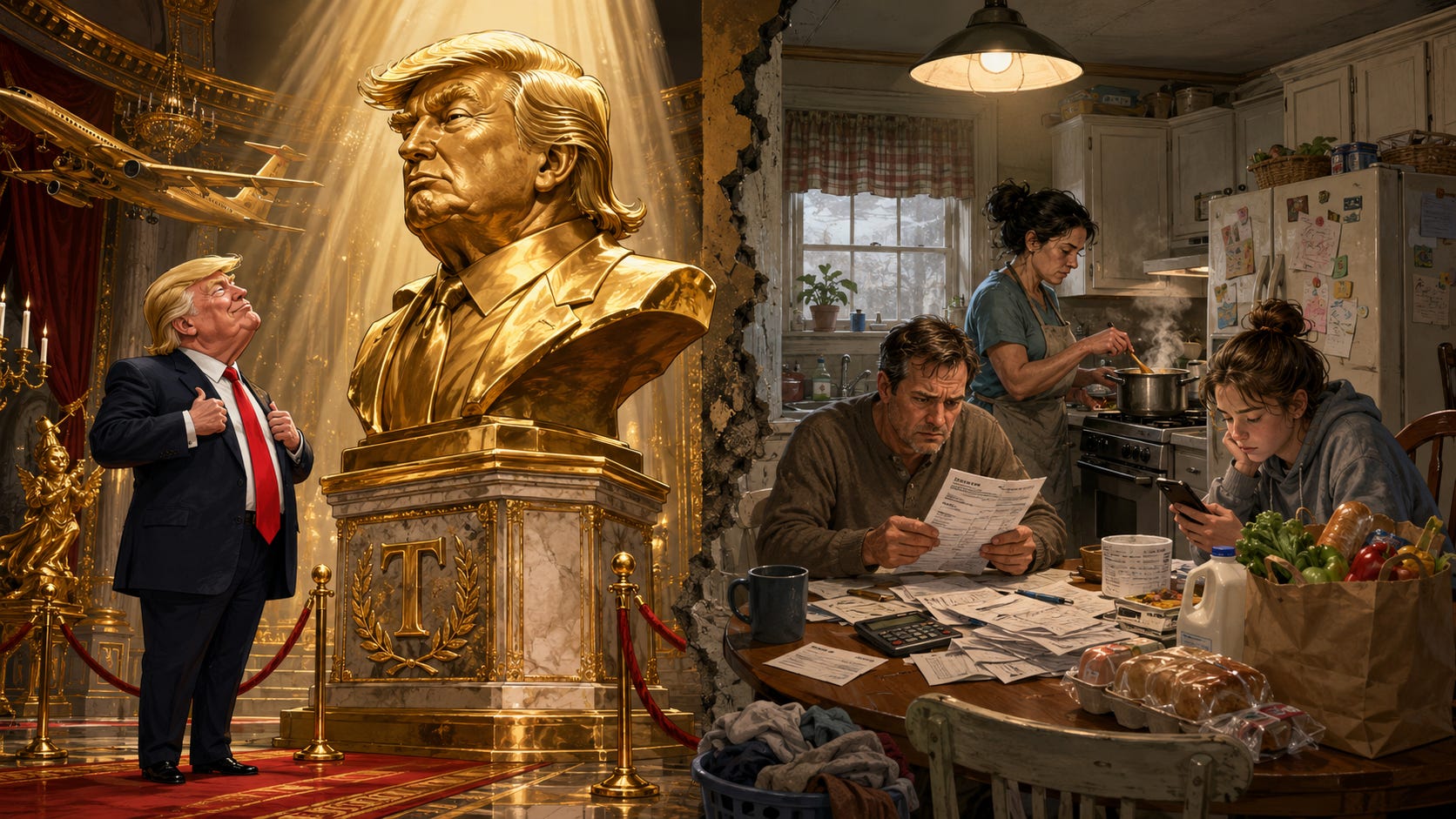
But history has a long memory for this kind of thing. Every empire eventually discovers that marble cracks, statues weather, currencies change, and the people asked to carry too much will, at some point, put the burden down. Sometimes it happens in the streets, sometimes it happens at the ballot box, and sometimes it happens quietly, in the stubborn daily refusal to accept that the richest country on earth must ration mercy like it’s a luxury good.
And sometimes, thank God, life offers a small and personal reminder that not every system is designed to crush the soul. So here is our little update from the home front: we finished the appraisal, and we passed. We passed!
After all the forms, all the blisters and scrapes and cuts, all the checking and rechecking and pretending to be calm while our nervous systems were doing jazz hands in a burning theater, we’re almost there. Almost there is not there, and I am not tempting fate by dancing too close to the finish line, but I will say this: there is a special kind of relief that arrives when one of the big gates finally opens. It feels like being handed a glass of water after weeks of licking dew off a spreadsheet.
So yes, the world is still doing its daily impression of a flaming Roomba. The war room is still humming, the courts are still busy, the maps are still being carved, and the health care system is still asking children to prove they deserve continuity of care. Somewhere, someone is probably workshopping commemorative money with a straight face.
But we passed the appraisal.
And maybe that is the whole strange assignment right now, to hold both truths at once. The machinery is loud, and yet, life is still here. The powerful are trying to build monuments to themselves, and ordinary people are trying to build homes, protect children, keep coverage, get prescriptions filled, make dinner, and laugh where we can because laughter is still one of the few things they haven’t figured out how to means-test.
The bill always comes due. The question is who gets stuck paying it, and who finally decides they are done picking up the check.
This is a good one Shanley! Many quotable paragraphs.
"children don’t lose health insurance because they made bad choices or failed to hustle hard enough or subscribed to the wrong ideology. Children lose health insurance because adults with power build systems with trapdoors and then act surprised when small bodies fall through them.
Good news about the appraisal!
When it's not constantly worrying and enraging, this Trump insanity is fascinating from all sorts of political perspectives... It's like being Germany in the beginning of the 1930's and watching fascism and it's constant pal, violence, take over the political structure of an entire country--like a tree dying little by little from some invisible disease...
One thing that is eternally true about the rise of fascist dictatorships throughout history is how THIN (what a veneer) civilization is; how quickly the hard work of centuries is set on fire by the root-fire of mythology and primitive urges that lurk just below the surface of civilization. ...Animal Farm, The Crucible, Lord of The Flies, etc.
Now, a pay-to-play cage match at the White House-- hurtling us straight back to zero on the evolutionary scale; a mass descent into chaos and the primitive, led by our the Fuhrer-de-Jour. ...The homicidal/racist soul of America is a live and well, and for only 1.5 million a ticket you can rub shoulders with the leader himself. Just make sure you bring a powerful disinfectant...
These days I have to remember to close my mouth which is always dropping open in sheer disbelief.