


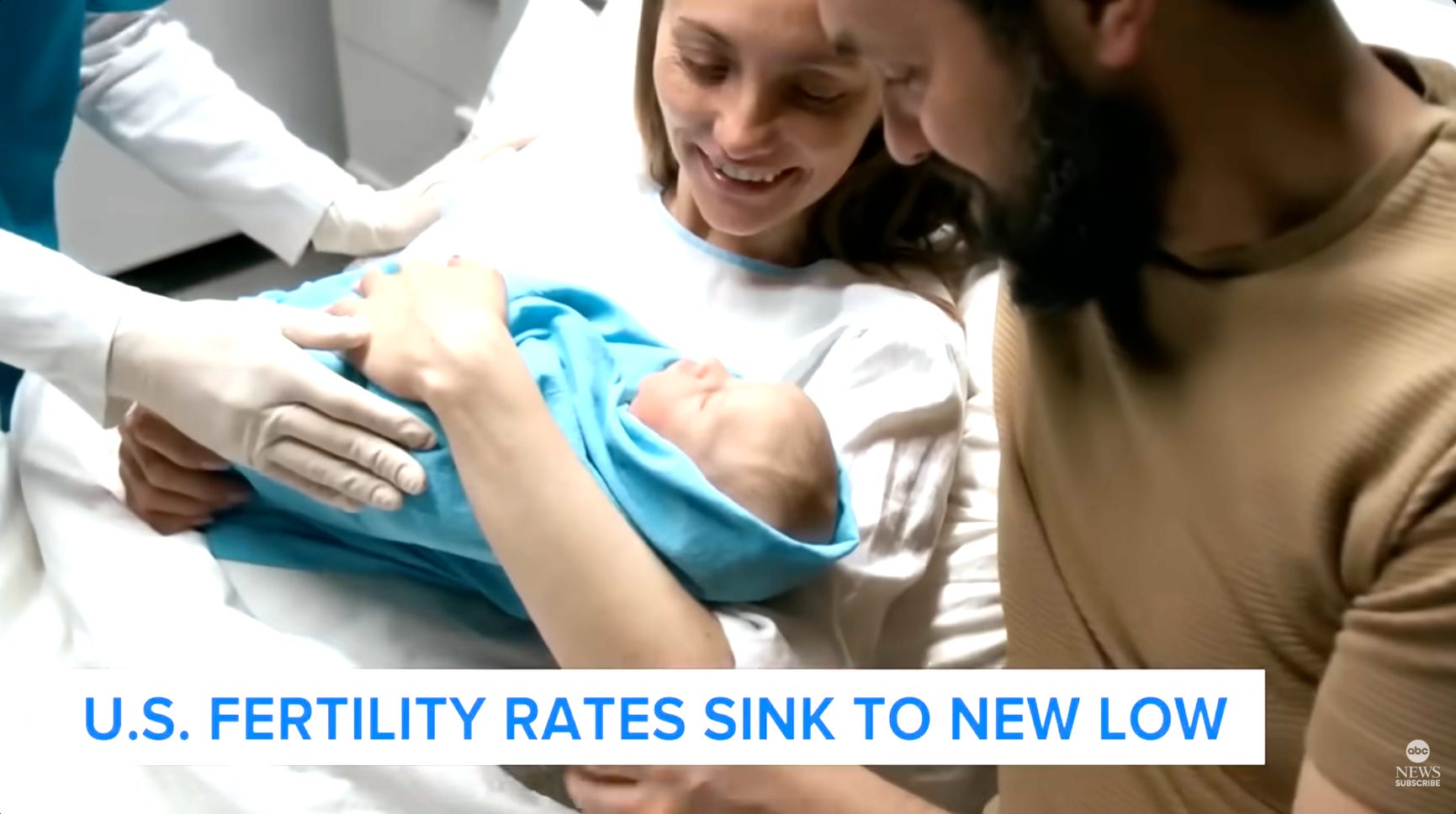
Conservatives have spent the past several years warning that America has a birthrate problem, and on the numbers, they are right. The CDC’s new provisional report says U.S. births fell to 3,606,400 in 2025, with the general fertility rate dropping to 53.1 births per 1,000 women ages 15 to 44. What deserves more attention, though, is the contradiction at the center of the right’s response. The same movement that says America needs more babies is backing a policy agenda, gathered around Project 2025 and the Heritage Foundation’s newer family-policy reports, that would make pregnancy, childrearing, and family life less secure for many of the women most likely to bear the risk, and yes, you read that correctly.
This is not a broad program for making parenthood more feasible in a country where housing, health care, and childcare already strain family budgets. It is a program for rewarding one preferred family form while reducing support, or making support more conditional, for mothers and children outside it. Once you read the documents themselves, the apparent contradiction disappears. The point is not family security in general; the point is a moral hierarchy in which married households are affirmed and everyone else is treated as a problem to discipline, redirect, or quietly blame. They didn’t exactly bury the lede.
Project 2025 says a future conservative administration should pursue “eliminating marriage penalties” and “installing work requirements for food stamps” as part of a plan to “restore the American family.” That is revealing all by itself, the document does not begin from the premise that parenting is expensive and precarious and that government should therefore make it less punishing. It begins from the premise that public policy should be used to steer people toward the approved arrangement, with marriage and paternal presence treated as the solution to a wide range of social problems, because apparently economic insecurity is best cured with a lecture. It’s hard to know whether to call this ideology or performance art.
The newer Heritage report is even more blunt. In a section proposing a new family credit, it proudly says the credit “Favors large families, but only with married parents.” Elsewhere, it complains that Congress has chosen to subsidize out-of-home, “marriage-agnostic” childcare rather than privileging care provided inside married-parent households. The report also argues that imposing work requirements on a single parent might “seem callous,” before insisting the results are beneficial because they reduce the relative value of welfare for single parents compared with marriage. None of this is hidden, the theory is right there on the page, support is simply not supposed to reach families neutrally. It is supposed to reward the right kind of family, and everyone else can enjoy the character-building exercise. At a certain point, the documents begin to read like parody that accidentally got typeset.
That may satisfy a certain ideological appetite, but it is a bizarre way to approach a fertility crisis. If the problem is that fewer people feel able to have children, then the obvious question is what makes childbearing feel materially possible. The answer is not mysterious: affordable health coverage and childcare, adequate pregnancy and postpartum care, and income stability. Most people do not make reproductive decisions based on whether some think tank approves of their household structure, they make them based on whether they can pay the bills, hold onto coverage, find care, and survive the chaos that now accompanies even fairly ordinary family life. This is not exactly esoteric.
That is why the material facts matter so much here. Medicaid finances 41 percent of U.S. births nationally, and the Department of Labor says families spend between 8.9 percent and 16 percent of median income on full-day care for just one child, and in some places infant care costs more than rent, which is a fairly efficient way to discourage family expansion. A recent economics paper found that a 10 percent increase in childcare prices is associated with a 5.7 percent decrease in the birth rate, while also delaying first births and lengthening the gap between first and second births. In other words, when pregnancy, birth, and childcare become harder to afford, people respond in exactly the way you would expect rational adults to respond: they postpone, they scale back, or they decide the numbers just don’t work. Strange, apparently, how arithmetic keeps intruding on ideology.
What makes this even harder to ignore is that the scarcity here is plainly selective. Trump recently said that “it’s not possible for us to take care of day care, Medicaid, Medicare, all these individual things” and suggested those responsibilities belong to the states because the federal government must prioritize “military protection.” At the same time, his 2027 budget requests $1.5 trillion for national defense, a 44 percent increase over the prior $1 trillion topline. So this is not really an argument about what the country can afford. It is an argument about what, and who, it considers worth paying for. There is always money to build the machinery of war, but never quite enough for the programs that help families carry pregnancy, survive early childhood, and raise children with some measure of stability. And there is a bitter logic to that arrangement: a politics that romanticizes national strength while neglecting the material conditions of family life still depends on the next generation showing up eventually, whether as workers, taxpayers, or soldiers.
And yet the right’s fertility rhetoric often proceeds as though the real problem were not cost or instability but insufficient virtue. Americans are too selfish, women are too independent, and the culture is too detached from duty. This is politically convenient because it turns a structural problem into a moral one. It lets conservatives lament demographic decline in sweeping civilizational language while leaving untouched the much duller, much more important question of whether people can actually afford to have a child, which is less thrilling than staging another pageant about family values, somehow the sermon always arrives before the subsidy.
Today, the rhetoric must meet reality. A movement can be sincere about wanting more births and still be badly wrong about what makes people feel safe enough to have children. It can even want more children in the abstract while advancing policies that would make actual parenthood harder in practice. Project 2025 also proposes to “Eliminate the Head Start program,” a reminder that even supports tied directly to low-income children are often treated not as family infrastructure but as suspect forms of public indulgence. In Project 2025’s telling, Head Start should go because it is “fraught with scandal and abuse” and supposedly offers “little or no long-term academic value,” with Heritage pointing to federal findings on serious safety incidents at about one in four grant recipients. But even the HHS inspector general report they lean on did not recommend abolition. It recommended tighter oversight, stronger reporting requirements, better data-sharing with states, and wider use of safety practices that were already working in some regional offices. That is a very different argument from saying the whole program should disappear.
And the case for Head Start is not exactly hard to find. Head Start’s own program data say it has served more than 40 million children and families since 1965 and was funded to serve 778,420 children and pregnant women in fiscal 2023. HHS’s own impact study found that access to Head Start improved children’s preschool experience and had positive effects on several aspects of school readiness while children were in the program. Brookings, looking at longer-term outcomes, found that Head Start improves educational attainment, raises the likelihood of pursuing higher education by 4 to 12 percentage points, increases postsecondary credential completion, and has lasting positive effects on measures like self-control, self-esteem, and later parenting practices. So yes, there were real safety failures that needed fixing, and no serious person should minimize that. But the evidence points much more clearly toward reforming and supervising the program properly than toward scrapping one of the country’s largest early-childhood and family-support programs and calling that pro-family policy. In practice, the proposal belongs to a larger ideological project: shrinking broad public support for poor families and redirecting family policy toward a narrower, marriage-centered model of who deserves help. That is not a serious answer to falling fertility. It is a moral sorting project wearing a pronatalist badge and waiting to be applauded for its bravery.
There is an important caveat here: no single policy explains the entire U.S. fertility decline, and good researchers are careful about that. An NBER paper on the post-2007 fall in birthrates says the Great Recession mattered early on but does not find one factor that explains most of the broader decline. That is a useful warning against tidy monocausal stories, but it does not rescue the Heritage agenda. If the best evidence says parenthood is highly sensitive to cost, timing, and support, then policies that make motherhood riskier for single mothers, lower-income women, and families relying on public programs are much more likely to deepen the problem than solve it. You really cannot make this stuff up, though to be fair they keep doing it for us.
The right keeps telling us America needs more babies, and perhaps it does, though the planet might have a few notes. But a movement that responds to falling birthrates by weakening public supports, moralizing assistance, and reserving its warmest concern for married households is not trying to make parenthood broadly easier. It is trying to decide which families deserve to feel secure, and which ones should experience motherhood as a test of character. That may be a coherent ideology, if you are determined to admire that kind of thing, it’s just not a serious answer to a fertility crisis.
This is an excellent article and very timely. I had no idea the birth rate had significantly dropped, however not surprised. I worked in early childhood for 42 years starting out owning my own family childcare business for 16 years then moving on to a center for three years. After direct care, I worked in nonprofits that supported the early childcare community.
The evidence is there about the benefits of early learning not only academically but socially. The people that would suffer the most from the proposed policies are low income people, one parent families, plus the middle class. Childcare is not cheap nor are the providers making lots of money. In many places childcare is difficult to find or nonexistent.
Seems to me these policies are designed to move people into marriage and have the little wife stay home with the kids. Of course this is presented as a moral issue. You should be married. And I am quite sure that you need to be heterosexual as well. For the people that voted for Trump and were screaming about DEI and complaining about laws infringing on their rights, they sure have embraced the restrictions the current regime has placed on free speech and freedom.
If I was young enough to have children right now I wouldn’t. When had my first baby I had her on my chest and cried. What kind of world did I bring her into? She’s 45 now and I still worry. Not to mention the fear for my 5 grandchildren.