


Good morning! Divider, not uniter; that part writes itself by now. What’s harder to say out loud, and what’s increasingly being said anyway, is that this may also turn out to be a presidency of unforced, compounding losses. Not managed setbacks and the ordinary cost of governing. Losses that were foreseeable, foreseen, and in some cases practically waving from the shoulder of the road.
Ian Bremmer said as much back in June, in real time, as the Iran ceasefire was being announced. No agreement on Iran’s nuclear program. None on ballistic missiles. None on its support for proxies. The regime Washington went to war against still standing and, in his words, getting paid off. Bremmer called it the biggest foreign policy failure of the Trump administration by a long margin.
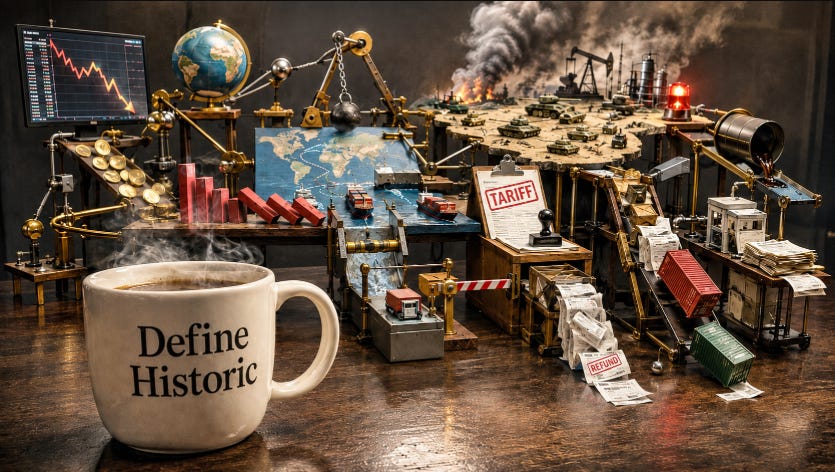
Lest anyone forget how definitively this was presented at the time, Trump put pen to paper at the Palace of Versailles, with cameras rolling and dignitaries applauding, while the White House leaned hard on the word “historic” agreement that had brought the conflict to an end. Because if you’re going to declare history finished, you might as well do it at Versailles. What looked considerably less prominent amid the palace grandeur was the fine print: this was an interim memorandum with a 60-day clock to produce an actual final agreement.
Two months on, the negotiating window has come and gone without an agreement and the war has settled into that uniquely Washington category of disaster: quiet enough to stop dominating the headlines, expensive enough to keep dominating everything else. Today is largely an accounting of what “quiet and expensive” actually costs, and, increasingly, who is being handed the bill.
Start with the ledger abroad, since that’s where the accounting is furthest along.
Iran, for its part, is telling anyone who’ll listen where the next front might open. According to Financial Times reporting from Tehran and London, Iranian officials have weighed striking US military targets beyond the Middle East entirely, including the Bulgarian air base at Bezmer, approved last month for American refueling flights, and the British base at Akrotiri in Cyprus, already hit once by a drone in March. Subsea fiber-optic cables running through the Strait of Hormuz are reportedly on the list too, because apparently the escalation ladder needed a telecommunications package.
The logic, as one regime insider put it, is escalation as message: a strike on US bases in Jordan earlier this year, the most precise long-range attack Iran has carried out to date, was, in his words, also a message to Europe about where it should stand in this war. The subtext hardly needs translating. Hit our infrastructure, the insider said, and the war goes beyond the region.
Whether Tehran can actually make good on the Europe threat is a separate question. Outside analysts call the risk to European targets real but limited, with range and payload trade-offs likely to blunt anything beyond a symbolic hit. But intent doesn’t need to be operationally airtight to be diplomatically corrosive, and Iran seems to understand something about the calendar that Washington keeps talking past. As Andrew Neil put it on Times Radio, Iran is “playing Trump like a fiddle” not because Tehran is winning outright, but because it knows exactly how unpopular this war has become at home, and exactly how long it has to wait. Drag it out through the summer, Neil argued, and let the midterms do the rest.
Tehran thinks it’s holding the clock. Washington appears to be arguing with the clock about whether deadlines are binding.
Somewhere between the strait closures and the strikes, the actual invoice for this war arrived, and it’s addressed to anyone who buys diesel. The pump price hit $5.47 a gallon on Tuesday, closing in on the all-time high of $5.82, with the “crack spread,” the gap between diesel and crude, hitting a record in recent days. Diesel was trading at roughly a $100-a-barrel premium to crude, more than three times the average spread in 2025. “Energy dominance” has entered the invoice-processing phase.
The mechanics are almost too clean for a coincidence: Hormuz restrictions and bombing campaigns knocking out regional energy infrastructure, layered on top of Ukrainian drone strikes crimping Russian refining capacity, layered on top of falling Chinese exports leaving the US, in the words of one analyst, as the “supplier of last resort,” running its refineries flat out with no slack left in the system. Tom Kloza at Gulf Oil called it “a quiet crisis.” He wasn’t being coy about the volume: “these are body punches to the middle of the economy.”
The people absorbing those punches aren’t abstractions. John Boyd, founder of the National Black Farmers Association, told the FT the diesel spike is pushing farmers toward foreclosure on top of fertilizer costs that were already up, also because of the Iran war. “My field tractor holds about 100 gallons,” he said. “So one fill-up really costs a lot.” That’s the ledger at ground level: a war fought over a shipping lane a Minnesotan or an Oregonian will never see, billed monthly to the people who move freight and grow food. Foreign policy, meet Accounts Payable.
It’s also landing at the worst possible moment politically: a bond sell-off, borrowing costs climbing, heating season and holiday retail stocking and harvest all converging in the same stretch of calendar as the run-up to November. One analyst put the quiet part out loud: bad ideas discarded in April, he said, might get a second look in October if prices stay this high. It is its own kind of admission: the fixes being contemplated aren’t necessarily the ones that solve the war, but the ones that make the receipt look a little less ugly before voters inspect it.
Keystone XL, notably, wouldn’t solve this. It would bring more crude to US refineries; the immediate problem is that those refineries are already running nearly flat out, while global refining capacity is constrained. Keep that in mind for the next item, because Washington may be about to answer a refinery crisis with a pipeline press release.
Just before midnight Tuesday, with 50% tariffs on $20 billion of Canadian goods set to take effect, Trump announced a three-day pause posting that the US and Canada, “subject to the finalization of documents,” have “a DEAL!” Mark Carney’s version of events ran a half-step behind the exclamation point: “substantial progress” had been made, he said, but “there is important work still to be done.” One side is declaring a deal. The other is declaring a draft.
This round of tariffs wasn’t imposed under the emergency powers the Supreme Court already struck down, it came via Section 338 of the Tariff Act of 1930, a different statute entirely, retaliating against what the administration calls discriminatory Canadian trade practices in dairy, alcohol, and government procurement. Which means the throughline isn’t really about Canada’s conduct at all. It’s about an administration that lost one legal tool and, without missing a step, reached for another. The tariff pause is less relevant than the persistence of the leverage is.
Almost as an afterthought, in the same post: Keystone XL, dead since 2021, “may be awoken from the grave.” No conditions attached. No detail on what Canada would need to do to earn it, or whether it’s even connected to the tariff talks. Just the suggestion, dropped into a Truth Social post about a trade dispute, that a fifteen-year fight over a pipeline, one that consumed a decade of permitting battles, tribal opposition, and environmental review before TC Energy itself abandoned it, might simply be willed back into existence.
If the last three items are about rules and relationships becoming strangely provisional abroad, this one brings the principle home, to a promise most people didn’t know needed making at all: interstate extradition is supposed to be among the most boring procedural obligations in American federalism. Abbott had honored every extradition request Walz sent him over the previous five years. Since Castro’s request landed on his desk, he has approved three more Minnesota extraditions. Just not this one.
Castro faces assault and false-reporting charges stemming from a January shooting during Operation Metro Surge, in which prosecutors say he fired through the door of a Minneapolis home, wounded Julio Cesar Sosa-Celis, and then gave investigators a false account of what happened. Minnesota requested his extradition in June. Abbott has yet to sign it. With Castro nearing the end of Texas’s 90-day detention window, Attorney General Keith Ellison has now sued in federal court to force the issue because even extradition paperwork now requires constitutional litigation.
Abbott’s own stated reason is the part worth sitting with: he says he won’t sign until Minnesota officials “acknowledge their fault” in the state’s fraud problem, the same fraud narrative the administration has used to justify Operation Metro Surge. Literally, a fugitive warrant is being held hostage to a state’s willingness to validate a political talking point. Moriarty called it what it is: “It is not supposed to be controversial.” Ellison, for his part, wasn’t interested in diplomacy about it. “Christian Castro is not above the law,” he said, “and Greg Abbott isn’t either.”
That sentence could serve as the epitaph for the whole day. Substitute “Trump” for “Abbott” and it scans just as well. A presidency and now a politically aligned governor taking the lesson downstream has discovered that the ordinary machinery of obligation can become optional if you’re simply willing not to turn the key. Iran is banking on Washington running out of patience before it runs out of leverage. Canada got a pipeline promise with no terms attached. And now a sister state is finding out that even interstate comity, the most unglamorous, least ideological gear in the federal machine, turns out to be negotiable too, if the person holding the warrant decides it is.
Trump keeps staging moments meant for history while making the arrangements underneath them increasingly temporary.
All this is before we even get to the part of the legacy that will quite literally outlive everyone involved: climate, sustainable energy, environmental regulation, and the physical systems being altered now on timelines measured not in election cycles, but decades. That accounting deserves its own day.
Only because Donald sees everything as an opportunity to grift, I think Iran was right on their earlier assertions that he was using the "conflict" to manipulate the markets via his "now Hormuz is open, now it's closed" pronouncements. He's doing the same thing, IMHO, with the "negotiations" with Canada currently being discussed. A convenient deadline on a Tuesday that I'm sure he knew wouldn't happen so he could issue a 3 day delay (why THREE days, why not a week? Or a month?)....which brings the matter to a Friday. Fridays have been known for Donald to claim gloom and doom before market close, and then miraculously shout "success!" on the Sunday so that the markets on Monday know what to do. But then, maybe I'm just getting too cynical in my old age and, maybe it's just a coincidence. I mean, just because all the dots connect, it doesn’t mean anything, right??
Man. My moonbeam vigils look like one continuous wolfscream. I am so, so very over this.