


Good morning! Fresh off yesterday’s spectacle, where Defense Secretary Pete Hegseth was openly called a liar in front of the House Armed Services Committee, we get an encore today. Apparently, six hours of testimony, visible irritation, and a credibility collapse weren’t quite enough.
Hegseth is back on Capitol Hill this morning, this time facing the Senate, where the questions will be the same but the stakes are higher. The administration’s war with Iran is now two months in, costs are climbing past $25 billion, and no one, no one, can clearly explain how this ends. The official line is that it’s not a quagmire. The unofficial reality is that everyone knows exactly what it looks like when one is forming.
Overnight, the backdrop only got worse. Oil has surged past $120 a barrel, gas prices are climbing again, and central banks around the world are effectively frozen in place, waiting to see how bad this gets. The U.S. economy is still growing, barely, but even that modest 2% pace is already undershooting expectations. Inflation is ticking back up. Both the Fed and the World Bank are issuing warnings. Everyone is warning.
Rest easy, because there are memes. While markets react, allies recalibrate, and Pentagon officials try to explain themselves under oath, the president was up late posting.
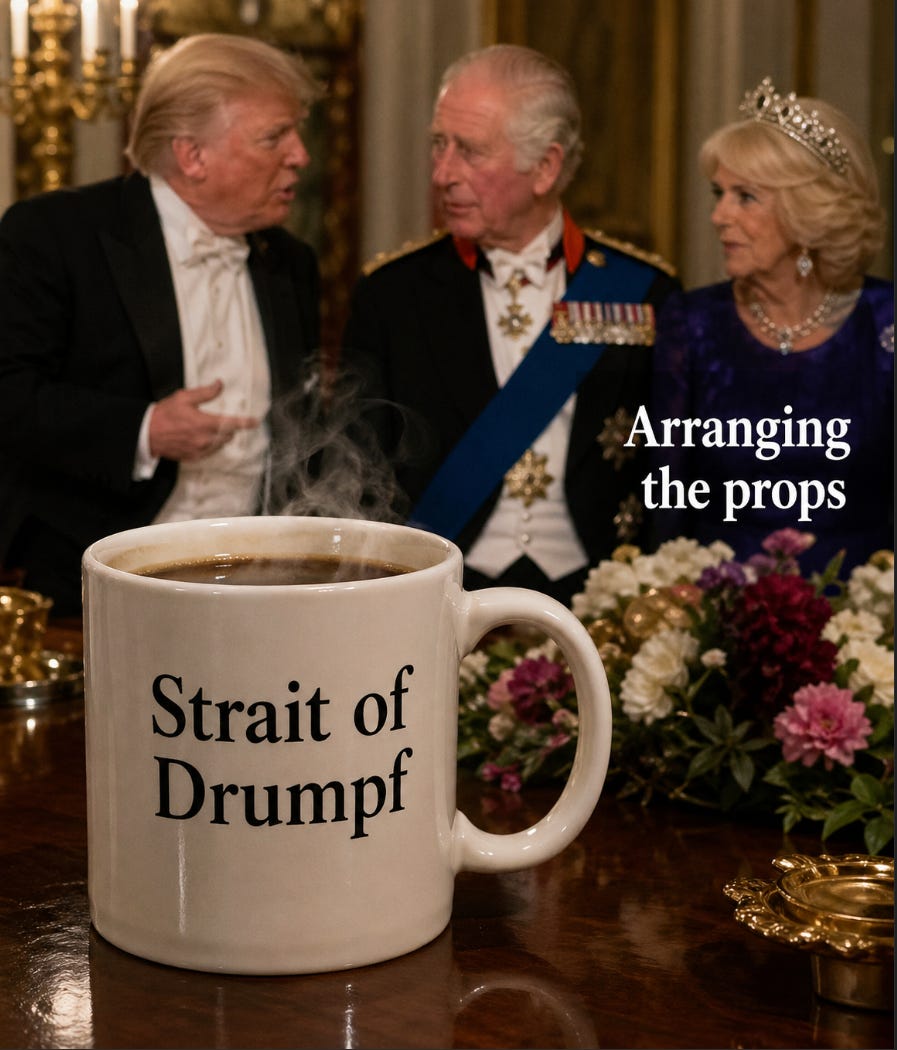
Trump took to Truth Social with a string of late night, early morning, messages that veered from conspiratorial to combative, reviving language tied to extremist movements, insisting political opponents are threatening his life, and posting a doctored image of the Strait of Hormuz rebranded as the “Strait of Trump.”
The same narrow waterway that carries roughly a fifth of the world’s oil supply, currently under blockade, currently rattling global markets, currently driving up gas prices, is up for a rebrand.
There’s a kind of surreal symmetry to it: the world’s most volatile energy corridor reduced to a punchline, while the price of gas quietly climbs toward five dollars in parts of the country.
It didn’t stop there. Trump escalated his fixation on James Comey’s old “86 47” seashell photo, declaring it mob code for assassination, then added nautical coordinates for good measure. Seashells in the sand, now an assassination plot with depth charges. CSI: Sandcastle, live from the Situation Room.
Of course, Trump would know a thing or two about mob shorthand. This is, after all, a man who has spent years openly admiring figures like Al Capone, once even praising him as a “great” figure despite being one of the most infamous criminals in American history.
Totally normal. Very compos mentis. Nothing says steady wartime leadership like panic-posting CSI: Sandcastle at 12:30 in the morning.
At a moment when allies are looking for clarity and adversaries are testing boundaries, the signal coming from the White House… looks like this.
On their own, these posts might be brushed off as late-night venting. But they’re not landing in a vacuum anymore, they’re landing at the same moment that allies are openly questioning U.S. strategy, adversaries are mocking American leadership, and foreign governments are beginning, carefully, but increasingly publicly, to factor something new into their calculations: judgment.
We saw it this week in Germany’s unusually blunt criticism of the war, and in the tone coming out of European capitals. And again in how Iran’s leadership is responding with escalation and theatrical threats about Americans ending up at the bottom of the Persian Gulf. This is what it looks like when questions about fitness stop being partisan and start becoming geopolitical.
Into that vacuum steps Vladimir Putin. Having found a spare 90 minutes between threatening Ukraine and attempting to rebrand himself as a global elder statesman, Putin picked up the phone and called Trump to discuss Iran, Ukraine, and the exciting possibility that Russia might help de-escalate a crisis it is very much enjoying.
The timing is not subtle. Two days before the call, Putin met with Iran’s foreign minister, Abbas Araghchi, and reaffirmed Moscow’s support. Then he warned Trump of “the inevitable and extremely damaging consequences” if the U.S. and Israel escalated against Iran again. Translation: he showed up with Tehran’s talking points in one pocket and a wishlist for Ukraine concessions in the other.
Putin even floated a temporary ceasefire in Ukraine “for the duration of Victory Day celebrations,” because every “peace initiative” needs a pause designed to protect your military parade from the consequences of your own invasion. The Kremlin claimed Trump “actively supported” the idea, while Putin accused Zelensky’s government, with European backing, naturally, of “pursuing a policy of prolonging the conflict,” which is Kremlin-speak for “please ignore the country that actually invaded.”
Russia offers to help manage the Iran crisis, then quietly tries to collect payment in Ukraine. Putin didn’t call as a mediator. He called as the arsonist offering to sell the fire extinguisher.
America’s allies, alas, are left trying to figure out whether they’re part of the plan, or just part of the scenery. Nowhere is that clearer than in the ongoing royal visit.
On one level, it’s all ceremony: King Charles and Queen Camilla welcomed with pomp, pageantry, and a White House state dinner.
On another level, it’s something closer to brand management. Trump seemed to be using the royals as props in the oldest influence game there is: stand next to power, photograph the proximity, then sell the illusion of legitimacy to people who already have too much money and still want more access.
It’s hard not to think of Jeffrey Epstein’s infamous habit of covering his tabletops with photos of himself alongside the world’s movers and shakers. Not because this suggests the same crimes, it does not, but because it reflects the same social grammar of elite image-laundering: proximity as proof, association as currency, the photo as the product.
Trump has turned the event into a curated showroom, stacked with billionaires, media allies, conservative judges, and loyalists, while quietly excluding political opposition and even much of the British cultural presence the dinner was ostensibly meant to honor.
Outside that ballroom, the reception has been… less enthusiastic. In New York, Mayor Zohran Mamdani declined a private meeting with the king and instead suggested, if they did talk, they might begin with returning the Koh-i-Noor diamond, an object lesson in how history doesn’t disappear just because it’s dressed up in ceremony.
That’s the split-screen reality of this moment: gold plates and photo ops in Washington, skepticism and indifference on the ground.
Almost beneath the noise, something even more consequential happened. The Supreme Court has now effectively finished what it started over a decade ago: dismantling the Voting Rights Act.
In its latest decision, the Court’s conservative majority argued that the law had done its job so well, eliminating the worst forms of racial discrimination in voting, that it is no longer needed. “Vast social change has occurred throughout the country and particularly in the South,” Justice Samuel Alito wrote for the majority. It’s a remarkable argument. The law worked, therefore it should be weakened.
The dissent saw it differently. Justice Elena Kagan warned that it is Congress, not the Court, that should decide when the country no longer needs protection against minority vote dilution. Progress, in other words, doesn’t sustain itself once protections are removed.
There’s evidence to back that up: research cited in the analysis found the Black-white turnout gap widened by nine percentage points in previously covered jurisdictions after Shelby County, translating into hundreds of thousands of uncast ballots by voters of color.
Or, as Ruth Bader Ginsburg famously put it in Shelby County, getting rid of protections that are working is “like throwing away your umbrella in a rainstorm because you are not getting wet.”
The practical impact is already underway. States are moving to redraw maps, entrench power, and reshape elections for years to come.
Individually, each of these stories would be concerning, but together, they form something else entirely. Not just chaos, but a governing system where spectacle replaces strategy, grievance replaces judgment, and the costs, economic, geopolitical, and democratic, are passed along to everyone else. Still the photos will look great.
Can there be any doubt now that the method for appointing judges in the United States is totally flawed?
The appointment of judges by Presidents on the basis of ideological beliefs cuts right through the notion of justice being blind to all but the evidence.
The Supreme Court is seen to have a 6-3 majority favouring the Republicans. That there is any "majority" to one party or the other in a Supreme Court that will be the final judges on important matters is unbelievable to me in the UK. Our Supreme Court is appointed by judges, confirmed by the Home Secretary but not decided by them, and no-one has any idea if their political beliefs.
Judges should leave their political beliefs outside the Court when deciding their view. That clearly doesn't happen which leaves matters Ike the Voting Rights Bill totally vulnerable.
Al Capone died of syphilis. By the time he died, the 48-year-old had deteriorated so severely from the advanced syphilis ravaging his brain that he had the mental capacity of a 12-year-old.
Any similarities?