

Good morning! Donald Trump delivered yet another major announcement on Monday. We can likely expect many more before November.
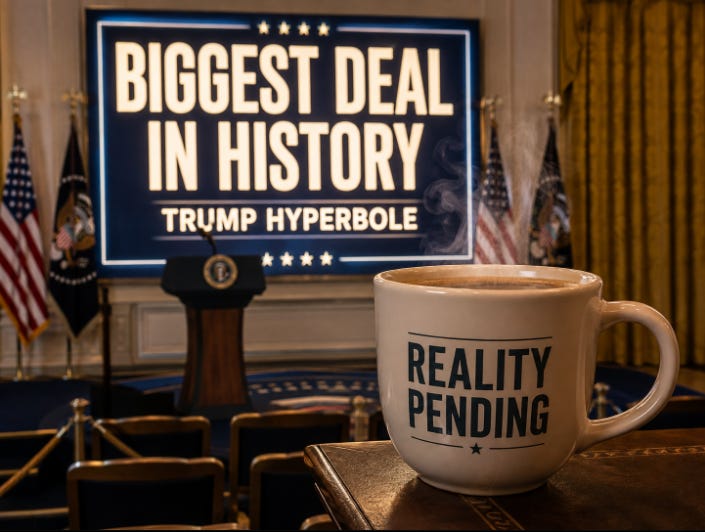
Surrounded by pharmaceutical executives and members of his administration, Trump announced new agreements on prescription drug pricing, an achievement he described as one of the biggest medical developments ever, perhaps the biggest thing to happen in medicine, certainly the largest drug-price reduction in the history of medicine, and naturally something the press would refuse to cover properly because if a Democrat had done it there would presumably already be commemorative stamps.
Drug prices, Trump said, are coming down 50, 60, 70, even 80 percent. This represented a notable improvement in percentage discipline: moments earlier he had briefly reverted to his old habit of promising reductions of 400, 500 and even 600 percent, but somebody appears to have explained that prices cannot actually fall below zero, and by the next paragraph he was safely back among numbers recognized by mathematics.
The agreements will save Americans more than $600 billion, he said, over a “very short period of time.”
Twenty minutes later, one of his own officials supplied the missing footnote: the Council of Economic Advisers estimates those $600 billion in savings over ten years. Short compared with, say, the Cretaceous period, but it is not generally how Americans understand the phrase “very short period of time.”
There is real policy underneath the performance. Pharmaceutical companies have agreed to new pricing arrangements, Medicaid discounts, and domestic manufacturing commitments. That deserves scrutiny on its own terms. But the presentation followed a pattern that has become increasingly familiar: take the largest conceivable future value, strip away the timeline, contingencies and qualifying language, then announce the result as something Donald Trump has already delivered personally through an unprecedented application of Donald Trump.
Robert F. Kennedy Jr. compared the achievement favorably with the landmark 1962 drug reforms enacted after the thalidomide disaster, then went considerably further. “Nothing changed the public health business like this,” he declared, before assuring the room that the achievement “could not have happened under any other president except for this one.”
Howard Lutnick dispensed with the historical comparison altogether. “It’s all thanks to you,” he told Trump, praising the president’s “power of energy,” innovative thinking and unique understanding of where the country needed to go. There was enough incense in the room to set off a smoke detector.
It might have seemed excessive if we had not just watched the same machine operate a few days earlier.
On Friday, Trump announced another historic achievement: the United States, he declared, had struck “THE BIGGEST OIL DEAL IN WORLD HISTORY,” obtaining control over 65 billion barrels of Venezuelan oil, more than doubling American reserves and promising lower gasoline prices at no cost to taxpayers.
The actual arrangement appears rather less cinematic and considerably stranger.
The White House now says a private company, North American Blue Energy Partners, has received 100-year concessions over 17 Venezuelan fields containing roughly 65 billion barrels. Washington gets a 35 percent corporate interest, guaranteed rights to buy 20 percent of production at cost, first refusal on the rest, and substantial control over the company’s board. The company, meanwhile, plans to raise as much as $100 billion in private American capital to develop fields whose oil is, inconveniently, still underground.
That “plans to raise” is doing rather more work than Trump’s announcement suggested.
Francisco Rodríguez, a Venezuelan economist and former head of the country’s Congressional Budget Office, noted Tuesday that even the notoriously concession-friendly government of Cipriano Castro handed out rights for 50 years, not 100. He also raised a more immediate problem: Article 150 of Venezuela’s constitution requires National Assembly approval for public-interest contracts involving foreign governments and entities, and this agreement has apparently never gone before the Assembly.
Nor has anyone published the contract.
Venezuela’s interim president describes a 25-year bilateral project. The White House describes 100-year concessions. Trump describes 65 billion barrels America now controls. The company at the center of it all still has to raise up to $100 billion to develop oil that remains underground.
The announcement had already outrun the contract.
In Iran, it has begun outrunning the physical limits of the world around it.
At Monday’s event, Trump was eventually asked about the renewed fighting. Iran, he said, is a failed nation. Its military has been devastated. Its leaders are largely dead. Its air force and navy are gone. The Strait of Hormuz is in “extremely good shape.” Iran will never have a nuclear weapon, America has done a “great job,” and if Tehran misbehaves, “that doesn’t mean we won’t smack them.”
Later, when confronted with military warnings that a prolonged campaign was weakening America’s ability to deal with threats elsewhere, Trump waved that away too. The United States has so much ammunition scattered around the world that it can simply take more if needed. There are, he said, “unlimited amounts” of older but still powerful munitions.
“This is a relatively little war for us,” he explained.
The Financial Times reports that Trump has summoned major American refiners to the White House today as gasoline remains above $4 a gallon and diesel near $5.80. They are not exactly limping into the meeting: Marathon Petroleum, Phillips 66 and Valero reported a combined $12.6 billion in second-quarter net income as refining margins surged. Two months ago, Trump accused Big Oil of “gouging” consumers and ordered the Justice Department to investigate.
Now he needs their help.
The difficulty is that the refiners are already running nearly flat out. U.S. utilization has remained above 95 percent for twelve straight weeks, the longest stretch since 2000, with some operators even deferring maintenance to keep fuel moving.
So the same administration that recently threatened the industry over high prices is now gathering it at the White House to ask how prices might come down and capacity might go up. The physical economy may have some disappointing news.
A refinery is not a tariff rate. It cannot be raised by executive order, threatened into compliance, or summoned into existence before the midterms. “Try harder” stops being an effective energy policy.
The desperation is understandable. According to the figures reported by the FT from Brown University’s war-cost tracker, Americans have already paid tens of billions more for gasoline and diesel than they would have at prewar prices. This is an unusually democratic form of foreign policy. Everyone gets to participate right there at the pump.
Nor are Americans the only ones participating.
In Britain, energy regulator Ofgem has announced another increase in the household energy price cap beginning October 1, this time by 4 percent, driven by the sharp rise in wholesale fuel prices associated with the U.S.-Israel war on Iran. Al Jazeera spoke with Andrew, a 70-year-old retiree in Norwich who had already locked himself into an 18-month fixed-rate plan because previous wars taught him what geopolitical instability eventually looks like when it arrives in the mailbox.
Trump’s little war is being paid for in pounds and dollars and many other currencies.
Bond traders are pricing it in basis points. Al Jazeera reports that oil-driven inflation fears are now contributing to a global sovereign debt selloff, with Japan’s 10-year yield reaching 3 percent for the first time since 1996 as investors worry central banks may have to keep rates higher.
This arrived less than twenty-four hours after Trump complained that the Federal Reserve should be lowering interest rates because America is doing so well. Growth, he insisted, does not cause inflation.
Perhaps not.
Wars that disrupt one of the world’s most important energy corridors have other ideas.
There is also the small matter of that Strait of Hormuz Trump says is in extremely good shape.
Qatar says the unresolved crisis there will “lead to escalation and harm everyone” and says it is working with Oman and Pakistan toward a peaceful solution that would reopen the strait. Shipping has been diverted elsewhere; Jordan’s Aqaba port is reporting sharply higher transit traffic as traders seek alternatives to the disrupted route.
“Extremely good shape” is one of those technical maritime terms meaning “regional governments are urgently trying to reopen it.”
Then there is Iran itself, the failed, leaderless country Trump described Monday.
Its president, Masoud Pezeshkian, spent Tuesday at the Shanghai Cooperation Organisation summit meeting Vladimir Putin and other heads of government. He thanked Russia for its support during the war, while Putin promised continued economic and trade ties despite Washington’s threats against countries doing business with Tehran.
Pezeshkian also reiterated that Iran would return to the interim arrangement if the United States fulfilled its own commitments under the agreement.
It does not mean Tehran has somehow won the war, but it does mean the country Trump described as barely knowing who is in charge has a president sufficiently identifiable to attend an international summit, meet Vladimir Putin and publicly offer Washington a route back to negotiations.
The difficulty with declaring reality is that other people keep showing up in it.
The same problem is appearing inside the Pentagon.
The Washington Post reports that commanders responsible for U.S. forces in Europe, the Indo-Pacific and Latin America, along with the Navy’s top admiral, formally objected to orders extending Middle East deployments because they believe prolonged large-scale operations against Iran are unsustainable and risk weakening America’s ability to respond elsewhere.
Then the machinery itself supplied another warning. Army Secretary Dan Driscoll submitted his resignation after months of friction with Pete Hegseth, including clashes over the defense secretary’s purge of senior officers. His departure will leave the Army without either a Senate-confirmed civilian secretary or a confirmed chief of staff.
The juxtaposition is hard to miss. Four-star commanders have already registered formal non-concurrences with orders extending large-scale Middle East deployments into 2027, dissent entered into the record, acknowledged and overruled. Senator Ruben Gallego, a Marine combat veteran, translated the Pentagon’s language into English: keep this up and “you’re about to break the military.”
Nobody voted on any of this. The generals didn’t get a vote; they got a non-concurrence, and then an order anyway. Iran’s president didn’t get a vote on whether the world believed the American story about Hormuz; he got a stage in Bishkek and used it. Andrew in Norwich didn’t get a vote on his energy bill; he got a four percent increase and the good sense to have seen it coming.
The announcement economy keeps colliding with the physical economy, and while the physical economy can’t hold a press conference, every time it happens, the physical economy wins the argument.
Thank you all for the kind words and for your patience while I was away. Marz and I managed a 616-foot elevation gain over roughly a mile and a half to reach the crest at about 5,200 feet, where we discovered that the memorial site still lay another two miles downhill on the other side.
Marz and I developed a renewed appreciation for the oxygen-rich, near-sea-level environs of home.
I took one look at the descent, considered the return trip, and decided the family gathering would be improved considerably by not ending with a rescue operation for Grandma and her 140-pound dog. So we took in the view, wished the others well, and began our own descent back to the trailhead.
It was a beautiful, meaningful day, and my muscles have been filing grievances ever since. My ex-husband, the boys’ dad, is no doubt chuckling about having the last laugh.
My Dear Mr. President:
I applaud your efforts to reinforce the Apostle Paul’s New Testament teaching found in his first pastoral letter to Timothy. In that missive he reminds his student that…
“… for the love of money is the root of all kinds of evils.” [1 Timothy 6:10 (ESV)]
Your administration is serving as modern-day proof of Paul’s centuries-old teaching.
Regards,
Wise decisions “Gramma” ..
A pathological liar ups the ante because having to impress their ego …insists , “the greatest , the most ever, the best..” is hopefully firmly decided by a blue wave and decidedly what now 90% of America wants …not even close to demented Don’s deluded dialogs.