


My daughter had her first ballet class today, an event she had reminded me about approximately twenty million times before it finally arrived. Yesterday it was eighteen million, by this morning she had reached twenty. She loved every minute of it, all that anticipation, which had grown too large for her small body and spilled out in repeated questions, elaborate plans and regular announcements that Monday was, in fact, still coming, finally found somewhere beautiful to go.
This is how children experience emotion; a feeling arrives and fills every available room. Excitement becomes jumping, disappointment becomes tears, anger becomes a slammed door, a clenched fist or a declaration that someone is never invited to their birthday party again, even if that birthday is eleven months away and the accused party is their brother.
Children have big feelings because they are still becoming people. Their brains are developing, their sense of time is unreliable, and their understanding of consequence remains largely theoretical. When something hurts, they don’t always know where to put the hurt, so they hand it to everyone else in the house.
This is why we teach them. We tell them that anger is real, but it’s not an instruction. We explain that being hurt doesn’t grant permission to hurt someone else. We ask them to take a breath, tell the truth, listen to what happened and repair what they damaged. Sometimes this works immediately, sometimes it works after twenty minutes of crying under a blanket, and sometimes everyone just needs a snack.
The point isn’t that children should already know how to regulate every emotion. The point is that they’re learning. The federal government, meanwhile, is having big feelings.
President Donald Trump announced Monday that Iran would “pay” for the deaths of American soldiers “many times over,” because the commander in chief of the most powerful military on Earth has apparently arrived at the advanced diplomatic principle of you hurt me, so I will hurt you more.
The United States has now carried out nine consecutive nights of strikes against Iran. Two American soldiers were killed in Jordan during an Iranian missile and drone attack. Another service member died in Iraq during what the military described as the “controlled detonation” of a downed Iranian drone. Seventeen American service members have been killed since the war began. Seventeen American men and women won’t come home to see their children, their partners, their parents, or their lives again.
Iran has retaliated against American and allied targets in Bahrain, Kuwait and Jordan. Its president now says the country is engaged in a “full-scale war.” Shipping through the Strait of Hormuz has slowed to a trickle, two oil tankers were reportedly attacked, and the Houthis have announced a blockade of Saudi ports. There is, somewhere beneath the smoke and wreckage, reportedly a ten-day ceasefire proposal being passed between diplomats, although the adults with the missiles remain busy expressing themselves.
Iranian officials also say a U.S. strike damaged a desalination plant serving roughly 10,000 people across about twenty villages. Images and video show damage to water infrastructure, although the United States has not established publicly that the plant was deliberately targeted. If civilian drinking water was intentionally attacked without lawful military necessity, the legal questions become grave. The human consequences already are.
When one of my children becomes angry enough to want revenge, I stop them. I don’t hand them a bomber and explain that the important thing is to establish dominance before bedtime. Children must learn that retaliation doesn’t resolve pain; it reproduces it. They learn that lesson because adults are supposed to know it already. Washington has decided to conduct the experiment backward.
The results have now reached the neighborhood gas station. The national average for regular gasoline crossed $4 a gallon Monday as the war disrupted energy shipments through the Strait of Hormuz, which carried about one-fifth of the world’s oil and gas before the conflict. Brent crude briefly climbed above $90 a barrel.
This is how a presidential tantrum enters an ordinary American household. It doesn’t arrive wearing a uniform. It glows from the sign above the gas station while a parent calculates whether there’s enough money left for groceries.
The administration is also angry with Canada, although this time the aggressor is wind. After smoke from Canadian wildfires drifted into the United States, Trump declared that the country had been “invaded” by dirty air and suggested adding the cost of the pollution to Canadian tariffs. This is a remarkable solution because tariffs are taxes on imported goods, while smoke is famously difficult to assess at customs.
Nature then contributed its own editorial correction. Smoke from twenty-two large fires burning across Oregon and Washington began drifting north into British Columbia, prompting air-quality warnings in Canada. The atmosphere crossed the international border without a passport, an approved tariff classification, or apparent concern for the president’s feelings.
“Fighting climate change is the responsibility of all countries, including the United States,” Canadian Prime Minister Mark Carney said, introducing the radical possibility that a shared planetary crisis might require cooperation.
If one of my children blamed a sibling for the direction of the wind, I would explain that weather isn’t a personal attack. I wouldn’t impose an import duty on their crayons. Yet the administration has developed a governing philosophy in which every inconvenience is an invasion, every disagreement is treason, and every solution begins by identifying someone who must pay.
That philosophy has now found a secret courtroom. The Justice Department has filed the first case in the thirty-year history of the Alien Terrorist Removal Court, seeking to deport an unnamed noncitizen through a process that can conceal classified evidence from both the public and the person facing removal.
The one-page filing doesn’t identify the accused, describe the alleged conduct or specify which provision of the law the government believes was violated. Normal federal rules of evidence don’t apply, and the law even permits the government to use illegally obtained evidence. Chief Judge Joan Ericksen has ordered the Justice Department to provide additional facts and legal analysis after questioning whether the allegations fit the statute.
When a child makes an accusation, we ask questions. What happened? What did you see? What did the other person say? Are you telling me what you know, or what you think? The administration’s preferred method is apparently to hide the accused, hide the evidence and ask the country to trust that whatever happens behind the closed door is necessary.
This demand for trust becomes especially obscene when the government resists allowing the public to see its own agents at work. Thirty-nine senators are demanding answers after ICE officers fatally shot people in separate encounters in Maine and Houston. They are calling for body cameras, visible identification, stronger officer vetting and clearer rules governing vehicle stops. Both deaths involved agents firing at vehicles and one of the officers reportedly had a documented history of violence in family court records.
When my children make a mistake, I teach them not to hide it. Concealment doesn’t erase harm; it only adds dishonesty to the original injury. The federal government appears to believe accountability is something that happens to other people.
There was, however, one modest sign Monday that someone in America still remembers how to establish a boundary. A federal judge temporarily halted the proposed Paramount and Warner Bros. Discovery merger after twelve states argued that the deal would reduce competition, raise prices, eliminate jobs and place an alarming portion of American entertainment and news beneath one corporate roof.
The merger would combine Warner Bros., Paramount Pictures, CBS, CNN, HBO, TNT, MTV, Nickelodeon, Paramount+ and HBO Max. Apparently corporate consolidation has reached the developmental stage where a company grabs every toy in the room, stacks them against its chest and announces that sharing would interfere with innovation. A judge has said no, at least for fourteen days.
Children need adults to say no. They need boundaries strong enough to survive screaming, consequences that don’t disappear when enforcement becomes inconvenient and love sturdy enough to distinguish compassion from surrender.
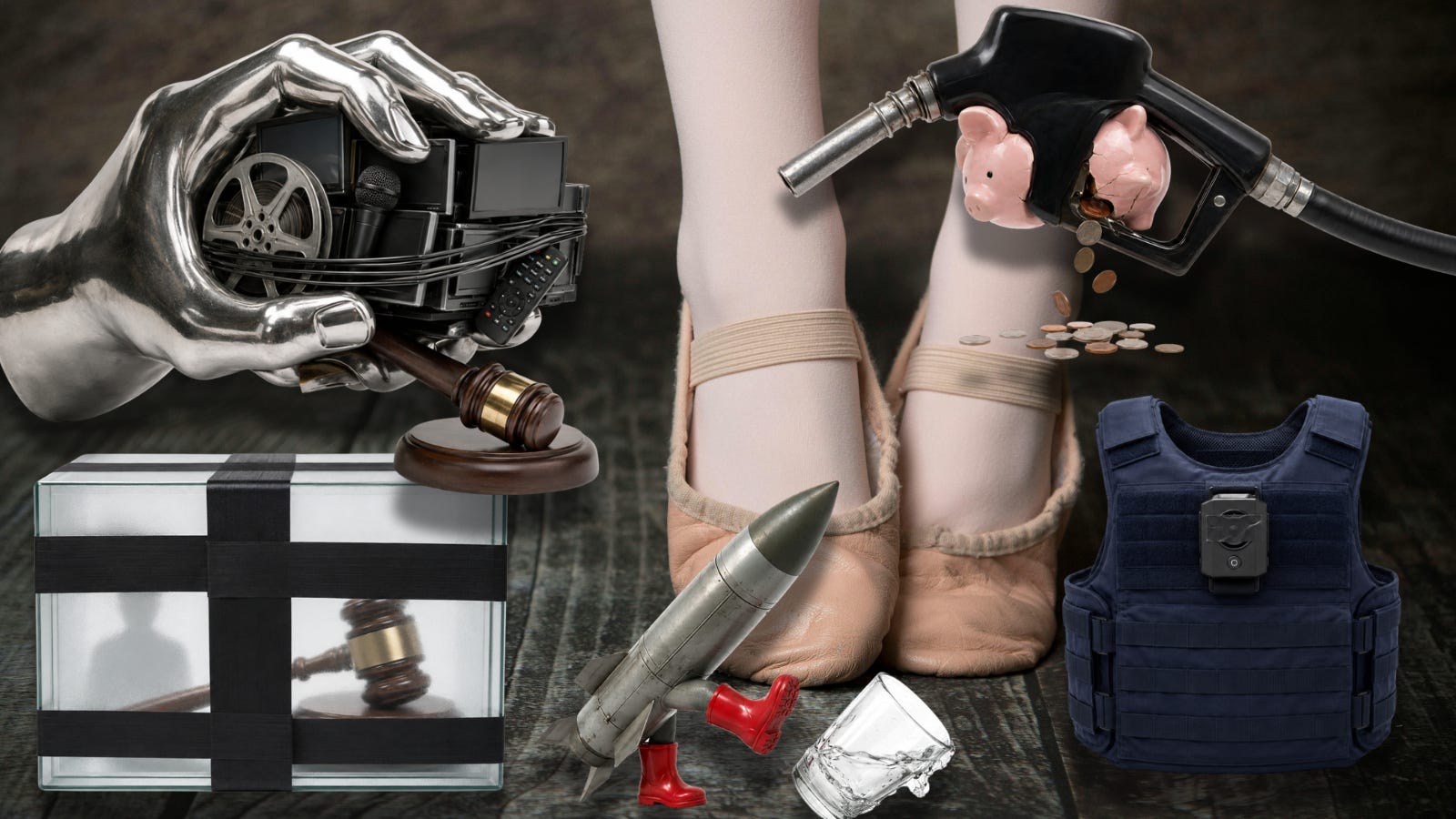
Governments need those things too, although we use more dignified words for them. We call them laws, courts, oversight, elections and the separation of powers. My children won’t always throw themselves into the hurricane of every feeling. They will grow, they will learn that disappointment is survivable, anger can be expressed without cruelty, and power creates responsibility rather than exemption. They will become, if we are careful and fortunate, wonderful adults.
The men running the country have already had that opportunity. What we are witnessing now isn’t childhood. It isn’t innocence, confusion or an unfinished brain struggling to make sense of an enormous world. It’s a group of fully grown adults using armies, tariffs, secret courts and armed federal agents to externalize every grievance they are unwilling to govern within themselves.
A child’s tantrum may leave toys scattered across the floor. An adult hissy fit with an air force leaves graves, broken bridges, empty water pipes and a glowing receipt at the gas pump.
Feelings are real, they are still not instructions.
Beautifully written and on point (unintended yet possible ballet connection? - I checked: the ballet term is “en pointe”).
How did we citizens came to accept extreme emotional deregulation in adults with power over our lives - as if rage, self-deception, vengeance and hate would not ensure poor outcomes for everyone in the circle of harm?
History tells us what unhinged, ignorant, devious, greedy, selfish persons with power leave in their wake. As the old folk song asks, “when will they (we) ever learn”?
OK. Only responding to the happy opening here. My youngest son was EXACTLY the same on his first day of ballet. I was probably the same on my first day. Ballet, if she sticks with it, will give her maturity, self-reliance, and TOUGHNESS beyond belief (along with strength, flexibility, neurosis about weight, and various aches and pains that she will be reminded of after 40). It's a pretty good trade.