


Good morning! The setting was Malacañang Palace, a whitewashed colonial landmark of arched galleries and wrought-iron balconies overlooking Manila’s Pasig River. Decked out for Christmas, it came complete with a bamboo band playing Elvis Presley’s It’s Now or Never, an honor guard, and the 75th anniversary of a mutual-defense treaty to celebrate. Donald Trump was explaining American energy dominance to Ferdinand Marcos Jr. when he reached for one more line item.
“And then you add Venezuela, which was our new acquisition.”
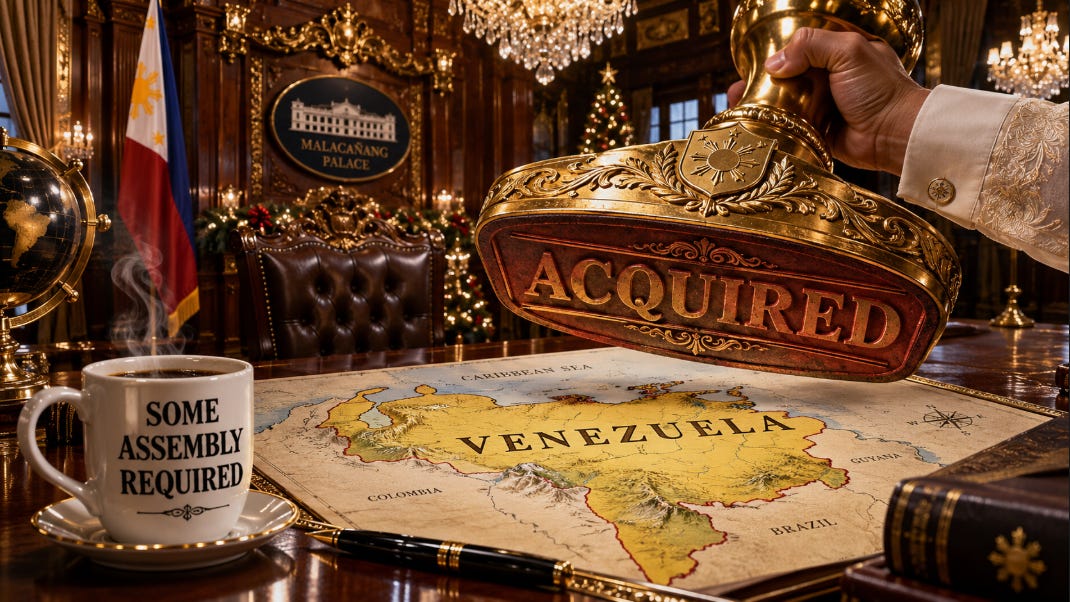
Anticipating the objection, he doubled down. “It was an acquisition whether people like to say that or not.”
For good measure, he added a casualty report: “Nobody killed. Think of it.” By U.S. officials’ own estimate, the January raid killed roughly 75 people, civilians among them.
The location made the remark land differently. The United States had once purchased the Philippine islands from Spain, for $20 million.
But we’re getting ahead of ourselves. Before Trump started acquiring countries, he had some trade deals to finish. Or, more precisely, some unfinished trade deals to announce.
Trump landed Tuesday evening and went straight into the Quad, the first leaders’ summit since 2024 for the four democracies concerned about Beijing’s growing regional influence. He got through his entire speech without saying “China,” a handy skill for a man heading to Shenzhen to meet Xi Jinping.
By 7:25 he was announcing “a historic trade deal” with Thai Prime Minister Anutin Charnvirakul. Trump said Thailand would drop tariffs and buy $2.6 billion in American farm products.
In almost the same breath, he explained what was actually being signed. “We’ll sign a joint statement talking about the deal,” he said, “and then they’re going to finalize it.” The formal agreement would follow “in the coming weeks.” Anutin politely agreed there was “still a little more to do.”
Hold on to that gap between the announcement and the paperwork. It comes up again.
Asked afterward what he’d signed, Trump called it “a joint statement agreement,” then upgraded it on the spot: “actually it’s a very big trade deal.” By dinner it was simply “a new deal,” and Anutin, Trump joked, “made a much better deal than I did, but these are minor details.”
He also lamented that he gets “no credit” for brokering peace between Thailand and Cambodia last year. The shortage may have something to do with the agreement collapsing within six weeks, followed by nearly three weeks of renewed fighting.
At the ASEAN dinner, he turned to his host. “I knew your parents very well, and they were great,” he said. “I believe in genetics, and they did a good job. You have very good genetics.”
The parents in question were Ferdinand Marcos Sr., who ruled the Philippines under martial law for most of a decade, and Imelda Marcos, whose shoe collection became shorthand for plunder. Imelda also oversaw a lavish renovation of Malacañang in the late 1970s, complete with carved hardwood and enormous chandeliers. Trump, who has gilded the Oval Office and cleared the White House’s East Wing for a ballroom, might have recognized a kindred approach to presidential home improvement.
A popular uprising forced the Marcos family from the palace in 1986. American helicopters provided the transportation. The décor stayed.
Trump praised their parenting twice.
Wednesday morning’s bilateral meeting, where Venezuela made its debut as an American asset, kept to the same tone throughout. Trump pitched the Philippines on Alaska’s natural gas, calling it “a very natural partner,” along with a catalog of American weapons. “Everybody wants it,” he said.
A Filipino reporter then asked the question at the heart of the alliance. With tensions rising in the West Philippine Sea, how prepared was the United States to respond if the Philippines invoked its Mutual Defense Treaty?
“I’m not concerned at all,” Trump said. “I’m not concerned about that at all. That’ll be taken care of.”
Seventeen words, none explaining what Washington would actually do if the treaty were invoked, delivered hours before he left for China.
One more item got settled as the press filed out. Marcos and U.S. Ambassador Lee Lipton confirmed there would be no signing of the Pax Silica technology framework on this trip. Nothing on paper, then. Lunch would change that, at least verbally.
At the state luncheon, Trump had news. “We’ve just consummated a very big trade deal, the biggest trade deal we’ve ever made by far.”
Nobody had seen it coming, he said: “It took place very quickly.” He then folded it into a tribute to the war dead. “Many people died defending the Philippines and that’s why I’m so happy that we were able to do a deal today.”
Marcos’s office described the outcome as an “understanding” on economic cooperation, mostly energy and food security. Neither government offered a value, terms or a timetable. Asked whether anything had actually been signed, Philippine Ambassador Jose Manuel Romualdez replied, “None.”
The biggest trade deal ever, by far, was one neither government could describe.
The history lesson followed. “Generations ago,” Trump said, “America ended the Spanish tyranny and domination of these islands and quickly laid the foundations for a modern and independent Philippines.”
Here is the abridged version he skipped. Filipino revolutionaries had already declared independence from Spain in 1898 when the United States bought the islands from Spain anyway, for $20 million, under the Treaty of Paris. Filipinos who believed their country belonged to them fought the Philippine-American War from 1899 to 1902. More than 20,000 Filipino combatants and as many as 200,000 civilians died, many from disease and famine. William Howard Taft, whom Trump listed among America’s “best minds,” became the colony’s first American civil governor. Independence came in 1946.
“Quickly,” it turns out, means 48 years.
Same palace, same day, same accounting method. Venezuela was an acquisition in the morning, and the Philippine acquisition was a liberation by lunch.
Trump then recalled that President Manuel Quezon once presented Douglas MacArthur with a gold baton and the rank of field marshal in this very building. “I’d like to have you do that to me if you don’t mind,” he told Marcos. “I mean, why the hell shouldn’t I get that?”
Having celebrated American liberation, omitted American colonization and inquired about a field marshal’s baton, Trump had a plane to catch. Back home, Alaskans had just closed a transaction of their own.
On September 30, Sen. Dan Sullivan stood in the Oval Office as Trump announced a purported $54 billion in South Korean investment for the Alaska LNG pipeline, a project discussed for five decades and not expected to begin exporting gas before 2031. Sullivan hailed it as “the single most important project for our state’s future.”
Seoul, however, had not committed the money. South Korea’s industry minister said the announcement went beyond what had been agreed, and its ambassador reiterated in November that participation remained subject to commercial viability and Korean legal requirements.
In Manila, Trump sold that pipeline twice. ASEAN leaders heard about a “colossal” source of “abundant, affordable American energy” at dinner, and Marcos got the pitch again the next morning.
Alaskans weren’t feeling the abundance. Rural heating fuel averaged $8 a gallon by August, up from $6.49 in January. At an October campaign rally in Wasilla, Trump told voters that rising fuel and food prices were “a small price to pay” for the Iran war. In Manila, he assured Marcos that the same war was going “very well.”
Mary Peltola, a commercial fisher who in 2022 became the first Alaska Native elected to Congress, ran on exactly that frustration. She supported the pipeline, too, but its promised benefits were years away while Alaskans were paying today’s bills. Her slogan never changed: “Fish, Family, Freedom.”
Trump left Manila with a collection of announcements, some unsigned agreements, and a newly acquired Venezuela, at least in his telling.
Back in Alaska, voters had been studying their own balance sheets. Gasoline, groceries, heating fuel: things considerably more immediate than the promise of future exports.
On Tuesday night, already Wednesday in Manila, the Associated Press called the Senate race for Mary Peltola. Democrats would enter January with 56 Senate seats.
One deal, at least, had been settled. No joint statement required.
On a personal note: My knee MRI explained the pain: a complex meniscus tear. The results came with those dreaded words: a referral to an orthopedic surgeon.
Even my knee has managed to produce more definitive paperwork than Trump’s trade agreements.
It is abundantly clear that Trump is living in his own fantastical world, untethered to reality. I drove across Washington DC's Memorial Bridge with my granddaughter yesterday and was blinded by the Trump-gilded statues - my granddaughter's comment was that they look like "blobs." Cue the reference to Trump's ludicrous request for a gold marshal's baton - probably the one thing that was important to him during the visit. What an utter waste the next two years are going to be, as Trump (and minions) dig the hole we are in ever deeper.
Our current president lives in a universe made in his own mind, not in reality. He is f—cling bat shit crazy- and the world knows it!