


Richard Kahn, Jeffrey Epstein’s former accountant, testified in a closed-door session before the House Oversight Committee on Wednesday. He would like the public to believe that a person can spend years at the center of Jeffrey Epstein’s finances and still remain somehow outside the moral meaning of them.
That is the real challenge posed by his closed-door House deposition. Kahn told lawmakers that he was “not aware” of Epstein’s abuse while Epstein was alive, described his relationship with Epstein as “strictly on a professional level,” and suggested that the gifts moving through Epstein’s finances did not register to him as meaningful warning signs. If he assisted Epstein in any way, he said, he did so unknowingly.
That defense might sound less strained if Kahn had been a distant accountant who handled a few returns and then disappeared into the administrative background. He was nothing like that. He began working for Epstein in 2005, remained in his orbit until Epstein’s death in 2019, and was made co-executor of Epstein’s estate two days before Epstein died. He later helped oversee an estate that paid more than $121 million to over 135 survivors through the victims’ compensation fund. That is not the biography of a man who merely passed near the machinery. It is the biography of someone who stood close enough to understand what that machinery made possible.
Kahn did not deliver a cinematic confession or produce a single revelation that suddenly rearranged the public understanding of Epstein’s world. What his testimony did instead was sharpen the central credibility problem surrounding the people who managed Epstein’s money, protected his operations, and later administered the paper aftermath of his life. How close can someone be to the money, the payments, the accounts, the reimbursements, the gifts, the estate, and the institutional cleanup before the claim of ignorance stops sounding plausible at all?
That question becomes harder to avoid the more clearly Kahn’s role comes into view. He was not simply a man who knew where the files were kept. According to lawmakers’ readouts after the deposition, he helped sketch a financial map of Epstein’s empire, confirming wealthy paying clients that included Les Wexner, Glenn Dubin, Steven Sinofsky, Leon Black, and the Rothschild family. Lawmakers said the committee has now reviewed more than 40,000 bank records and linked Epstein to at least 64 business entities. Kahn’s testimony, in other words, described a world of extraordinary complexity and deliberate financial architecture, which only made his insistence on his own innocence seem more brittle.
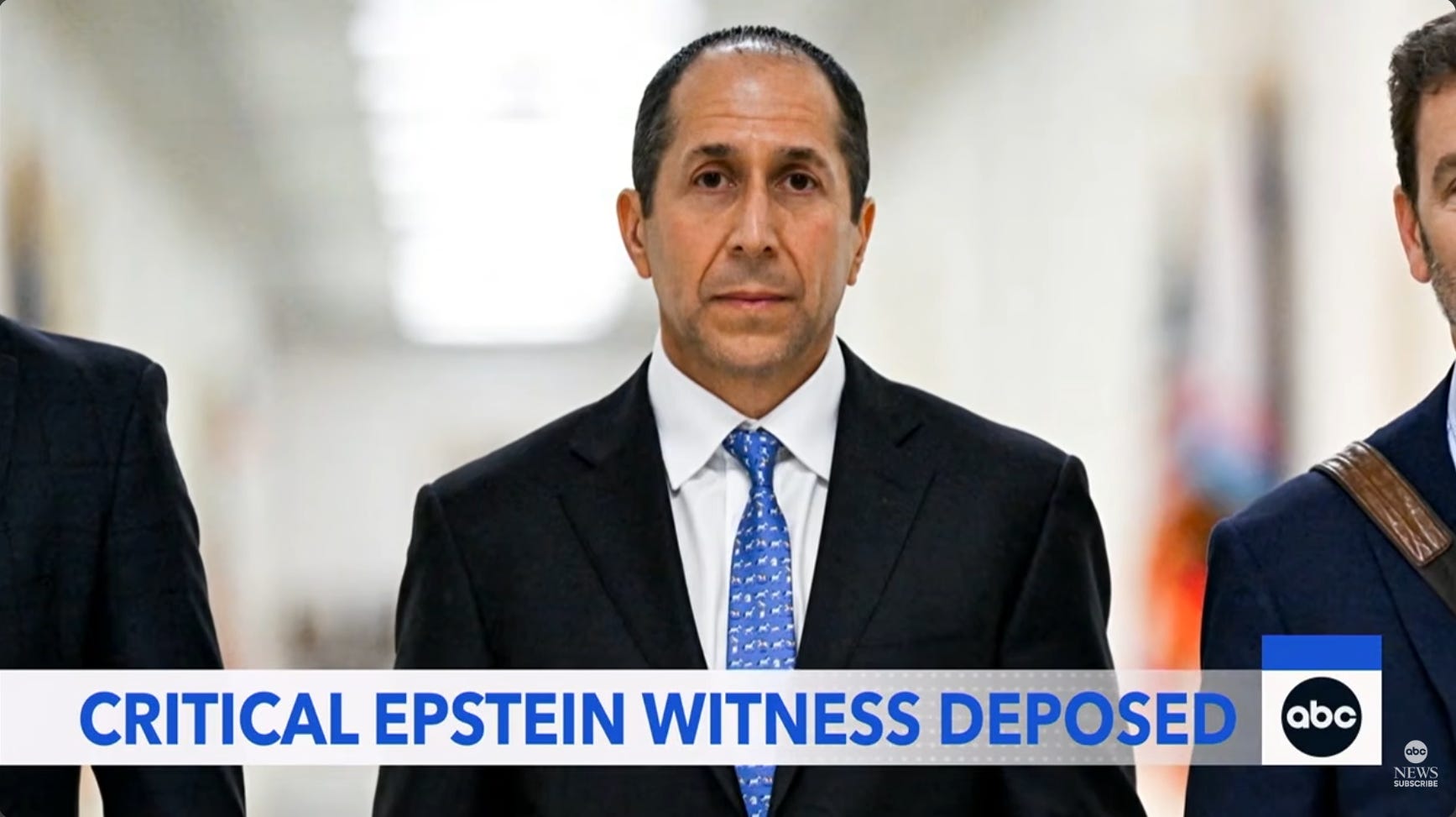
His defense is not that he was too junior to know anything, nor that he was kept far from important decisions, nor even that he entered the picture only after Epstein’s abuse had already become public. His defense is that he was there for years, saw what he took to be a “very small fraction” of Epstein’s spending on gifts to women and men, heard Epstein describe the 2006 case as “a mistake,” and still failed to grasp the reality in front of him.
Perhaps that is possible in the narrowest sense. Human beings are capable of astonishing forms of denial, especially when money, prestige, dependency, and access all pull in the same direction. People convince themselves of useful things every day. Even so, the more central a person’s role becomes, the harder it is to treat ignorance as morally or intellectually persuasive.
Public reporting has noted that Kahn appears thousands upon thousands of times in the Epstein files and that lawmakers questioned him about transactions that included medical reimbursements for the “girls” and vouching for tuition payments that had been flagged. Victims have accused Kahn and fellow estate executor Darren Indyke of helping create and maintain the financial infrastructure that allowed Epstein’s trafficking operation to function. Kahn denies wrongdoing, and a recent settlement of claims against him and Indyke includes no admission of liability. Even so, the larger problem does not disappear, because the man closest to the books is still asking the public to believe that he never understood what those books were helping finance.
There is something especially revealing in the structure of that defense. Kahn does not appear to be arguing that Epstein was innocent, because that would be absurd. He is arguing for a narrower and more exculpatory proposition, namely that the abuse somehow sat outside the sphere of what a financial gatekeeper was obliged to recognize. The work was professional, the relationship was professional, and the warning signs did not look like warning signs. The money moved, but its human meaning supposedly never announced itself with enough force to require understanding.
That argument is more sophisticated than outright denial, and in some ways it is more unsettling. It rests on the premise that proximity to a criminal system can be severed from responsibility for understanding it, so long as one’s own role can be described in the clean language of administration. Yet Epstein’s world depended on exactly that division of labor. One person arranged, another paid, another booked, another reassured, another signed, and another looked away. The system did not sustain itself by requiring every participant to confront its full moral reality. It sustained itself by making each role appear partial, technical, and deniable. That is why Kahn matters, not simply as a witness to Epstein’s world, but as a case study in how such a world functions.
There is also a second layer to this story that makes his testimony more troubling. Senate Finance Democrats said late last year that they wanted to know why the FBI and the Justice Department had apparently never interviewed Kahn or Indyke during the criminal investigations into Epstein and Ghislaine Maxwell. If that is true, it is astonishing. One of the men closest to Epstein’s financial machinery may have gone years without the kind of scrutiny that should have been obvious from the beginning. That failure would not belong to Kahn alone. It would belong as well to institutions that treated someone this central as if he were somehow secondary.
Kahn came to the deposition to “set the record straight.” What he may actually have done is clarify how much of the Epstein story still turns on the credibility of people who were close enough to know better and disciplined enough to say less. The issue is not whether he offered a theatrical revelation. The issue is whether the public is supposed to accept that a man can stand at the center of a financial system, help manage its complexity, remain attached to its principal until the very end, assist in administering the estate after the crimes became undeniable, and still present himself as someone who simply failed to understand what he was looking at.
That is the claim now on offer, and it is also the reason his testimony matters. The Epstein story has always been about more than one predator and his crimes. It has also been about the people who made his world operable, legible, and durable. Richard Kahn may not have blown that story open this week, but he may have done something just as useful. He may have shown, in the calm and careful language of professional innocence, exactly how implausible that innocence now sounds.
no one should be surprised... the guy had to know what was going on, and that he remained close to Epstein following his conviction, until his death, and disbursed a zillion dollars to the victims... yet, Sargent Schulz style "I KNOW NOTHING!" Of course one might not expect these slime balls to jump in front of Congress and admit to knowing the incredibly awful and evil things going on... "sure, i knew that, but what the hell... a job is a job..." the breadth and scope of this whole thing continues to amaze. equally amazing is how many members of Congress are willing to ignore all this... how many members of the public... people with daughters... are willing to ignore this or believe that all these women are liars and it is all made up.... You have to wonder how many other rings like this exist or have existed and were never noticed or covered up more successfully than this one. many questions with a few key ones at the top of the pile... just how deep into the trafficking was trump? was Epstein murdered or is he still alive having paid his way out of jail and a fake autopsy, how much information has been permanently deleted or scrubbed from these files?
Have to wonder how the guy imagines it’s good for his business to make himself out as being that clueless.