


Good morning! The United States did not abolish the Navy’s logistics system before sending carriers to fight Iran. Nor did it abolish the intelligence community before making decisions about the war. The Food and Drug Administration did not cease to regulate food before thousands of Americans became sick with cyclospora. The Army did not stop having procurement rules before spending more than half a billion dollars on an artillery factory that produced no usable artillery.
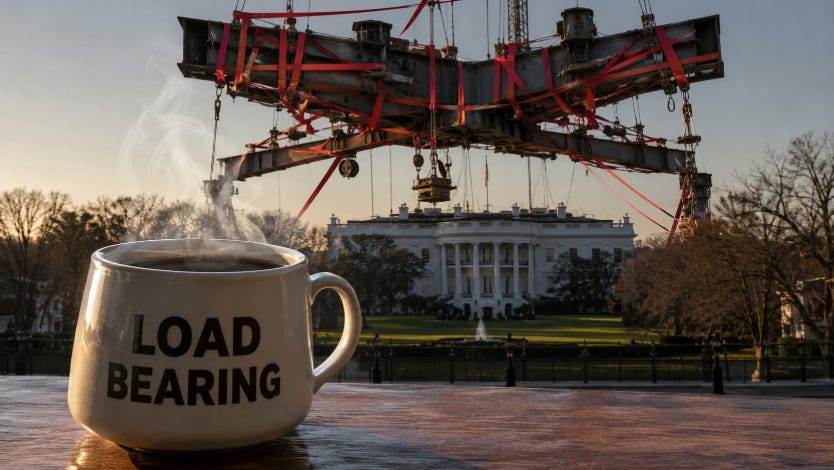
In each case, the large institution remained standing. What came under pressure were the irritating little mechanisms inside it: contingency planning, coordination, dissent protections, traceability requirements, inspections, competitive procurement, technical testing. The stuff that slows decisions down, imposes costs, produces paperwork and gives someone in the room permission to say, “Actually, this may not work.”
The erosion of institutional competence often begins when the mechanisms that produce reliability are mistaken for burdens standing in the way of more immediate goals.
The USS Abraham Lincoln is becoming an unusually vivid place to watch that distinction play out.
The carrier has now been at sea for nearly nine months without what the Navy calls a liberty port, while Democratic lawmakers and sailors’ families have raised concerns about shortages of basic supplies and worsening mental health aboard the ship. President Trump’s response Friday to a question about whether carrier deployments had become too long was: “No, no, no, not nearly long enough.” Defense Secretary Pete Hegseth offered a similarly expansive view of endurance when asked how long the United States could maintain its blockade of the Strait of Hormuz: “We can hold it as long as we need to, indefinitely.”
Indefinitely is a wonderfully simple unit of time if the people saying it are not the ones sleeping in a steel box in the Gulf of Oman.
The more revealing development came from the New York Times, which traced some of Lincoln’s supply problems back to the first days of the Iran war. Iranian missiles and attack drones badly damaged the longtime U.S. Navy base in Bahrain, eliminating a logistics hub the fleet had relied on for decades. The Pentagon’s answer was Diego Garcia, the British-controlled island south of the Maldives, roughly 2,200 miles from where the American carrier groups have been operating.
That substitution did more than lengthen a supply route. Bahrain was also one of the limited regional ports where carrier crews could get off the ship. The other usual option, Fujairah in the United Arab Emirates, lies comfortably inside Iranian missile range. So the destruction of Bahrain simultaneously damaged the machinery for moving food, fuel, ordnance and supplies and removed one of the mechanisms for keeping several thousand sailors functional over a prolonged deployment.
Classified contingency plans may have existed that prove the Pentagon planners hadn’t simply forgotten that Iran possessed missiles. But it does sharpen the question. The United States entered a major regional war dependent on exposed infrastructure, lost one of its key logistics nodes almost immediately, and ended up relying heavily on a fallback more than 2,000 miles away whose use initially required overcoming the objections of another government. Iran subsequently fired ballistic missiles at Diego Garcia as well.
This is increasingly suggestive evidence of a system whose planning lacked resilience once the enemy began doing the sorts of things the enemy had long been expected to do.
Here Julia Curlee’s argument becomes useful. Curlee, who spent two decades as a CIA analyst, served at the National Security Council and briefed senior officials, has been warning that the United States has not lost its ability to collect intelligence so much as damaged the machinery that turns intelligence into decisions.
Her most important point is easy to miss because “speak truth to power” sounds like a character test. Curlee argues that in a functioning intelligence system it is supposed to be an institutional achievement. Analysts can deliver unwelcome judgments because analytic standards require it, dissent channels preserve minority views, layered review tests conclusions, and an ombudsman exists for allegations of politicization. Candor is not supposed to depend on finding a sufficiently heroic GS-14 willing to sacrifice a mortgage.
Curlee’s contention is that firings, security-clearance revocations, attacks on intelligence products and retaliation against analysts who produce inconvenient findings change that incentive structure without requiring anyone to formally order the CIA to lie. The formal protections may remain on paper; employees simply learn that trusting them can be professionally expensive. Her formulation is brutal in its simplicity: when officers see colleagues lose careers for reaching unwelcome conclusions, the institution no longer needs to be ordered into silence.
She applies that argument directly to Iran. The administration, she says, appeared surprised by Tehran’s willingness to close the Strait of Hormuz and by the Iranian system’s ability to survive the killing of its supreme leader, hardly exotic possibilities in decades of American war-gaming and analysis of Iran. Her conclusion is that politicized intelligence produces “foreseeable crises that no one was willing to forecast.”
That is her causal interpretation, and it should remain identified as such. We do not have access to the classified warnings that reached the president, and Curlee herself is no longer inside that process. But her framework gives us a better question than, “How did nobody predict this?”
Perhaps somebody did.
Who predicted it? Through what mechanism was that warning supposed to reach the people making the decision? Was it heard? And if it was heard, what institution was supposed to turn the warning into a contingency plan? These are the more useful questions.
Curlee specifically distinguishes between intelligence failure and coordination failure. She describes the National Security Council as the wiring connecting the White House to the enormous machinery of State, Defense and the intelligence agencies. In her account, large numbers of career NSC staff were removed early in the administration without replacements ready, weakening the process that is supposed to make sure presidential decisions are informed by all of those institutions and then coherently implemented by them. In a podcast interview, her example was almost tailor-made for the Lincoln story: the military can execute its assigned mission extremely well while the larger government fails to coordinate evacuation, diplomacy, logistics, or the second-order consequences surrounding it. The carrier story does not prove Curlee’s thesis, but it looks increasingly like the kind of outcome her thesis predicts: considerable tactical capability embedded inside a system that has trouble converting foresight into resilient planning.
Because today’s tour of institutional competence needed an intestinal parasite, we arrive at cyclospora.
The New York Times reconstructed what happened as an enormous outbreak spread this summer. Michigan health officials noticed that many of the people becoming sick had eaten at Taco Bell. On July 1, they asked the company for the supply-chain records necessary to trace the ingredients. On July 3 they asked again. On July 6 they asked for a third time. Complete records eventually enabled investigators to trace the outbreak to iceberg lettuce from a Taylor Farms facility in Mexico.
A federal rule scheduled to take effect this January would have required companies to provide those records within 24 hours. The Trump administration postponed the rule until 2028, saying businesses needed more time to prepare.
This is almost suspiciously convenient as an illustration because the institutional mechanism is so boring.
A spreadsheet. That was the red tape. Somebody had to maintain the information and produce it promptly when public-health officials came asking. Until the outbreak, regulators could describe the requirement as another burden they imposed on restaurants and food companies. During the outbreak, the difference between “within 24 hours” and “after repeated requests over nearly two weeks” acquired a slightly different flavor.
The administration also eliminated a committee charged with studying failures that cause food-borne outbreaks, cut a program focused specifically on cyclospora surveillance, and initially laid off employees who helped food inspectors travel and coordinate with foreign governments. FDA says some of those workers were later reinstated, insists it retains sufficient resources and disputes the claim that the 24-hour rule would have significantly altered this outbreak.
The longer history shows that the food-safety system was not humming along magnificently until January 2025. Congress’s 2011 Food Safety Modernization Act set a goal of 19,200 foreign facility inspections annually by 2016. FDA conducted about 1,100 in 2025. The Taylor Farms facility implicated in the outbreak had last been visited in 2019. FDA has roughly 440 employees charged with inspecting more than 300,000 registered human- and animal-food facilities in the United States and abroad.
Some of this fragility, therefore, accumulated over decades. What the current administration did was make several additional choices that critics warned would reduce the system’s ability to detect and respond to outbreaks.
More than 24,500 confirmed or suspected cyclospora cases have been recorded nationally this year, with two deaths. Again, that number should not simply be attributed to the delayed traceability rule; cyclospora is notoriously difficult to detect, scientists have struggled for years to understand how it spreads, and the FDA disputes the causal claim.
The episode, however, does give us something the intelligence argument cannot: a visible timeline.
A mechanism intended to speed access to information was postponed. An outbreak occurred. Officials needed exactly that information. Emails show them requesting it repeatedly. Time passed.
This is what institutional degradation can look like without anybody abolishing an institution. The FDA still has laboratories. It still has epidemiologists. It still has statutory authority. What matters under stress is whether the connective tissue can move information quickly enough for those capacities to matter.
Mesquite, Texas, gives us another version of the same problem, and importantly, one that crosses administrations.
After Russia invaded Ukraine, the United States faced a genuine artillery-production emergency. Decades of disinvestment had left the country with a badly atrophied 155mm-shell industrial base. Congress and the Biden administration wanted more production, quickly.
Congress therefore relaxed some of the normal procurement safeguards for Ukraine-related defense spending, including competitive-bidding requirements and restrictions on contracts that allow work to begin before all terms are finalized. The Army used those authorities to move aggressively on a General Dynamics proposal for a state-of-the-art new artillery plant near Dallas.
There really was urgency. The problem was what urgency made dispensable.
General Dynamics proposed machinery from a Turkish subcontractor, Repkon, using a production technique that had not been demonstrated on the newer American 155mm shell the Army needed. The equipment had been designed for an older shell using different steel. Neither the Army nor General Dynamics inspected an entire comparable line operating in production. Most critically, the Army did not require General Dynamics to demonstrate that the process could manufacture a complete shell meeting Army specifications before committing to the project.
Then it ordered three lines. If you are uncertain whether one unproven production line can work, the federal solution is to buy it in bulk.
The factory ultimately cost taxpayers $533 million and produced zero usable shells.
Inside, according to ProPublica’s interviews and documents, robots caught fire. Robot arms smashed into equipment. Machines dropped hot steel. Presses mangled shell bodies and sometimes needed to be hit with sledgehammers. Workers sat around because almost nothing was making it far enough down the line to give them work.
It reads less like an advanced defense-manufacturing facility than an extremely expensive episode of Looney Tunes sponsored by the Department of Defense.
But Mesquite is valuable precisely because it prevents the institutional argument from collapsing into “Trump bad.”
The critical procurement decisions were made under Biden. The immediate goal was speed. Competitive procurement, finalized contract terms, comprehensive testing and technical due diligence were the obstacles.
Except those procedures were also the machinery by which someone was supposed to ask, before several hundred million dollars moved: Will this actually make artillery shells?
The story contains a second failure, this one stretching into the Trump administration. General Dynamics missed deadline after deadline. The Army finally halted two of the factory’s three lines in August 2025. But it did not terminate the company for default or require it to repay the money described in the investigation. In December 2025, the government paid another $26.3 million in progress payments for two lines that had never produced a usable shell. The same General Dynamics business unit has subsequently received $2.5 billion in Army contract awards for unrelated work.
So Mesquite adds another piece to the institutional cycle: before acting, a competent institution needs a mechanism that asks will this work?; while acting, it needs one that asks is this working?; and after failure, it needs one that asks what happens now that it didn’t?
Right now, the Iran war is producing another urgent demand for rapid defense-industrial expansion, this time around interceptors, missiles, and other munitions being consumed faster than expected. ProPublica ends its story with officials describing how attention is already shifting away from artillery toward those weapons. General Dynamics, conveniently enough, makes components for those too.
The Reflecting Pool provides a sort of comic relief, since it makes the same point without death, war, or explosive diarrhea. A high-profile project rushed on a political timetable, professional caution overridden, a botched installation initially blamed on an alleged vandal rather than the work itself. Sometimes the guy telling you to slow down isn’t an enemy of progress. Sometimes he just knows how pools work.
That may be the thread connecting everything this morning.
The mechanisms that create reliable institutions impose their costs immediately while producing benefits that are mostly invisible.
Competitive bidding delays the contract today; the failed factory it prevents never appears.
A traceability rule costs businesses money today; the infections prevented by faster recalls never become patients.
Dissent protections force political leaders to hear irritating analysis today; the disastrous decision abandoned because somebody successfully challenged an assumption never becomes a war.
Redundant logistics cost money today; the carrier deployment that never develops a supply crisis attracts no headlines.
That makes all of these mechanisms politically vulnerable. Their costs are concrete. Their successes are counterfactual.
Different actors can attack these mechanisms for entirely different reasons: faster procurement, lower compliance costs, greater presidential control, or simply the belief that a committee is redundant, an inspector too expensive or an analyst insubordinate.
The immediate goals are not the same. The mistake is.
Something that produces friction is assumed to be obstructing performance, when sometimes the friction is part of the process that produces performance.
The distinction often reveals itself when the institution is stressed.
Mesquite belongs beside the FDA outbreak even though one began under Biden and the other reflects Trump-era regulatory choices. Curlee’s argument deserves attention without requiring us to accept every causal inference she makes about Iran. And the Lincoln’s miserable deployment conditions are worth examining as more than another story about sailors having a hard war.
They share a warning: complex institutions do not remain competent merely because the agency logo is still on the building. Competence has to be manufactured continuously through procedures that test assumptions, move information, protect unwelcome judgments, preserve redundancy, impose consequences and sometimes force powerful people to wait.
A lot of that machinery looks wasteful right up until the second you need it; when something catches fire, whether it is a robot in Texas, the food-safety system or a naval logistics network operating thousands of miles from its replacement supply base. Sometimes, if Julia Curlee is right, it is the decision-making machinery of a superpower.
Only under stress do we discover whether the thing we cut was fat or tendon.
As this essay makes clear once more, Trump and his acolytes hate rules and restrictions of any kind and couldn’t care less about their victims.
Their malicious indifference extends to a long and growing list: children suffering in decrepit detention camps or dying in a measles outbreak; thousands severely ill because this government recklessly cut food safety protections; Navy sailors literally going insane after unplanned extensions of their deployment at sea, in horrific conditions, with no end in sight; misidentified and brutalized targets of lawless ICE thugs on our streets; women and minorities presumed to be undeserving because of their gender, race or heritage; young women again forced to carry pregnancies to term regardless of circumstances; and the millions of sane Americans who must endure the daily torture of a treasonous, incompetent regime toxic with sadism and cruelty.
We the people need to end this nightmare with action, beginning with individual acts to help defeat MAGA at the polls this November and in court as Trump and MAGA pursue their ongoing coup to keep power in order to enrich themselves.
The world is complex, hence the need for testing, thoughtful decision making, peer reviews, planning, processes, etc., etc. Work needs to be planned and plans need to be worked. Late changes cause massive disruptions. Interference from a no nothing hip shooter does nothing to speed production of a quality product. Just saying as a retired engineer with experience in ship building, computer design, project installation, product design, management, and team management. Complex things are not easily done. What bites you in the butt is usually not what you anticipated.