


Good morning from a rain-soaked bunker where I am racing the power grid and the thunderclouds to finish this before everything flickers off and I’m left dictating economic collapse updates by candlelight.
Let’s begin with the week’s central character: Donald Trump’s favorite word. Remember when he said “tariff” was the most beautiful word in the dictionary? The Supreme Court just looked at that word and said, gently but firmly, no.
In a 6–3 decision, the Court ruled that Trump overstepped his authority by using the International Emergency Economic Powers Act to slap sweeping tariffs on half the planet. IEEPA was designed to freeze dictators’ bank accounts, not redesign the global trading system because you don’t like trade deficits. The majority applied the “major questions doctrine,” which is legalese for: if you’re about to detonate the global economy, Congress should probably be involved.
Trump’s response? “It’s ridiculous but it’s OK.” Because, he reassured us, there are “numerous other ways.”
One of those ways, of course, would be Congress, the branch of government the Constitution explicitly empowers to impose tariffs. For some reason, that route never seems to appeal.
Instead, within hours he pivoted to a different statute and announced a global 10 percent tariff. Then 15 percent. Because if you can’t win the argument, or pass the law, just change the number.
The problem is that the numbers aren’t cooperating. The annual goods trade deficit hit a record high. Manufacturing jobs fell by more than 80,000 over the past year. Chinese imports dropped, yes, only to be replaced by surges from Vietnam, Taiwan, Mexico and India. Instead of launching a grand reindustrialization, everything is simply rerouting.
Remember how this began. The administration declared America’s trade deficit a national emergency, a decades-old structural feature of the U.S. economy suddenly treated as an existential crisis requiring sweeping executive action.
A year later, after tariffs not seen since the 1930s, the “emergency” remains. The goods trade deficit hit a record high. Manufacturing jobs fell, and imports shifted rather than shrank. The only thing shrinking appears to be legal patience, and now corporate America would like a refund.
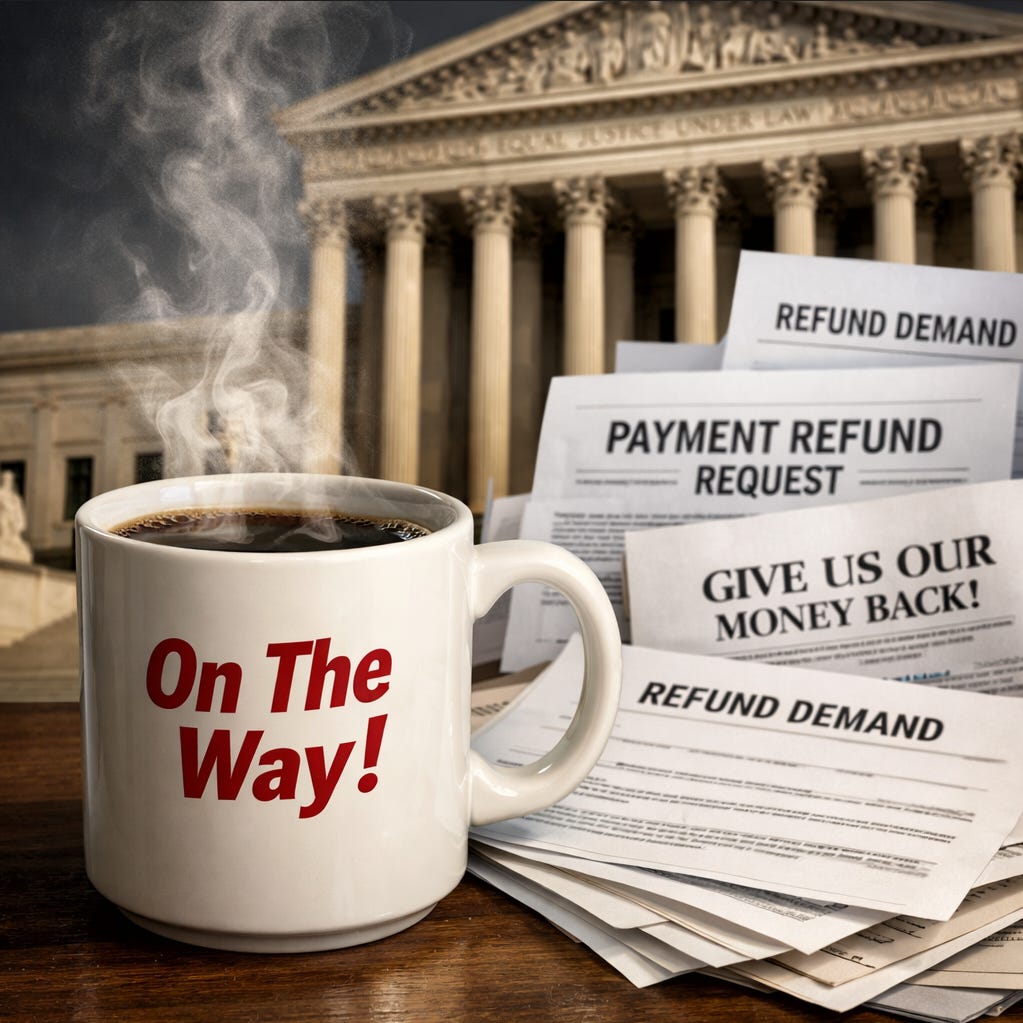
Customs data shows more than $130 billion, possibly closer to $200 billion, was collected under the now-invalid tariff authority. Business groups are lining up for repayment. Treasury is signaling this could take “months, years.” Which means the same tariffs sold as a revenue engine to offset tax cuts may now become a fiscal sinkhole. Consumers paid higher prices at checkout. If refunds come, importers get the check. The public gets the inflation and the deficit.
Abroad, allies who rushed to cut deals under tariff duress are now staring at their signed commitments and wondering if they negotiated with a ghost. Japan pledged $550 billion in financing. South Korea pledged $350 billion. Taiwan, $250 billion. Indonesia opened key sectors of its economy. Vietnam hammered out framework concessions. All under threat of 30 to 46 percent tariffs. Now the legal foundation is wobbling and the global rate floats somewhere between 10 and 15 percent depending on which day it is and which statute is being invoked.
The early movers may have overpaid. The late movers are looking smug. China, the supposed target of this grand strategy, remains largely intact while America’s allies calculate whether they should have simply waited.
Max @UNFTR made the comparison that if Trump had simply left his inheritance in the S&P 500, he’d be richer. The same logic now haunts this trade experiment. If he had done nothing, no emergency declarations, no tariff roulette, the trade deficit would likely look much as it does now, minus the legal chaos, diplomatic friction, and refund liability. Instead, the administration managed to shake the global table without actually moving the centerpiece.
Europe is not amused. France has openly discussed deploying the EU’s so-called “trade bazooka,” the Anti-Coercion Instrument, if Washington escalates further. That tool can hit U.S. services and tech companies, not just goods. Translation: if the tariff roulette wheel keeps spinning, retaliation may no longer be confined to steel and autos.
Then there’s the Greenland saga. In what may be the most surreal foreign policy moment of the week, and that’s saying something, Trump announced on Truth Social that he was sending a “great hospital boat” to Greenland to treat “the many people who are sick, and not being taken care of there.” He added, for emphasis, that it was “on the way!!!”
Denmark’s defense minister responded that his government had not been informed of any such plan and that Greenland had no need for “special health care efforts.” Greenlanders already have universal health coverage.
The image Trump posted showed the Navy hospital ship U.S.N.S. Mercy, which maritime industry sources report has been in drydock for maintenance since last year. The Navy’s other hospital ship, the U.S.N.S. Comfort, is currently moored as well. It’s increasingly difficult to tell whether these announcements are diplomatic strategy or social media performance art. Either way, Copenhagen appears unimpressed.
Back home, the Department of Justice continues its campaign of aggressively prosecuting protesters and critics under assault-on-an-officer charges. And those cases keep collapsing. In Minneapolis, felony charges against two Venezuelan men were dismissed with prejudice after video evidence contradicted officers’ sworn statements. In Los Angeles, juries have acquitted protest defendants at a rate that would make federal prosecutors blush. In Chicago, dozens of arrests have produced virtually no convictions.
The pattern is unsettling. Press releases blast out vivid allegations, circulating mugshots. Then evidence arrives and the cases dissolve. The punishment, as ever, is the process.
Speaking of poetic consequences, courtesy of a reader in the Netherlands, allow me to introduce the world’s tiniest violins playing over Palm Beach. While the global trade system teeters, some of the wealthiest Trump supporters in America are discovering what economists call “externalities.” The Secret Service has permanently rerouted aircraft around Mar-a-Lago, even when Trump is not in residence, as part of the ongoing protective perimeter funded by U.S. taxpayers.
The result: multimillion-dollar oceanfront estates now sit under a near-constant flight path. One homeowner says his property value has been cut in half. Dinner guests must pause every two minutes as jets roar overhead. Noise begins at 5:30 a.m. and ends late at night. Many of the aggrieved voted for Trump. Some are members of Mar-a-Lago. Some have framed autographed notes in their studies. And now they are wearing noise-canceling headphones in their $50 million living rooms.
The irony is almost architectural. Trump bought Mar-a-Lago in the 1980s at a discount precisely because it sat under the airport’s flight path. The noise was built into the price. Now, with aircraft permanently diverted around the property as part of its security perimeter, the disturbance has effectively been relocated away from the club and onto neighboring estates. If you were trying to increase the tranquility, and therefore the value, of your own property while externalizing the cost onto others, you might design something very much like this.
And just this weekend, the security apparatus that reshaped their skyline became headline news again. A man in his early 20s was fatally shot by law enforcement after breaching the secure perimeter near the north gate of Mar-a-Lago. Trump was in Washington at the time, but the protective detail, as always, remained in force. Multiple agencies are now investigating the incident.
Champagne problems, yes. But also a perfect metaphor. Even when the president isn’t home, the perimeter remains. The taxpayer-funded costs remain, and the diversions remain. When you shift burdens without asking, whether it’s air traffic, trade flows, or legal authority, the noise lands somewhere.
Finally, in Georgia, where the right has spent years hunting phantom voter fraud, the State Elections Board issued a formal reprimand to Elon Musk’s America PAC for sending out partially prefilled absentee ballot applications in violation of state law. Musk, a naturalized immigrant and one of Trump’s loudest allies, now finds himself attached to the only substantiated election meddling story in the state. The search for fraud continues to circle back to the fraud alarmists.
Sometimes I wonder whether Trump cannot perceive how this looks to the rest of the world. Or whether he simply doesn’t care because the intended audience isn’t Copenhagen, or Tokyo, or Brussels. It’s the rally crowd and the Truth Social feed.
Some blue sky is breaking through here on the Southern Oregon Coast. Maybe that’s a metaphor, a reminder that even prolonged storms eventually move on. The past week has felt like governing by turbulence: tariffs declared emergencies, allies hedging, courts pushing back, jets rerouted, headlines colliding. The Trump tunnel of chaos may feel long, but there is light at the end of it.
The odds are pretty good that the "hospital ship" Trump is talking about sending to Greenland is a modern Trojan Horse, packed with Seal teams and Special Ops troops instead of doctors and nurses. Trump is THAT desperate/crazy!
ALSO, I was considering sending Trump a bill for illegally overcharging me for groceries in the last year... Should I address it to The White House, Mar-y-Lago, or Don's Qatari bank (the one where he's stashed the cash from selling Venezuelan oil and, also, the money he's leeching from various dictators to join his bullshit "Board of Peace".
The Trump tunnel of chaos may feel long, but there is light at the end of it. 💜💜💜💜