


James Comey found some seashells on a North Carolina beach last May. He photographed them, posted the picture to Instagram, and within days had been accused of threatening the life of the President of the United States. He deleted the post, apologized, said he hadn’t understood the arrangement carried that connotation, and condemned violence. The federal government indicted him anyway. Twice.
The second indictment, the seashell one, comes courtesy of a lead prosecutor whose primary experience is Medicaid fraud cases, overseen by an acting U.S. Attorney who had prosecuted nothing before being handed this assignment. The acting Attorney General, Todd Blanche, went on Meet the Press to assure the public that the case rests on more than an Instagram post. Pressed for specifics, he declined to offer any and suggested everyone wait for trial. Experienced career prosecutors had already left the case by then.
Blanche, for what it’s worth, is said to want the AG job permanently.
In Trump’s revenge state, the Department of Justice has two jobs. It acts as a sword against the people Trump wants punished, and as a shield against the consequences Trump wants erased. The Comey prosecution is the sword. We’ll get to the shield. What connects them is that neither has anything to do with justice in any sense the word has previously carried.
The blueprint was not subtle. Last September, Trump took to Truth Social to complain publicly, in writing, to his millions of followers that his own Attorney General was underperforming on the enemies list. “I have reviewed over 30 statements and posts saying that, essentially, ‘same old story as last time, all talk, no action. Nothing is being done,’” he wrote, before naming his targets: Comey, Senator Adam Schiff, New York Attorney General Letitia James. “They’re all guilty as hell, but nothing is going to be done.”
The prosecutor overseeing the James investigation in Virginia resigned rather than pursue a case he didn’t believe in. Trump publicly called him a liar, announced he’d been fired, and replaced him with his own former personal lawyer. The message to everyone else holding a federal appointment was not difficult to decode.
Less than an hour after his Truth Social broadside against Bondi, Trump posted again to praise her as doing “a GREAT job.” The carrot and the stick, visible in a single afternoon’s social media, from the man who appoints the nation’s top law enforcement officer.
The sword, once forged, has been put to varied use. Consider Sarah Fitzpatrick, a reporter for The Atlantic who published a piece about FBI Director Kash Patel detailing emotional outbursts, unexplained absences, and drinking serious enough that, in the words of her sources, “some of Patel’s colleagues at the FBI worry that his personal behavior has become a threat to public safety.” Patel sued The Atlantic for defamation. The Atlantic stood by its reporting and said it had received further corroboration since publication.
True to form, the FBI then opened a criminal leak investigation into Fitzpatrick. This is, as The Washington Post’s Carol Leonnig and Ken Delanian reported, highly unusual: the investigation did not stem from a disclosure of classified information, and it is focused on leaks to a reporter rather than any underlying crime. Agents in a unit in Huntsville, Alabama, where Patel transferred more than 500 FBI personnel, a reorganization that also conveniently moved them away from Washington, were directed from the executive suite to examine Fitzpatrick’s social media interactions, contacts, and communications. With this designation, the FBI can seek access to her phone records, run her name through federal databases, and attempt to compel phone carriers to hand over metadata.
Some agents, Leonnig reported, are deeply uncomfortable. One told her: “They know they are not supposed to do this, but if they don’t go forward, they could lose their jobs. You’re damned if you do and damned if you don’t.”
Here is the logical problem Patel has created for himself. He is simultaneously pursuing a defamation lawsuit against The Atlantic, which requires him to argue the reporting is false and was published with malice, while directing federal investigators to hunt down the sources who provided it. If the story is false, he has the goods. He can prove it. He doesn’t need the FBI to go through a reporter’s phone. If he does need the FBI to go through a reporter’s phone, what he’s actually doing is trying to find out who told the truth about him. Those two postures cannot coexist. One of them is a lawsuit, but the other is a confession.
Attorney General Pam Bondi quietly made all of this easier before she was replaced. She rescinded media investigation policies that had been strengthened under Merrick Garland, eliminating the requirement for the Attorney General and Deputy Attorney General to personally authorize compelling phone metadata from carriers, and expanding the definition of leaks warranting investigation from “classified information” to the considerably murkier “sensitive information.” Discussing law-enforcement sensitive material is not a crime. But it is now, apparently, enough to get a reporter’s contacts examined by a federal agency.
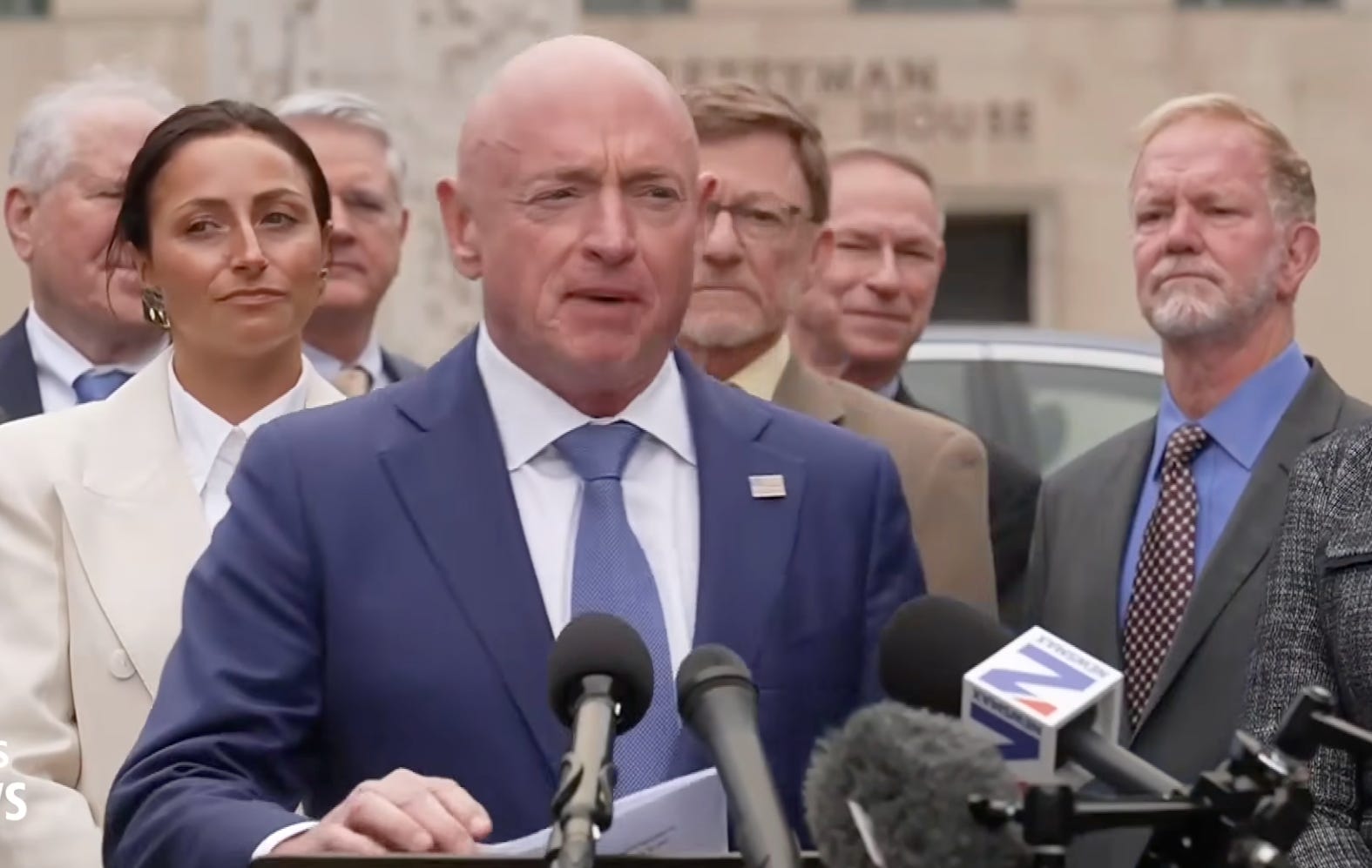
The sword has also been turned toward the military, or more precisely, toward those who served and now have the audacity to speak. Senator Mark Kelly, Democrat of Arizona and retired Navy captain who flew combat missions in the Gulf War, told service members last year what the law actually says: that troops have a legal duty to refuse unlawful orders. This is not a controversial legal position. It is written into the Defense Department’s own law of war manual, and taught at West Point and the Naval Academy. It is, as the JAG professor who testified in Kelly’s defense noted, something military officers don’t merely have the right to say; they have an obligation to say it.
The response from this administration: the president said Kelly should be prosecuted and hanged. Pete Hegseth moved to censure him, reduce his rank, and strip his pension. When a federal judge ruled these attempts unconstitutional, Hegseth appealed. The government argued in court that not only does Kelly lack First Amendment rights as a military retiree, none of the millions of retired veterans across the country do either. Any of them who says something the Secretary of Defense dislikes can be punished.
Kelly stood outside the courthouse afterward, flanked by veterans from every branch. “I signed up to serve our country and protect our freedoms, including the freedom of speech,” he said. “I know Donald Trump doesn’t understand that.”
He also noted, without elaboration that required none, that Trump is two months into a war with Iran he started without a strategic goal. Thirteen Americans have died. The Strait of Hormuz is closed. The same Iranian regime remains in power, enriched uranium still in hand. “Who better to speak out and share their perspective,” Kelly said, “than the people who served.”
The three-judge appeals panel appeared unpersuaded by the government’s position. One judge repeatedly reminded the DOJ attorney that refusing unlawful orders is textbook teaching at the service academies. Another pressed whether Kelly would have needed to formally discharge rather than retire in order to keep his First Amendment rights, a question the government’s attorney could not answer to anyone’s satisfaction.
No ruling as yet, but Kelly’s prediction: “We win in the circuit court, and I also expect them to probably appeal again. It might go to the Supreme Court.”
Now for the shield.
A jury of his peers found Donald Trump civilly liable for sexually assaulting E. Jean Carroll in a department store dressing room. That verdict came first, in 2023, accompanied by a $5 million award. Then came the defamation case, because Trump, standing on the White House lawn, had called her a liar, and a second jury awarded her $83.3 million for that. Trump, by then a private citizen, chose not to invoke the Westfall Act, a federal statute that allows the government to substitute itself as defendant if an employee was acting within the scope of their official duties, and went to trial anyway. He lost both times.
His Justice Department is now trying to invoke the Westfall Act retroactively on the defamation verdict.
The argument, as legal analyst Harry Litman explained, is a “one-two dirty trick”: declare that Trump was acting in his official capacity when he made his defamatory comments, have the United States substitute itself as defendant, and watch the case evaporate, because the federal government has not waived its sovereign immunity for intentional torts, and defamation is an intentional tort. Seven years of proceedings, $83.3 million verdict, gone as if it never happened.
The Second Circuit has already rejected this maneuver three ways: the plain language of the statute requires substitution before trial; Trump waived it by going to trial without raising it; and equity, basic fairness, forbids allowing it now. The DOJ’s response has been to petition for cert at the Supreme Court, where, as Litman noted with characteristic understatement, there are “some warm and solicitous justices” who might be willing to take it.
Carroll has said she’ll let the interest accrue and donate the damages to charity. She is, at this point, probably the least surprised person in America.
The thread running through all of this, Fitzpatrick’s phone records, Kelly’s pension, Comey’s beach photo, Carroll’s verdict, is not complicated, even if each individual case is dressed in procedural complexity. A presidential administration has decided that the apparatus of federal law enforcement exists primarily to advance the president’s personal interests: punishing critics, silencing dissent, and erasing the legal consequences of his own conduct.
Not a series of isolated overreaches; this is a system. There is the directive, Trump’s Truth Social post, naming names, complaining that nothing is being done. There is the enabling infrastructure, Bondi’s quiet policy rewrites, the installation of loyalists over career prosecutors, transferring hundreds of agents to a unit operating at the director’s personal direction. And there are the operations themselves, each one a demonstration to everyone else watching of what criticism costs.
What gives this moment something other than despair is the agents in Huntsville who went to Carol Leonnig anyway. People inside the machine, doing the thing they weren’t supposed to do, because they still understood what the machine was supposed to be for. They know they’re not supposed to do this, and they said so to a reporter. That’s not nothing.
Neither is Mark Kelly, standing outside a federal courthouse with his wife, his daughter, and the man he flew most of his combat missions with, telling the people trying to silence him: Don’t give up the ship.
And the whole regime commits treason against their home country, while the feckless, bobbleheaded, sycophantic republicans nod along in complicancy.
I simply can't fathom how we got from 2008 (recession and all) to 2026. What happened to my country?