

Good morning! We begin with a truth that is getting harder to dodge: this is not just another Trump scandal cycle, another slurry of lies, threats, and grotesque social media posts, but the exposure of a country that has lost its moral center. The widening rupture between Trump and Pope Leo is useful because it throws the contrast into brutal relief. One side is still speaking the language of moral restraint, human dignity, and the sanctity of life. The other is run by a convicted felon and adjudicated rapist who treats cruelty as branding, corruption as strategy, and military violence as a stage light he can point at himself whenever he needs the camera back. In an interview with Germany’s DW News, political scientist Steven Walt warned that American power has always rested partly on the belief that the United States exercised judgment and restraint. That credibility is now collapsing. “The United States is now being viewed by others as impulsive and erratic and predatory,” he said. Worst of all, the damage no longer belongs to Trump alone. Electing him twice told the world this was not an accident. It told them that criminality, cruelty, and reckless abuse of power were not disqualifying to the American people.
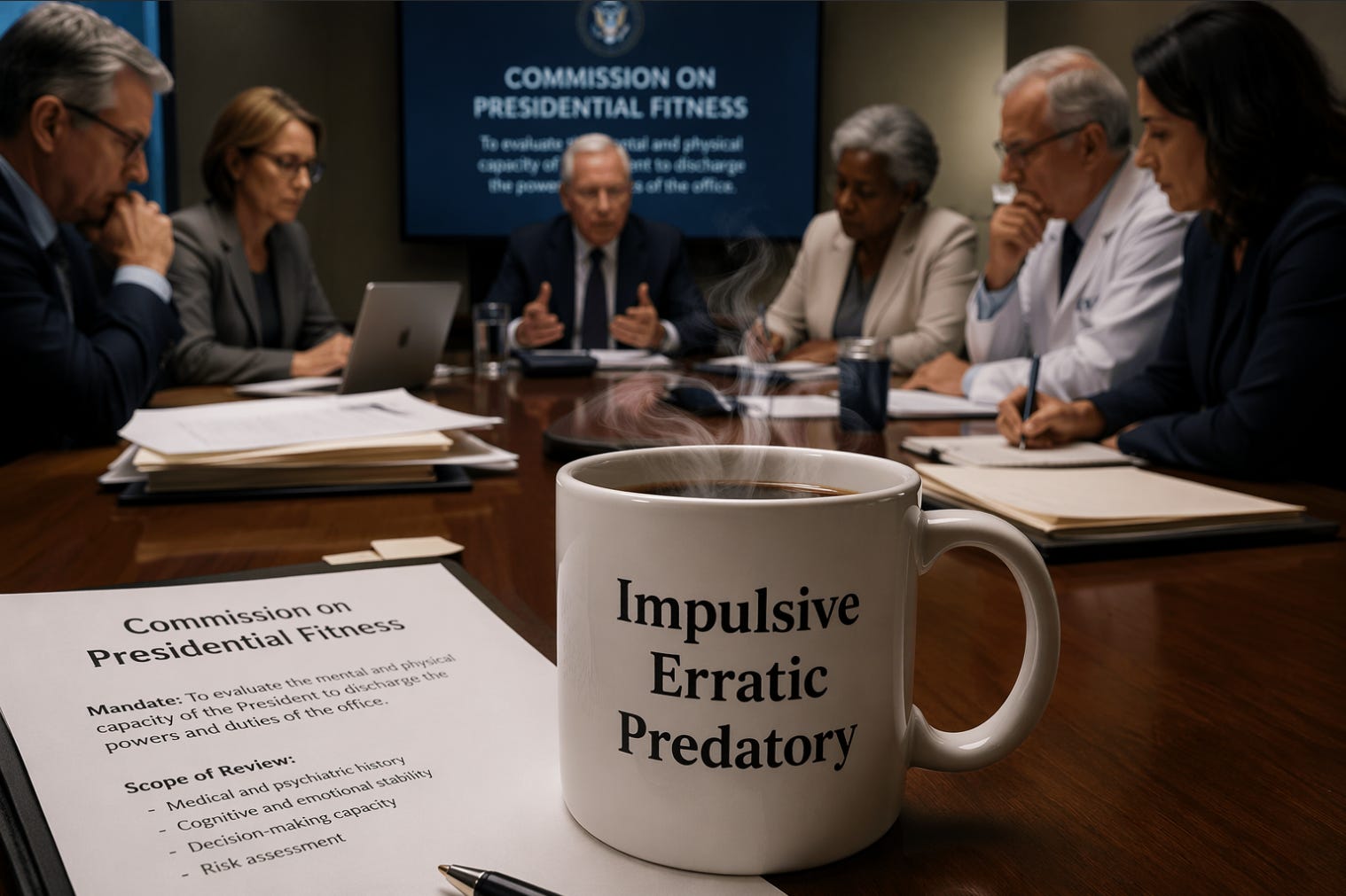
That takes us to the second ugly truth: Trump’s fitness is not merely a late-night punchline or a cable-news parlor game; it is a national security issue. The discussion around his latest messianic posting spree gets at something deeper than bad taste. It points to a man who seems unable to distinguish between public office and personal worship, between criticism and heresy, between the national interest and whatever fresh insult his ego is busy chewing on that day. It is not only that he says bizarre things or posts AI-generated religious kitsch like a mall kiosk prophet on a bender. The danger is that a man marinating in grandiosity, grievance, and delusion holds war powers and sole command over the nuclear arsenal. Dr. Bandy Lee’s warning is pertinent here precisely because it frames the question as one of containment and public safety, not gossip. In her urgent letter to congressional leaders, she argues that “what is important is that we contain the dangers and protect society.” She specifically urges Congress to “immediately retake its constitutional authority over war,” to create “a circuit breaker” against “the potential use of nuclear weapons,” and to “initiate consultation” on presidential fitness under Section 4 of the Twenty-Fifth Amendment. Lee also points to Rep. Jamie Raskin’s new bill to establish a Commission on Presidential Capacity, including physicians and psychiatrists to determine whether a president is “mentally or physically unable to discharge the powers and duties of the office.” When the office in question carries sole command over more than 5,000 nuclear warheads, there is a live threat lodged inside the most dangerous machinery on Earth.
That threat is already visible in Iran, where even mainstream U.S. media is growing more blunt about the widening gap between Trump’s declarations and reality. Trump keeps trying to sell the war as tidy, decisive, “done and dusted,” the geopolitical equivalent of a cheap contractor slapping paint over a cracked wall and calling it renovated. The facts are refusing to cooperate. The New York Times notes that trade through the Strait of Hormuz remains far from normal, Iran is not yielding to Trump’s nuclear demands, and analysts believe the war may actually have strengthened hard-liners and the Revolutionary Guards rather than producing some pliant “reasonable” new regime. Trump is once again confusing his own narration with reality, as if saying “mission accomplished” loudly enough can bully events into obeying him.
Once you move from the lie to the logistics, the picture gets even worse. Sal Mercogliano and Matt Randolph both drive home the same point from different angles: a flood of empty tankers heading toward the United States is not proof of American dominance, and it is certainly not proof that Trump has heroically “opened” a strait that was open before he helped turn the region into a crisis zone. Mercogliano explains why the shipping side of MAGA fantasy does not work. As he puts it, “we don’t have the loading capacity to load all those tankers,” and even if the ships arrive, the trip from Houston to Shanghai is far longer than the route from the Persian Gulf. Randolph supplies the energy-market translation, warning that the tanker surge is “not bullish” but “a huge red flashing light,” because it means panicked buyers are all chasing replacement barrels through an export system already near its limits. More ships headed to the U.S. does not mean more real supply. It means congestion, delays, and price spikes. A bottleneck with a comb-over.
What Steven Walt adds to all this is the geopolitical diagnosis. We can still blow things up. We are still good at that, in the same way a toddler is good at knocking over a lamp. But the ability to destroy is not the same as the ability to shape outcomes, and the war with Iran is exposing that with humiliating clarity. Walt argues that the problem is no longer just imperial overreach, but sheer incompetence piled on top of it: “amateur hour diplomacy,” a war “ill-planned,” and a leadership class that seems to have assumed everything would go quickly and cleanly because reality would politely rearrange itself around American arrogance. It has not. And the result, as Walt puts it, is that “the United States is now being viewed by others as impulsive and erratic and predatory.” That is the real strategic cost here. Power rests not only on force, but on trust in your judgment, and America’s judgment now looks reckless, improvised, and dangerous.
This is where the broader empire frame becomes useful as a way of understanding how war, debt, currency stress, and social fracture can all be symptoms of the same disease. Defense contractors profit from war. Politicians benefit from donors who profit from war. Media profits from spectacle. Financiers profit from a system built to defend dollar privilege long after its moral and strategic rationale has rotted away. Every actor can call their move rational, but the collective result is suicidal.
For me, it all comes back to sustainability, because that may be the clearest lens of all. Sustainability is supposed to mean meeting the needs of the present without compromising the ability of future generations to meet their own needs. What America is doing now looks like the exact opposite. Literally, we are borrowing against generations not yet born to finance wars we cannot define clearly, much less win. We are burning through ecological stability, democratic legitimacy, public trust, and social cohesion for immediate political advantage. Worse, perhaps, we are normalizing corruption, lawlessness, and institutional decay, then calling it realism or patriotism or toughness, as if slapping a flag decal on the looting makes it stewardship. A society is no longer sustainable when it preserves present power and present comfort by stealing possibility from the future. On that measure, the United States is not merely in trouble. It is running an intergenerational smash-and-grab.
The budget fight in Washington is the domestic expression of the same rot. Senate Republicans are not arguing over whether Trump’s agenda should be restrained. They are arguing over how much of it they can cram into reconciliation before voters take the car keys away. John Thune wants a lean package built around tens of billions for ICE and Border Patrol. Ted Cruz and the hardliners want to supersize it with more defense money, tax changes, anti-Planned Parenthood provisions, and assorted right-wing ideological ornaments. The revealing part is not the menu so much as the panic behind it. Even Republicans are calling this their last meaningful chance to lock in Trump’s priorities before the midterms. There it is in plain language: they know the window may be closing, and they are racing to cement as much cruelty, militarism, and corruption as possible while they still have the votes. The disagreement is tactical, not moral. They are debating the packaging of the assault, not the assault itself.
This is not where the story has to end. Many experts are plainly telling us that America has lost its moral, strategic, and civic bearings. But collapse is not destiny unless we insist on clinging to the very systems that are failing us. This is also our chance to enact real, substantive change toward a more sustainable future, one that provides for the needs of the present without stealing from the generations that come after us. If decline is one path, transformation is another. Over the next few days, I’ll be publishing a series of articles on that very question: what it would take to stop liquidating tomorrow for the comforts and delusions of today, and start building something worthy of survival.
This is a very difficult column to read mainly because of its accuracy. This is not because of “them” but of all is us. The years of comfort in our position in the world has not led us to gratitude but for the past decades to apathy and denial.
Denial has led us to superficial changes rather than real change that includes and embraces all of us and our environment.
Dear Speaker Johnson,
It would take some intestinal fortitude on your part, but if Grandpa behaved as erratically and unhinged as Donald Trump has been behaving of late, for his own safety and the safety of others, you would take Grandpa’s keys away.
Kindly Google “intestinal fortitude” and then act as if you were in a position of national responsibility lest your keys be lifted from you.
Cheers!