

Good morning! Let’s just acknowledge what happened before we try to explain any of it.
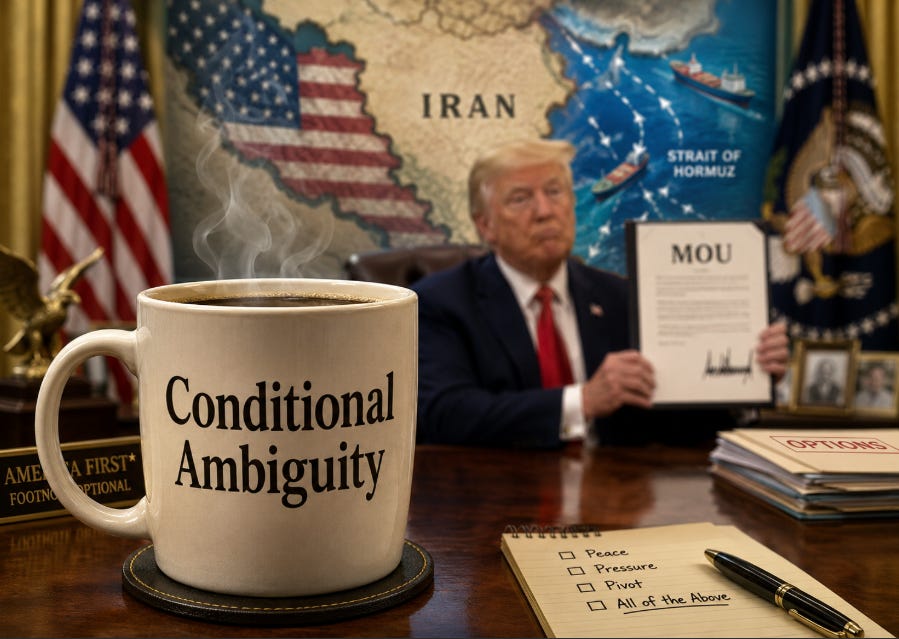
On Saturday, May 23rd, 2026, a day the President of the United States was supposed to spend at his golf resort in New Jersey, Donald Trump instead remained at the White House, announced from the Oval Office that a historic peace deal with Iran was “largely negotiated” and would be announced “shortly,” then re-truthed a quote attributed to Turkish President Recep Tayyip Erdogan, one of the leaders on his Iran peace call, calling him “the leader the world has been awaiting for centuries.” Erdogan’s foreign minister contacted Marco Rubio directly to demand its removal. Trump quietly deleted it. Then he posted a map of Iran overlaid with the American flag captioned “United States of the Middle East?”, thanked Colin Montgomerie for endorsing his Scottish golf course, shared a Laura Loomer piece about his own geopolitical genius, celebrated 400 billion TikTok views, gloated about Thomas Massie’s political demise, and somewhere in the middle of all that, a 21-year-old man named Nasire Best walked up to a security checkpoint near the White House with a weapon in a bag and fired approximately 30 rounds before being shot dead by Secret Service agents.
Iran’s foreign ministry is posting the ancient-world equivalent of Trump bowing at the Ayatollah’s feet.
It was, in other words, a completely normal Saturday in the American republic, which will celebrate its 250th birthday this July.
Here is what we know about the Iran agreement as of Sunday morning: everything, and nothing.
Trump posted on Truth Social at 1:30 PM Saturday that an agreement had been “largely negotiated, subject to finalization” between the United States, Iran, “and the various other Countries, as listed.” The Strait of Hormuz, he wrote, “will be opened.” He signed it “President DONALD J. TRUMP,” in case anyone had forgotten who they were reading.
Marco Rubio, speaking from New Delhi on Sunday, offered the diplomatic translation: “significant progress, although not final progress.” Which is another way of saying: we are making progress toward the possibility of eventually making progress.
Here is where it gets interesting. Two U.S. officials told the New York Times that a key element of the deal was Iran’s commitment to surrender its stockpile of nearly 1,000 pounds of uranium enriched to 60 percent purity, a short technical step from weapons grade. Three senior Iranian officials told the same newspaper that the memorandum of understanding “said nothing about the fate of Iran’s nuclear program.” Those are not different interpretations of the same document. That is two different documents, or possibly one document that neither side has finished writing.
The Iranian foreign ministry spokesman offered his own clarification in the form of an ancient history lesson, specifically, a third-century relief carving at an Iranian archaeological site depicting the Roman Emperor Valerian kneeling before the Persian king Shapur I. “In the Roman mind, Rome was the undisputed center of the world,” he wrote. “The Iranians shattered that illusion.” He did not mention Trump, a deal, or enriched uranium by name. He didn’t need to.
This is, for the record, at minimum the third time Trump has announced an Iran deal was essentially done. In June 2025, he declared a “Complete and Total CEASEFIRE” ending what he dubbed “THE 12 DAY WAR.” Iran denied any ceasefire agreement and launched missiles at Israel hours later. In April 2026, he announced a two-week ceasefire 90 minutes before his own deadline for destroying Iranian civilian infrastructure, declaring the U.S. was “very far along with a definitive Agreement concerning Longterm PEACE.” Even his own administration staffers reportedly had no idea what was going to happen until the post went up. Now we have a third announcement, with “final aspects” still under discussion and an announcement coming “shortly,” a word that, in this administration’s usage, appears to be measured in geological time.
What appears to actually be on the table is a memorandum of understanding, not a treaty, not a deal, not a surrender, not a peace agreement, that would reopen the Strait of Hormuz in phase one, release $25 billion in frozen Iranian assets, lift the U.S. naval blockade, and defer every hard question about nuclear enrichment, missile arsenals, Hezbollah, and the future of the Islamic Republic to a second phase of negotiations to begin within 30 to 60 days. The second phase is, of course, where negotiations go to die.
Danny Citrinowicz, former head of the Iran Branch in Israeli Defense Intelligence, whose analysis circulated widely this weekend, put it with admirable clarity: the war was “built on a profound misunderstanding of the Iranian system” and has “likely produced a more extreme and more determined Iran.” His conclusion, that accepting a bad deal was probably better than the alternatives, is the most honest assessment anyone with relevant expertise has offered. In American terms, he noted, “you break it, you own it.”
Eleven weeks ago, Trump wrote on Truth Social: “There will be no deal with Iran except UNCONDITIONAL SURRENDER!” Iran did not unconditionally surrender. Iran’s foreign ministry is posting memes of Trump bowing at the Ayatollah’s feet. The Republican Senate Armed Services Committee chairman said a 60-day ceasefire with Iran would mean “everything accomplished by Operation Epic Fury would be for naught.” The White House communications director told Mike Pompeo, who raised similar concerns, to “shut his stupid mouth.”
The hawks will grumble and then fall in line. They always do. The Tehran analyst who called this a strategic fiasco is probably right. The deal that emerges, if one does, will be called a historic victory by everyone involved, and everyone involved will be describing different victories.
Before you celebrate the reopening of the Strait of Hormuz, it is worth understanding what Iran says “reopening” means, because it is not what you think it means.
Iran has stated clearly that it will never return the strait to its pre-war status quo. It considers the waters territorial. It proposes a joint Iranian-Omani management mechanism and has signaled that “fees” may still apply, framed as charges for “services and security arrangements.” Iran is not opening the strait. Iran is agreeing to manage it more generously, for now, on its own terms, subject to change.
The IRGC announced Sunday that it had authorized 33 ships through the strait in the past 24 hours, which is real movement. But the CEO of Abu Dhabi’s state oil company said this week that full flow through the strait won’t return until the first or second quarter of 2027, at minimum four months to reach 80 percent of pre-war levels. The insurance premiums that make shipping through the strait economically treacherous don’t disappear because Trump posted that the strait “will be opened.” They disappear when the legal and military ambiguity disappears, and Iran is doing everything in its power to preserve that ambiguity as a future leverage point.
The market consequences are not landing where Washington expected. This connects directly to something the mainstream Iran coverage has underplayed: Saudi Arabia’s quiet catastrophe. Riyadh has the East-West pipeline. It can bypass the strait entirely. It was perfectly positioned to be the war’s oil-market winner. Instead, Saudi crude exports have collapsed from 7.3 million barrels per day in February to roughly 3.9 million in May, a historic low because Asian refiners, already losing money processing crude, refused to pay the $20-per-barrel crisis premium Aramco was charging. China cut its Saudi imports roughly in half. Japan went from 1.2 million barrels per day to 202,000. The buyers found alternatives and may not come back.
Which brings us to Mohammed bin Salman, who was on Saturday’s call with Trump, and who is widely understood to have pressed Trump to accept the framework rather than resume strikes. MBS has positioned himself as a voice of regional moderation and diplomatic reason. He is also, per the CIA’s assessment with high confidence, the man who ordered the murder and dismemberment of Washington Post journalist Jamal Khashoggi in a Saudi consulate in 2018. Nothing happened then. Nothing has happened since. He remains among Trump’s most trusted advisors on Middle East peace. The man whose war has devastated his own oil market is now one of the architects of the peace. Washington treats this as normal. It is worth noting, at minimum, that it is not.
The “United States of the Middle East?” graphic, Iran overlaid with the stars and stripes, tells you everything about the two-audience problem. To the diplomatic world, Trump was threading a needle between Tehran, Tel Aviv, Riyadh, and Islamabad. To his Truth Social feed, he was sharing American-flag-over-Iran imagery within hours of announcing a deal with Iran. These are not reconcilable messages. They are, however, a perfectly accurate picture of how this foreign policy actually works: improvisationally, for the crowd, with the details to be sorted out later by whoever is still in the room.
At just after 6 PM Saturday, while journalists were being ushered inside the White House briefing room, a man named Nasire Best, 21 years old, walked to a security checkpoint near 17th Street and Pennsylvania Avenue and pulled a weapon from a bag. He fired. Secret Service agents returned fire. Best was taken to a hospital and pronounced dead. A bystander was wounded. No officers were injured.
Trump was inside the White House.
Two hours later, White House communications director Steven Cheung posted: “Can’t stop, won’t stop.”
Trump’s own response, posted later that evening, thanked the Secret Service for “swift and professional action,” against a gunman who had “a violent history and possible obsession with our Country’s most cherished structure,” noted that the incident was “one month removed from the White House Correspondent’s Dinner shooting,” and used both events to argue for building “the most safe and secure space of its kind ever built in Washington, D.C.”
This is now the third assassination attempt since July 2024, plus the Correspondents’ Dinner breach last month. Nasire Best was 21 years old. The age suggests, to anyone paying attention, a profile far more consistent with a mental health crisis than state-sponsored violence, though motive remains officially unconfirmed as of this writing. Iran placed a $58 million bounty on Trump and Netanyahu following the death of Ali Khamenei. The proximity is noted. The connection, as of now, is not established. The pattern of security failures, however, requires no such connection to be alarming.
In considerably better news for American democracy, the state of Hawaii, with a 24-0 Senate vote and a 50-1 House vote, has enacted a law that may be the most creative assault on Citizens United since Citizens United was decided in 2010.
The law, signed by Governor Josh Green on May 14th and taking effect July 1st of next year, does not attempt to restrict corporate political speech, the battlefield where states have lost repeatedly in federal court since the Roberts Court ruled that corporations have a First Amendment right to spend unlimited money in elections. Instead, Hawaii has done something considerably more elegant: it has declined to grant corporations the power to engage in political spending in the first place.
The distinction sounds technical. It is actually revolutionary. Corporations are not born. They are created by state law, granted their powers by state law, and dependent on state law for their existence. Chief Justice John Marshall established this in 1819, writing that a corporation “is an artificial being, invisible, intangible, and existing only in contemplation of law” that “possesses only those properties which the charter of its creation confers upon it.” That 200-year-old ruling has never been superseded. Tom Moore, a senior fellow at the Center for American Progress, realized that states had never actually been asked whether they wanted to grant corporations political spending power. Hawaii has now answered: no.
The law doesn’t eliminate Super PACs. It cuts off their most corrosive fuel source, anonymous corporate dark money. Super PACs can still operate in Hawaii, but only on money raised from human beings whose names must be disclosed. Corporations that violate the law face the loss of tax privileges, the right to sell to the state government, and potentially the right to do business in Hawaii at all. These are not symbolic consequences.
From 2010 to 2024, outside groups spent more than $4 billion on federal elections alone. Dark money hit a record $1.9 billion in the last presidential cycle. A Montana ballot initiative is gathering signatures right now. Legislation based on the same framework has been introduced this year in 14 states, from California and New York to Georgia and Vermont. If California and New York adopt this model, the impact on American political financing would be, and this is not an overstatement, seismic.
The Republican who gave the floor speech, Hawaii state representative Kainani Sousa, asked a question that deserves to outlast the news cycle: “To whom does this democracy actually belong?”
The Roberts Court had one answer. Hawaii just offered another.
Forty thousand people in Orange County, California spent Saturday evacuating their homes because a tank of methyl methacrylate at a GKN Aerospace facility began off-gassing Thursday and has been heating up by approximately one degree per hour ever since. Responders from across the country have been brought in. Standard protocols appear to be failing. Governor Newsom declared a state of emergency. The tank will either explode or leak its contents, and as of this writing, neither outcome has been averted.
Marz and my thoughts are with the people of Garden Grove and the surrounding communities. The bigger story, about what this emergency represents and what it connects to, deserves more space than we can give it here. It will get that space.
Thank you for the most concise, understandable account I've seen yet of just what Hawaii did to defang Citizens United in the Aloha State. It was elegantly clear. Here's hoping other states following Hawaii's blazed trail are successful also.
What security failure? A guy with a gun walks toward the White House and is stopped at the first security screen. Sounds more like a security success.