


Good morning! It was, by any measure, a remarkable week to be Donald Trump. His acting attorney general, who just happens to be his former personal lawyer, granted the president, his sons, and his businesses total immunity from investigation of any past tax offenses, in exchange for Trump dropping a $10 billion lawsuit against his own government over the 2017 leak of his tax returns. The same Justice Department then established what Trump calls an “anti-weaponization fund,” $1.8 billion in taxpayer money earmarked for people Trump says were victimized by Democratic administrations. The fund’s eligibility criteria, written into the document itself, excludes anyone victimized by Republican ones. This is not a loophole. It is the point. Senate Republicans, facing their own voters over Memorial Day weekend, finally found a teeny little bit of spine. Senator Tom Tillis of North Carolina called it “stupid on stilts,” and that was before it emerged that the acting attorney general could not confirm that a pardoned January 6th rioter subsequently convicted of child molestation would be ineligible for a payout.
Tulsi Gabbard resigned Friday as Director of National Intelligence, citing her husband’s diagnosis with a rare form of bone cancer. That is true, and it deserves to be taken at face value. Two things, as Simon Marks observed this week, can be true at the same time. By law, the DNI is the president’s chief intelligence adviser. Gabbard never was. She was excluded from Venezuela planning since last summer. She was cut out of Iran entirely. When she testified to the intelligence community’s consensus that Iran was not building a nuclear weapon, Trump replied, publicly, “I don’t care what she said.” The Atlantic noted this week that while Trump’s national security team made final preparations to snatch Nicolás Maduro, Gabbard was posting to Instagram from a beach in Hawaii. “My heart is filled with gratitude, aloha, and peace,” she wrote. She was doing yoga. Trump called it an incredible job. Aaron Lukas, her deputy and now acting DNI, is a name almost nobody knows, which is either reassuring or instructive. The permanent nomination, whenever it comes, will tell you everything you need to know about whether Trump wants an intelligence chief or a decorative title. Based on the last fifteen months, we have a working hypothesis.
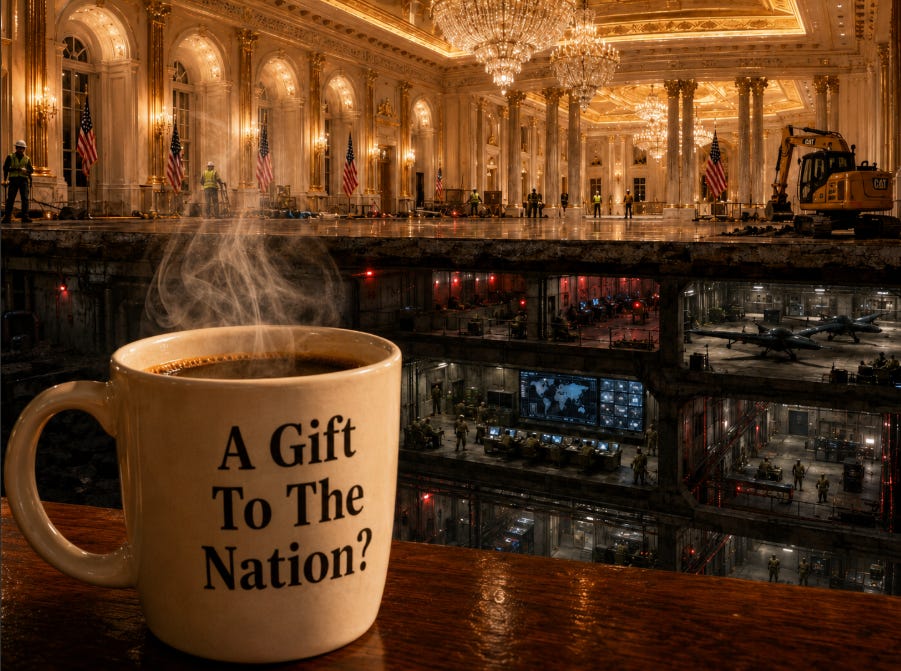
The White House is under construction; this much is not in dispute. What is in dispute is what, exactly, is being built. Trump calls it a ballroom, a gift to the nation from himself and fellow patriots, he says, at no cost to taxpayers, but this is not quite right. The ballroom, it turns out, is a shield. Behind it: six stories of subterranean fortress, a military hospital, secure communications rooms, a scientific research laboratory, a drone port, four-inch bulletproof glass, bulletproof walls, snipers’ nests, a titanium perimeter fence, and 360-degree elevated views of the city. The Secret Service and the military will have a new promontory from which to observe everything laid out before them. The taxpayer, meanwhile, will have a bill of approximately one billion dollars for what Trump originally described as a gift. He now wants Congress to fund the security components, and warns that without the money, the White House won’t be a very secure place. The Commission of Fine Arts approved the design Friday. A triumphal arch is also planned, slightly larger than the Arc de Triomphe, Trump noted, because it has to be. As one British analyst observed this week, the more Trump talked about what he’s building, the more it sounded like exactly the kind of compound in which a president who one day decides not to leave power could hold himself up, protected by loyal members of the military. He said it plainly, and it seemed worth repeating.
A new congressional report puts the cost of the war in Iran at $29 billion so far. That number is almost certainly low. It does not include repairs to U.S. bases and facilities across the Gulf. It does not capture the indirect costs, energy prices, supply chain disruption, the knock-on effects hitting American families at the pump and the grocery store. What it does capture is enough to be alarming. In the first four days of the conflict, the U.S. fired off the equivalent of every Patriot missile it had given Ukraine over the previous four years. Each missile costs millions of dollars. Many were fired at Iranian drones costing tens of thousands. European allies and Ukraine are now being told there are no missiles to spare.
Trump’s blockade of the Strait of Hormuz, “like a steel wall,” he said Friday, “100 percent effective,” is costing Iran an estimated $500 million a day. Iran, meanwhile, is negotiating with Oman over the formalization of toll collection on the strait. Asked directly whether that was acceptable, Trump pivoted to the blockade. The operation now has a name: Epic Fury, which, in addition to sounding like a mid-tier energy drink, confirms what the War Powers Act would like a word about: this war has now surpassed sixty days without congressional authorization. Congress, to its credit, has been kept too busy receiving incremental Pentagon disclosures to notice. The highly enriched uranium will be seized and probably destroyed. The nuclear program will end one way or another. What it will cost to get there remains, like so much else this week, a number nobody is being given in full.
The “anti-weaponization fund” did not survive its first week without a legal challenge; in fact, it has not survived it without two. Capitol Police and Metropolitan Police officers attacked on January 6th have already filed suit against the fund, arguing that the people it proposes to compensate are the very people who assaulted them. Now a fired January 6th prosecutor and a law professor acquitted of charges brought by the Trump Justice Department have filed a second suit in the Eastern District of Virginia, arguing that the fund’s eligibility criteria, written again into the document itself, constitutes a politically discriminatory filter. The plaintiffs are not abstractions. Andrew Floyd is a career federal prosecutor, a deputy in the Capitol Siege Section, fired by Pam Bondi last June. The law professor was prosecuted by the same administration now offering compensation to people it says were wrongly prosecuted. Neither can access the fund, because neither was targeted by a Democratic administration. The Eastern District of Virginia is not where you file a nuisance suit. It is where you file when you want a fast, serious court. The fund’s defenders will argue that the eligibility criteria reflect the fund’s stated purpose. The plaintiffs will argue that the stated purpose is the problem. The document indicts itself.
On Friday, in the Oval Office, surrounded by grocery executives and flanked by Lee Zeldin, the president signed an executive order rolling back Biden-era refrigerant regulations. This, Trump explained, will lower grocery prices. The causal chain runs as follows: refrigerant efficiency standards affect appliance manufacturing costs, which affect appliance prices, which have essentially nothing to do with the price of eggs. No matter. The Kroger CEO was there. The Piggly Wiggly franchise owner was there. A man from a single-store grocery in Claxton, Georgia was there. They all said thank you. Zeldin called it historic. Kevin Hassett announced that deregulation has saved the average American family $14,000, a number that will not survive contact with a calculator. Trump noted that a friend of his, a savvy guy, big league, had installed the new refrigerant equipment and called to report that it doesn’t cool the food. The administration projects $2.4 billion in annual savings, which is what industry saves in compliance costs, not what families save at checkout. When a reporter asked whether Kroger would pass the savings on to consumers, the CEO said they were “concerned about the cost of living” and “interested in ensuring customers are paying the right price.” Trump called it a great answer. I’d note that it was not a yes.
Kevin Warsh was sworn in as Federal Reserve Chairman Friday morning in the East Room, with Clarence Thomas administering the oath and Brett Kavanaugh in the audience, because subtlety is not this administration’s register. Trump, introducing him, declared he wanted Warsh to be “totally independent,” “don’t look at me, don’t look at anybody, just do your own thing.” This is the same Trump who spent the better part of a year publicly calling Jerome Powell a fool, demanding rate cuts, and threatening to fire him. The independence promise had a shelf life of approximately four hours. By the time Trump took the stage at a campaign rally in Rockland County that afternoon, he was telling the crowd: “I had a rotten head of the Fed and now I have a great head of the Fed.” The implication being that greatness and compliance are, in this administration, synonyms.
Warsh’s own remarks were notably careful. He did not echo Trump’s assertion that the Fed should simply “let it boom.” Instead, he pledged to lead “with wisdom and clarity, independence and resolve,” language that lands differently when you know who is sitting in the front row. He invoked Greenspan. He said “the real work begins” the moment they left the stage. He is telling the institution who he is before Trump can define him. Whether that works is the question every market is currently pricing.
Thank you, genuinely, for the kind messages this week. My family lost a good man, and your words meant more than you know.
We spent the weekend doing what families do, clustering, drifting, reconvening, telling the same stories from slightly different angles. Which brings me to a matter of some taxonomic importance. After considerable deliberation, my cousin and I have settled on the collective noun for a large gathering of our family: a murmur of Geddrys. It earned its keep. We were, at the memorial, very much murmurating.
The program, meanwhile, listed us as the Geddrey family. And if you have been reading this newsletter for any length of time and pronouncing it with a hard G, as in get, or golf, or graft, all words that feel uncomfortably relevant this week, allow us to gently correct you. It’s a soft G. As in gentle. As in, we try. My uncle and my father endured both the misspelling and the mispronunciation for more decades than I have, and I can say with some confidence that they would have found all of it absolutely hilarious. My uncle especially. He had that kind of laugh, the kind that made you want to earn it.
Thank you for everything, including correcting my mental mispronunciation of your name!!
Thanks for thinking of us, even when your focus is on your family's loss. You're in our thoughts too.