


Good morning! Professor Tim Wilson put his finger on the moral rot at the center of this war. No, Trump did not explicitly threaten a nuclear strike. He did something more slippery and, in its own way, more dangerous: he used the language of obliteration while claiming to be preventing it. A war sold as necessary to stop Iran from becoming some civilization-ending menace is now being narrated by the President of the United States in phrases about “massively” blowing up the world’s largest gas field with power Iran has “never seen before.” That is the obscenity here. We were told this was about preventing the unthinkable, and now the man in charge is normalizing the vocabulary of vaporization without ever having the courage or discipline to say plainly what he means. Wars escalate through weapons and they escalate through rhetoric, through suggestion, through the slow erosion of the boundaries that used to keep leaders from speaking like comic-book supervillains on a sugar bender. Trump may not have said the word “nuclear,” but he is speaking in a register that invites everyone else to imagine it.
Once you start talking that way, the “boots on the ground” fantasies begin to feel less like contingency planning and more like a dare. That danger is no longer abstract: the 31st Marine Expeditionary Unit is already en route to the Middle East aboard the USS Tripoli, giving Trump a real amphibious force that could be used to seize Iranian-held islands near the Strait of Hormuz. That option is being dressed up as clever leverage, as though occupying territory next to one of the most volatile chokepoints on earth is some tidy little pressure tactic. A Marine landing there would not be a pinprick. It would be a major escalation against Iranian-controlled ground, with all the obvious consequences: retaliation, counterstrikes, and a strong chance that a “limited” mission turns into a wider war. European leaders are already balking at joining this mess, even as Trump pressures allies to help secure Hormuz, because they can see the obvious: once a war spreads from missile exchanges to shipping lanes to energy infrastructure to potential ground operations, there is no neat perimeter around the damage. There is only the next escalation and the next one after that.
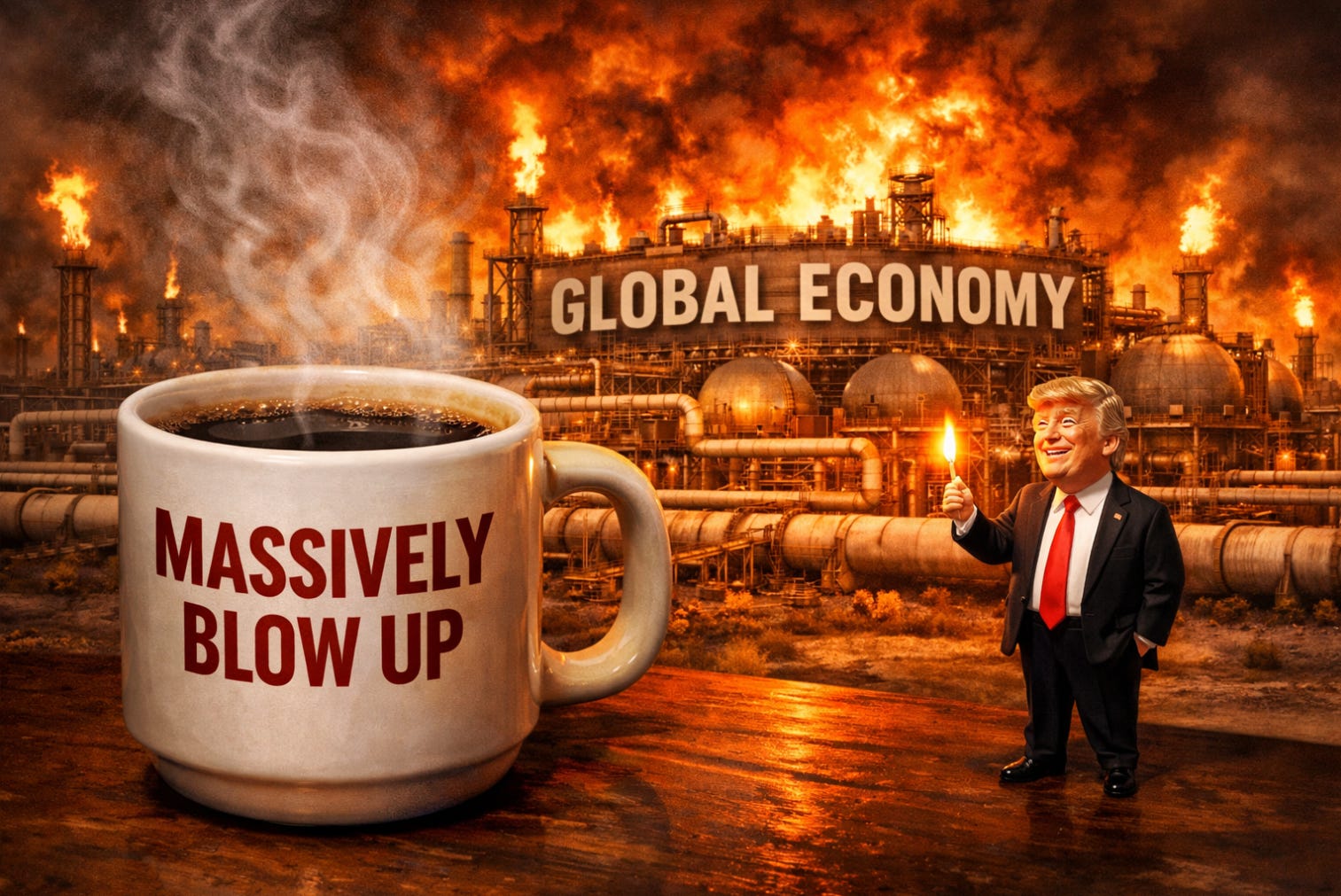
Which brings us to Qatar, where the global economy is now being mugged in broad daylight. Iran’s strikes caused extensive further damage around Ras Laffan, the vast industrial complex tied to the world’s largest LNG export hub, after Israel struck Iran’s South Pars gas field. This war has now migrated into the plumbing of the global economy. When missiles start landing on infrastructure like Ras Laffan and South Pars, they are not merely hitting enemy assets. They are hitting shipping, electricity, manufacturing, fertilizer, food, freight, and every other nerve ending of modern economic life. The men who promised strength have managed, in less than a month, to light the energy map on fire.
Trump’s response, naturally, was to make it worse. After insisting the United States knew nothing about Israel’s strike on South Pars, he also announced, with the confidence of a man who thinks contradiction is a leadership style, that Israel would not hit the gas field again unless Iran struck Qatar once more. Then came the threat: if Tehran did that, the U.S. would “massively blow up” South Pars. So let us pause to appreciate the strategic genius on display here. First, Washington either did not know what its closest regional partner was doing, or it did know and lied about it. Second, the President responded to a spiraling war on energy infrastructure by threatening a bigger attack on even more sensitive energy infrastructure. This is not deterrence so much as two raccoons in a trench coat trying to run a superpower.
If you have the nagging sense that Israel is driving while Washington keeps fumbling for the map, you are not alone. Even some of Trump’s own people have started saying the quiet part out loud. Former counterterrorism official Joe Kent resigned over the war, said Iran posed no imminent threat, and claimed he and others were not allowed to present their concerns to Trump before the strikes. That does not prove Israel literally dictates every American move. It does show an administration repeatedly reacting to a war whose tempo it does not appear to control, then retrofitting explanations after the fact. The South Pars episode captured the whole thing perfectly: Israel lashes out, the region burns, the markets convulse, and then Washington rushes out to say it knew nothing, except apparently enough to promise what happens next.
Amid all this macho posturing, one of the strangest and most revealing reversals in the world is unfolding. The same Ukraine Trump once tried to humiliate is suddenly the country everyone needs. Zelensky says roughly 200 Ukrainian military experts are now in Gulf countries helping counter Iranian drone threats, and earlier reporting said the U.S. and Middle East partners were actively seeking Kyiv’s expertise because Ukraine has spent years learning how to defeat exactly the kind of cheap, relentless drone warfare now chewing through the region. Funny thing about “cards”: they do change hands. Trump sneered at Zelensky that he didn’t have them. Now Washington and the Gulf monarchies are looking to the people they treated like desperate supplicants for lessons in survival. It turns out that being forged in the fire of real war teaches you things a Patriot invoice cannot.
Even this obvious lesson arrives wrapped in the usual American arrogance. Ukraine’s value here is not abstract courage or democracy cosplay; it is practical competence. The U.S. and Gulf states are discovering, very expensively, that you cannot keep burning million-dollar interceptors to shoot down bargain-bin drones forever. Ukraine learned that because it had to. It learned how to layer defenses, improvise, and fight economically while the richer, shinier militaries of the world were still busy believing that cost was for peasants. Now the war in Iran has exposed the same truth in the Gulf skies: the future belongs not just to the side with the fanciest hardware, but to the side that can survive the arithmetic.
Back in Washington, the other great reveal this week came from Tulsi Gabbard, who managed to take an already rotten story and make it smell worse. Pressed at a Senate hearing over whether Iran posed an “imminent threat,” Gabbard said it is not the intelligence community’s job to determine what counts as imminent and that only the president can decide that. That is an extraordinary statement, and not in a good way. Intelligence agencies are supposed to assess threats, warn about dangers, and provide nonpolitical analysis. Presidents decide policy. They are not supposed to moonlight as the nation’s chief intelligence analyst because the real analysts have been demoted to decorative shrubbery. Gabbard did not defend the intelligence; she handed it over. That is what institutional collapse sounds like when it puts on a blazer and testifies under oath.
All of this would be bad enough if the economy were healthy, calm, and ready to absorb another war. It is not. The February PPI (producer price index) report already showed heat building in the pipeline before the latest Gulf chaos really detonated. Producer prices rose 0.7 percent in a single month and 3.4 percent year over year, with goods surging 1.1 percent in one month. That matters because PPI is the part of the inflation story that businesses feel before consumers do. It is the upstream gauge, the canary in the mine, the little feathered messenger that dies first while everybody on television keeps talking about how nice the weather looks. Max at UNFTR is right about the basic setup: the economy was already taking on water before this war poured gasoline on it.
The gasoline part is no metaphor. Brent surged toward $118 a barrel, European gas prices jumped sharply, and the spread between Brent and WTI widened as markets started pricing what this really is: not a brief panic, but a seaborne global energy shock with unknown duration. Bloomberg’s analysts have been blunt about the psychology of it. Markets keep cycling between denial and the next leg down as reality sets in. That matters because it tells us this is not just about what fuel costs today. It is about what people are beginning to believe fuel, shipping, manufacturing, food, and borrowing costs will look like in the weeks and months ahead if the Strait of Hormuz remains dangerous and LNG infrastructure keeps getting chewed up. The market is not merely nervous. It is trying to price chaos without admitting the word out loud.
Central bankers, as usual, are left standing there like substitute teachers in a riot. The Federal Reserve has already signaled that it cannot really model the trajectory of a war whose inflation impact depends entirely on how long the energy shock lasts, and Europe is facing the same dilemma. This is the part where the phrase “stagflation impulse” starts slithering back into the conversation. Higher prices, weaker growth, no clean off-ramp, and policymakers forced to choose between looking too passive on inflation or too brutal on the economy. The war is now doing what wars so often do: exporting suffering abroad while importing higher costs at home.
And just in case anyone was still clinging to the idea that this would be a quick, manageable, reasonably priced bit of imperial freelancing, less than one month in, the Pentagon is reportedly already seeking another $200 billion for the Iran war. Not a final appropriation yet, not money Congress has fully signed off on, but a very real request serious enough that AP sourced it from within the administration and the Defense Secretary declined to knock it down. So there you have it: war sold as urgent and contained is already sprouting a price tag large enough to swallow domestic priorities whole before the public has even had time to finish processing the lies that launched it. “America First,” apparently, now means paying through the nose for an Israel-shaped disaster while gas prices rise, debt climbs, and the men who started it all ask for another wheelbarrow of money.
To ensure the war in Iran doesn’t prevail in making us forget…things are getting uglier by the hour on the Epstein front, and now the fight is no longer just about what’s in the files, but about the increasingly obvious effort to keep key answers off the record. After House Oversight issued a bipartisan subpoena ordering Pam Bondi to sit for a sworn deposition, Bondi and Todd Blanche instead showed up for a last-minute closed-door “briefing” that Democrats say was no briefing at all. According to members in the room, Bondi offered no meaningful presentation, refused to clearly commit to complying with the subpoena, and appeared to be trying to pass off a private, untranscribed session as cooperation. Democrats walked out, calling it a fake hearing and a cover-up. Even the Wall Street Journal framed the episode as a clash over whether DOJ was trying to substitute informal access for actual sworn testimony. A briefing is theater; a deposition is evidence. And Bondi still will not simply say she’ll show up under oath. At this point, the administration’s strategy looks painfully clear: stall, blur the process, hide behind procedural fog, and hope the public loses the thread before the full story comes into view.
All of these sycophants surrounding and supporting Trump are going to have a hefty price to pay when they reach the Golden Gates, someone must live who can bell this poor excuse for a cat, surrounded by greedy yes men and women raised high above their ability levels, this has to end and it must end with a whimper, not a giant ball of flame which will kill us all, it must end NOW.
I have long believed our nation responds to cathartic events such as war, not planning or discussion. We are in such a moment again. Our President is the 7 Deadly Sins and epic corruption combined. Our health care systems is collapsing into trope and opinion, not science. Our DoJ is compromised to the point Judges are outraged, law is a tool of revenge. Our elections are under attack. Into this maelstrom, Iran. We are beyond the lie to start the war; rather, the open question, how do we end it. The GOP Congress has abdicated whatever vestige of their remaining Constitutional responsibility. We are at the nexus of economic and diplomatic collapse. We are adrift, the cathartic winds strengthen.