


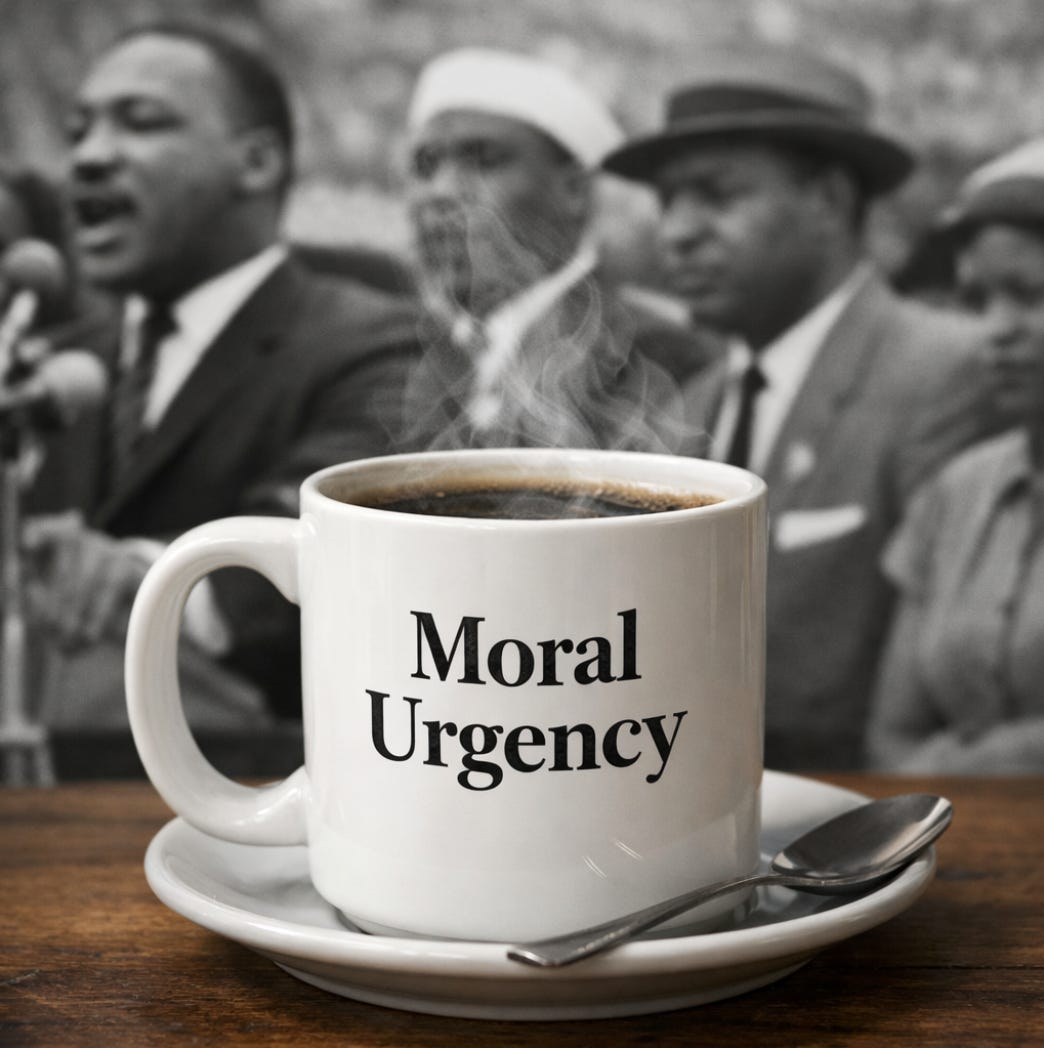
Good morning, and happy Martin Luther King Jr. Day, a day that always seems to arrive precisely when the country most needs to reread Letter from Birmingham Jail and then do the exact opposite of pretending it’s about vibes.
We’ll start there, because it frames everything that follows far better than any chyron or talking point ever could:
“Injustice anywhere is a threat to justice everywhere.”
That sentence is doing a lot of heavy lifting this morningm and unlike Congress, it’s actually showing up for work. Over the weekend, Donald Trump managed to turn Greenland into the epicenter of a transatlantic crisis, NATO into a hostage, and the Nobel Peace Prize into a personal grievance letter. According to multiple reports, Trump is now openly floating a “Puerto Rico option” for Greenland, offering citizenship, tax exemptions, and a century-long lease as a colonial sweetener, while backing it up with tariffs, threats, and the subtle implication that sovereignty is negotiable if the U.S. president feels under-appreciated. European leaders, for their part, are responding with the diplomatic equivalent of gritted teeth, quietly sharpening retaliatory tariffs while insisting their “priority is engagement, not escalation.” Which is diplomatic code for we are trying very hard not to punch the arsonist while he’s still holding the match.
Then came the part where satire simply resigns: Trump sent a letter to Norway’s prime minister explaining that because he did not receive the Nobel Peace Prize, he no longer feels obligated to “think purely of peace.” That is not spin; it is a written admission that restraint was conditional on applause. The same letter questions Denmark’s right to Greenland at all (“a boat landed there hundreds of years ago”), demands “complete and total control,” and reframes NATO as something that owes him personally. If you were trying to explain to a future historian how alliances collapse, you could probably just hand them this document and a stiff drink.
To justify all this, Trump has settled on a new talking point: a supposed “Russian threat” to Greenland. This claim makes almost no sense. The United States already dominates Greenland’s military posture under a 1951 treaty and operates a major base there. Russia has no territorial claim, no realistic invasion pathway, and is currently struggling to sustain a war it started elsewhere. Trump himself has spent the past week insisting Vladimir Putin “wants peace” and blaming Ukraine for prolonging the war. The contradiction isn’t subtle, Russia is not the driver here; ego is. “National security” is just the wrapper.
While Trump plays Risk with the Arctic, Europe is watching something else with growing alarm: a breakdown in trust. Reports, not independently verified, have circulated suggesting that Ukrainian intelligence may have tested U.S. intelligence channels to assess whether sensitive information was leaking to Russia. That claim traces back to commentary by Vincent Crouzet, a French intelligence analyst with ties to the DGSE, rather than to confirmed reporting by major European outlets. What is confirmed, however, is that France has increasingly become a primary provider of military intelligence to Ukraine, and that the Trump administration previously paused U.S.–Ukraine intelligence sharing altogether. Allies are not reorganizing intelligence flows because Denmark failed to defend Greenland; they’re doing it because confidence in Washington’s stewardship itself is eroding. In that context, Trump’s attempt to cast himself as the indispensable bulwark against Russian influence sounds a lot less like leadership and a lot more like gaslighting.
Back home, the authoritarian logic is more familiar, and more lethal. Minnesota remains ground zero for ICE escalation, evidence suppression, and narrative laundering. After the killing of Renee Nicole Good, both President Trump and DHS Secretary Kristi Noem repeatedly amplified claims that the ICE officer involved had been seriously injured, even invoking “internal bleeding” and hospitalization to frame the shooting as self-defense. But dispatch transcripts, EMS records, and video analysis now make clear that claim was false. The officer was not injured, was not treated by EMS, was not transported to a hospital, remained upright throughout the incident, lingered on the scene for nearly half an hour, and then left under federal escort to a government building. There is no evidence, medical or otherwise, to support the catastrophic injury narrative the administration pushed. By the time official records surfaced, however, the lie had already raced through corporate media pipelines at the speed of access journalism, providing political cover for a killing that evidence does not justify.
When accountability edges closer, the administration pivots, not to transparency, but to criminalizing dissent. DOJ is now threatening charges against protesters who disrupted a church service after discovering that a Cities Church pastor is also the acting head of ICE’s St. Paul field office. Rather than grapple with the moral contradiction, a man overseeing violent raids while preaching on Sundays, the Justice Department chose to center the sanctity of worship over the sanctity of human life. MLK addressed this exact impulse sixty years ago, writing:
“I have almost reached the regrettable conclusion that the Negro’s great stumbling block… is not the Ku Klux Klanner, but the white moderate, who is more devoted to ‘order’ than to justice.”
Adding fuel to the fire is a phenomenon Trump loves to project onto others: “professional agitators.” The difference is that in this case, the professionals are real, and they’re on the administration’s side. The Guardian reports that right-wing influencer Nick Sortor, who has White House ties and DOJ defenders, has been roaming Minnesota generating viral content that frames protesters and immigrants as violent criminals while cheering on ICE brutality. He monetizes chaos, amplifies enforcement violence, and then gets treated like a credible on-scene reporter by Fox News and local outlets. This is not organic outrage; it’s an attention economy feedback loop where provocation becomes policy justification.
The public reaction to all of this is getting louder, and more global. Over the weekend, Trump was booed in packed arenas from London to New Jersey. At London’s O2 Arena, chants of “Leave Greenland alone” drew applause. Bruce Springsteen told a New Jersey crowd that Americans should not be murdered for exercising their First Amendment rights, dedicating his performance of The Promised Land to Renee Good, a song about belief in a better future and, as its chorus puts it, insisting that “Mister, I ain’t a boy, no I’m a man / And I believe in a promised land,” even in the face of cold eyes and rising storms. Springsteen’s choice of that anthem, about striving for something better despite adversity, underscored how far many feel the country has drifted from its ideals. Protests erupted in Greenland and Denmark as Trump continued to threaten invasion, and these aren’t fringe demonstrations. These are mass audiences in spaces that usually confer legitimacy, and the verdict is increasingly unanimous: the promise, at least, is slipping.
As if to underline the moral inversion of the moment, the New York Times reports that Trump quietly issued another batch of pardons, including a second pardon for the same convicted fraudster, who returned to crime after being freed the first time. He also pardoned a banker whose daughter donated millions to a Trump super PAC while he was under indictment, along with a former governor and a former FBI agent tied to the same corruption case. Serial offenders, political donors, and well-connected allies receive mercy; anti-fraud programs serving poor communities get defunded. Clemency is no longer an act of grace but a loyalty reward system.
Which brings us to the conspicuous absence of Congress. This is the branch that controls tariffs, war powers, oversight, and the purse. It is watching a president extort allies, destabilize NATO, reward donors with pardons, escalate domestic force, and openly admit that peace is optional when his ego is bruised. History will not remember who tweeted what, but it will remember who had the power to intervene, and didn’t.
This is good day to remember another line from Birmingham:
“An unjust law is no law at all.”
So on this MLK Day, with alliances fraying, institutions failing, and the noise getting louder by the hour, we’ll end where we often do, outside. Marz and I have been taking advantage of the rare clear skies, getting some badly needed exercise, and keeping up our moonbeam vigils. They’re quiet, small rituals in a world that feels anything but. Lately they feel less like reflection and more like resolve. In a moment when injustice is being normalized and cruelty is being rebranded as strength, those pauses matter. They remind us that the promised land was never something handed down by power, it’s something people insisted on, fought for and must protect, and keep faith with, even when the night feels long.
I see that a quote from Mary was included in Frank Bruni's weekly NY Times roundup of outstanding writing, "For the Love of Sentences." I continue to marvel at how she can churn out such funny, poignant, and insightful commentary on a daily basis. If you're reading this, Mary, thank you.
Our gratitude is infinite - a voice of reason, compelling and profound!! (And I love how you bring your pooch into it… kudos ❤️❤️)