


Good morning! Donald Trump has concluded that the best defense against an unhappy public is to bury it beneath a quantity of claims too large for any human institution to inspect before lunch.
Trump’s 75-minute Las Vegas production moved from patriotic music through a solemn tribute to a murdered police officer, then opened the fire hose: the greatest economy, the strongest border, the highest exports, the largest investment boom, the greatest military in history, all delivered with the confidence of audited accounts and the provenance of cocktail-napkin arithmetic. He complained the press had fixated on his one primary-endorsement loss instead of his 28 wins, then spent several minutes discussing the loss himself, a reliable feature of his method: accuse the press of amplifying an inconvenient subject, then personally attach a public-address system to it.
Numbers arrived faster than they could be examined. Opinions became measurements, setbacks became victories, and any institution that might object was discredited in advance. The polls were fake; the reporting was fake; the critics were enemies. America’s “golden age” had arrived, and it ran through the familiar sequence: powerful, wealthy, healthy, strong, proud, safe, and great again.
The venue told its own story. Red Rock Casino Resort is a Fertitta family property with deep Republican ties, and Trump was introduced by UFC president Dana White after a slate of Nevada Republicans, Gov. Joe Lombardo among them, warmed up the room. Officially, this was economic messaging: a pitch for “No Tax on Tips” aimed at Nevada’s tip-dependent service workforce, three months out from the midterms. In practice, it was a rally in all but name, staged for a friendly crowd with his approval rating sitting below 39 percent, a number he dismissed on stage as fake before the numbers even started.
The next three months will likely be an assault on the shared factual record. Trump can produce a claim in ten seconds; determining whether it is false, misleading, unsupported, outdated or merely nonsensical can occupy several reporters and an afternoon. By the time the correction is published, he has generated a dozen replacements. The correction will be longer, duller and less emotionally satisfying than the original, and his audience has already been told that the act of checking him proves the checker is corrupt. It is a propaganda perpetual-motion machine, except the fuel is everyone else’s time.
Trump’s Truth Social feed supplied the visual aids. In one post, he insisted the United States possesses “massive amounts” of munitions and promised that the people who leaked contrary assessments were being hunted down, with long prison sentences to follow. No charges or legal process were mentioned, and no distinction was offered between revealing classified information and embarrassing the president. The important message was simpler: the arsenal is full because the president says so, and anyone describing an empty shelf may soon receive a guided tour of the justice system.
Elsewhere, Trump attacked filmmaker Michael Moore as a lifelong loser, labeled Michigan Democratic nominee Abdul El-Sayed a communist who hates Jews and Israel, and shared an “Only Trump” image featuring a golden equestrian monument. The account now operates simultaneously as presidential bulletin, campaign headquarters, fan club, grievance archive and casino marquee.
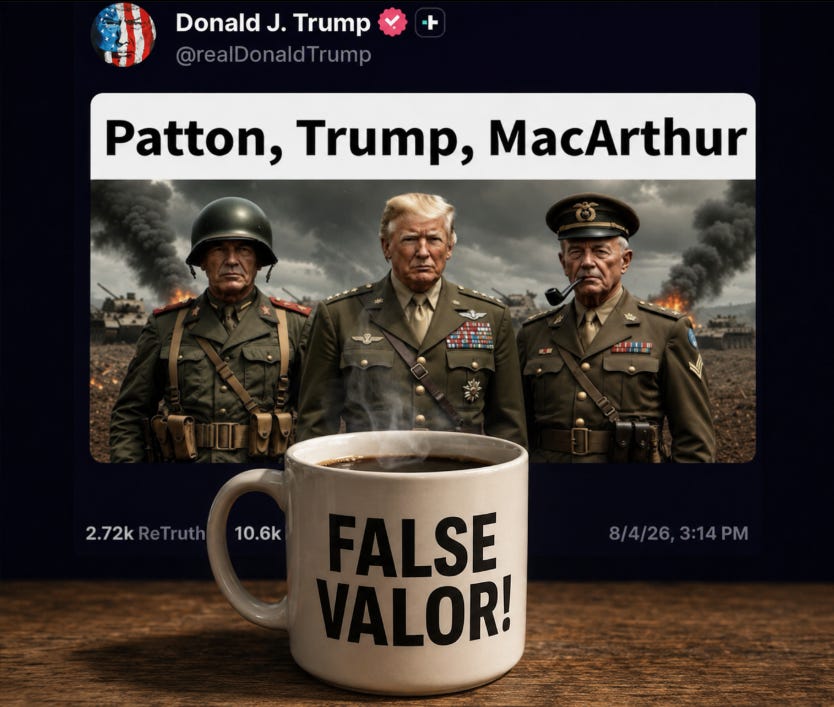
The day before, Trump had posted the synthetic military history. An AI image placing himself between Generals George Patton and Douglas MacArthur, wearing a uniform he never wore and decorations he never earned, while the two actual commanders appeared with fewer stars. Critics called it false valor, but one reply identified the deeper offense: Trump is manufacturing an image of supreme military leadership while the real Iran war he promised would be brief drags on, the Strait of Hormuz remains disrupted, munitions claims are contested and his administration threatens those who contradict its account.
Not every allegation in a social-media reply should be accepted without verification. The central contrast requires little interpretation. In the fictional battlefield, Trump is the most decorated man in the frame; in the real one, military officers, allies, and civilians must live with the consequences of his judgment. Authentic service becomes scenery for synthetic greatness. AI supplies the heroic photograph history declined to take, conferring all the grandeur of command while eliminating the tedious requirements of service, sacrifice and strategic success.
MS NOW offered a useful contrast Wednesday night by doing something radical: treating public opinion as information rather than insubordination.
The network cited a Reuters/Ipsos poll conducted July 29–August 3, in which the cost of living remained voters’ leading concern and 70 percent of Americans disapproved of Trump’s handling of both the cost of living and inflation specifically, his approval on those two issues sitting at 23 and 22 percent, well below his already-weak 35 percent overall approval. Democrats held an 8-point lead over Republicans on the cost of living, 35 to 27, the first time in nearly a decade that Americans have picked Democrats over Republicans as better economic stewards. Another 28 percent did not know, a considerable bloc of people apparently waiting to see whether either party might eventually present an idea instead of a commemorative mug.
Trump’s answer in Las Vegas was that the economy is the greatest America has ever had and the contrary polls are fake. This may be emotionally satisfying, but it has a technical weakness: voters purchase groceries. They make rent payments. They fill gas tanks, price inhalers, renew insurance and watch the total at checkout perform feats of vertical ambition not yet celebrated in a presidential speech.
Michigan Representative Debbie Dingell described returning home and speaking with constituents at Kroger, where they show her what groceries cost. They talk about gasoline, the expense of commuting in a state built around the automobile, and the mother who did not know how she would afford her child’s inhaler. These stories do not by themselves constitute a complete economic dataset. They do explain why declaring the economy perfect is not the same as making people feel economically secure. The price displayed at Kroger remains stubbornly unmoved by the president’s approval of it.
The “more Americans are working than ever before” boast illustrates the problem neatly. In a growing country, the raw number of employed people will regularly reach new highs. The useful questions concern employment relative to population, labor-force participation, wages, working hours and what those wages can buy. Trump takes the largest available numerator, removes the denominator and awards himself a trophy. It is less economic analysis than statistical taxidermy: the number is technically recognizable, but something important has been removed from the living organism.
Three other techniques were on display in Las Vegas, and they are worth naming because they will recur for the next hundred days.
The first is outright fabrication dressed as an audited figure. Trump’s claim of $19.2 trillion in new investment, “five times greater than any country in history,” has no supporting basis. Even the White House’s own promotional tally, itself widely criticized as inflated, has topped out around $9.7 to $10.7 trillion, and independent analysis found more than $2.5 trillion of that total isn’t investment at all, with roughly $3.5 trillion resting on vague sovereign pledges, some announced before Trump returned to office. The number does not describe the world. It describes the speech.
The second is the durable statistic that survives its own debunking. Trump’s claim that 11,888 murderers entered the country illegally has been checked and rechecked by outlets across the political spectrum, which found no evidence supporting it as stated; the figure appears to conflate people on ICE’s non-detained docket, some convicted decades ago and under prior administrations, with recent illegal border crossings under Biden. The number itself has shifted over time, sanded down from over 13,000 in earlier tellings without explanation. It survives not because it withstands scrutiny but because it is repeated faster than the scrutiny can travel.
A third technique, quieter than the other two, showed up in Trump’s boast that Nevada has lifted nearly 100,000 residents off food stamps. The number is roughly accurate. The causation is inverted. Nevada’s SNAP enrollment has fallen by more than 70,000 people in the past year, but state health officials attribute the decline to new work-requirement and documentation rules under the One Big Beautiful Bill Act, not to Nevadans finding jobs and no longer needing assistance. Some of those removed remain eligible by income; they simply could not clear the new paperwork in time. A drop in caseloads is being sold as a triumph of prosperity when the state’s own administrators describe it as an artifact of process.
The electoral news carried a similar warning: Missouri and Kansas voters both rejected Republican-backed measures designed to make their own past decisions harder to defend at the ballot box, a fitting rebuke on a night otherwise built for narratives no one voted on.
Michigan Democrats, meanwhile, began the familiar and often ungainly process of reassembling after a bruising Senate primary won by El-Sayed. His former rivals signaled support, state leaders planned unity events, and Dingell emphasized affordability as the issue capable of bridging the party’s ideological divisions. Unity after a primary is not guaranteed, and photographs of politicians standing together should never be confused with voters actually following them. But Republicans hoping Democratic combat would continue indefinitely received an early indication that their opponents understand November is a different contest.
The most revealing electoral moment may have come from a Trump judicial nominee asked who won four recent presidential elections. Barack Obama, the nominee replied, “was sworn into” office. Trump won in the Electoral College. Joe Biden “was certified” by Congress. The nominee could describe the constitutional and ceremonial debris surrounding the result but seemed unable to pronounce the dangerously direct verb won. It was a virtuoso exercise in standing immediately beside the truth without making eye contact.
This is why the coming information fight cannot be reduced to a running tally of fibs. The administration is not merely asserting preferred facts. It is training officials, candidates and supporters to treat plain acknowledgments of reality as betrayals. A judge who cannot say who won an election is not displaying caution. The evasion is the credential.
The distance between Trump’s declared victories and material conditions becomes more consequential beyond the campaign trail, where slogans encounter shipping lanes, missiles and governments with interests of their own.
Anne Applebaum’s most useful observation about the Iran war was also her simplest: “I don’t believe anything that comes out of the White House.” She was not transferring credibility to Tehran. Iran’s authoritarian regime is an accomplished manufacturer of deception in its own right. Her point was that neither belligerent can be trusted to describe the war, the negotiations or even its own objectives with enough honesty for outsiders to know what is actually happening.
That leaves everyone else operating inside a fog deliberately produced by both governments. Washington announces imminent breakthroughs that dissolve, threatens attacks that are canceled and declares victories whose terms remain mysterious. Tehran issues its own self-serving accounts of negotiations and battlefield success. Independent Pentagon access has been restricted, embedded American reporting is absent, and even basic claims about casualties, munitions and proposed agreements are difficult to verify. The responsible conclusion is to suspend judgment until evidence exists.
Allies cannot coordinate around promises they do not trust. Markets cannot price risks hidden behind dueling press releases. Citizens cannot evaluate a war whose objectives change with the president’s mood, and military planners cannot speak plainly if unwelcome assessments may be branded treason. Historians will eventually inherit an official record assembled from Truth Social posts, Iranian communiqués and announcements that expired before the evening news.
Nor is credibility the only casualty. Neither government has displayed judgment that allies should feel comfortable borrowing. Tehran has learned that it can create enormous pressure through escalation; Trump has repeatedly treated escalation, reversal and self-congratulation as consecutive stages of the same policy. A deal may emerge, or another promised deal may evaporate. Until something verifiable occurs, the safest assumption is that both sides are narrating the outcome they want—and that the rest of the world must plan around what they do, not what they declare.
The final stretch before the midterms will be rife with mistruths, some outright false, others misleading uses of real numbers, unsupported assertions, or opinions dressed in a lab coat and introduced as data. Calling everything a lie would reproduce the carelessness we’re examining, so our standard has to be sharper than his: we’ll concentrate on claims that carry consequences; war, elections, public safety, economic policy, the use of government power, and group repeated falsehoods into their larger narratives rather than treating each iteration as a new discovery. When Trump says the economy is the greatest ever, the answer isn’t an adjective duel; it’s evidence about prices, wages, participation and household security. When he says the war is nearly won, we’ll look at shipping traffic, casualties, alliances, and the terms actually under negotiation. When he says an election was corrupt, we’ll ask for evidence before the claim gets a day of oxygen.
We’ll also say so when uncertainty is the honest answer. “Unverifiable” doesn’t mean false, and “official” doesn’t mean verified. Applebaum’s refusal to manufacture certainty out of an information blackout is worth imitating, since replacing the administration’s confident fiction with our own confident speculation serves no one. Not every provocation earns equal weight: the AI general matters because it reveals the cult of synthetic greatness, but it doesn’t outrank threats against leakers, efforts to disable elections, or decisions that prolong a war. Trump’s feed will serve a daily buffet of ornamental outrages built to commandeer the news cycle. We’re not obliged to eat everything on the table.
Trump can produce falsehoods faster than any newsroom can investigate them, and we won’t pretend otherwise or turn this roundup into a sanitation department for his account. The task is to identify the deceptions that move votes, conceal consequences, or prevent the public from understanding what its government is doing, and to give readers the evidence to recognize them tomorrow, wearing a slightly different hat. The flood is the strategy. Attention is the finite resource. We intend to spend ours on the truth that matters.
I find this black background/white font hard to read. Please go back to black on white.
“The evasion is the credential “ is one of the most accurate descriptions of this phenomenon I’ve read or heard. Thank you for that