


Donald Trump’s most revealing moments at Davos didn’t come from behind the lectern. They came later, at the reception, after the formal address, after the polite but cautious applause, when the setting shifted from staged authority to donor lounge candor and the mask slipped almost immediately.
Standing before a room packed with executives, financiers, and political insiders, Trump dropped any remaining pretense that this was about policy or dialogue. Instead, he offered something closer to a victory toast. “I go around and I say meet the biggest people, biggest businesspeople,” he told the crowd. “I say congratulations. They say, ‘What?’ I say, ‘You’ve doubled your net worth since I’ve been president, right?’ And they say, ‘Yeah, more than that.’”
This Trump considers proof of success.
“We’ve given you a platform where you can really put your genius to work,” Trump continued, casting his presidency as an accelerator for elite wealth. Regulation, oversight, and restraint were treated as obstacles already cleared. The room was not being asked to debate values; it was being congratulated for winning.
Then came the line that clarified everything. “I’m a dictator,” Trump said, pausing just long enough for the laugh. “But sometimes you need a dictator.”
No one seemed especially alarmed, and no one left. The reception speech was riddled with moments like this, offhand confessions passed off as humor, grievances rewarded with laughter, power framed as something personal and transactional. Trump openly acknowledged that some people in the room he “couldn’t stand” had become very rich anyway. “I would screw them if I could,” he said, pausing as the room laughed, “but I can’t do it.” The barrier wasn’t principle, at least not his, It was process.
He praised the deployment of troops into American cities as a model of governance, bragging that Washington, D.C. had been made “safe” in weeks through force. If he were a mayor, Trump said, he’d call the president and ask him to “send about a thousand troops in here and we do it fast.” Law enforcement, civil authority, and consent were afterthoughts. What mattered was speed, spectacle, and control.
Immigration rhetoric at the reception was stripped of even the thinnest euphemisms. Trump described migrants as criminals “dumped” into the United States from foreign prisons and mental institutions, insisting that if they were “bad someplace else, they’re going to be bad here.” Individualized justice disappeared entirely, replaced by collective suspicion and mass removal framed as necessity.
By the time Trump wrapped up, the meaning of the earlier, more formal Davos speech had been clarified.
In that first speech, Trump had performed a familiar routine of inflated claims and historical grievance. He declared that the United States was enjoying “the fastest and most dramatic economic turnaround in our country’s history,” boasting that inflation had been “defeated,” the border rendered “virtually impenetrable,” and growth unleashed at levels “no country has ever seen before.” He cited “$18 trillion. maybe closer to $20 trillion” in investment commitments, a figure so large it floated free of verifiable reality.
America, he said, was the engine of the world. “When America booms, the entire world booms,” Trump told the assembled leaders. “When it goes bad, you all follow us down.” Allies were warned, implicitly and explicitly, that their prosperity depended on American indulgence.
Europe, in Trump’s telling, was in visible decline, its cities “not recognizable anymore,” its energy policies a “Green New Scam,” its leaders too weak to stop the damage. Windmills were mocked as economic poison. Germany and the UK were held up as cautionary tales. Energy independence was recast as cultural purity.
Then came the line that echoed louder the second time around: “Without us right now, you’d all be speaking German and a little Japanese perhaps.” Trump delivered it in Switzerland, a country where German is the most widely spoken language, while arguing that Denmark should hand over Greenland as a matter of overdue gratitude for World War II.
Greenland, in fact, loomed large in the speech, described as “a big beautiful piece of ice” of existential strategic importance. Trump complained that the United States had foolishly returned it to Denmark after World War II. “How stupid were we to do that?” he asked, casting himself as the lone realist brave enough to correct the historical record before an audience of Europeans who actually live with that history. The implication was that postwar norms, sovereignty, and alliance-building were naïve errors rather than deliberate choices made to prevent another catastrophe. Denmark, he said, was now “ungrateful.” The logic was unmistakable: restraint was a mistake, power should never be relinquished, and history creates permanent debts to be collected indefinitely by the strongest party in the room.
What made the moment especially jarring was Trump’s confidence that he was educating Europe about its own past. The speech treated World War II not as a shared trauma that produced institutions like NATO and the postwar order, but as a transactional event, an invoice that never expires. There was no recognition of why territories were returned, why alliances were structured as they were, or why American power was deliberately constrained by law and norms after 1945. History, in Trump’s telling, is not something to be learned from; it is a myth to be massaged, simplified, and weaponized.
Throughout the address, Trump flirted openly with force. NATO was accused of exploiting the United States. Allies were portrayed as freeloaders living off American generosity. If they didn’t comply, Trump suggested, America could always remind them who was really in charge. “We probably won’t get anything unless I decide to use excessive strength and force,” he said, before assuring the room he wouldn’t, at least for now. The reassurance landed hollow, the threat had already done its work.
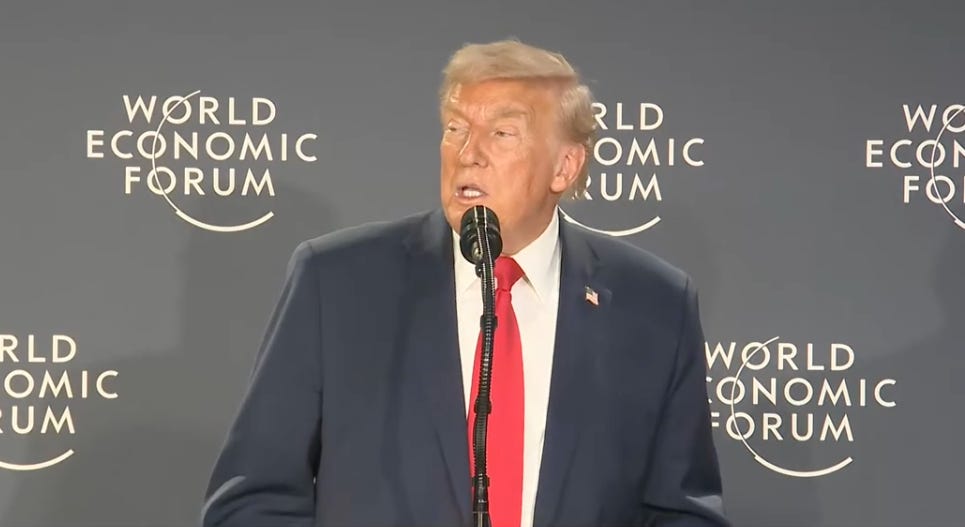
Physically, the performance told its own story. Trump appeared slumped and weary, leaning into the microphone, his expression heavy and fixed. The delivery wandered, looping through tariffs, windmills, nuclear power, Greenland, NATO, Ukraine, grievances recycled rather than arguments built. Against the crisp, hyper-controlled World Economic Forum backdrop, the contrast was stark. Instead of vitality, it was inertia.
Here is the important background we need to pay attention to. While Trump was projecting limitless authority in Switzerland, the legal reality he avoided mentioning was moving sharply in the opposite direction.
The D.C. Circuit Court of Appeals just issued a unanimous ruling rejecting Trump’s claim of presidential immunity for his January 6 conduct. In an opinion joined by judges across the ideological spectrum, including a Trump appointee, the court drew a clear, objective line: acting as a political candidate or party leader is not the same as acting as president. Campaign rallies, pressure on officials, and efforts to cling to power are not official acts, and they are not immune. Damn straight they are not immune!
The decision directly undercuts Trump’s central defense in the federal January 6 criminal case and signals that the sweeping immunity he assumes, on stage and off, does not exist in law. While procedural battles remain and the Supreme Court always lurks as a wildcard, the trajectory is unmistakable. Accountability is moving closer, not farther away.
Other unresolved issues Trump breezed past in Davos, including the legal vulnerability of his tariff regime, also hang in the background. Courts, unlike applause lines, demand evidence.
Taken together, Trump’s Davos appearances amount to something more revealing than either speech alone. The reception showed the intent. The podium speech supplied the doctrine. Power was framed as personal, wealth as validation, force as a shortcut, and law as an inconvenience that would eventually yield.
I can barely watch him he is so disgusting. I rely on you to help me through his important appearances. Nicole Wallace ran clips of some of our previous president’s speeches at Davos. Contrast practically made me cry. I’m sure a lot of the folks in Davos are wondering why we even let him loose. And then there was Mark Carney! I want to be Canadian! 💙
What we need is a stage manager unafraid to use his big hickory hook to pull Trump off stage. I’ll pay for the wood. But we don’t have an effective person to install as stage manager. Whom would you pick to lead the charge?