

Good morning! Trump loves gold, which is fitting, because the week is starting to look less like Midas and more like a hazmat response. The reflecting pools are green, the alliances are cracked, the World Cup is laughing at us, the grocery aisle is doing emotional damage, and somewhere in the Oval Office Ted Cruz is explaining to children that they are now captains of industry because they own a thimbleful of McDonald’s.
So let us begin, naturally, with the world’s game, because even soccer is not safe from the tiny orange finger of state interference.
The United States is out of its own World Cup after losing 4–1 to Belgium, which would have been painful enough without the pregame scandal in which Trump personally asked FIFA to review Folarin Balogun’s red card. FIFA then deferred the suspension, Balogun played, and Belgium responded by doing the most Belgian possible thing: quietly, efficiently, and devastatingly removing every possible excuse.
The White House can deny “influence” all it wants, but Trump himself said he asked for the review because he is, by his own account, “good at this stuff.” Marco Rubio weighed in too, because nothing says functioning superpower like the secretary of state offering instant replay analysis on a red card. The Belgians then answered in the only language that mattered: four goals.
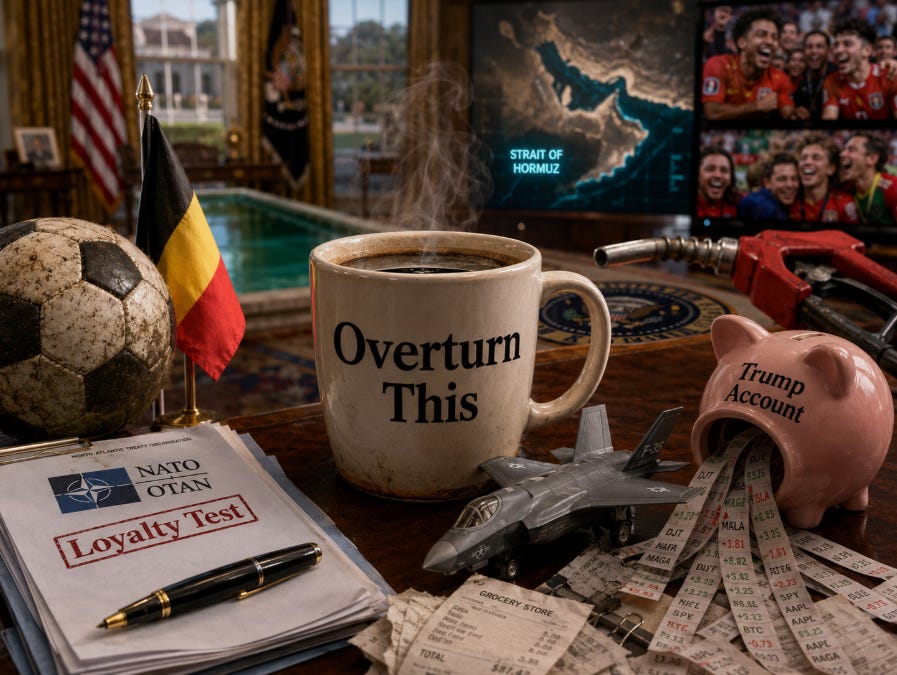
Afterward, Belgium reportedly posted “Overturn this,” which may be the most efficient diplomatic communiqué of the tournament. Europe mocked us. Belgium mocked us. FIFA looked ridiculous. Trump looked ridiculous. America got sent home in front of its own crowd with its reinstated striker and its presidential hall monitor.
Trump got the spectacle. FIFA got the scandal. Belgium got the quarterfinal. America got mocked in multiple languages.
I am sure it is only a coincidence that the one NBA Finals game Trump attended was the one the Knicks lost, and that after he stuck his thumb on the World Cup scale, the U.S. got flattened by Belgium. Still, for the love of Simone Biles, please keep this man away from the Olympics.
The Financial Times’ Edward Luce called it Trump’s “anti-Midas touch,” which feels about right. The man loves gold, but lately everything he touches turns into a cleanup site: the Reflecting Pool, U.S. alliances, the Knicks, and now the World Cup. Luce also made the helpful and horrifying point that Trump is the first leader since Benito Mussolini in 1934 to intervene publicly on behalf of his national team at a World Cup, which is one of those sentences that should come with its own tiny fascism air horn.
Luce’s better point may have been the one about the Somali referee. Because the Balogun intervention was not the first sign that Trump’s World Cup had become a Trump World Cup. Before FIFA folded on the red card, Trump’s agents had already deported a Somali referee, barred Iran’s team from staying overnight on U.S. soil, and snarled visas and entry for players from Senegal, Haiti, and Iraq. So the scandal was not only that Trump called and FIFA obeyed. It was that the tournament had already begun absorbing the logic of the regime: favored players get rescued, disfavored people get detained, delayed, deported, or made to understand that the “world’s game” still has a very American border checkpoint.
Belgium then scored four times. Sometimes karma wears cleats.
Since this administration never confines its damage to a single institution when it can metastasize across several, Trump took the same “peace through public extortion” act on the road to NATO.
Shortly after arriving in Turkey for the NATO summit, Trump complained that European allies had not joined the U.S. war against Iran. “Italy turned us down, and Germany turned us down, and France turned us down,” he said, adding, “in a way, I was testing people.” Which is one way to describe asking allies to help you widen a war you didn’t consult them on.
Then, sitting with Turkey’s Recep Tayyip Erdogan, Trump praised Turkey for staying out of the Iran war and suggested maybe “they didn’t do that because of me.” A moment later, he seemed to workshop the branding in real time: “The war with Iran, or whatever you call it, it’s a military operation, it’s a denuclearization, that’s really what it is.”
So there it is. Allies who refuse to join the war are disloyal. The NATO host who also refused to join the war is loyal. And the war itself is not a war, but “whatever you call it.”
Erdogan said Trump had made him a “personal promise” about selling Turkey advanced F-35 fighter jets. Turkey, you may remember, was thrown out of the F-35 program during Trump’s first term because it bought Russia’s S-400 air defense system, raising the obvious concern that Russian technology and American stealth aircraft should not be placed together like toddlers with matches. But on Tuesday, when asked about those S-400s, Trump said he had “no concerns at all about anything.”
No concerns at all about anything is quite the foreign policy doctrine. It is what you say when the babysitter asks whether your dog eats crayons.
Volodymyr Zelensky was in Ankara begging NATO allies for more Patriot air defense systems because Russia is still killing Ukrainians. Ukraine’s emergency services said at least 26 people were killed in strikes early Monday, and at least 57 had been killed since Friday. Zelensky’s message was simple: “Those who defend lives need more Patriots.” Trump’s message was also simple: who likes me, who turned me down, and what can I give Erdogan to make him happy?
It is not a subtle contrast. One leader is asking for air defenses so civilians can survive Russian missiles. The other is turning NATO into dinner-theater with defense procurement as the gift bag.
All of this is happening while the Iran “deal” continues to look more and more like a demolition contract with a signing ceremony.
Al Jazeera reports that Iran’s foreign minister Abbas Araghchi says negotiations on a final deal will not begin if threats continue, after Trump warned that Washington will reach an agreement with Tehran or “finish the job.” Trump told reporters the United States could knock down Iran’s bridges in one hour and wipe out its power plants in “a small part of an afternoon.” He also said he did not want to affect 91 million people, which is thoughtful, in the way an arsonist might say he does not want to inconvenience the tenants before pointing at the stairwell.
“We’re either going to make a deal, or we’re going to finish the job,” Trump said.
While Trump is threatening infrastructure from the Oval Office, the Strait of Hormuz is flashing red again. A tanker was reportedly hit off the coast of Oman, Qatar is blaming Iran and holding it “fully responsible,” and gas and oil prices are already rising because, as it turns out, global energy markets do not find “maybe we’ll finish the job” especially calming. Al Jazeera also notes that the Iran war has sharply reduced LNG flows through the Strait of Hormuz, a route that in peacetime accounted for about 20 percent of global LNG supplies.
The sales pitch is peace, but the operating system is threats. The result is a region where every ceasefire comes with explosions, every deal comes with a blockade, and every “final” negotiation arrives wrapped around the promise that the bridges can still be gone by sundown.
In Gaza, Hamas says it will no longer govern and will make way for a technocratic committee, which would be a major development if the word “govern” still meant much inside a territory where more than 90 percent has reportedly been destroyed. Gaza’s Health Ministry says the cumulative death toll since October 2023 has reached 73,098, and more than 1,500 patients who needed treatment abroad have died amid critical shortages. Israeli attacks continue in Gaza. Israeli attacks continue in southern Lebanon. Israeli forces have arrested fishermen off Gaza’s coast, dropped stun grenades in southern Lebanon, and carried out patrols with armored vehicles and heavy gunfire.
Germany’s foreign minister warned in Jerusalem that weakening the Palestinian Authority does not serve Israel’s security because it could create a vacuum that more radical forces fill. That is the kind of sentence international officials keep saying after every preventable catastrophe, usually while standing somewhere that has already been reduced to rubble.
The region is being managed by people who keep confusing domination for stability and wreckage for leverage.
The Guardian has a new Harris poll showing that 95 percent of Americans believe the country is in an affordability crisis, and about half of Democrats, Republicans, and independents say they are struggling to afford everyday necessities like groceries and gas. Fifty-seven percent say the economy is getting worse, up from 46 percent in February. Even Republicans are feeling the floor drop: in February, 49 percent said the economy was improving; now only 27 percent do. Awkward timing for a president currently overseas complaining that NATO allies did not help him widen the war in Iran, threatening to knock out another country’s bridges and power plants, and treating the World Cup like a loyalty program.
The stock market may be high. Employment may look stable on paper. But the lived economy is the one where people stand in the grocery aisle doing math in their heads, where gas prices do not fall as quickly as presidential boasts, and where “record highs” on Wall Street do not pay the electric bill.
Trump can call the Iran war “denuclearization,” call NATO refusal a “test,” call housing “minor importance,” and call a locked market account for children capitalism. But most Americans appear to have a simpler name for the moment. Unaffordable.
Which brings me to one more thing I am working on today: an impromptu video reaction to the Trump Accounts rollout, because we have reached the stage of the republic where children sit on the Oval Office rug while Ted Cruz congratulates them on becoming capitalists.
The pitch was almost too perfect: a little money in an account, a little McDonald’s, a little Boeing, and suddenly every child is an “owner.” But the account itself tells a different story: a locked retirement vehicle, publicly seeded, routed into the market, wrapped in Trump’s name, and sold as a substitute for the floor this government refuses to build beneath children’s feet.
The line that will stay with me is Cruz telling the kids that when they walk into McDonald’s, they can look around and say, “I own this place.”
Which will be news to McDonald’s.
In France, Marine Le Pen has been cleared to run for president next year after an appeals court upheld her embezzlement conviction but shortened her sentence and electoral ban enough to reopen the door. The conviction did not vanish; the punishment was simply trimmed into something politics can metabolize.
Le Pen has reportedly said she may not run if forced to wear an electronic bracelet because it would limit her ability to campaign, which is certainly one way to discover that criminal consequences can be inconvenient.
Before Americans get too smug, let us remember that the United States already reelected a man convicted on 34 felony counts. Trump is appealing, but a jury found him guilty, voters returned him to power, and the Republican Party turned the record into a persecution narrative.
Le Pen’s case is not a foreign oddity. It is the export model coming home with a French accent: the conviction stays, the grievance machine starts, and accountability becomes the alleged crime.
That is the pattern today. A red card can be reviewed, war can be rebranded as “denuclearization,” and a conviction can become campaign fuel. Most telling, an affordability crisis can be answered with a branded account for children who are told they own McDonald’s.
The republic is not short on spectacle, just short on floors.
Remarkable reporting, Mary!! As a retired English teacher, I relish your factual reporting in poetic language!!
Too bad Zelensky can’t run for office here.
And thanks again for your ideas and the humor during these dark times.