


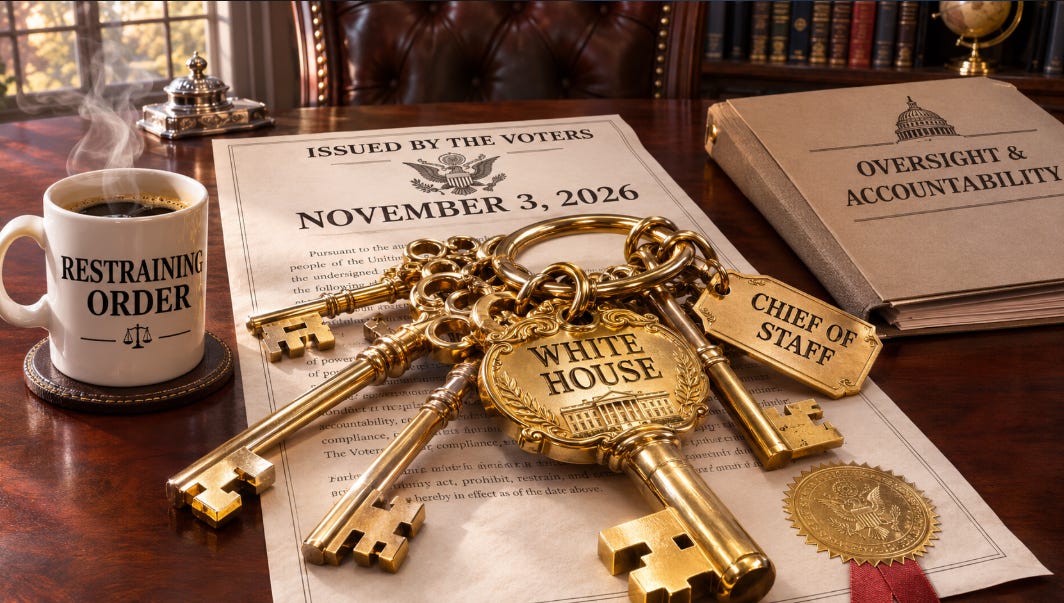
Good morning! On Tuesday, American voters did something they rarely do with this much force: they filed a political restraining order. The message wasn’t subtle. It was a country telling the man in the White House to back away.
By Friday afternoon, Donald Trump had responded. He replaced the chief of staff who’d spent nearly two years keeping his operation on its feet and put Stephen Miller in charge of the locks.
Miller starts Monday. Voters can expect a callback never.
Start with the scale, since the White House would prefer you didn’t dwell on it. Tuesday delivered the largest leftward electoral swing in roughly half a century, and Democrats took both the House and the Senate. In majority-Hispanic counties, the Washington Post measured a shift of nearly 30 points toward Democrats. The Wall Street Journal found Democrats carrying counties with populations at least 80 percent Hispanic by 40 points. Every congressional district touching the Mexican border went Democratic.
Those border numbers deserve a pause. Two years ago, Hispanic voters moved toward Trump in historic numbers. Then came masked raids, immigration dragnets that swept up American citizens alongside their intended targets, and the deaths of two Americans during federal immigration operations in Minneapolis. Voters who had once welcomed Trump’s promises of tougher border security were now confronting the consequences of how those promises were being carried out.
Voters weren’t voting on any one thing. Grocery bills, gas prices inflated by the war in Iran, and a steady drip of corruption stories all made the list. But immigration enforcement was on it too, and the dramatic shifts in Hispanic communities suggest that Trump’s approach had become a substantial political liability. Voters rejected how the policy was being carried out. Trump promoted its architect.
Three weeks earlier, Trump had declared there was “zero chance” Susie Wiles would be replaced and pledged his “COMPLETE confidence” in her. On Friday, asked what had changed, he offered a philosophy worthy of a fortune cookie: “Sometimes in life you have to make moves.” Asked what he wanted Miller to do differently, he said, “Just run things well.” Profiles in vision.
He also called Miller a “great manager.” In fairness, Miller has managed plenty: a staff of dozens, a daily call coordinating agencies, an immigration apparatus that answered to him. What he has managed, though, is compliance, turning presidential directives into orders and making sure they were carried out. Starting in January, a chief of staff needs a different skill entirely: running a White House that must negotiate with an opposition Congress holding subpoena power and the purse strings.
That was precisely the worry of Republican Sen. Thom Tillis, who supports tougher border security and still called Miller “the worst of all possible choices.” A chief of staff, Tillis noted, has to be able to tell the president no. He said he had trouble imagining Miller ever disagreeing with Trump at all.
So what is Miller for? According to the New York Times, his pitch for the job included winding down the Iran war, partly because Trump’s core supporters saw it as a betrayal of his 2024 promises. Plenty of Americans outside MAGA want out of that war too, and if Miller helps end it, good.
The same reporting, though, says people familiar with his views expect him to steer Trump away from his initial post-election instinct to cut deals with Democrats, and toward more hard-line immigration enforcement and renewed attacks on diversity initiatives. Miller’s own statement on his promotion promised to “fight with all of our soul.”
That contrast is the tell. Miller’s reported willingness to wind down a war that alienated Trump’s own supporters should not be mistaken for a broader change of direction. On the domestic policies that have defined his career, the reporting suggests precisely the opposite. Trump heard Tuesday’s message perfectly well. He just decided most of the people who sent it aren’t his audience.
Trump may have concluded that Tuesday changes nothing about his agenda. The Constitution says otherwise about the powers of the incoming Congress. Beginning January 3, the White House will face a legislature with both the authority and the responsibility to examine what this administration has done, how it spent the public’s money, and whether the law was followed.
The administration’s first answer arrived within hours. Rep. Robert Garcia, in line to chair the House Oversight Committee, said Miller “should lawyer up.” Attorney General Todd Blanche replied on Fox: “Stephen Miller has a lawyer. It’s me.” The nation’s chief federal law enforcement officer was publicly volunteering his support for the incoming chief of staff before a single congressional subpoena had been issued.
It tells us something about the administration’s posture, which matters because of the plumbing. Congress can refer criminal contempt cases to the Justice Department, which Blanche now runs, or pursue enforcement through the federal courts. Either route can become a protracted struggle. The Justice Department may represent federal officials in appropriate official-capacity matters, but its institutional obligations extend well beyond protecting presidential advisers. Blanche has already made clear that Miller can count on his support.
An early test may come next week. Pete Hegseth, whose handling of the Iran war became another political liability for Republicans, faces impeachment articles that Rep. Thomas Massie, a Republican, has said he will bring forward. Hegseth’s response to Miller’s promotion included posting a photo of himself with the new chief of staff captioned “Stand. Fight. Defend the Republic.” Whether Massie’s effort advances, Hegseth has made his alliance with Miller unmistakable.
Which brings us to the people voters just put in charge of Congress. Hakeem Jeffries, likely the next speaker, told Morning Joe that Americans “don’t want us to get even,” a line some took as a sign accountability was off the table. It isn’t. Later in the same interview, he argued that corruption carries an economic cost and that Congress should follow the facts and hold wrongdoers accountable. He told NPR that Democrats would pursue affordability and accountability simultaneously, with the Judiciary and Oversight committees responsible for investigating potential wrongdoing.
Good.
The two goals reinforce each other. Investigating questionable spending, exposing conflicts of interest, pursuing the recovery of public money where wrongdoing is established, and closing the loopholes that permitted abuses are not distractions from governing. Oversight can expose waste, inform legislation and help ensure that taxpayer money serves the people who paid it rather than those who may have improperly profited from it.
Congress doesn’t need to prove corruption before investigating credible evidence of misconduct. Finding out what happened is the purpose of an investigation. And when wrongdoing is established, the job doesn’t end with a televised hearing and a sternly worded press release. There are records to recover, legal remedies to pursue, safeguards to strengthen and, where the law permits, taxpayer funds to reclaim.
The voters exercised their power on Tuesday, but their responsibility didn’t end when the ballots were counted. Beginning January 3, Congress will have the authority to legislate, investigate, follow the money and pursue accountability wherever the evidence warrants it. Economic relief and oversight are not competing assignments. Both are part of governing.
Our job now, as citizens, is to make sure the people we elected do theirs. We must measure them not by promises, press releases or televised hearings, but by the laws they advance, the facts they uncover and the results they deliver.
An electoral mandate is not a substitute for doing the work.
Thank you all for your kind words and good wishes. With a little help from some pain meds onboard, my knee has progressed from agony to almost tolerable. I’m counting this as a victory.
Marz, meanwhile, is still keeping a keen eye on the perimeter for squirrels. I’ve informed him that any future squirrel-related emergencies will have to be handled without my knee’s participation.