


Sunday’s uplifting news is arriving on Monday this week, which feels appropriate because apparently even hope can get lost when I am the one responsible for navigation. We were supposed to spend Sunday hiking to Christi’s Spring with my brothers, my sister, Mom, our families and I, carrying the ashes of the man who was their father and, in all the ways that mattered, one of mine too. I had imagined the forest, the hike, the gathering at the cabin afterward and the chance to be there for my brothers in a way that felt meaningful.
There was only one problem. I have ADHD, and directions are not among my spiritual gifts. Somewhere along the way, I entered the wrong destination into the GPS, and by the time we figured it out, we were more than an hour from where we were actually supposed to be.
We’d missed the hike. I was heartbroken. For a while, we considered staying and meeting everyone at the cabin later, but the kids had already spent hours in the car. They were hot, tired and hungry, and sometimes caring for the people you love means admitting that the day you planned is no longer the day everybody needs. So we went back into Medford, took the kids to the mall, fed them, let them move around, and eventually pointed the car toward home. It wasn’t the goodbye I had imagined for Papa Juice. But somewhere on the way back, I began to understand that it was still a kind of tribute.
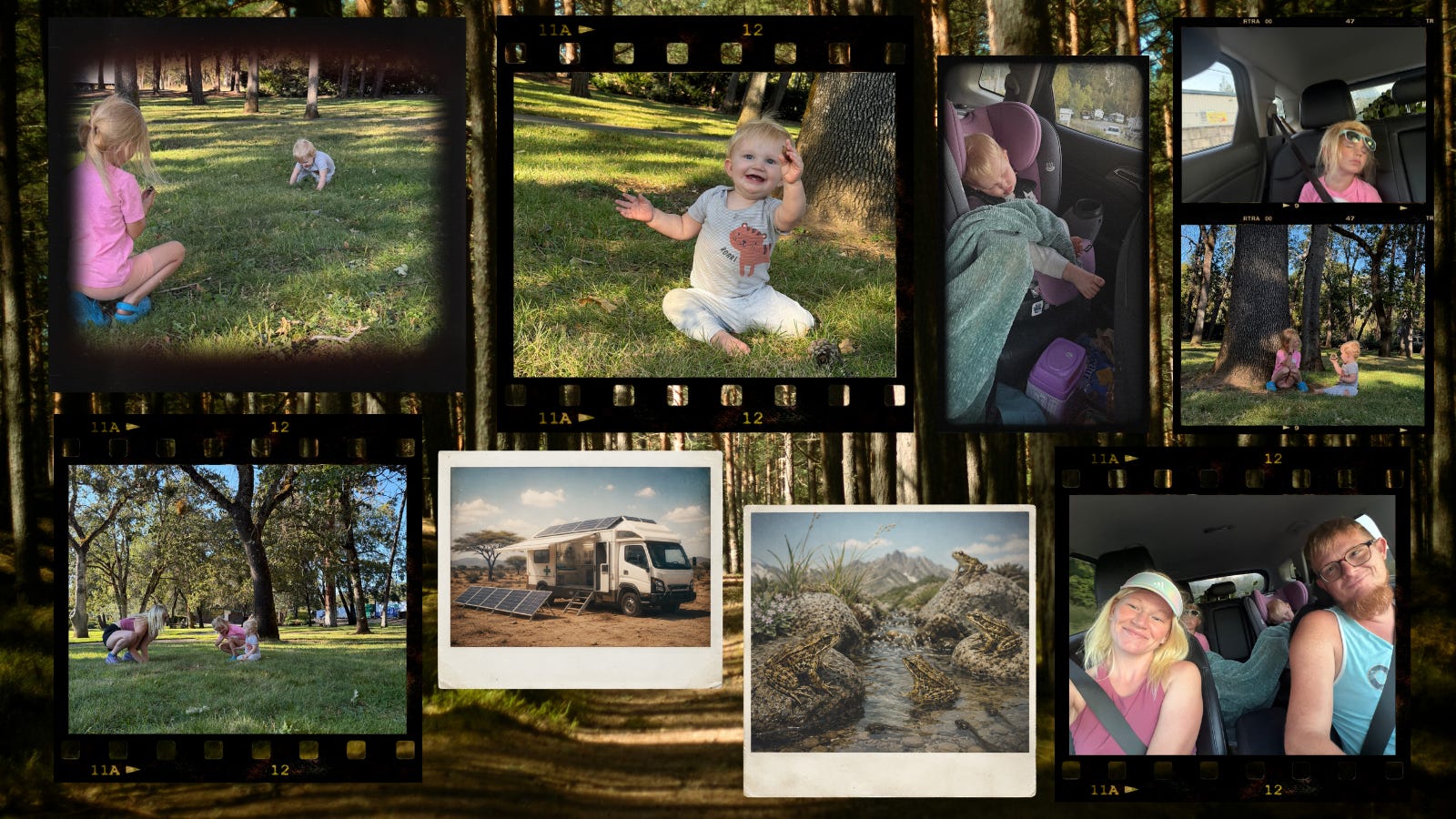
At a rest stop, we let Ezra loose in the grass after far too many hours confined to his car seat, and he took off crawling like a tiny man with appointments. My husband had started collecting acorns to see whether he could germinate them, and Ezra quickly decided this was now his occupation too. He crawled around gathering acorns, then held each one up toward us with the biggest grin on his face, waiting for us to notice what he had accomplished. He wanted us to be proud of him. Naturally, we were.
His sister had spent the whole trip being the kind of big sissy that makes my heart ache in the very best way. At the Airbnb, Ezra nearly knocked over a small table, and before anyone else could react, she stepped directly between him and it and took the hit herself so he wouldn’t get hurt. She is four years old, and she did not hesitate.
We had driven all that way hoping to show up for the people we love, and somehow, all around me, my children kept demonstrating exactly what that means. I didn’t get to be there for my brothers in the way I had hoped, and I’m still sad about that. I think it would be dishonest to transform that disappointment into some grand declaration that everything happened exactly as it should have. Sometimes we make mistakes, sometimes they cost us moments we wanted very badly to have, and there isn’t always a profound cosmic reason for it. Sometimes Mom just puts the wrong place into the GPS, but disappointment doesn’t erase everything beautiful happening around it.
My beautiful family didn’t let me stay heartbroken for long. We celebrated Papa Juice in the way that remained available to us: by being together, by taking care of one another and by paying attention to the life still happening right in front of us. And there was so much life to notice. The drive wound through mountains and forests that smelled exactly as promised, overwhelmingly and beautifully of pine. We found a grove of aspens shimmering beside the road. We passed through a valley scattered with lava rock. We watched the landscape change around us mile by mile, each turn revealing some new piece of the natural world we hadn’t expected to see.
It wasn’t the journey we planned, but we were together, and we were lucky enough to notice where we had ended up. Perhaps that’s what care so often looks like, it’s simply paying enough attention to recognize what the living things around us need, then being willing to adjust. Which brings me, rather perfectly, to several thousand tiny yellow-legged frogs.
The mountain yellow-legged frog was once abundant in the mountains of Southern California, hopping and swimming through cold mountain streams long before any of us arrived with roads, GPS systems or the impressive human ability to get ourselves spectacularly lost. Then their world changed; disease arrived. Non-native trout preyed on them and disrupted their habitat. Wildfires, drought and other pressures followed. Populations of the Southern California mountain yellow-legged frog fell by more than 98 percent.
There are moments in conservation when the numbers become so terrible that extinction begins to feel less like a possibility and more like an appointment, but people refused to accept it. For roughly two decades, conservationists from the San Diego Zoo Wildlife Alliance and their partners have been breeding mountain yellow-legged frogs, studying the threats against them, restoring habitat and learning how to prepare animals raised in human care for a world considerably less controlled than a conservation center.
They have even learned that raising a frog for release isn’t as simple as producing a healthy frog and politely pointing it toward the mountains, young frogs need practice. Researchers have experimented with exposing them to artificial currents while they’re still developing, essentially giving tiny endangered frogs a swim gym before sending them into real mountain streams. Scientists are studying their skin microbiomes and investigating beneficial microbes that may help protect them from chytrid fungus, the devastating disease that has hammered amphibian populations around the world.
There are human beings spending their working lives developing skincare routines for endangered frogs, and if that doesn’t restore at least a small portion of your faith in our species, I’m not sure what will. This year, all of that patient, strange, meticulous work put more than 3,000 mountain yellow-legged frogs and tadpoles back into Southern California’s San Bernardino and San Jacinto mountains. More than 10,000 have now been returned through the broader conservation effort.
That doesn’t mean the frogs are saved. Releasing thousands of animals doesn’t magically remove disease, drought, predators or a changing climate. Researchers will have to keep monitoring them, learning, adapting and trying again. That may be the part I love most. Hope in this story is refusing to disappear just because the danger did not. It’s looking at an animal whose population has collapsed by more than 98 percent and saying there is still enough here to fight for. It’s rebuilding the conditions that allow something vulnerable to remain where it belongs.
And sometimes, the problem is not that the vulnerable need to be carried home, sometimes it’s that everything they need is too far away. We have learned something about that ourselves while arranging Ezra’s MRI. The technology, the doctors, and the care all exist. Yet when you live in a rural community, the existence of medical care somewhere and your ability to actually reach that care can be two very different things. Our circumstances are, of course, very different from those faced by families in remote parts of Kenya, where distance can be compounded by far more profound shortages of electricity, equipment and medical infrastructure. But the underlying question is one I recognize immediately.
What do we do when the person who needs care can’t easily get to the place where care exists? Twenty-three students in the Netherlands decided to ask whether we have been thinking about that problem backward. Instead of always moving the patient toward the hospital, why not move the hospital toward the patient? They built Stella Juva, a solar-powered vehicle that looks like an ambulance but functions more like a clinic capable of bringing medical technology into communities where both healthcare and reliable electricity can be difficult to reach.
On board are an X-ray machine, an ultrasound scanner and refrigerated storage for vaccines. Solar panels cover the roof, with additional panels that can extend when the vehicle stops, allowing the same sun beating down on the road to provide the electricity needed to deliver care once the journey ends. This month, the students took Stella Juva across more than 800 kilometers of Kenya to find out whether their beautiful idea could survive contact with reality. It traveled long distances, handled difficult roads, and reached a clinic without electricity.
Then they unfolded the panels and turned on the medical equipment. While stationary, Stella Juva generated more energy than all of its onboard medical equipment consumed. The equipment wasn’t used on real patients during the test, an important distinction when celebrating a prototype, but the team estimates that roughly 200 people could have been served during a two-day period. There’s still a long distance between a successful prototype and fleets of solar clinics traveling throughout rural communities, and funding, manufacturing, maintenance and local healthcare systems will determine whether Stella Juva becomes something larger than an extraordinary experiment.
Still, twenty-three students looked at one of humanity’s oldest problems, the distance between suffering and help, and decided distance itself was something they could work on. I love that. Sometimes care looks like thousands of tiny frogs returning to mountain streams because generations of scientists refused to accept their disappearance. Sometimes it looks like twenty-three students driving an experimental hospital across Kenya because they refuse to accept that a person should go without an ultrasound simply because electricity and equipment happen to live somewhere else.
Sometimes it looks much smaller. A four-year-old girl sees a table falling toward her baby brother and steps between them. A father wanders through the grass collecting acorns because perhaps, with enough patience, one of them will become a tree. A baby watches him, understands only that Dad is doing something important, and begins collecting acorns too, holding each one in the air with a smile that asks the people he loves whether he has done well.
And sometimes it looks like turning the car around. I wish I had entered the right destination yesterday. I wish I’d been standing beside my brothers when they said goodbye to their dad. I wish I’d smelled the pine from the trail instead of through an open car window, and I wish the story I’m telling you today included the spring and the hike and all the things I thought I would see. I can’t make that mistake meaningful simply because I would prefer it that way. What I can do is notice what survived it; love.
It was there in the front seat beside me, dancing in sunglasses in the back, and crawling through grass collecting acorns. It was in the mountains, in the aspens, in the strange valley of ancient lava rock and in every mile our family traveled because we wanted to be near the people we love. Papa Juice was being carried somewhere beautiful by people who loved him. Thousands of frogs were being carried home by people who refused to lose them. And halfway around the world, a group of students were building a machine capable of carrying medicine down roads it had never traveled before. Maybe that’s enough of a reminder for this Monday. We’re not required to believe everything works out perfectly.
Hope asks something much more difficult of us: pay attention to what is still alive. Protect it, carry it when you can, make the road easier for whoever comes next, and, perhaps most importantly, if you happen to find an acorn along the way, pick it up. Someone you love might be trying to grow a tree.
A friend once said a secret of living well is adapting to change like a recalibrating GPS signal for a new route. You did just that to build a wonderful day that honored the spirit of the original plan.
This is beautiful and a reminder that we all make mistakes. While it wasn't the trip you planned, looking for the good (and the magic) makes all the difference. Take care and continue being kind.