


Good morning! At an Oval Office event ostensibly about beef, a rancher told the President of the United States that wolves are “very violent.” Trump agreed, and for a few minutes the conversation proceeded the way conversations about vermin proceed: the wolf appeared principally as a problem to be removed.
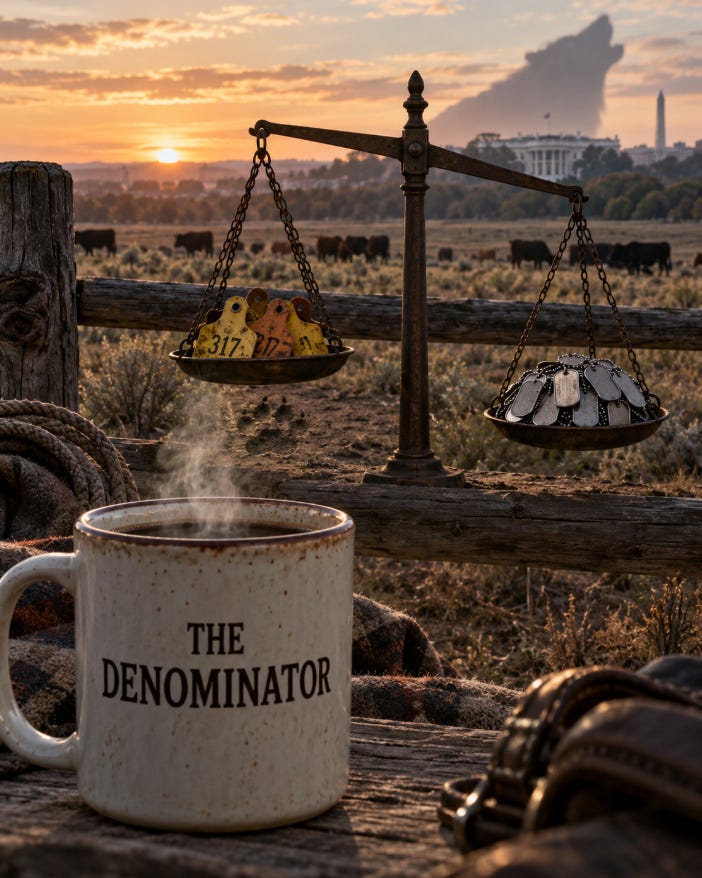
Somewhere in the middle of it, Trump asked whether wolves are beautiful. No one asked whether wolves have any claim on the landscape beyond the inconvenience they cause us, whether they are entitled simply to exist, thrive, and continue evolving as wild animals.
The thought went no further.
That is worth sitting with, because one of the executive orders Trump signed that day sets in motion a process that could substantially reduce federal protections for gray and Mexican wolves. It directs the Interior secretary to determine within ninety days whether the wolves meet the criteria for delisting or downlisting under the Endangered Species Act, prepares the ground for legislation to do the same and calls for reconsidering federal rules governing lethal removal when wolves threaten livestock.
The conflict itself is much older. Mexican wolves were nearly eradicated from the United States after decades of extermination campaigns driven largely by conflict with livestock. They were listed as endangered in 1976 and returned to the wild in Arizona and New Mexico in 1998. Gray wolves were reintroduced elsewhere in the West during the same general period.
And now we are arguing about them again.
The trouble is that “very violent” is not a measurement. It is a mood.
So before asking what the executive order proposes to do about wolves, it is worth asking a duller, more answerable question:
How many cattle are wolves actually killing?
In Oregon, the answer is: not many. State investigators confirmed wolves killed 87 cattle in 2025, a real increase, and a real cost to the ranchers who absorbed it. But Oregon has roughly 1.2 million cattle and calves. Eighty-seven animals out of that herd is a rounding error, not a crisis. And Oregon already has a program built for exactly this problem: it paid ranchers in full for every confirmed loss last year, and spent most of its wolf-management budget on the fencing and range riders meant to prevent the next one. The legislature just made the compensation formula more generous still, although it did not fully fund the expansion. None of that erases what an individual rancher loses when a wolf kills a calf. It does mean the state has already been treating this as the manageable, bounded problem the numbers say it is right up until Friday, when the federal government decided it wasn’t.
It is the part of the press conference worth returning to, because it wasn’t really a conversation about wolves. It was a conversation about whether a rancher should ever have to tolerate a cost he didn’t choose, and the answer, arrived at without a single number changing hands, was no. Not from wolves, not from the “big four” meatpackers, not from Mexico or Canada or the Federal Reserve. The wolf executive order shares its DNA with everything else signed that day: an instinct that any friction between a person and their profit is, by definition, an injustice waiting to be corrected by presidential decree.
For the first few minutes, at least, the event remained recognizably about ranching.
Then came roughly fifty minutes inside a pinball machine.
The conversation ricocheted from wolves and meatpackers to guns and the border, Mexico and Canada, interest rates and campaign money, Putin, Xi Jinping, the Nobel Prize, the new White House helipad and, eventually, Iran. By the end, an Oval Office event that had begun with meat-processing rules, cattle markets and wolf management had become a discussion of whether eighteen dead Americans constitute a large enough number to call a war a war.
The same instinct showed up in a different register entirely when a reporter asked the President whether the country is at war with Iran. “I call it a military conflict,” he said, “because it’s small potatoes for us.” Eighteen American service members have died since the strikes began. He knew the number, he cited it himself, unprompted, three sentences later, while explaining that Vietnam was worse.
The comparison isn’t really an argument. The National Archives records 58,220 U.S. military fatal casualties from the Vietnam War, not the “100,000” the President cited. And the length of a deployment has nothing to do with the length of a war, a distinction retired Lt. Gen. Mark Hertling made pointedly on The Bulwark’s Command Post that same evening.
The comparison of scale does one thing: it makes eighteen deaths feel small by standing them next to a much bigger number. Nothing about the eighteen changes. Only the frame does.
Ask the families of those eighteen dead service members how small the number feels.
Trump did later acknowledge that “one is too much.” It came and went in half a sentence, the same way “are they beautiful” came and went. But the larger argument remained the same: eighteen was being presented as comparatively minor because other American wars had killed far more.
Trumpotato. A unit of measurement in which a human cost becomes acceptable not because it’s been justified, but because something worse exists somewhere else to measure it against. It’s the same reasoning that made Sleepy Joe Biden’s thirteen dead at Kabul airport a bigger scandal, in the President’s telling, than his own eighteen, as though grief were a leaderboard, and the only way to lose the game is to have the higher score.
Hertling, who spent much of his career thinking about what military force can and cannot accomplish, reacted later that day on The Bulwark’s Command Post. The episode was devoted specifically to Trump’s “small potatoes” remarks. Hertling has also argued repeatedly in his military analysis that destroying targets is not the same thing as achieving a political objective; tactical destruction has to connect to some attainable strategic end.
Body counts cannot answer the question Trump was being asked. Eighteen is unquestionably smaller than 58,220, but it does not follow that eighteen is therefore small.
Comparing the duration of the Iran conflict with Vietnam doesn’t tell us whether the current objective is achievable, whether the means are proportionate to the objective, whether the campaign is moving closer to an end, or what those eighteen Americans died to accomplish.
Trump answered those questions with a denominator.
Ranchers do face a difficult market. Small processors do face barriers. Wolf attacks have risen sharply in parts of the Northwest even while remaining a tiny fraction of aggregate cattle losses. The government already compensates producers and pays for prevention, and there is a legitimate debate over whether those programs are sufficiently funded and whether current wolf-management rules strike the right balance.
Iran presents rather larger questions. The conflict is now more than six months old. Eighteen Americans are dead, many more are wounded. The United States has spent tens of billions of dollars, and military exchanges continue. On Saturday, barely a day after Trump called the conflict “small potatoes,” U.S. forces struck three Iranian oil tankers after the military said missiles had been fired at American warships. Call it what you want but it is ongoing.
"Ask the families of those eighteen dead service members how small the number feels" 😢Those of you with no military connections may not know, but because this is 'not a war' it's costing those families, and all the soldiers who have been injured, Real Money!
The wolf fight and the wild horse fight are really variations on the same Western argument: who gets to use the land, who gets the forage and water, and whose economic interests carry the most political weight. Wolves are treated as an intolerable threat to cattle even when the actual losses are tiny and compensated.
Mustangs are treated as an ecological burden even while cattle and sheep continue grazing on the same public lands. When wildlife and livestock collide, the argument is rarely just about biology. It is about land, resources, and money -- as I discuss here:
https://jaywilson1.substack.com/p/what-is-a-wild-horse-worth?r=10sd39