


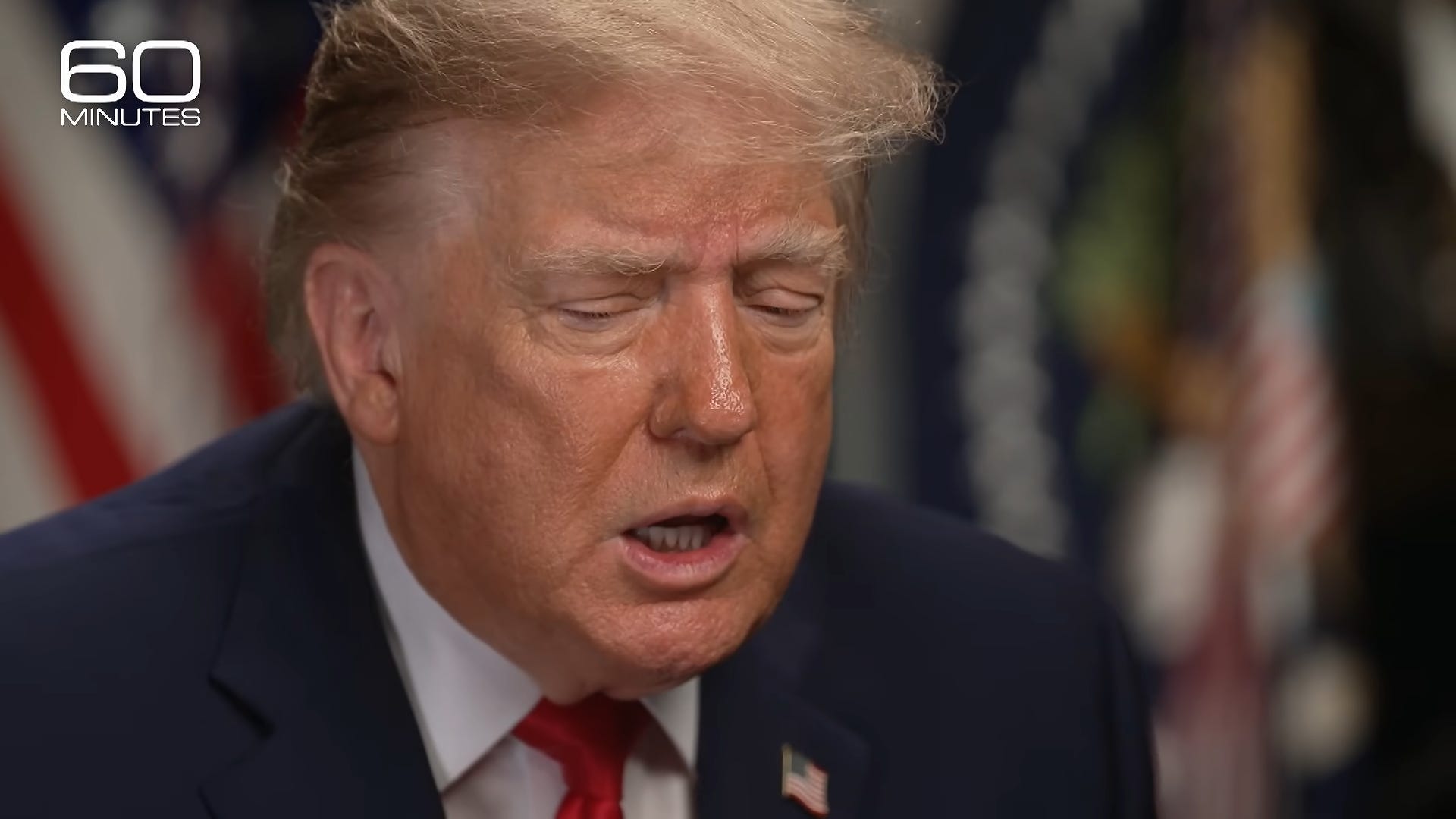
Donald Trump appeared on 60 Minutes on Sunday night to discuss his presidency, his party’s election losses, his finances, the future of humanity, and his prospects in the afterlife. By the end, I felt that heaven should request references.
The interview with Ross Douthat offered something for everyone: investment advice for people who have misplaced their billions, a surprise inspection of military haircuts, and the possibility that George Washington would have understood cryptocurrency if only someone had brought a laptop to Valley Forge.
Through it all ran a remarkably consistent argument. Donald Trump has done wonderfully. Any evidence suggesting otherwise has arrived improperly labeled. Consider the economy.
Asked why Americans weren’t feeling the benefits of the prosperity he described, Trump blamed “bad messaging,” allowing that perhaps some of the responsibility for that belonged to him. A moment of reflection. Brief, but visible. Like spotting a deer beside the highway before it disappears into the brush.
Then we were back to the familiar complaint that the press doesn’t adequately report how well everything is going. There it is. Your household budget has a communications problem. You thought the issue was that the money leaving your account kept exceeding the money entering it. Apparently, the president’s explanation of your prosperity hasn’t reached you. Check your spam folder. There may be three billion dollars in there beside the coupon for printer ink.
This became an especially helpful possibility when Douthat raised a Forbes estimate of a roughly $3 billion increase in Trump’s wealth. Trump suggested everyone had benefited. When Douthat explained that his own fortune had not increased by that amount, the president supplied the missing ingredient.
“You should have had stock.”
Of course. I knew I’d forgotten something. Milk, bread, three billion dollars in capital appreciation. You get distracted trying to remember which child needs collecting from which building, and suddenly you’ve squandered another opportunity to become a financial dynasty.
Somewhere, a woman working a double shift is going to be furious when she discovers that wealth was available through the simple expedient of already having enough money invested. There’s also a problem with Trump’s explanation of his own gains. PolitiFact’s review found that the bulk of the increase came from sources other than ordinary stock holdings, particularly cryptocurrency ventures.
Even the financial advice needed a financial adviser. Douthat then asked about the conflicts surrounding World Liberty Financial, the Trump family’s crypto business, and investors connected to the United Arab Emirates. Wouldn’t Trump consider a comparable arrangement involving the Bidens corrupt? Trump’s defense included his own lack of knowledge about the business.
An interesting qualification for the man selling himself as the person who understands money better than everyone else. Apparently, his financial expertise is highly responsive to the question being asked. When there’s credit available, he is the conductor of the orchestra. When somebody asks who paid for the violins, he has never heard music.
The conversation wandered through his sons, investment managers, and the proposition that presidents have always faced conflicts, going back to George Washington. When Douthat pointed out that presidents hadn’t always owned cryptocurrency companies, Trump invoked “whatever crypto was at the time.”
I am delighted to announce the discovery of FoundingFatherCoin. An exciting opportunity for the discerning colonial investor. Limited supply. Revolutionary potential. Your password is written on parchment, and if you lose it, Benjamin Franklin can’t help you.
Washington had substantial private interests, and the relationship between wealth and political power has a long, ugly history. That history gives us reasons to examine presidential conflicts carefully. Trump seemed to be presenting it as a loyalty program in which enough previous misconduct earns the next customer a free pass.
Then came immigration, where he acknowledged that his deportation policies might have been too harsh and suggested working with Democrats on a deal.
That admission matters. So does what followed the interview’s recording: he elevated Stephen Miller, a principal architect of the hardline immigration agenda, to chief of staff. The patient has identified excessive caffeine as a problem and appointed an espresso machine his primary care physician.
Mom has already covered Miller’s promotion, but it belongs in this interview’s trail of contradictions. A president can express concern about the consequences of his policies. His staffing decisions tell us who will be helping produce the next set of consequences. The people living with those decisions deserve more than a thoughtful sentence followed by a personnel announcement that kicks the sentence down the stairs.
On war, the same habit of self-congratulation became considerably harder to laugh at.
Trump defended his record, talked up victories, and promised eventual success. Discussing Ukraine, he identified the hatred between Putin and Zelenskyy as an obstacle to peace. When Douthat noted the obvious difference between invading a country and having your country invaded, Trump brought up disrespect toward Russia.
Disrespect.
A sovereign country is fighting for its survival, and somehow the conversation has reached the question of whether the invader felt sufficiently appreciated. Imagine reporting a burglary and being asked whether you’d made the man carrying your television feel welcome.
The moral difference should be easy to locate. It doesn’t require a summit, a gilded conference table, or six weeks of consulting the television.
Artificial intelligence brought another round of confidence. Trump emphasized the competition with China and said the risks could be managed. He also expressed openness to safeguards, provided they didn’t leave the United States far behind.
That opening deserves follow-up. What safeguards? Who enforces them? What happens when a company’s ambitions collide with the public’s safety?
These are questions that require answers more substantial than assurances that somebody brilliant has it handled. Most of us have heard that sentence immediately before being handed a project that is on fire.
Then Douthat asked about UFOs, and the interview briefly escaped Earth’s regulatory environment. Trump described military pilots who had told him about strange aerial encounters. In the extended interview, he also spent time admiring their looks, their haircuts, and their resemblance to Tom Cruise.
We have reached the national security briefing’s swimsuit portion. An unidentified object is apparently exceeding the capabilities of American aircraft, but first, let us establish that the witnesses have excellent bone structure.
I would like to think that if aliens are monitoring our broadcasts, this is the moment one of them quietly cancels the landing. They crossed unimaginable distances hoping to make contact with humanity. They’re going to be told they look tired and asked whether their spacecraft could be finished in gold.
And finally, having visited the economy, immigration, war, private wealth, artificial intelligence, and outer space, the interview arrived at the one jurisdiction where Donald Trump can’t appoint the management.
Heaven.
Douthat posed a hypothetical: if entering paradise required forgiving political opponents such as Nancy Pelosi and James Comey, could Trump do it?
He couldn’t bring himself to say yes.
“I do hate some of my enemies, and I always will.”
Eternal happiness. One condition. And Donald is at the reception desk asking whether Nancy Pelosi has to be included.
Most of us hesitate to buy the enormous bag of spinach because we can’t guarantee our intentions through Thursday. This man is prepared to maintain a grudge beyond the collapse of his physical body.
Somewhere, eternity has acquired a records retention problem.
Even at the imaginary gates of heaven, Trump was looking for an exception. Again and again, Trump encounters a question that might require him to reconsider something about himself. Again and again, he finds a route back to his own exceptional treatment.
Americans should recognize their prosperity. Critics should accept his explanations. Historical precedent should excuse the conflicts. The world should appreciate his deals. Even an imaginary offer of eternal peace cannot quite persuade him to put down the grievance.
That habit has consequences while he holds public office. A president’s resentment comes with staff, a microphone, and institutions that can be pressured to accommodate it. His confidence shapes decisions affecting people who have no opportunity to interrupt and ask a follow-up question.
We need those questions asked anyway.
How do families afford their lives? Who benefits from presidential decisions? What limits apply to the people making them? Who is responsible when the promises fail?
An interview can expose the evasions. Congress, journalists, courts, and the public have to keep pursuing the answers. Because the rest of us are living here, paying for the decisions, and trying to build a future our children can inhabit.
Donald, meanwhile, has reviewed eternal paradise. He would like to speak to the manager.
Hahahaha!!! That was a memorable interview.
Our question is this: what the hell drugs was Trump on??