


Good morning! Trump walked into the Black History Month celebration like a man who had been told there would be history, but assumed they meant real estate history. He opened by proudly announcing… a ballroom. Nothing says “100 years of Black History Month” like explaining that the White House is finally getting the event space it supposedly “needed” for 150 years.
He then pivoted into what can only be described as a strange, backhanded eulogy for Jesse Jackson, calling him “a piece of work, but a good man,” and assuring the audience that “as you got to know him, he got better and better all the time.” He praised Jackson’s “serious street smarts,” describing them as a “very important ingredient to life,” as though decades of civil rights leadership could be distilled into the skill set of a particularly savvy neighborhood dealmaker. In Trump dialect, “piece of work” hovers somewhere between compliment and critique, and “street smarts” becomes a catch-all tribute — less a reflection on moral courage than on tactical grit.
Then came the inevitable “I have Black friends” portion of the program. Trump began listing famous Black athletes as character witnesses. Muhammad Ali. Mike Tyson. “Whenever they say Trump’s a racist,” he recounted, Tyson says, “He’s not a racist, he’s my friend.” That remains his gold-standard defense.
And then he arrived at Pro Football Hall of Famer and civil rights activist Jim Brown.
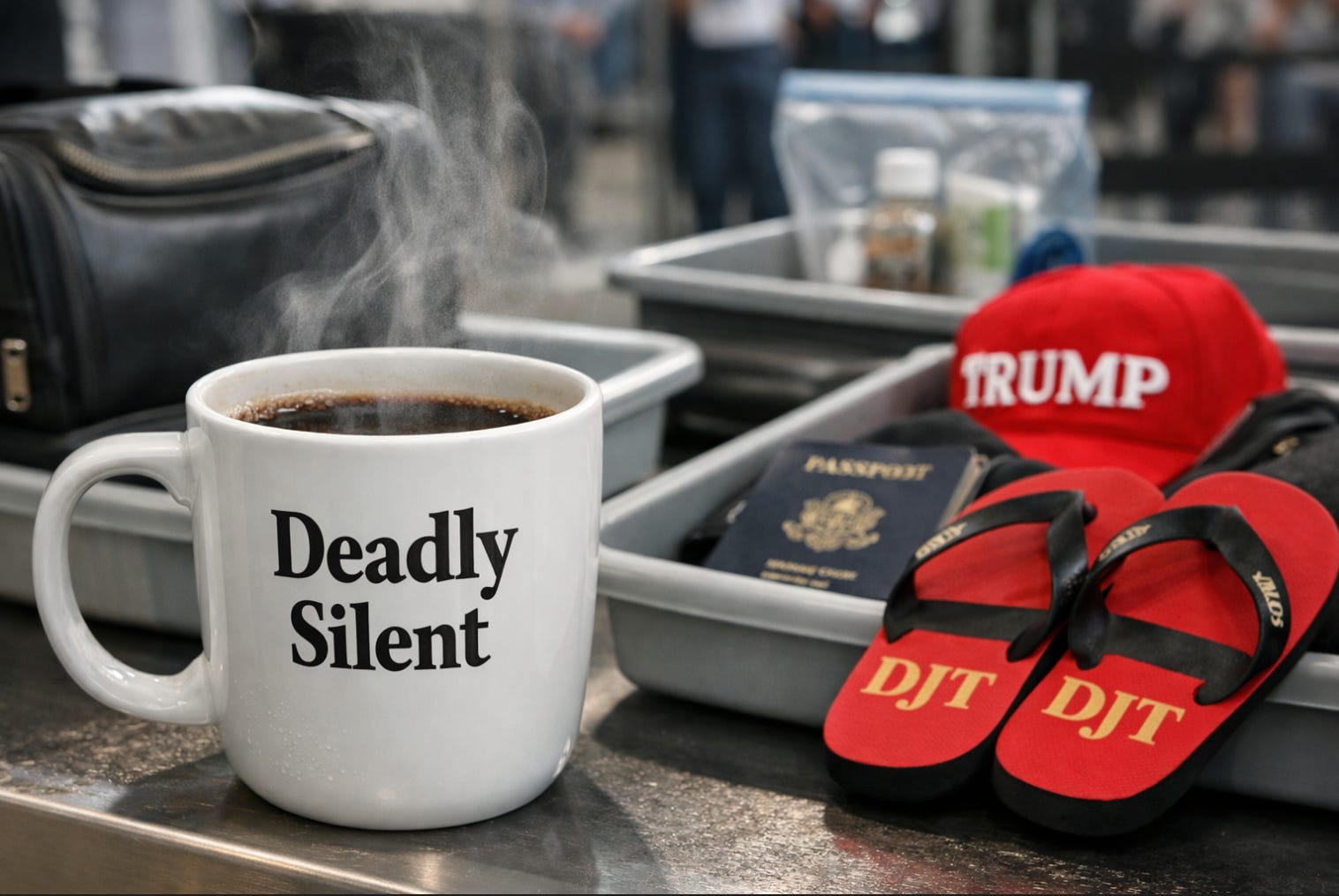
“He came in and was very silent. Silent but deadly,” Trump said, delivering the phrase with complete solemnity, apparently unaware of how that expression circulates in modern American vocabulary. “He would look at people, and if he didn’t like them, he’d look at me and go, ‘That’s no good.’”
It was meant to convey quiet gravitas, the aura of a formidable presence who didn’t need to speak loudly to command a room. Instead, it landed with the awkward energy of someone confidently using a phrase they’ve only half-heard before. One of the most important athletes and activists of the twentieth century was reduced to an ominous side-eye anecdote, filtered through Trump’s preferred storytelling lens: who approved of him, who signaled loyalty, who validated his instincts.
The subtext was unmistakable. A roll call of famous Black men who once stood near him, as if proximity equals absolution. The stories were less about them and more about him, who liked him, who defended him, who was “loyal.”
From there, the ceremony took on the tone of a tribute banquet. One by one, invited guests offered praise for the president’s leadership, while Trump stood soaking it in.
Scott Turner thanked him for his “heart for America,” insisting that when Trump says “America First, he really does mean America First.” Leo Terrell declared Americans are living “under the administration of the greatest president in our lifetime” and that the country is now “the hottest country in our lifetime.”
Alice Johnson, the formerly incarcerated woman whose life sentence Trump commuted during his first term and who has since become a prominent clemency advocate, shared deeply personal gratitude. “I fell in love with this man… with his heart for this country,” she said. “Don’t let anyone tell you that this president right here, Donald Trump, is not for Black America, because he is. I’m standing here today as a testament.”
Johnson’s story is undeniably powerful. Her second chance is real, but the way the moment was framed, folded into a broader narrative of personal loyalty and presidential benevolence, shifted the focus back to Trump himself. When he responded with, “When I met her, I fell in love. My wife was very upset,” and assured the room she was “cleaner than anyone in this room,” the tone slid from solemn to theatrical. Even in moments that belonged to others, the spotlight found its way back to him.
Without warning, the speech veered into familiar grievance terrain. Trump claimed he “saved” historically Black colleges and universities, telling the room, “They had no funding… and we took care of the historically Black colleges and universities.” He attacked Harvard as “extremely discriminatory” and urged his Justice Department, “Good, you keep suing them. To hell with them.”
He boasted about stock market records. “We broke it before the end of my first year… They said we couldn’t do it in four years, we did it in one year.” He called Biden “an idiot,” declared, “He didn’t win the election,” and insisted “they cheated,” adding that the silver lining was that waiting four years meant he now gets to preside over the Olympics and the World Cup. “The good thing,” he said, “when they cheated… I get the Olympics… I got the World Cup.”
At one point, while attempting to honor Black cultural contributions, he drifted from jazz and blues to rap and then into commentary about Nicki Minaj’s nails and skin. “Are they real?” he wondered aloud. The gravitational pull of the beauty pageant judge remains undefeated.
He claimed crime is down for the first time in 125 years, described Washington as one of the safest cities in the world, and suggested that the DOJ might need to get involved with the “fake news,” warning, “We have to get LEO and the DOJ involved.”
And then came the line that should have stopped the room cold. Speaking about federal intervention in cities, he said, “Sometimes we have to force ourselves upon them.”
That is not a sentence any president should utter under any circumstance, like ever.
The evening closed with him wishing everyone a “Happy Black History Century,” which is not, to anyone’s knowledge, an officially recognized unit of time.
While Trump was busy admiring celebrity nails and threatening to “force” federal power onto cities “whether they like it or not,” something far more consequential was happening elsewhere, under oath.
In Ohio, the House Oversight Committee deposed Les Wexner, the longtime Victoria’s Secret chairman and the billionaire patron whose wealth helped make Jeffrey Epstein possible. Democrats showed up; Republicans reportedly did not. According to Rep. Jasmine Crockett, Wexner acknowledged in the deposition that roughly a billion dollars had either been given to or lost to Epstein over the course of their relationship, an astonishing sum by any standard.
This is the man who granted Epstein sweeping power of attorney, entrusted him with extraordinary access to his finances, and provided the financial credibility that enabled jets, properties, and the infrastructure that later became central to Epstein’s trafficking operation. He sat before lawmakers under oath while the other party, which routinely demands answers about the Epstein files, couldn’t even be bothered to sit in the room.
Wexner’s spokesperson insists he had no knowledge of Epstein’s crimes. Wexner claims he was duped by a con man. And yet survivors have said for years what should be obvious to anyone with a functioning moral compass: follow the money. Epstein was not a lone wolf operating on vibes. He was a financed operation. A network with a balance sheet.
The most jaw-dropping detail to emerge from the deposition was this: Democratic members say Wexner told them that the FBI and the Department of Justice never reached out to interview him. Never. One of Epstein’s primary financial benefactors, the man whose wealth underwrote Epstein’s legitimacy, allegedly never formally questioned by federal investigators. If accurate, that is a flashing red warning light about how incomplete, and how protected, this entire story has been.
Survivors like Annie Farmer reacted with disbelief. Epstein’s crimes were monstrous, but the systems that allowed them to continue, the money, the silence, the institutional reluctance to interrogate the powerful, are what make this scandal metastasize.
The White House is busy launching its newest foreign policy brand: Trump’s Board of Peace, a title so grand it practically demands a gold-plated plaque. The inaugural meeting is set for Washington this week, hosted at the newly renamed Donald J. Trump Institute of Peace, because nothing says “neutral international diplomacy” like slapping your own name on the building.
The Board was initially framed as a Gaza reconstruction initiative. Now its mandate has ballooned into a catch-all conflict club meant to rival the United Nations itself. The White House has hinted the summit will largely function as a fundraising round, with Trump boasting of $5 billion in pledged support and “thousands” of personnel committed to an International Stabilization Force, details offered with the familiar opacity of a Trump promise: grand, vague, and suspiciously unaccompanied by public agendas or enforceable commitments.
Major European allies have declined to participate. The UK, Germany, France, Ursula von der Leyen, all out. Canada was uninvited after criticism. Pope Leo XIV declined to join, with the Vatican politely suggesting that perhaps global crises should be managed through the United Nations rather than an ad hoc Trump-branded council that might allow Trump to remain chairman indefinitely. When the Pope turns down your peace board, that is a theological side-eye.
On the ground, Gaza remains devastated. Aid is still severely limited. Reconstruction is stalled by restrictions so extreme they include metal tent poles. The technocratic committee meant to administer Gaza is stuck in Cairo, unsure what authority or budget it even has. There is reportedly an office inside Gaza labeled “ISF” for the stabilization force, but no one is inside.
And as this peace-themed fundraiser unfolds, the Pentagon is simultaneously moving enough firepower into the Middle East to make a real mess. NBC reports the U.S. is sending additional warships, submarines, air defenses, and a second aircraft carrier toward the region in preparation for possible strikes on Iran, depending on Trump’s decision. Diplomacy is technically ongoing, while indirect talks continue. The White House insists progress is being made.
Options reportedly range from limited strikes on missile sites and nuclear facilities to broader operations aimed at regime weakening, even “decapitation” strikes against leadership. Iran, meanwhile, has repeatedly warned about closing the Strait of Hormuz, through which roughly 20 percent of global oil supply flows. The Board of Peace may be meeting in Washington, but the real foreign policy is steaming across the Atlantic.
Finally, because the branding must never stop, Trump’s family business has reportedly filed trademarks for “President Donald J. Trump International Airport,” “Donald J. Trump International Airport,” and even “DJT” as a possible airport code, as Florida Republicans advance legislation to rename Palm Beach International Airport after him. The trademark filings include airport-themed merchandise, including luggage, animal carriers, and shoes meant to protect passengers’ feet during TSA screening. Nothing says presidential legacy like monetizing the security line.
On that note, it’s nippy here tonight, rain coming down hard, the lights flickering like they’re auditioning for their own Trump speech, and lightning expected before morning. So rather than wake up to a powerless house and an unfinished draft, I figured I’d pound this out now and schedule it for sunrise. That way, if I sleep in, hopefully no one will notice… and if the grid gives up overnight, at least this roundup won’t.
Given Trump’s copious consumption of carbonated beverages and fast food, it’s surprising he’s not more familiar with the expression “silent but deadly.”
Hmmm…an international stabilization force sounds suspiciously like we will help you put down any opposition to your rule.