


Good morning! Eight days ago, asked to define the word “ceasefire,” Donald Trump offered this: “in that part of the world, ‘ceasefire’ is when you’re shooting in a more moderate manner.” He said it with a smile, to laughter from the officials behind him. “It’s not bad. But it’s true.”
This morning, the shooting is no longer especially moderate. The United States and Iran traded fire overnight in the sharpest escalation since the April 8 truce, American strikes on southern Iran, Iranian missiles and drones on U.S. targets in Bahrain, Kuwait, and Jordan. The “ceasefire” is still, officially, in effect, simply redefined down to the point where it can survive almost anything, including its own violation.
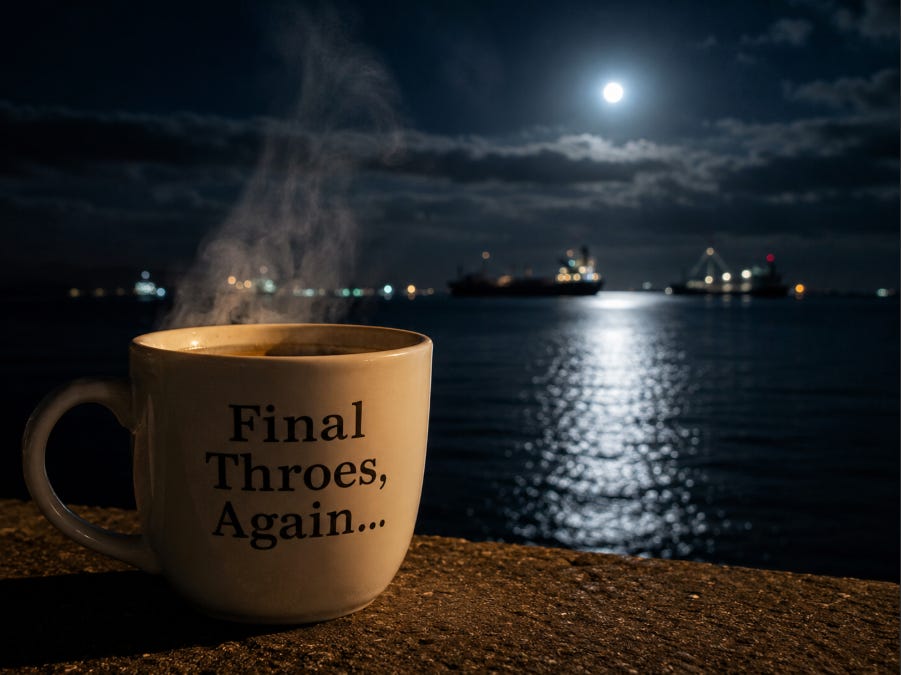
The U.S. and Iran have now exchanged fire in the most serious flare-up since the April 8 ceasefire, a phrase that keeps becoming less a description of events than a decorative label someone forgot to peel off the box. The immediate trigger was the downing of an American Apache helicopter over the Strait of Hormuz. U.S. Central Command called the American response “self-defence strikes” against Iranian targets in southern Iran, while Iran retaliated with missile and drone attacks on U.S.-linked targets in Bahrain, Kuwait, and Jordan. Two U.S. crew members were rescued and were reportedly in stable condition, while Iran’s foreign minister Abbas Araghchi suggested the helicopter incident may have been an accident. In the old days, that might have been treated as a reason to slow down. In the Trump era, it is apparently the green room for infrastructure targeting.
Trump, who only a day earlier said the U.S. and Iran were in the “final throes” of a “very good deal” that could reopen the Strait of Hormuz within “two or three days,” responded by warning Iran that it had taken “too long” to negotiate and would now “pay the price.” He did not elaborate, because ambiguity is so much more statesmanlike when paired with exclamation points. He also claimed Iran’s military is a “complete and total mess” and that its navy and air force no longer exist, which is an interesting way to describe an adversary you are simultaneously threatening with further strikes because it remains dangerous enough to attack U.S. assets across the region.
If that sounds familiar, it is because Trump has been announcing the imminent arrival of this Iran deal with the regularity of a man promising the check is in the mail. CNN’s Aaron Blake counted at least 38 times Trump has claimed a deal was near or that Iran was desperate to make one, dating back to March. On April 7, Trump said the sides were “very far along” and needed two weeks to finalize the agreement. A week later, he said it was “very close to over.” On April 17, he claimed Iran had “agreed to everything,” predicted a deal in “the next day or two,” and insisted there were not “too many significant differences.” By May, Iran was still “dying to make a deal,” the war was still going to end “very quickly,” and the agreement was still “largely negotiated” and coming “shortly.” Now, in June, after two more months of allegedly imminent peace, Trump says the deal is again two or three days away, while warning Iran it will “pay the price” for not signing fast enough.
At some point, “around the corner” stops being a forecast and becomes the corner itself: the place Trump parks every failure until the next news cycle. The deal is always close enough to calm markets, far enough away to avoid scrutiny, and useful enough to justify whatever escalation comes next. Peace, in Trump’s telling, is forever in the final throes. The war, inconveniently, keeps surviving them.
The more alarming detail is that Trump is reportedly moving closer to ordering strikes on Iranian power plants and bridges. That would mark a shift from military targets around Hormuz to civilian infrastructure, dragging the war into a far more dangerous phase while putting Gulf allies in the path of retaliation. Those allies have reportedly urged Washington not to take that step, presumably because they have noticed that when Trump picks up a sledgehammer, the neighbors tend to lose windows.
The Strait of Hormuz remains the pressure point. Trump is bragging that the U.S. naval blockade is the “most successful Blockade in the history of Naval Warfare,” calling it a “STEEL WALL” and claiming Iran is doing “ZERO business” and becoming a “FAILED NATION.” But analysts warn that bombing a few radar and missile sites is not going to solve the Hormuz crisis. Iran is a large country with long-range missiles and drones, and its leverage over the strait does not depend solely on coastal launchers. As one analyst put it, Hormuz needs a political solution, not a military one. Washington can play whack-a-mole with launch sites, but oil markets do not run on catharsis.
Qatari mediators have gone to Tehran after consulting with the U.S., while Pakistan and Qatar continue trying to bridge the gaps between Washington and Tehran. But the diplomacy is being poisoned by the broader regional war, especially Lebanon. Iran has insisted that Israel’s war with Hezbollah must be part of any agreement, while Israeli strikes across Lebanon continue.
Those strikes are relentless. Al Jazeera reports that Israeli attacks have killed at least 3,696 people in Lebanon since March 2 and wounded 11,413 more. Three hospitals have shut down and 17 others have been damaged. In Tyre and the surrounding areas, Israeli strikes killed more civilians as displacement orders sent people fleeing without anything resembling a safe route out.
Israel can issue evacuation warnings, but a warning is not a humanitarian corridor. Civilians in southern Lebanon are being told to leave while drones circle overhead, roads remain dangerous, and densely populated Palestinian refugee camps are still full of people with nowhere safe to go. Under the Geneva Conventions, evacuation requires safe routes, enough time, and a path back. What is happening in southern Lebanon looks less like the protection of civilians than the paperwork of their displacement.
Gaza remains the catastrophe beneath every other headline. Gaza’s Health Ministry says Israel’s war has now killed at least 72,991 Palestinians and wounded 173,212 since October 7, 2023. It says 981 Palestinians have been killed since the October ceasefire entered into force. Even the ceasefire has a body count.
While Gaza and Lebanon absorb the air war, Amnesty International warns that the West Bank is being transformed through a quieter machinery. In a 149-page report, the group accuses Israel of a state-sponsored campaign of “ethnic cleansing” in the occupied West Bank, arguing that the forced displacement of Palestinian communities is not merely the work of violent settlers but the product of government policy.
So the regional picture this morning is not one war, or even two. It is a system of interlocking fronts, Gaza, Lebanon, the West Bank, Iran, the Gulf, Hormuz, Yemen’s coast, and global shipping routes, all held together by the fantasy that escalation can be kept “controlled” if everyone just fires carefully enough.
That fantasy is now showing up in American prices.
The May inflation report landed this morning, and it did not do Trump’s “golden age” economy any favors. Consumer prices rose 4.2 percent from a year earlier, the third straight monthly acceleration and the fastest annual pace since April 2023. Prices rose 0.5 percent in May alone. Energy did most of the damage, rising 3.9 percent over the month and 23.5 percent from a year ago. Gas is averaging about $4.15 a gallon, roughly a dollar higher than last year. Airline fares jumped 2.7 percent in May and are up nearly 27 percent over the past year, a direct result of higher jet fuel costs from the Iran war.
This is how foreign policy becomes a grocery bill. First the shock hits oil, then it moves into gasoline, jet fuel, freight, packaging, and anything that has to be cooled, shipped, flown, trucked, wrapped, or cooked. Campbell’s has already warned investors it will raise prices, citing higher energy and materials costs tied to the Strait of Hormuz. “Oil obviously gets into products,” the company’s CFO told analysts, the sort of sentence that should be printed on a little card and placed in front of every politician who thinks wars come with separate receipts.
The food picture is mixed, but the pain is specific. Ground beef is up 12.1 percent from last year. Frankfurters, 7.7 percent. Fresh fruits and vegetables, 6.7 percent. Tomatoes, 32 percent. Lettuce, nearly 25. Beer at home is up almost 3 percent, and at bars and restaurants 3.5. So if you are hosting a World Cup cookout, congratulations: the tomatoes, hot dogs, beer, gas, and airfare have all joined hands into a little inflation conga line through your disposable income.
The larger problem for Trump is that paychecks are not keeping up. Inflation-adjusted average hourly earnings have fallen 0.7 percent over the past year, wiping out the real wage gains from the early months of his term. In real terms, workers’ pay is exactly where it was when he returned to office. That undercuts the White House’s effort to cherry-pick the better numbers and declare victory over affordability. People do not live in core inflation. They live in rent, gas, groceries, medicine, insurance, and the creeping suspicion that every trip to the store now requires a small act of emotional preparation.
The Fed is boxed in too. Trump wants lower rates, because Trump always wants the institution he is berating to fix the problem he helped create. But the energy shock has pushed inflation further above target just as Kevin Warsh prepares for his first meeting as chair. The core number was softer than feared, which may let the Fed stand pat for now, but it does not deliver the cuts Trump wants. The war is pushing prices up, the economy is hot enough to keep the Fed cautious, and consumers are showing signs their capacity to absorb more is eroding.
And in a neat institutional gut punch, the report landed the same day a Senate committee was set to hold a confirmation hearing for Brett Matsumoto, Trump’s nominee to run the Bureau of Labor Statistics, a post that has drawn unusual attention because Trump fired the last commissioner after a jobs report he did not like. The prices are bad enough. The campaign to intimidate the measuring stick is worse.
Which brings us, somehow but not really somehow, to the World Cup.
The tournament kicks off tomorrow in Mexico City, and the United States, co-host, self-appointed patron, recipient of an inaugural “FIFA Peace Prize” that Gianni Infantino pressed into Trump’s hands at the December draw like a participation trophy for a game not yet played, has spent the week demonstrating exactly what kind of host it intends to be.
Omar Artan, named Africa’s best referee of 2025, flew into Miami with a valid visa and flew back out to Istanbul, turned away over unspecified “vetting concerns” and quietly dropped from the tournament. By Tehran’s count, fifteen members of Iran’s delegation were denied visas. Iraq’s striker Aymen Hussein was held and questioned for nearly seven hours at Chicago’s O’Hare before being let in; the team’s photographer, Talal Salah, was held for ten, had his devices searched, and was sent back to Baghdad, leaving Iraq to document its first World Cup in forty years without him. Iran’s entire fan ticket allocation evaporated, and the team itself, playing in its seventh World Cup in a country that bombed it in February, has been pushed off U.S. soil, the Tucson training base abandoned for Tijuana, quick in and quick out, for the privilege of being inhospitably received.
In each case the official explanation was the same: “vetting concerns,” classified, case by case, unelaborated. FIFA, which once insisted through Infantino that any qualifying nation’s supporters and officials must be admitted, “otherwise there is no World Cup,” now explains that immigration is simply not its department. It is a curious helplessness for an organization that, in 2023, stripped Indonesia of a tournament in eight weeks flat for the sin of one governor refusing to host Israel. The mechanism exists; the will is apparently rationed by the wattage of the host.
Lest anyone mistake this for hospitality failure rather than a fully integrated business model, FIFA spent the lead-up debuting dynamic pricing that pushed a seat at the July final toward $33,000 and raised prices across the tournament by a third, earning subpoenas from the attorneys general of New York and New Jersey, plus an inquiry from California, over what New Jersey’s Jennifer Davenport called “fake scarcity” and “impossibly high prices.”
So the turnstile is doing double duty: pricing out the faithful who are permitted to come, and barring the ones who are not. The greatest sporting event on earth arrives as a gated spectacle, the world invited, the world’s people optional, the gate attendant working for the house. As the Independent’s Miguel Delaney put it, this is what sportswashing looks like when it migrates from the autocracies that usually buy it to a democracy that decided to host one anyway.
Trump’s America wants to host the world, police the world, bomb parts of the world, sell tickets to the world, deny visas to the world, and hand itself prizes for peace while the missiles are still warm. It wants cheaper gas while blockading Hormuz, lower inflation while escalating an energy war, lower interest rates while prices accelerate, trustworthy data while punishing the people who produce it, and a global sporting festival with a velvet rope at the border.
So that is where we leave the morning: with missiles flying, prices rising, tickets soaring, borders tightening, and Trump forever standing at the imaginary threshold of a peace deal that keeps not arriving.
Marz and I continue our nightly moonbeam vigils, holding the line in the quiet hours and holding all of you in our thoughts. May the day bring you steadiness, softness where you can find it, and enough light to see your way through.
A belated congratulations to Mary for being cited (not once, but twice!) in the Frank Bruni's most recent weekly roundup of the best writing in journalism. His column appeared in Monday's New York Times.
Mary's sharp wit almost always makes me laugh, which is no small achievement in these trying times. I'm glad she's getting the recognition she deserves.
Might aswel go back to bed. Djeesh. This amoebe with yellow hair is wrecking more lives by the day. When will this world disaster stop? Take the keys and hide the nuclear codes. I was going to say "Take the football away", but this is a kind of a very sad joke. Remember though, Hitler had games on also. 🤮🤢🤮🤢🤮🤢🤮🤢🤮🤢🤮🤢🤮🤢🤮🤢🤮🤢🤮🤢🤢🤮