


Good morning! Almost six months into the war with Iran, we have reached the stage of Schrödinger’s War in which the conflict is simultaneously a demonstration of overwhelming American success and an open-ended military commitment that may have to continue indefinitely.
Yesterday, Defense Secretary Pete Hegseth claimed reports about conditions aboard the USS Abraham Lincoln had been “completely misrepresented,” while also insisting that the United States can sustain its naval blockade of Iran “indefinitely.”
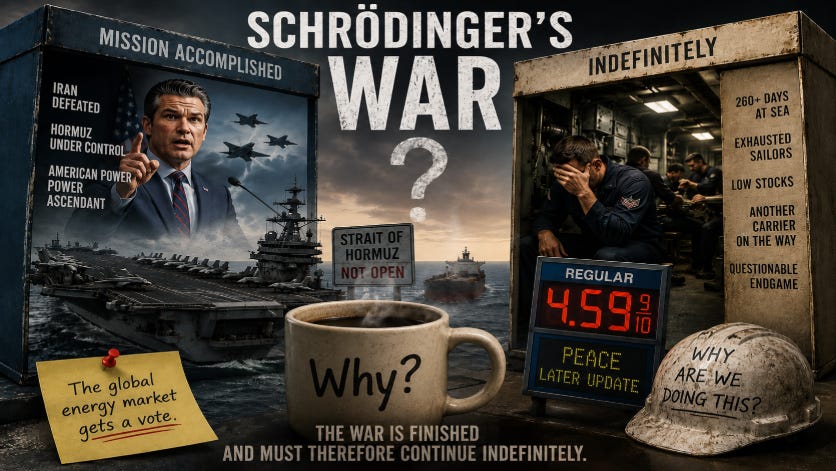
That response landed badly. The Lincoln has been at sea for more than 260 days, and reporting from sailors and their families has described food and supply problems, deteriorating mental health and incidents involving sailors attempting or threatening to go overboard. Hegseth did not address those allegations individually. Instead, he said the Pentagon gives every ship and crew everything it can and praised sailors for enduring “austere conditions” with fewer port calls.
Democratic lawmakers were considerably less diplomatic. Sen. Ruben Gallego, who says he has been communicating with the wife of a sailor and has seen messages describing conditions aboard the ship, responded to Hegseth with a sentence admirably free of senatorial syntax: “Stop lying and fix the problem.” Sen. Mark Kelly, the former Navy pilot, said he had spoken with the grandmother of a Lincoln electrician who has reportedly lost 20 to 25 pounds and is struggling with depression.
The Navy is sending the USS George Washington toward the Middle East to relieve the Lincoln. Officials say the rotation was pre-planned, so it should not be treated as evidence that the worst accounts aboard the Lincoln are accurate or that the Navy suddenly changed course because of the controversy. But it does underline the awkwardness of Hegseth’s “indefinitely” boast: keeping one carrier on station eventually requires another carrier, another crew and another set of strategic tradeoffs. The George Washington’s move could leave the Pacific without a U.S. carrier for an unknown period.
For Hegseth, then, the problem is no longer simply hostile coverage. He is dismissing reporting as distorted while lawmakers say they are hearing directly from military families describing the same underlying strain. “Completely misrepresented” is a much harder line to sustain when the people supposedly being misrepresented are sending Congress the receipts.
Carriers are not the only finite resource entering the conversation. This morning, the Pentagon announced framework agreements with Boeing and RTX intended to boost production of components for SM-3 Block IIA and SM-3 Block IB missile interceptors, the ship-launched weapons underpinning the Aegis ballistic-missile defense system. The move follows the Pentagon’s call earlier this week for industry to accelerate weapons production to replenish stocks after five months of war. The White House disputes reports that U.S. munitions inventories have reached dangerously low levels. What does not appear to be in dispute is that Washington now considers replenishment urgent enough to start expanding production capacity.
Which brings us back to “indefinitely.”
There is an important distinction between having the military capability to continue something and being able to continue it without significant opportunity costs. An indefinite blockade requires ships, crews, maintenance cycles, interceptors, logistics and replacement forces. A carrier committed to one theater is unavailable somewhere else; a high-end interceptor expended has to be replaced; and extended deployments eventually exact a human cost in retention, readiness and military families.
Former Naval Lieutenant Commander Julie Roland put the underlying question well in a MS NOW discussion of the Lincoln: if there is a worthwhile reason to ask American service members to endure these conditions, the government has an obligation to explain that reason clearly to them, their families, Congress and the public. Mission readiness, she argued, cannot sensibly be separated from taking care of the people expected to carry out the mission.
The original sell was not that preventing an Iranian nuclear weapon was the only objective and gasoline prices did not matter. The bargain was more coherent than that: Americans might have to tolerate a period of higher prices and economic disruption while Washington eliminated Iran’s nuclear threat and broke its ability to hold global energy markets hostage. Short-term pain was supposed to purchase a defined strategic resolution, with cheaper and more secure energy on the other side.
Five-plus months later, there is no resolution on the other side.
The Strait of Hormuz remains severely disrupted. Iran continues to reject Trump’s assertion that Washington has “total control” of it and says ships cannot pass without Iranian authorization. Commodity traffic remains a fraction of its prewar level. The U.S. and Iran are still deadlocked as the current memorandum-of-understanding deadline approaches, while Hegseth says the blockade can be maintained indefinitely.
It is worth remembering that this particular crisis did not exist before Trump attacked Iran. Hormuz was open, oil was moving and Washington was not scrambling to keep a war-induced energy shock from reaching American gas pumps. The administration is now treating restoration of something the war itself disrupted as one of the objectives of continuing the war.
Vice President JD Vance is now describing keeping oil and gasoline prices stable for Americans as Washington’s first objective, followed by preventing Iran from obtaining nuclear weapons. Al Jazeera correspondent Mike Hanna characterized that as a reversal of the administration’s previous emphasis. “Reversal” may be stronger than the evidence yet warrants; reordered emphasis is not necessarily a formally changed war aim. But the change in tense matters.
Cheap gas has moved from the promised payoff after the strategy succeeds to a problem the administration has to solve while the strategy remains unresolved.
The government is now trying simultaneously to maintain military pressure on Iran, restore the energy flows disrupted by that pressure, prevent the resulting shock from reaching American gas pumps, replenish munitions, sustain an exhausted naval force and persuade voters that all of this remains a successful application of “peace through strength.”
Peace is thus far scheduled for a later update.
The economic constraint is becoming impossible to treat as incidental. July inflation came in at 3.4 percent, down slightly from June, with core inflation at 2.5 percent. But the path of gasoline prices tells the larger story: prices surged past $4.56 a gallon as the war intensified through the spring, fell as a ceasefire briefly held, then climbed again once fighting resumed in July. Even after that summer dip, gasoline remains 24.6 percent more expensive than a year ago, and energy costs overall are up 14.7 percent, the clearest sign that this war has permanently repriced the American gas pump, ceasefire or not. Markets are now being forced to price not merely a war but the possibility of an open-ended confrontation around the most important oil transit corridor on Earth.
This continues to support what we have been calling the market-stability veto. Washington may have enormous military latitude, but its freedom of action contracts rapidly when strategic choices threaten the global oil supply, domestic inflation and ultimately the American voter standing underneath the giant glowing numbers at a gas station.
We have seen this constraint before. Vance reportedly pressed Zelenskyy to ease attacks threatening the Caspian Pipeline Consortium because Washington wanted to protect oil flows even at the expense of Ukraine’s pressure campaign against Russia.
The pattern is now hard to miss: Ukraine wants to squeeze Russian revenues; Washington wants the oil flowing. The United States wants to squeeze Iran; Washington still wants the oil flowing. Military strategy keeps encountering the same immovable object: the global energy market gets a vote.
This is where Hegseth’s Panama performance becomes more than colorful footage.
Standing in the jungle with troops behind him, Hegseth explicitly told “our friends in the press” that what they were looking at was the restored “warrior ethos.” It does not happen in Congress or in Pentagon corridors, he said; it happens with Americans doing difficult things in difficult places. He called them “the real 1%.”
The rhetoric only grew more muscular from there. Hegseth celebrated the new coalition slogan “we do bad things to bad people,” talked about bringing violence against drug cartels and proposed taking the “kill chain” refined over 25 years of counterterrorism operations and applying it to networks in the Western Hemisphere. He mocked the previous SOUTHCOM agenda as preoccupied with gender, climate and diversity and compared it to “USAID with some guns.” At the end, he thanked reporters for coming all the way into the jungle because their presence made the troops a “demonstration” of what America produces.
Hegseth understands television.
What makes the Lincoln controversy damaging is that it presents another image of the same military. One is designed for the cameras: toughness, lethality, warriors in the jungle, bad things happening to bad people. The other comes through messages home: sailors losing weight, families unable to get answers, people wondering when they will return, mental-health problems and a man telling his wife he does not know whether he can finish.
Hegseth enthusiastically places military sacrifice in front of reporters when sacrifice looks like strength. When sacrifice looks like exhaustion, the resulting reporting is “completely misrepresented.”
“We can do this indefinitely” is not actually an answer to “why should we?”
If the bargain was temporary sacrifice for a durable outcome, what happens when the temporary part disappears?
The Guardian this morning described the Iran conflict as a deeply unpopular war with “no end in sight.”
Schrödinger’s War is won whenever Washington discusses American power and still ongoing whenever Washington discusses what that power must do next. Washington says Iran’s capabilities have been devastated, yet an indefinite blockade is necessary. America controls Hormuz, yet normal shipping has not returned. The economic burden was temporary, yet keeping gasoline prices down is now itself a principal objective. The military is stronger than ever, yet another carrier must cross from the Pacific and weapons production must accelerate to replenish what has been consumed.
The war is finished and must therefore continue indefinitely.
Maybe the United States can sustain all of that for a very long time.
The more important question is the one coming from the people actually being asked to sustain it:
Toward what end?
"Warrior ethos." Excuse me while I go vomit.
"Indefinitely" Is a synonym for endless! Before Trump ripped up Obama's INARA agreement, Iran had no remaining nuclear stockpile and the Strait of Hormuz was an international waterway. In condemning Obama's nuclear deal as "the worst deal ever negotiated" and "insane", Trump's brilliance leaves us with a more powerful Iran with more radical leaders, a continued development of nuclear weapons, control of the Strait of Hormuz, empowered influence in the Middle East, the loss of US influence in the region and appearing weakened, and now engaged in an indefinite, endless war.
Hegseth's "warrior ethos" champions testosterone but demands a prerequisite of knuckle-dragging stupidity. George W Bush promoted the notion that empire's create reality. Donald Trump squandered this influence, peddling gaslighting self-serving, corrupt, deluded fantasies totally detached from any beach head of reality.
Feeding Trump's addiction has been extremely costly to America and the world. November 3rd can not come soon enough!