


Good morning! Please hold your head very still, and welcome to today’s edition of “The War That Both Exists and Doesn’t, Depending on Who’s Asking.”
First, the magic trick. Yesterday, Donald Trump spent his time doing what he does best: bragging that Iran had been effectively erased from the map. At the Forum Club, he declared that Iran’s air force was “non-existent,” its navy was gone, and that “every single ship is at the bottom of the sea.” Then, for good measure, he added that Iran had “no anti-aircraft capacity,” “no radar,” and “no leaders,” because apparently we are now doing foreign policy by obituary.
Earlier, at the Villages, he ran the same victory lap, telling seniors that Iran had “no navy,” “no air force,” “no anti-aircraft equipment,” “no radar,” and “no leaders,” before announcing that the U.S. was “winning so big.” Strength. Power. Total control. Or at least, that was the story before Congress showed up with a stopwatch.
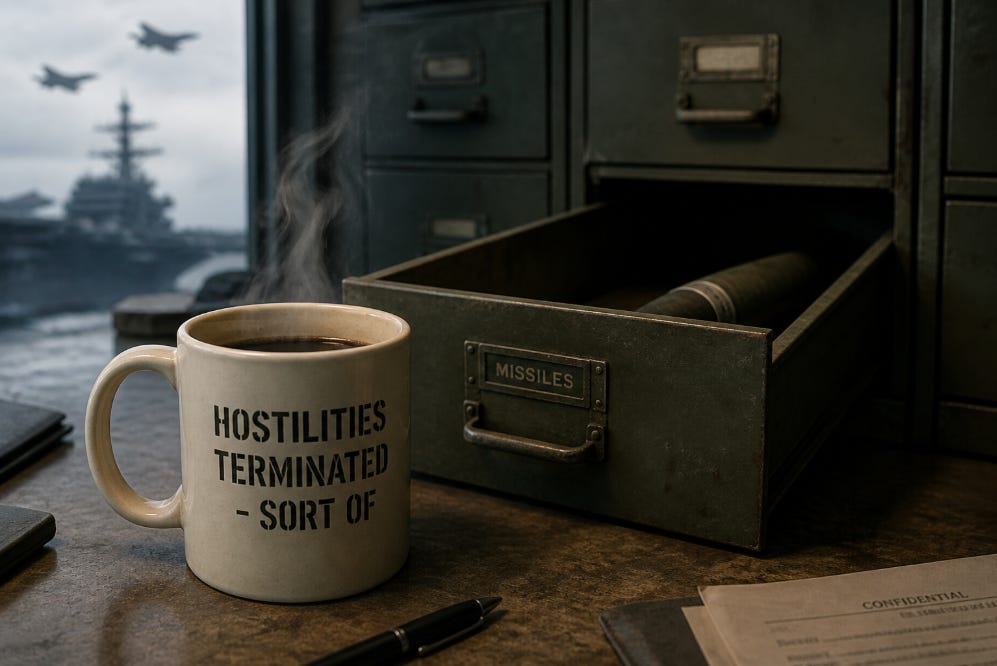
Then, almost on cue, like a man spotting a bill collector across the room, he pivoted, because the 60-day War Powers deadline hit. All of a sudden, the war he’d been chest-thumping about all week… ceased to exist. In a letter to Congress, Trump declared: “There has been no exchange of fire between United States Forces and Iran since April 7, 2026. The hostilities that began on February 28, 2026, have terminated.” Not just winding down, or paused, or transitioning. Terminated. Past tense. Over. Done. Kaput. Nothing to see here, please move along and ignore the aircraft carriers.
This would be comforting, if literally anything else in the world reflected that reality. While Trump is declaring peace on paper, the United States is still enforcing a naval blockade of Iran, still maintaining tens of thousands of troops in the region, and still openly threatening to resume strikes “at the push of a button.” The White House letter itself admitted that “the threat posed by Iran to the United States and our Armed Forces remains significant,” which is an odd way to describe a conflict that supposedly just tucked itself into bed. Iran, for its part, is still very much behaving like a country in a conflict. The Strait of Hormuz remains disrupted, or, as Trump called it during one of his geography-by-fever-dream moments, the “straight of Hormone.” Global markets remain jittery. Allies remain… let’s go with “tense.” The war is over, except for all the war parts.
Iran, for its part, is still very much behaving like a country in a conflict. Which raises the obvious question: if none of that changed, why did the administration suddenly need the war to be over? The answer, it turns out, has less to do with diplomacy than with logistics.
While Trump was telling reporters, “All over the world, we have inventory, and we can take that if we need it,” the Pentagon has been quietly telling allies the exact opposite. Washington has warned European allies including the UK, Poland, Lithuania, and Estonia to expect “serious delays” for several missile systems, with one expert noting that the Pentagon may need to fight a long war in the Middle East while also trying to shore up deterrence in the Indo-Pacific. Ukraine is already feeling the squeeze: a senior Ukrainian official said U.S. weapons for Kyiv have faced delays since the Iran war began, and Zelenskyy has said late arrivals have sometimes left Patriot launchers empty during Russian missile barrages.
They didn’t find a diplomatic off-ramp. They found the bottom of the weapons drawer. Suddenly, a lot of things make sense: the “ceasefire,” the legal gymnastics around War Powers, and the insistence that everything is fine while the Pentagon quietly triages supply chains. It’s not that the war ended; it’s that the capacity to keep doing it at the same pace may have ended.
Drivers are getting their own little reminder that the war is very real, just not in the way the White House would prefer. Gas prices have surged 42% since the conflict began. Diesel is up nearly 50%. The U.S. now has the sharpest fuel-price shock in the G7. The summer driving season is about to kick off, and nothing says “Mission Accomplished” like $4.39 a gallon and climbing.
Trump’s explanation? Don’t worry. In the May 1 White House press gaggle, he insisted, “When this war ends, gasoline and oil and everything, it’s going to come tumbling down.” Which is awkward, because this was the same day he told Congress the hostilities had already “terminated.”Which is awkward, because according to Trump, the war already ended.
So now we have a new economic theory: Gas prices are waiting for a war that has already ended to end again.
The chaos doesn’t stop at the pump. While the Pentagon quietly triages its weapons inventory, Trump has decided the moment calls for a spite tour. After Germany’s chancellor suggested the U.S. looked ‘humiliated’ by Iran, Trump threatened to pull 5,000 troops out of Germany, and floated similar moves against Italy and Spain, countries that failed to applaud loudly enough.
This is worth pausing on, because it tends to get lost in the theatrics. Those bases are not favors to Europe. They are American staging grounds for operations across Europe, the Middle East, and Africa, assets that exist to project U.S. power. When Trump threatens to pull them as punishment, he’s not hurting Europe. He’s degrading American reach and calling it toughness. The 25% tariff on EU cars and trucks, justified with the familiar ‘they’re taking advantage of us,’ follows the same logic: a move that costs American consumers real money, dressed up as strength.
All of it, the legal dodge, the supply crunch, the ally alienation, points in the same direction.
The War Powers Act is very clear. If you start a war without Congress, you have 60 days to get authorization or stop.
Trump’s response? First, declare the war over.
Second, say the law is “totally unconstitutional” anyway. Third, carry on as before.
It’s a neat trick. If you redefine “hostilities” narrowly enough, and dismiss the law entirely, you never have to answer the question.
Democrats, to their credit, have stopped pretending this is a polite disagreement. Chuck Schumer went with the technical legal term “bullshit.” Others pointed out the obvious: troops are still at risk, escalation is still on the table, and the administration has neither a strategy nor authorization.
Republicans? Mostly quiet. A few murmurs about maybe, someday, possibly, Congress having a role. But for now, the default setting remains: look the other way and hope it sorts itself out.
Tying all of this together, the speeches, the legal dodge, the supply constraints, the economic fallout, is the tone.
If you watched Trump at the Forum Club or the seniors’ event, you didn’t see a commander-in-chief grappling with a complex conflict. In the span of an hour, he covered Iran’s demolished navy, the history of Mar-a-Lago, submarine water filtration, the Civil War’s tactical errors, Tom Cruise’s height, and his principled decision not to own a poodle, in that order, more or less, connected by the logic of whatever occurred to him next. Every topic was either the highest, hottest, lowest, or most historic in recorded history. Everything that was good, he did. Everything that was bad, Biden did, then took credit for the good things, which is why Trump had to run again. His attorney asked four questions. Approximately 1.5 were answered.
In summary, the war is over when Congress asks about it, or it’s ongoing when Trump wants to brag about it. It’s very real when allies are short on weapons, and it’s painfully real when Americans fill their tanks.
We might reconsider renaming the Iran fiasco Schrödinger’s War, simultaneously finished, ongoing, and wildly expensive, depending on which version of reality the moment requires.
Schrödinger’s War is absolutely brilliant…..and accurate.
The inflection point of Trump’s dilemma caught by Captain Boom’s pronouncement to Mr. Banks in Mary Poppins, https://www.youtube.com/watch?v=o21IxLe7cDU. Trump refuses to hear that we are coming into a nasty bit of weather.