

Good morning! By midmorning Pacific time on Thursday, Microsoft’s servers began to buckle. By evening in Europe, Outlook and Teams were down in 74 countries. British hospitals were cancelling appointments, GPs couldn’t see prescription requests, and members of Parliament were asking constituents to please just pick up the phone. Out of all that wreckage came the day’s most quietly devastating statement, from the Prison Officers Association: its members work largely on paper, and for once they were grateful.
Keep that image in mind.
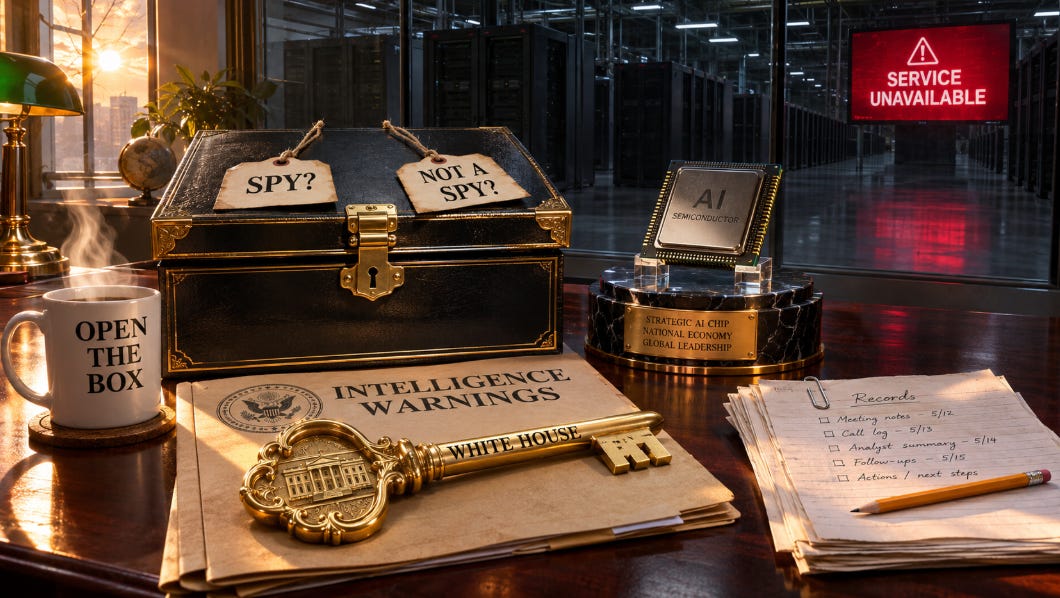
At the other end of the AI economy, Jensen Huang resigned as chief executive of Nvidia, the company whose chips power nearly every AI model you’ve heard of. CFO Colette Kress is now interim CEO. The board made that choice without taking presidential advice. Trump had spent part of Thursday on Truth Social recommending Tim Cook for the job, and the recommendation seems to have gone wherever boards file unsolicited résumés from heads of state.
Then there’s the matter of what the president knew. According to the New York Times, Trump was warned at least twice that Huang was involved with Alice Huang, a Chinese businesswoman U.S. intelligence concluded had been recruited by China’s Ministry of State Security. The first warning came late last year. The second came in May from Secretary of State Marco Rubio, aboard Air Force One, before Huang boarded during the refueling stop in Alaska on the way to Beijing. Trump let him on anyway. In September, Huang was a guest at the White House state dinner for Xi Jinping. This past Tuesday, Trump called him to urge him to keep fighting for his job, and on Thursday he called Huang a “legend.” His aides told the Times that the president saw the whole affair mainly as a story about adultery, and that what worried him was the stock market.
Asked Thursday whether Huang made the right call by stepping down, Trump offered this:
“The big thing is, was the woman a spy? And I don’t know if that’s been determined yet, but if the woman was a spy, yes. If the woman was not a spy, perhaps it would be different.”
Allow me to introduce a new entry in the Lords and Serfs Dictionary.
Schrödinger’s Spy (n., Trumpistemology): A potential foreign intelligence asset who exists in a state of being both real and imaginary until the president’s portfolio decides which.
To be clear, intelligence officials had warned Trump twice about the relationship. Other officials now dispute whether the evidence proves Alice Huang was knowingly working for Beijing. That uncertainty is precisely why counterintelligence warnings exist. They are supposed to trigger scrutiny.
The money explains a lot. At Huang’s urging, Trump relaxed restrictions on Nvidia chip sales to China while finding a way for Washington to collect a cut, first through a proposed 15 percent revenue share, then a 25 percent tariff. National security with a toll booth.
Congress, at least, is paying attention. Sen. Tim Scott, a South Carolina Republican and no one’s idea of a Trump antagonist, has asked Huang to testify before the Senate Banking Committee on Dec. 3, with Commerce Secretary Howard Lutnick following on Dec. 10. Subpoenas are available if voluntary appearances prove too much trouble. Lutnick’s department was supposed to vet the national security risks of those China sales. Sen. John Kennedy of Louisiana said his jaw was “still stuck on the floor.” Notably absent from the witness list is the man who was briefed twice.
Treasury Secretary Scott Bessent says multiple departments wanted Megaspeed restricted months ago, but Lutnick’s Commerce Department controlled the decision. Congress may have considerably more to ask him than whether he knew about Huang’s affairs.
And the market panic Trump was protecting against? When Nvidia’s stock dropped, the sky stayed up. AMD and Broadcom gained ground as investors discovered that other companies also make computer chips. Nvidia lost its supposedly indispensable chief executive, but the American economy continued functioning.
Trump spent months defending Huang despite repeated counterintelligence warnings. Wall Street, in the meantime, was already making other arrangements.
The timing could hardly be worse, or more revealing. Next week, Trump flies to Shenzhen for the APEC summit, Nov. 18–19. If he goes, he’ll be the first sitting president to visit China’s tech capital, home to Huawei, the company Nvidia’s China sales were supposed to keep in check. It will be his third meeting with Xi Jinping this year, after Beijing in May and Washington in September. A fourth is set for December at the G20, hosted at Trump National Doral in Miami, because even summitry runs through the family business.
The trade truce between the two countries now runs to Jan. 10, 2027, and keeping that arrangement alive remains a central objective of the summit. Trump also says he wants to discuss ending the Iran war. Whether he’ll confront Beijing over its role in that conflict is another question. Randy Schriver, chair of the bipartisan U.S.-China Economic and Security Review Commission and a former Pentagon Indo-Pacific chief, told the BBC that the president seems to want “a fairly constrained” discussion focused on trade. In Schriver’s telling, that leaves out China’s material support for Iran in its war with the United States, its backing of Russia in Ukraine, Taiwan, and, presumably, whether Beijing’s spy service recently got into bed with America’s most important tech executive. Asked whether the scandal would change the summit, Schriver offered a quiet understatement: “Maybe it should more than it will, but I doubt it’ll affect much.”
Consider what’s at stake. China has long been Iran’s largest oil customer, providing Tehran with billions in revenue before the American blockade interrupted the trade. There are also reports of Chinese companies supplying intelligence and other assistance to Iranian forces. In May, Trump said Xi had assured him China wouldn’t provide Iran with military equipment and declared that he had Iran very much under control. Six months later, the war continues, and Beijing’s relationship with Tehran remains a consequential question for Washington.
There’s also an item receiving remarkably little attention: the U.S.-China “Super Intelligence Dialogue,” created during Xi’s September visit to discuss the risks and benefits of advanced AI. According to the White House’s own fact sheet, the next exchange is due this month. So in the same month the head of America’s leading AI company resigned over a suspected Chinese intelligence operation, the two governments are scheduled to sit down and talk about AI safety. The timing is extraordinary. Two governments are preparing to discuss the risks of advanced AI while one of them investigates whether the other tried to compromise the executive who helped build the industry.
The South China Morning Post reports that Trump has said Xi may raise the Huang case himself. If he does, it will be on Xi’s home ground, in the city Huawei built, with a president who has spent the week insisting nothing has been determined. Schrödinger’s Spy may be on the agenda in Shenzhen after all. And if Xi raises the question, it will be the Chinese president asking why his American counterpart spent the week insisting nobody knew what was inside the box.
Back to Thursday’s other failure, the one that reached people who have never heard of Megaspeed.
By evening in Europe, Microsoft 365 disruptions had spread across 74 countries, affecting Outlook, Teams, and services that much of the world takes for granted. The company says there’s no indication of a cyberattack. Its own infrastructure simply stopped working properly, and much of the world discovered how much it depended on that infrastructure.
In Britain, the consequences went well beyond unanswered emails. The BBC reported that one hospital cancelled scheduled C-sections because its booking system relied on Outlook. GPs couldn’t retrieve prescription requests or send patients for hospital scans. Emergency call handlers struggled to pass along patient information. Ambulances kept running and emergency care continued, but the disruption varied enormously depending on which systems individual hospitals used.
There was one revealing exception. Britain’s intelligence and security services were essentially unaffected. Their classified communications run on separate infrastructure. The government had ensured its secrets could survive a Microsoft failure. Its maternity wards weren’t quite so fortunate.
Even the AI revolution stumbled. OpenAI and Anthropic reported problems with Microsoft-dependent tools, a reminder that the companies building tomorrow’s technological future still depend on someone else’s systems working today.
And remember those prison officers? Their largely paper-based procedures kept prisoner releases moving. Some courts reportedly managed much the same way. The systems that had been criticized for falling behind the digital revolution were suddenly the ones that didn’t need permission from Redmond to function.
Thursday gave us two versions of the same problem. Nvidia demonstrated the extraordinary political influence that comes from controlling technology everyone needs. Microsoft demonstrated what happens when everyone needs a service they cannot provide for themselves.
Different vulnerabilities, same underlying question: Who controls what we depend on, and what happens when they fail us?
Seen from Washington, Thursday’s Microsoft outage was a tech story. Seen from Europe, it was another entry in a ledger that has been filling up for years.
Amazon, Microsoft, and Google control roughly 70 percent of Europe’s cloud infrastructure market. The European Commission estimates that more than 80 percent of the EU’s key digital products and services come from outside the bloc. And under the U.S. CLOUD Act, American authorities can compel U.S. providers to produce data they control, even when it’s stored on European soil, through lawful legal processes. That’s an awful lot of dependence dressed up as convenience.
European lawmakers have stopped being diplomatic about it. German MEP Alexandra Geese calls it being a “digital colony of the US.” Her center-right colleague Axel Voss wants Europe to cut its dependence on American technology from 80 percent to 40 percent by 2030. Any medieval tenant farmer would recognize the arrangement.
And the concern isn’t simply that the lord’s mill might break down. It’s that the lord can use the mill to enforce his wishes.
In July, the EU fined Google €890 million for violating European competition rules. Trump responded by threatening tariffs and a trade investigation. Europe had enforced its own laws against an American company, and Washington threatened economic consequences. The message was difficult to miss. The lord’s mill grinds your grain, the lord sets the price, and you don’t take the lord to court.
So Europe is beginning to build alternatives. France is moving government videoconferencing away from Zoom and Teams toward its own platform. The European Commission has awarded cloud contracts to European-led providers, although some still rely on American technology. It will take years to unwind decades of dependence, and everyone knows it. Once you’ve built your institutions around someone else’s infrastructure, getting out is considerably harder than getting in.
This is the predictability premium in another form. Europe isn’t questioning American technology because it’s inferior. It’s questioning whether technological superiority is worth the political dependence that comes with it. When the government behind your essential infrastructure threatens retaliation for enforcing your own laws, looking for alternatives becomes a matter of sovereignty.
Thursday didn’t create Europe’s technological dependence. It merely made the cost visible. And Europe is discovering that independence isn’t something you can simply switch back on after you’ve spent decades switching everything else off.
Somewhere in Lancaster County, Pennsylvania, Thursday went by like any other day. The Amish didn’t notice that anything was down. Not because they wholly reject the modern world. Amish communities decide together whether to adopt a new tool, and the question isn’t simply whether it’s new or convenient. They ask what it will do to their families, their relationships, and their ability to govern themselves. That’s why you’ll find a shared phone shanty at the end of a lane rather than a phone in every kitchen. It’s a test, not a taboo, and on Thursday it held up better than most British hospital trusts’ IT departments did.
I’m not suggesting anyone swap the car for a buggy. I’m suggesting we steal the question.
The measure of a sustainable community is really about how much control it keeps over the essentials of its own survival, and whether that control belongs to the community or to someone who can withdraw it. Ask that, and Thursday’s two stories turn out to be one. One company became so important to the AI economy that its chief executive enjoyed extraordinary influence over American policy, even as intelligence officials raised national security concerns. Another became so embedded in British healthcare that a software failure could disrupt everything from prescriptions to maternity appointments. The question applies just as well to your county’s power, your town’s grocery supply, your bank, and the single employer some communities can’t afford to lose.
The economist Albert Hirschman gave us a simple way to sort it out. A relationship is healthy when you can leave it or when you have a say in how it’s run. It becomes feudal when you have neither. Nobody in Coos County is going to manufacture insulin or semiconductors, and nobody should try. Depending on others is fine. Having no exit and no voice isn’t.
So the work in front of us isn’t withdrawal. It’s recovering our ability to make decisions for ourselves, one essential at a time: community broadband, energy co-ops, regional food processing, and neighbors who know each other’s names before the ground starts shaking.
Here on the Oregon coast, with the Cascadia subduction zone just offshore, these aren’t abstract questions. They’re questions we’ll be exploring in the next installment of our sustainability series.
Depending on others isn’t the real problem. Having no alternatives is.
The opposite of dependence is agency, not isolation.
F-ing excellent.
After the WTC catastrophe on September 11, I was the only doctor in my HIV/AIDS practice in NYC who was able to continue caring for my patients after the servers went down: I insisted on keeping paper charts as well as the new EMR and had been teased about being a Luddite until September 11. . .