


Good morning! Oh, what a glorious place Schadenfreude lives, right there in the East Room of the White House, where this week Donald Trump tried once again to convince the world that he knows energy policy, even though reality keeps checking his homework. In a televised meeting that looked for all the world like Black Friday at the mall for geopolitics, Trump implored U.S. oil executives to pour “at least $100 billion” into rebuilding Venezuela’s oil industry, a nation whose infrastructure is essentially a museum of decay and whose legal system gives investors pause.
Here’s the part that’s truly delicious: after months of campaign rhetoric about American energy dominance and lower prices at the pump, the assembled oil bosses politely declined to write that check. ExxonMobil’s CEO Darren Woods looked the president squarely in the eye and said the country was “uninvestable,” noting that legal reforms, durable protections and a rewrite of hydrocarbon laws would be prerequisites for any real engagement.
Trump’s response? The usual mix of optimism and delusion: he insisted companies could make “massive wealth” there and said that if they weren’t interested, he had “25 people that aren’t here today that are willing to take your place.”
To underline the disconnect between presidential pep talk and boardroom reality, Trump also suggested that tapping Venezuela’s oil would help lower domestic energy prices. “Having a Venezuela that’s an oil producer is good for the United States because it keeps the price of oil down,” he told NBC, apparently unaware that driving prices down undercuts the very investment case he was pitching.
That’s the same scenario where Trump is reportedly gunning to push oil prices toward $50 a barrel, a sweet spot for cheap gasoline but exactly the opposite of the level oil companies need to justify spending tens of billions on risky, politically unstable drilling.
This wasn’t just awkward; it was a geopolitical pivot performed in real time. As the discussion drifted away from the $100 billion fantasy and toward uncomfortable reality, Trump literally stood up, walked to the window, and changed the subject, pointing outside to lament that the White House ballroom wasn’t finished in time to accommodate all the executives who supposedly wanted to attend. In a meeting about oil prices, sanctions, and international risk, the president abandoned the math and sold the room instead. It was like watching someone lose an argument about global energy markets and respond by giving an impromptu tour of a half-built wedding venue. I can still picture the egg dripping from his face.
Let that sink in for a moment: after grandiose talk of energy dominance, booming output, lower prices and patriotic duty, the big oil bosses looked at the nation that Trump had just captured, rich in resources and labyrinthine in uncertainty and essentially said, “Nice view, but we’re not writing a blank check.” And if that doesn’t warm the cockles of anyone who’s ever seen a big idea collapse under its own enthusiasm, I don’t know what will.
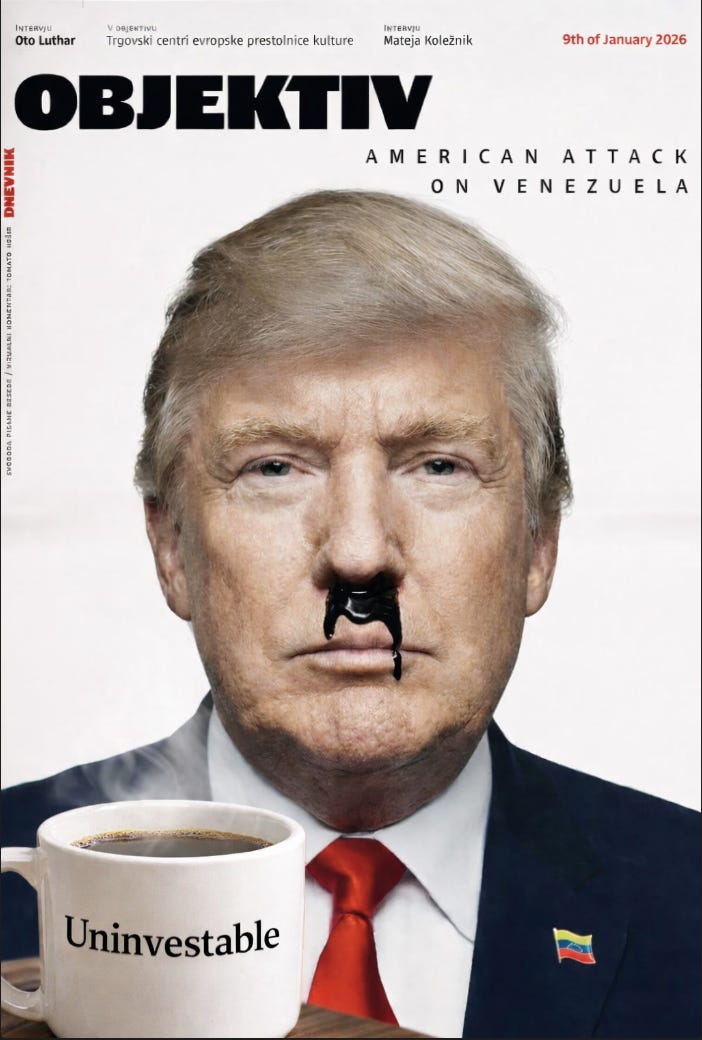
Of course, to watch this spectacle and not notice how the rest of the world is reacting would be to miss the bigger picture entirely. While Trump is busy hustling oil CEOs and daydreaming about bargain-basement barrels, the view from abroad is far less forgiving. In Slovenia, the small Central European nation that also happens to be the birthplace of Melania Trump, the weekly magazine Objektiv captured the moment with brutal efficiency: a cover depicting Donald Trump with crude oil dripping beneath his nose, forming a crude Hitler-style mustache under the headline “American Attack on Venezuela.” The designer didn’t hedge; he said the parallels were “fairly clear,” and the image resonated precisely because it came from outside Washington’s partisan echo chamber. That this visual critique was published in the homeland of the First Lady only adds to the irony.
At the same time, Greenland’s political leaders were issuing a rare united statement rejecting Trump’s threats outright. “We don’t want to be Americans. We don’t want to be Danish. We want to be Greenlanders,” they said, after Trump warned he would acquire the island “the nice way or the more difficult way.” Eighty-five percent of Greenlanders oppose joining the U.S., and even among Americans, support for any kind of invasion barely registers. The pushback wasn’t subtle, it was a reminder that what Trump frames as strategic necessity looks, to much of the world, like imperial shopping with a credit card America no longer deserves to carry.
This is the quiet but devastating shift underway: the United States is no longer assumed to be acting in good faith. Instead, it is increasingly seen as transactional, extractive, and erratic, a country whose president talks about ownership instead of partnership, oil instead of law, and ballrooms instead of consequences.
On the home front, the chilly reception for Trump’s Venezuela gambit sits beside a growing lack of faith in federal institutions, a theme we’ve seen echoed from Minneapolis to DOJ insiders: trust in impartial investigation and fair process is not merely frayed, it’s unraveling. That breakdown in institutional credibility is exactly what critics like Ty Cobb warned about when describing a Justice Department that, in its current form, seems to answer first to personality and only second to principle.
Taken together, the geopolitical overreach, the awkward American oil pitch, the incredulous executives, the distracted world reacting with disbelief, and the erosion of trust here at home, it’s hard not to see this as one of those moments where the emperor is suddenly very conspicuous without his policy pants. And for once, even the oil barons are comfortable saying so out loud.
Beyond the schadenfreude, the day-to-day reality continues to remind us that trust in federal institutions is dissolving faster than an ice cube in Death Valley. In Minneapolis, the FBI has unilaterally taken over the investigation into the fatal shooting of 37-year-old mother Renee Nicole Good by a U.S. Immigration and Customs Enforcement agent, and state officials say they’re being shut out of evidence and scene materials. Local investigative professionals from the Minnesota Bureau of Criminal Apprehension were initially working the shooting with the FBI, but were told that the federal agency would now control everything, leaving Minnesota investigators without access to critical case materials. Officials including Gov. Tim Walz say it will make a fair outcome very difficult to achieve, and that the public’s confidence in the process is already deeply shaken.
That distrust isn’t just about territorial turf wars between agencies; it’s about perception and legitimacy. When the federal government steps in and then keeps the locals from seeing the evidence, it looks like a cover-up, especially when, at the same time, public-facing narratives leap to conclusions about what happened before the facts are fully vetted. That’s the landscape in which Minnesota’s BCA has publicly withdrawn from the investigation because without access to the evidence, it “cannot meet the investigative standards that Minnesota law and the public demands.”
So this is where we are: a president who championed “law and order” and yet sees no problem with federal agencies cutting out state partners and holding the keys to the crime scene. A Justice Department once heralded as an impartial arbiter now being publicly described by insiders as protective of one man rather than the Constitution itself. Ty Cobb, a lawyer who once served inside Trump’s orbit, told Frontline that Trump’s DOJ appears to be operating “in service to him”, an institutional shift that raises fundamental questions about whether justice is even meant to be blind anymore. The federal takeover of the Minneapolis investigation, and the skepticism it has triggered at the local level, is exactly the kind of breakdown Cobb was warning about. (And yes, this is exactly the kind of thing cops and prosecutors used to roll their eyes at when “the rule of law” was something adults in the room talked about.)
The fall-out isn’t just institutional, it’s civic. The mayors of Minneapolis and Portland, Oregon have found common cause in standing up to what they describe as “reckless” federal actions, demanding independence in investigations and accountability to their communities rather than Washington’s spin. Together, their stance reflects a broader erosion of trust in a Department of Justice and federal law-enforcement apparatus that many feel no longer represents fairness or impartiality in the eyes of the people it is meant to serve.
There’s a palpable disconnect between how federal officials are handling these situations and how communities perceive it. It erodes trust in institutions across the board, from law enforcement to courts to everyday Americans who expect fair treatment. When the FBI sidelines state partners, when federal narratives are declared before investigations have even begun, and leadership signals loyalty to a person instead of to the systems designed to protect the public, people notice. They decide for themselves whether the system is worth believing in.
For those who feared that Trump's actions were part of a big oil conspiracy, we now see he simply weaves policies and actions based on grandiose notions fabricated from his unexamined and preposterously constructed belief system.
Relieving on one hand that Trump is not supported by a corporate cabal that offers muscle to flesh in his dictatorial over reaches, but terrifying on the other hand that we have a child in the basement playing with C-4 explosives.
The veneer of Trump's power and authority is wearing very thin both domestically and internationally. The absurd vacuousness of his policies, coupled with his lawlessness and abject cruelty of his actions are not sustainable.
A tide of discontent is developing and hopefully will explode into a tsunami of outrage, demanding correction. We enter an fateful but unstable period testing whether the will and stridency of the American People can successfully extinguish the toxic poisoning of our nation by this opportunistic Trump regime malignancy.
It sure would have been nice if the oil CEOs would have whispered in Trumps one good ear that "Venezuela was uninvestable" before his and Hegseth's rampage against Venezuela.