


One of the things I love most about research is that it rarely takes you exactly where you expect to go. I went looking for a rhetorical pattern and found a biography instead.
I had been tracking something simple at first: how often, and how casually, Donald Trump has started reaching for the word “communist” again.
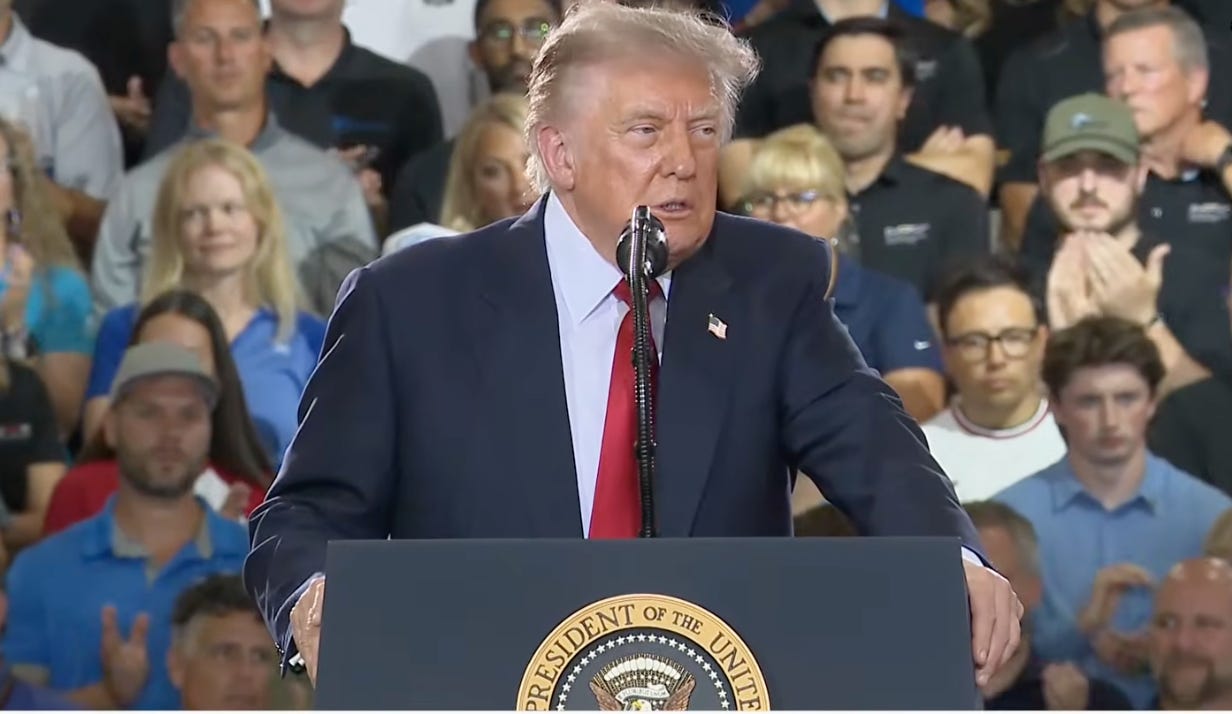
Not “socialist.” Not “radical left.” Communist, specifically, applied to open borders, bail reform, transgender healthcare, opposition to voter identification, health-insurance policy, a sitting Minnesota governor and, in the same breath, to the very Democratic Party he also claims is secretly in the pocket of private insurers.
I wanted to know whether this was new. I wanted to determine whether it was strategic.
I did not expect to end up reading about a disbarred lawyer who died in 1986.
But that is where the thread led.
Before following it, it helps to establish what communism actually is.
Communism is not a synonym for government spending. It is not universal healthcare, a higher minimum wage, subsidized childcare, environmental regulation or asking billionaires to contribute a larger share of their fortunes to the society that made those fortunes possible.
Franklin Roosevelt was not a communist. Medicare is not communism. Public schools, fire departments and Social Security are not outposts of the Soviet state. A country does not become communist because its legislature imposes a marginal tax rate that makes a hedge-fund manager frown.
In Marxist theory, communism is the proposed culmination of a historical struggle between economic classes: a classless society in which the major means of production, factories, industrial land, infrastructure and large concentrations of capital, are held in common rather than privately controlled for profit.
The distinction is between personal possessions and productive property. Marx was not coming for anyone’s toothbrush. The target was a system in which one class owned the productive assets while another survived by selling its labor to that owning class.
The imagined final society would eventually have no economic classes and, because the state was understood as an instrument through which one class ruled another, no coercive state in its familiar form. Goods and resources would be organized around collective need rather than private accumulation.
That was the theory.
Getting there was where the trouble began.
Marx anticipated a transitional period in which the working class would take political control and reorganize economic life. Later revolutionaries, most consequentially Vladimir Lenin, developed that idea into a system led by a disciplined revolutionary party claiming to govern on behalf of the workers.
In the Soviet Union and the states modeled after it, common ownership generally became state ownership. Markets were displaced by central planning. Political opposition was suppressed. The party that supposedly represented the people became inseparable from the government ruling them.
The result was not the stateless society promised as communism’s theoretical destination. It was usually a powerful, centralized state administering production, employment, and political life through a one-party system.
Social democracy, by contrast, retains private property, private businesses, competitive elections and a market economy while using taxation, regulation and public programs to distribute some of the economy’s benefits more broadly.
Democratic socialism may seek substantially greater public, cooperative or worker ownership, but its adherents pursue those changes through democratic institutions rather than one-party revolution. American liberalism ordinarily proposes something more modest still: regulated capitalism with public investment and a social safety net.
None of the mayors, prosecutors, protesters, primary winners or healthcare proposals I watched Trump fold into the word “communist” belongs to the first category. They belong, at most, to the second or third.
The distinctions matter because political language is supposed to help us understand what people actually believe. When every proposal to the left of another tax cut gets called communist, the word stops describing an ideology.
It becomes a noise, a warning siren switched on whenever the speaker would rather produce fear than offer a definition.
Donald Trump learned that technique from someone who received his own education at the source.
Long before he became Donald Trump’s lawyer, fixer and mentor, Roy Cohn was chief counsel to Senator Joseph McCarthy.
He was one of the architects, alongside McCarthy, of the loyalty-and-blacklist machinery that spent the early 1950s classifying Americans as security risks based on rumor, association and refusal to name names.
Cohn helped run the hearings and write the questions. Cohn helped decide who would be ruined.
In 1973, a young Queens real estate developer named Donald Trump was facing a federal housing-discrimination lawsuit when he was introduced to Cohn at a Manhattan club. Cohn’s advice, as he later told it, was simple: tell them to go to hell.
He became Trump’s personal lawyer. He remained his mentor for the next thirteen years, until his death.
What Cohn reportedly taught his protégé was not so much a legal strategy as a worldview: attack before you are attacked, admit nothing, deny everything, counterpunch harder than you were hit, and treat the media as a weapon rather than a witness.
People who knew both men have said the influence is unmistakable, that when you listen to Trump today, you are, in some real sense, hearing Cohn’s voice pushed through six more decades.
I had known, in the loose way most people know things, that Trump and Cohn were connected. I had not sat with what that connection actually was: a direct, personal, thirteen-year apprenticeship under one of the men who built the machinery of the second Red Scare, a man whose entire professional formation happened in service of turning “communist” into a word that could end a life without ever going to trial.
Not a metaphor, that is a lawyer-client relationship with a name, a start date, and eyewitnesses.
McCarthyism, properly understood, was never limited to identifying actual communists or Soviet agents.
The Soviet Union did not need Owen Lattimore removed from academia or Alan Lomax pushed into eight years of English exile to accomplish its aims. What the label accomplished instead was domestic: it gave the country’s fears a single grammar.
Anxiety about changing sexual mores, labor organizing, racial integration, and the loss of an older social order could all be filed under the same heading and handled by the same machinery of loyalty boards, blacklists and congressional hearings.
More than five million federal employees were screened for loyalty between 1947 and 1956. Around 2,700 were dismissed outright. Another 12,000 resigned rather than fight the process.
Those numbers do not count the far larger group who simply learned to stay quiet, to skip the meeting, decline the petition, avoid the friendship that might someday show up in a file.
A person could lose a livelihood because of a meeting attended years earlier, a petition signed in another political moment, an acquaintance’s testimony or a refusal to provide investigators with more names.
The choice was often designed to spread the fear. Cooperate and transfer the danger to friends and colleagues, or remain silent and allow that silence to be treated as evidence. Invoking a constitutional right could itself become proof that there must be something to hide.
The accusation did not need to hold up in court. It only needed to make a person expensive enough to employ that someone else became preferable.
That was how the punishment spread beyond government.
The Red Channels blacklist kept actor Sam Jaffe from working in radio, television and film for seven years. Alan Lomax left the country because he could no longer sustain his work at home. Writers published under false names. Actors disappeared from screens. Teachers lost their positions. Friends stopped calling because association itself had become professionally dangerous.
The anticommunist purge also merged with the persecution of gay and lesbian federal employees. Officials claimed that homosexuality made workers vulnerable to blackmail and therefore dangerous to national security. Thousands were dismissed or forced to resign.
Roy Cohn helped popularize that persecution even as he was, by virtually every private account, gay himself.
The cruelty of the contradiction is difficult to overstate: a man who helped destroy thousands of gay and lesbian lives depended upon secrecy to protect his own.
Some of those targeted lost careers. Some lost relationships when investigators exposed private lives they had struggled to keep safe. Some became permanently underemployed. In documented cases, some died by suicide.
By the spring of 1954, McCarthy had finally chosen an institution powerful enough to fight back. The nationally televised Army-McCarthy hearings arose from his charges of lax security inside the Army and the Army’s countercharge that McCarthy and Cohn had sought preferential treatment for a former committee aide. Joseph Welch, a Boston lawyer representing the Army, spent weeks exposing the recklessness beneath McCarthy’s accusations.
Then, on June 9, McCarthy reached beyond the people involved in the dispute and dragged in Fred Fisher, a young associate at Welch’s law firm, accusing him of ties to an organization McCarthy associated with communism. It was the old method in miniature: introduce a name, attach the label and allow the suspicion to do the rest. Welch, visibly appalled, stopped him.
“Let us not assassinate this lad further, Senator. You have done enough. Have you no sense of decency, sir, at long last?”
The room broke into applause. Millions had watched McCarthy bully witnesses on television, but now they had watched someone name the cruelty plainly. The exchange helped turn public opinion against him, and the Senate censured him six months later.
But the moment’s place in history can make it seem more redemptive than it was. The room could applaud and the Senate could censure McCarthy, but neither could restore the missing years, reopen the careers already closed, erase the files or persuade employers to forget the names they had learned to fear. By the time someone finally asked whether McCarthy had any decency left, the question had arrived too late for many of them.
Roy Cohn absorbed a different lesson. The problem was not that McCarthy had made reckless and unsupported accusations, but that he had allowed himself to lose control of the spectacle.
Attack. Deny. Counterattack. Never concede. Never apologize. Force the accused to defend against a charge vague enough that it can never be fully disproved.
The word did not need to be true, just useful.
A single rally is not enough to establish a pattern, so it helps to look at the timeline because there is one.
Trump’s pivot back to “communist” tracks almost exactly to Zohran Mamdani’s rise.
After Mamdani won the New York City mayoral race in November 2025, Trump told a Miami business summit that the choice facing the country was “a choice between communism and common sense.”
That was the opening note.
It grew louder in June 2026, when several Mamdani-aligned democratic socialist candidates won House primary races in New York, Darializa Avila Chevalier, Brad Lander, and Claire Valdez among them.
Trump spent that week warning his Truth Social followers about the rise of “Communists,” posting that “America the Beautiful will NEVER be a Communist Country!!!”
By the following month, at a July Fourth address at Mount Rushmore, he had sharpened it into an ultimatum:
“You can be a communist, or you can be a patriot. You cannot be both.”
None of the candidates he was describing is, in fact, a communist.
Democratic socialists pursue their programs through elections. Historically, communist governments have dispensed with meaningful competitive elections altogether. Several of the candidates Trump associated with “godless communism” are themselves observant, Muslim and Catholic among them.
The word was not doing descriptive work. It was doing the same work it did in Cohn’s era: naming a feeling rather than a fact and allowing the feeling to do what the facts could not.
By the time I watched Trump do it again in Michigan, folding open borders, bail reform, transgender healthcare, voter identification and health-insurance policy into the same word, it was not a new tactic.
It was a tactic on its fourth or fifth documented outing in nine months, each appearance a little more totalizing than the last.
At a General Motors event at the Milford Proving Ground, nominally a presidential visit to a manufacturing facility, Trump responded to a protester chanting “pedophile protector” by pointing at him and shouting, “He’s a communist. He’s a communist.”
The protester’s accusation concerned the administration’s handling of Jeffrey Epstein-related records. Trump’s response did not address that accusation, refute it, or even remain in the same conceptual neighborhood. It reclassified the accuser.
The crowd did not need the connection explained. It broke into chants of “USA! USA!” and the speech moved on.
Minutes later, unprompted by anything the protester had said, Trump extended the same classification into policy.
Open borders, communists want that.
No-cash bail, that is the communists too.
Transgender healthcare, the “mutilization” of children, opposition to voter identification, the entire architecture of private health insurance, all of it, somehow, communism.
At another point in the same speech, Democrats were also the paid servants of insurance companies. Nobody in the room appeared to notice the contradiction or require it to be resolved.
You cannot simultaneously be the vanguard of a revolution against private capital and the hired help of a private industry. But the label was never asking to be checked for consistency. It was never actually about Epstein, bail reform, or health insurance.
It was asking to be felt, attached to whatever happened to be in front of it at the moment someone needed a villain.
Trump supplied his own explanation for the change in vocabulary.
“They skipped socialism,” he said.
That line is doing more than escalating an insult. It is a reclassification notice.
“Socialist” had served for years as the Republican Party’s preferred master label for Democratic policy, but constant use had drained away some of its emotional voltage. Americans had heard Social Security, Medicare, public schools, labor protections, climate programs and nearly every other form of public action called socialist. The alarm had become familiar.
Trump’s formulation preserves every previous accusation while promoting the entire opposition into a more frightening category.
Democrats did not become less radical than Republicans had claimed. They supposedly advanced beyond socialism altogether.
No corresponding change in their actual beliefs was required. The label changed because the older label was no longer doing enough work.
That is the sentence I keep returning to: a propaganda taxonomy does not require logical coherence. It requires emotional coherence.
Every grievance has to trace back to the same enemy. It does not matter if the enemy is wearing two contradictory hats at once because the audience is not being asked to examine an economic theory.
They are pattern-matching against a feeling: the feeling that something is wrong, that there is a name for what is causing it, and that the name absolves them of having to sit with any more complicated explanation.
The border is insecure because communists want it open.
Cities experience crime because communist prosecutors oppose bail.
Children are endangered because communists control schools and medicine.
Elections are suspect because communists oppose voter identification.
Healthcare is expensive because communists, or perhaps the private insurance companies that supposedly own them, have designed it that way.
The contradiction is not a defect. The emotional destination is the same.
The taxonomy has another entry. The self.
Every bad outcome traces back to “the communists.” Every good outcome traces back to Donald Trump.
Factories are opening because he brought them home. Investment is booming because he secured it. The border is closed because he closed it. Prices fall because he acted. America is respected because he restored it. Wars are won because he ordered them.
Even future prosperity must remain his property.
Imagining another president someday taking credit for the economy, Trump stopped to instruct the audience:
“Will you please remember that I did it, okay? I did it.”
More than incidental narcissism ornamenting the ideological argument, this is the positive half of the taxonomy.
The system offers two universal causes.
One enemy is responsible for every form of decline. One leader is responsible for every form of restoration.
The communists explain the fall. Trump explains the rescue.
Cohn understood that feeling was the whole game. He built a career on the principle that it does not matter whether an accusation is true, only whether it becomes costly enough that the target cannot afford to fight it.
His student learned the lesson well enough to still be running the play seventy years later, on a factory floor, in front of sitting members of Congress who took the stage afterward and repeated “communist” back to the crowd without defining it once.
Language alone is not a loyalty system. But language can establish the categories through which a loyalty system begins to look reasonable.
I want to be careful here because I think the caution is part of the argument.
I am not claiming that Donald Trump has rebuilt McCarthy’s precise apparatus, the congressional committees, published blacklists like Red Channels and statutory federal loyalty boards screening millions of employees by name.
That machinery is not in place, and saying otherwise would be its own kind of category error. But saying there is no machinery would be inaccurate too, and I would rather correct that plainly than let a tidy caveat stand in for the truth.
The current administration has built something real. It has simply organized it differently.
Seventeen inspectors general, the independent watchdogs responsible for auditing federal agencies for fraud and abuse, were fired during the administration’s first week.
The Justice Department’s Civil Rights Division went from roughly 365 attorneys to about 105 within three months as career lawyers unwilling to follow the administration’s direction departed.
Attorney General Pam Bondi’s first-day memorandum instructed government lawyers to “zealously advance and defend” the administration’s positions, leaving little visible room for principled internal dissent.
Dozens of Justice Department and FBI officials were fired or reassigned, including every FBI executive assistant director. Career prosecutors who had worked on cases involving Trump or the January 6 attack were dismissed with termination language saying they could not be trusted to “faithfully implement the President’s agenda.”
At the Pentagon, the head of the Defense Intelligence Agency and two commanders were removed after an intelligence assessment concerning Iran contradicted the administration’s public position. The chairman of the Joint Chiefs was fired months later.
Schedule F, the mechanism designed to strip selected career civil servants of employment protections so they can be dismissed more easily, has exposed an estimated 50,000 federal positions to that form of removal.
This is not McCarthy-era machinery. But it is a system for identifying who inside the government can be trusted to serve the administration’s agenda and removing those who cannot.
That is close enough to the function of the older machinery that I do not think it is honest to wave it away.
What I am not willing to claim is that the rhetorical taxonomy I traced through Cohn, the word “communist” applied to a protester, a district attorney, a health policy, a mayor, has yet become as systematized or as individually targeted as the earlier purges.
For now, the word and the personnel removals are running on separate tracks.
One sorts the public into enemies and patriots.
The other sorts the government into loyalists and everyone else.
Whether those tracks converge is the question worth watching, not one I can answer from a rally in Michigan.
What I am arguing is narrower and, I think, more durable.
A man who spent thirteen formative years being personally mentored by one of the people most responsible for teaching America how a catch-all accusation functions as a weapon has now revived that specific word, in that specific totalizing way, as an organizing explanation for nearly every policy disagreement his party faces.
Whether that is inheritance, instinct or deliberate strategy is open to debate.
But I know where the technique comes from now. I know whose voice, however many degrees removed, might be underneath it.
And I know that one track is already sorting the public into enemies and patriots while another sorts the government into loyalists and everyone else.
Those tracks have not fully converged. Our job is not to wait until they do before remembering what the word was built to accomplish.
There was a very good movie - largely suppressed in the US - about Trump's relation with Roy Cohn, called, appropriately, "the Apprentice" - showing the depth of the influence you speak about here. https://en.wikipedia.org/wiki/The_Apprentice_(2024_film)
One would think that putting the label "communist" on health care, job security, maternal leave, kindness to immigrants etc might risk giving communists a good name, whether they deserve it or not.
Love your work. Wish you’d tighten it up a bit though. Rather long and repetitive.