

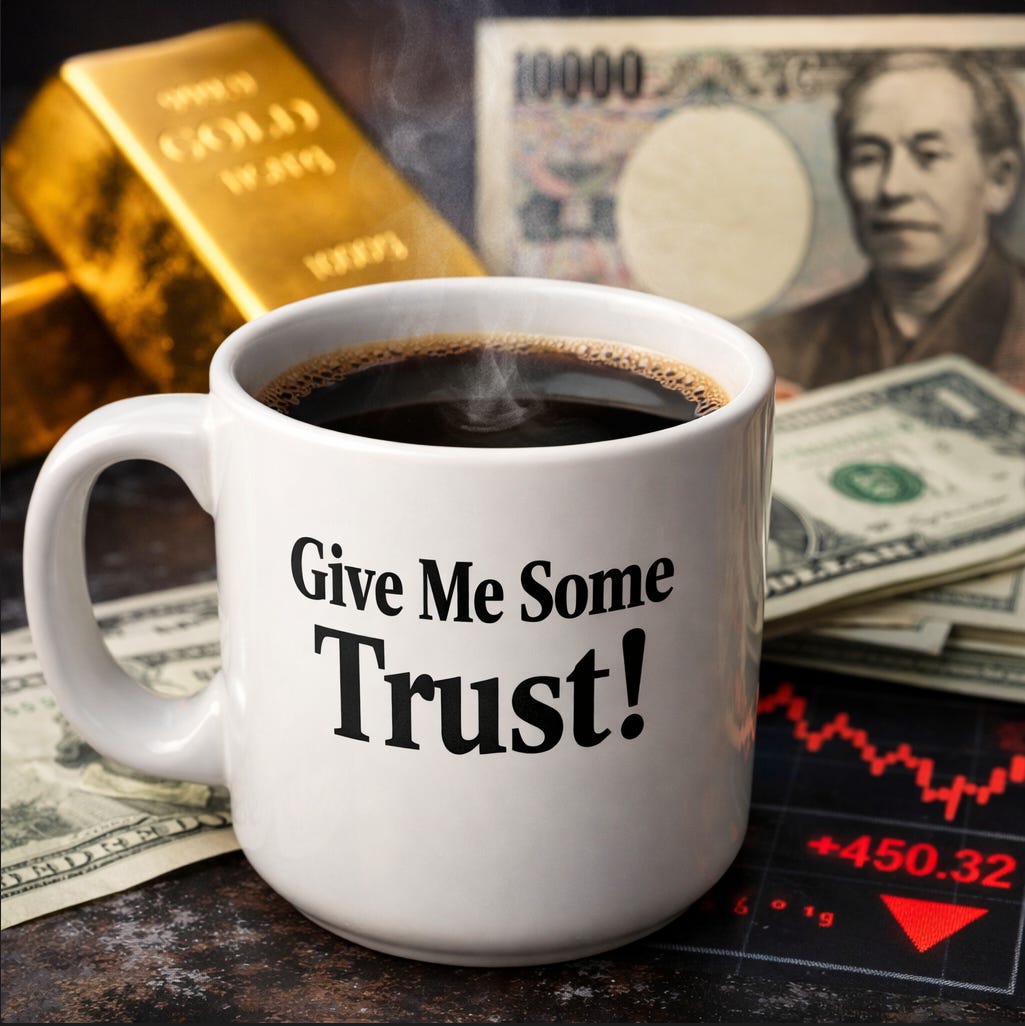
Good morning! If you want to know how the week is going before the State of the Union even begins, don’t watch the spin rooms; watch the markets. Gold has climbed, stocks have slipped, and the dollar has sagged.
“Uncertainty is back,” one strategist told the Financial Times, in the calm, clinical tone economists use when they mean, buckle up.
On Friday, the Supreme Court ruled that Donald Trump had exceeded his authority in imposing many of his sweeping tariffs under emergency powers. In a fit of pique, Trump responded by announcing a flat 15 percent tariff on trading partners under a different law, good for 150 days. A tantrum half-year trade policy. A temporary global tax, because nothing says stability like “we’ll revisit this in six months.”
The new levy relies on the 1974 Trade Act and carries a built-in expiration date unless Congress signs off. Which means markets now have to price not only the tariff itself, but the political mood of Congress and the outcome of the midterms. No one knows what the effective rate will be by autumn. Investors adore that sort of clarity.
Morgan Stanley notes that the reset actually lowers some Asian tariff rates compared to where they stood before the Court stepped in. China’s effective rate drops. Asia’s average drops. In other words, after a year of economic thunder about liberation and leverage, the practical effect may be to ease pressure on the very region the rhetoric targeted most heavily. Not exactly three-dimensional chess.
Across the Atlantic, a British manufacturer of folding bikes quietly made a far more rational calculation. Brompton, the U.K.’s largest bicycle maker, closed its New York and Washington stores when leases came up. In China, it opened a new store in Shenzhen and doubled its footprint in Shanghai.
Why?
“Everything that is coming out of the US is too unpredictable,” its managing director said. “Whether tariffs are on or off, I wouldn’t trust them.”
There it is. Not tax levels or ideology. Trust. The United States, long sold as the world’s most reliable commercial environment, is now being described as the unpredictable one. China, meanwhile, is praised because “we know where we stand.”
That’s a remarkable reversal when you remember how this all started. The stated goals of the tariffs were straightforward: shrink the trade deficit, weaken China’s leverage, bring manufacturing home, and, in some tellings, even help reduce the national debt by generating revenue. The “trade war” was framed as economic patriotism, a necessary battle with Beijing to rebalance the global order.
A year in, what do we have? The national debt has not meaningfully declined. Tariff revenue, while real, is a rounding error against multi-trillion-dollar deficits. Even aggressive import taxes cannot offset structural spending gaps without either major cuts or broader tax reform. The math was always strained; the rhetoric was louder than the spreadsheets.
The trade deficit? It has shifted, not vanished. Supply chains rerouted through Vietnam, Mexico, and other Asian economies. Imports were relabeled, reassembled, redirected. The overall imbalance didn’t disappear — it dispersed. Morgan Stanley now notes that the latest tariff reset may actually lower effective rates on some Asian goods compared to the previous framework. That’s not a knockout blow. That’s reshuffling the board.
And the grand showdown with China? It turns out that volatility can be as destabilizing to your own capital markets as to your rival’s. When gold rises, the dollar weakens, and investors openly discuss uncertainty about six-month tariff horizons, that’s a sign of unpredictability, not leverage.
The tragedy, or perhaps the irony, is that a strategy pitched as restoring American strength and sovereignty has instead introduced doubt about American predictability. In global commerce, reliability is power. When business leaders begin describing Beijing as the steadier environment, that’s a lost credibility story.
As if tariff whiplash weren’t enough, the president spent his weekend threatening Netflix with “consequences” unless it removes Susan Rice from its board. Susan Rice, former national security adviser, Democrat, currently a private citizen serving on the board of a private company.
There were people who built entire identities and voting patterns around the idea that Washington bureaucrats were tyrants for requiring masks in hospitals or vaccines in federal jobs. They cried for liberty and the sanctity of private decision-making. They warned of the danger of centralized power creeping into corporate policy.
Here we are. This comes as Netflix is locked in a $100+ billion takeover battle that requires federal approval. The president had previously said he wouldn’t interfere. Then he interfered.
Now, pause the partisan reflex for a second and look at the principle. A sitting president is publicly signaling that a private corporation should alter its board composition, not because of fraud or financial mismanagement, not because of national security clearance issues, but because he dislikes the political affiliation of a director. And he is doing so while federal regulators under his executive branch must approve that company’s merger.
The same “restore liberty” crowd that recoiled at OSHA mandates and corporate vaccine policies is now watching the federal government lean into corporate governance over a political grievance.
And then there is Gaza. At the newly renamed Donald J. Trump Institute of Peace, formerly the U.S. Institute of Peace, a congressionally established body now seized and rebranded, the president convened the inaugural meeting of his Board of Peace. He pledged $10 billion to rebuild Gaza. Nine countries pledged roughly $7 billion more. A stabilization force was outlined. A 5,000-person local police force was advertised on social media.
The rollout had all the trappings of a launch event. There was, according to multiple reports, a sweeping promotional vision of a “Mediterranean Riviera,” complete with 200 hotels, artificial islands, high-tech corridors and a 10-year arc toward prosperity. As one European observer diplomatically put it, it would have been better if “the rules of procedure were more transparent and more clear.” Rubble outside, renderings inside.
Critics were less diplomatic. Annelle Sheline of the Quincy Institute warned that the large sums pledged by governments “have the potential to become a slush fund that Trump alone controls and profits from, with little effect on the situation on the ground.” Others used a shorter word: grift. The concern isn’t beachfront aesthetics, it’s governance. Who controls the money? Who audits it? What safeguards prevent political or personal misuse?
No one explained where the $10 billion would come from, or whether Congress had been consulted. Article I still grants lawmakers the power of the purse. That hasn’t changed, yet the pledge was presented as a done deal, not a funding request.
The Board itself is chaired by Trump, with membership largely shaped by Trump, and housed in a building bearing Trump’s name. Several major European allies declined to join, citing ambiguity (an understatement) in the board’s mandate. And the president mused aloud that the Board of Peace might one day “look over” the United Nations, even as U.S. dues to the UN remain a point of leverage and strain.
When billions are promised without appropriation clarity, allies hesitate over structure, and critics warn of “slush funds,” it’s not surprising that some Americans hear the word grift echoing beneath the Riviera renderings.
The United Nations is funded largely through mandatory dues assessed on member countries based on the size of their economies, with the United States typically covering about a quarter of its regular budget and an even larger share of peacekeeping costs. When a U.S. administration withholds those dues, it weakens the UN’s operating capacity and reduces America’s influence inside the institution, since financial contributions translate directly into leverage. At the same time, launching and elevating a new international body chaired by the president while suggesting it could rival or even “look over” the UN reflects a shift toward building parallel structures with more centralized executive control rather than working within established, treaty-based multilateral systems.
During all this, funerals were held in Gaza after fresh violence. Hamas remains armed. Israel still occupies large portions of the territory. A 60-day deadline looms before potential renewed hostilities. But sure, let’s talk about beachfront development.
All of this lands just as Trump prepares to deliver his State of the Union address Tuesday night, effectively the soft launch of the midterm campaign. Polls show 39 percent approval on the economy, and just thirty-eight percent on immigration. The two issues that powered his return are now liabilities. Growth slowed in the final quarter of last year, and his tariff authority has been clipped by the Court.
The speech is expected to focus on jobs, reshoring, energy dominance, and bringing manufacturing home. Expect the word “Biden” to do some heavy lifting. Expect applause lines about stock gains, even as the dollar weakens and gold climbs. Expect Democrats to be cast as villains, Republicans as patriots, and the president as indispensable.
But the chamber itself may tell a parallel story. Some Democrats are weighing a boycott. Others are planning to attend and to make their own statement. Several members have invited Epstein survivors and family members as guests, ensuring that as the president speaks about strength and success, the unresolved shadow of that scandal will be seated in plain view, staring back from the front rows. The optics will be impossible to ignore. Cameras don’t just capture the podium; they sweep the room.
The State of the Union used to be a moment for recapping achievements and projecting unity. Now it functions more like a campaign rally with better lighting, applause on one side, stone faces on the other, strategic reaction shots replacing bipartisan standing ovations.
We will learn whether a speech can restore confidence in a system that increasingly looks improvisational and whether carefully scripted optimism can outweigh market jitters, court setbacks, political boycotts, and the very human reminders seated just a few rows away.
Pretty sure many of us will wait for the SOTU recap, the short version. Pity those journalists who must witness The Great Prevarication aka SOTU. What is there to brag about? An ICE who has gone rogue too often. The illegitimate use of military force, implied and actual. Sure the DOW is up, so is investor flight as I read in Treasury bonds. In the midst the dead serious, disgusting Epstein imbroglio. And the continuing grift. The Board of Peace sounds all too reminiscent of another Trump enterprise, the illicit Trump Foundation.
SOTU will be his typical littany of lies and grievances. It will be unbearable. I hope the Olympians don't get pulled in as props for standing ovations.