


Good morning! Donald Trump may be preparing to announce Reliberation Day, because the first Liberation Day failed to liberate Americans from high prices, unstable markets, dwindling export customers or the need for another round of tariffs wearing a different legal costume.
The original “reciprocal” duties were struck down by the Supreme Court in February. The temporary 10 percent global tariff imposed afterward expires Friday. So the administration is now rifling through the federal code like a burglar looking for a window someone forgot to lock, assembling replacement tariffs through forced-labor investigations, excess-manufacturing-capacity probes and obscure provisions written when Herbert Hoover was still wondering whether Smoot-Hawley might perk things up.
The policy remains constant. Only the statutory excuse changes.
Trump signed orders Monday imposing 50 percent tariffs on a broad assortment of Canadian products, including wine, dairy products, plywood, furniture, paper, cement and hockey sticks. The formal justification was not Canadian wildfire smoke, despite Trump’s threat last week to make Canada pay for the “filthy” air invading the United States. Nor did the administration allege that smoke had directly interrupted American commerce.
Instead, officials invoked Section 338 of the Tariff Act of 1930 and accused Canada of discriminating against American automobiles, dairy products and alcohol. The provision has apparently spent nearly a century waiting for a president sufficiently committed to reliving the Great Depression.
Trump was booed at the World Cup final on Sunday; Canadian Prime Minister Mark Carney was not. Twenty-four hours later, Canada got 50 percent tariffs, trade policy and wounded vanity, in this administration, rarely stay separated.
The broader tariff barrage was already being prepared. Officials have developed options for imposing duties of between 10 and 12.5 percent on roughly 60 countries under a Section 301 investigation into forced-labor practices. Additional investigations into excess manufacturing capacity could produce even higher tariffs on the European Union, China, Japan, South Korea, India, Mexico, Vietnam, and a long list of other economies.
The administration says forced labor creates the legal authority. Political concerns have apparently helped determine which products deserve moral urgency and which deserve an exemption.
Beef and coffee have been spared some tariffs because officials fear making groceries more expensive before the midterm elections. Aircraft parts have received consideration because grounding planes is less popular than liberating them. The ethical emergency appears to end somewhere between the supermarket checkout and the departure gate.
Senior advisers are reportedly urging Trump to proceed cautiously because voters already disapprove of his handling of the cost of living, gasoline has climbed above $4 a gallon and the Iran war continues to shake global energy markets. Their argument is essentially that another major trade shock could be politically inconvenient while Americans are already paying for the previous shocks.
Trump’s answer appears to be another major trade shock.
This would be alarming enough if we did not already know what happened the last time he liberated American producers from their customers.
The United States is now on the verge of losing its position as the world’s leading agricultural exporter. It sold $171 billion in agricultural goods last year, only $2 billion more than Brazil. Brazilian exports rose another 6 percent during the first half of this year, reaching a record $87 billion, and 2026 may be the year America finally falls into second place.
The decline is not entirely Trump’s creation. Brazil has cheap land, enormous scale, a favorable climate and regions capable of producing two or even three harvests a year. Its agricultural scientists developed crops suitable for tropical soils, while investors built processing facilities and new production centers across Mato Grosso.
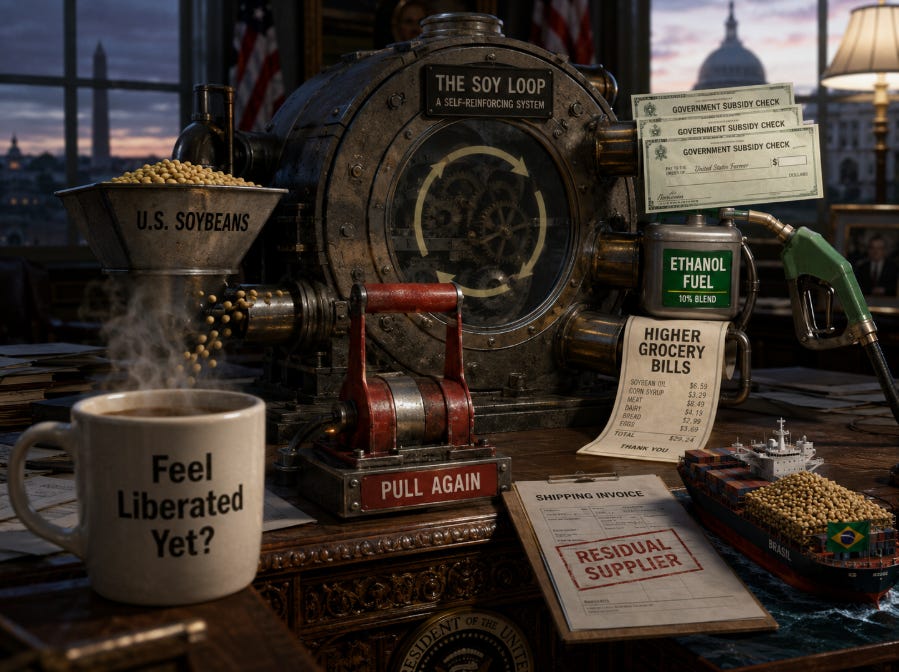
Trump did, however, provide a useful accelerant. When he imposed tariffs on hundreds of billions of dollars in Chinese goods in 2018, Beijing retaliated against agricultural products grown in states that helped elect him. Chinese purchases of American soybeans collapsed. The first Trump administration responded by distributing roughly $23 billion in farm subsidies during 2018 and 2019.
Farmers lost customers. Taxpayers received the bill.
China did not stop buying soybeans. It bought them from Brazil. Trade relationships were established, processing capacity expanded, shipping routes changed and investment followed the new demand. By the time Trump returned to office last year, Brazil supplied most of China’s soybean imports, and the customers America had lost had little reason to return.
As one Iowa farmer explained, the United States is no longer the world’s principal soybean supplier. It has become the “residual supplier,” the place buyers turn when Brazil runs out or encounters a problem.
That is what tariffs can accomplish when applied with sufficient confidence and insufficient strategy. They do not force customers to remain dependent on you. They encourage customers to build alternatives.
Corey Goodhue’s family farm in Iowa illustrates the result. His operation now covers 3,000 acres and uses machinery his father could scarcely have imagined when he started farming the land half a century ago. Last year, the farm produced its best soybean crop on record and still lost money.
This year, assuming respectable yields and no catastrophic equipment failure, the entire operation is expected to produce approximately $60,000 in operating income against more than $2 million in expenses.
This is no small family farm waiting to be rescued by one good harvest. It is a technologically sophisticated, highly productive industrial operation discovering that record abundance does not guarantee economic survival.
The American Farm Bureau Federation projects losses next year of $138 per acre for soybeans, $167 for corn, $145 for wheat and $406 for cotton. America remains capable of growing staggering quantities of food and fiber. What it increasingly cannot do is ensure that the people producing them earn enough to continue.
Trump’s administration insists that it is developing new markets through trade missions, export credits and patriotic adjectives. Agriculture Secretary Brooke Rollins has said no president in multiple lifetimes has been more supportive of farmers than Donald Trump. True if support is measured by how frequently the government must compensate farmers for the effects of Donald Trump.
The farmers themselves express a less ceremonial view. “We don’t really want the direct payment; we want the trade,” Goodhue said.
Markets lost through political whim are not easily restored through another round of political whim. Seeds must be purchased months before crops are harvested. Land leases, machinery loans and fertilizer contracts cannot be rewritten every time Trump discovers a new tariff authority. Farming requires planning across seasons. Trump governs in emotional weather systems.
With export demand weakened, American agriculture has become increasingly dependent on buyers created by federal policy at home. About 40 percent of the American corn crop now goes to ethanol production, supported through tax incentives and federal blending requirements. When the Iran war drove oil prices higher, the Environmental Protection Agency increased biofuel mandates and issued emergency waivers allowing broader sales of E15 gasoline.
The same administration that helped drive customers toward Brazil now needs American motorists to consume the crops those customers no longer buy.
One Iowa farmer described the transformation with unusual clarity: “We aren’t really growing food; we’re growing ethanol.”
The mythology of the fiercely independent American farmer survives. The independence increasingly does not. Farms depend on crop insurance, commodity programs, disaster assistance, export credits, ethanol mandates, emergency waivers and tariff relief payments. Production remains nominally private while demand, risk and survival become matters of federal policy.
“We’re really farming for the government,” the farmer said.
When individual operations fail, the land does not usually stop producing. A larger neighbor absorbs it. The machinery grows taller, the acreage expands and the harvest continues. The farmhouses, barns and families disappear.
Fewer families remain to shop in local stores, enroll children in local schools, support churches, serve in county government or keep machinery dealerships open. Output may rise even as the community producing it withers.
This is one of the central deceptions of modern economic measurement. A system can become more efficient on paper while becoming less resilient in reality. It can produce more grain with fewer people, fewer towns, greater debt, more government support and less capacity to survive a political shock.
Brazil’s rise offers no simple sustainability model either. Freight can consume 30 percent of the value of Brazilian soybeans, compared with roughly 10 to 15 percent in the United States, and the country imports about 85 percent of its fertilizer, leaving its farmers exposed to the fertilizer-price shock from the Iran war.
Into this landscape comes Trump’s declaration that America faces an energy emergency.
War with Iran is pushing up oil prices. Heat waves are increasing air-conditioning demand. Data centers are drawing unprecedented amounts of electricity. Utilities are planning costly new generation and transmission infrastructure. Household electricity prices are rising faster than inflation.
The administration’s response is to make cars, buildings and appliances use more energy.
Over the past year, Trump has weakened vehicle fuel-economy rules, attacked efficient building codes, phased out tax incentives for home insulation and efficient water heaters, and moved to repeal 17 appliance standards covering dishwashers, washing machines, kitchen equipment and other household products. The Energy Department has now proposed additional procedural barriers designed to make it harder for future administrations to strengthen those rules.
Faced with an energy shortage, the administration has identified the culprit: refrigerators that do not waste enough electricity.
The official explanation is “consumer choice.” Americans, the White House says, should be free from radical green mandates when choosing appliances.
That freedom generally consists of paying slightly less upfront for a product that consumes more electricity or gas every month for the remainder of its useful life. Manufacturers may reduce initial production costs. Utilities sell more power. Fossil-fuel companies sell more fuel. Consumers receive the liberty of a permanently higher bill.
Existing appliance standards are estimated to have saved the average household $576 each year, and fuel-economy standards have saved Americans an estimated $5 trillion in gasoline expenses. Efficiency is and should be integral to energy infrastructure.
A megawatt that does not have to be generated because a building wastes less electricity is just as real as a megawatt produced by a new power plant. It does not require a new gas pipeline, uranium supply, transmission line, coal train or data-center-sized prayer for a functioning grid.
The American Council for an Energy-Efficient Economy estimates that ambitious efficiency measures could eliminate the need to construct hundreds of power plants while reducing planet-warming emissions by as much as one-third.
Trump’s alternative is to expand oil, gas, coal and nuclear production while deliberately increasing demand. The administration is trying to fill a bathtub while widening the drain and congratulating itself for turning on another faucet.
The assault on efficiency also creates a lovely circular arrangement with agricultural policy. Higher oil prices increase demand for ethanol. Ethanol consumes more corn. More corn acreage requires more fertilizer, machinery and energy. The Iran war raises fertilizer and fuel prices. The government then weakens the standards that would reduce fuel consumption.
Every new inefficiency becomes a customer for another subsidized form of production.
Trump has now attacked the National Academies of Sciences, Engineering and Medicine over a climate-science chapter in a 1,700-page educational reference manual for federal judges. The chapter explained basic atmospheric physics, including how carbon dioxide and other greenhouse gases trap heat and how human activity has disrupted the natural carbon cycle.
The president called the material fraudulent, biased and misleading. He accused the Academies of being run by “Radical Left Dumocrats” and ordered officials to scrutinize its federal funding.
The manual was intended to give judges accessible introductions to scientific subjects that might arise in litigation. It did not instruct judges how to decide climate cases. It explained the science they might need to understand before hearing evidence and arguments.
The Federal Judicial Center withdrew the chapter in February after pressure from Republican attorneys general and conservative organizations. Hard copies containing the chapter were never distributed. The climate-liability cases cited by Trump remain in preliminary stages, and no court anywhere has imposed financial liability on a company or country solely because of its greenhouse-gas emissions.
Nevertheless, Trump claimed the manual had already caused massive losses. The losses appear to exist principally in the future tense: fossil-fuel companies fear that courts equipped to understand climate attribution might eventually evaluate evidence linking emissions to particular harms.
That concern has become more urgent as attribution science improves. Researchers can increasingly estimate how much human-caused warming influenced the likelihood or severity of a heat wave, wildfire, drought, flood or storm. The National Academies released a report on that subject only days before Trump’s attack.
The administration is not merely denying climate science. It is threatening the institutions that could convert scientific knowledge into legal evidence, regulatory policy and financial accountability.
Judges may listen to fossil-fuel lawyers. They must not be allowed to understand fossil fuels.
The wildfire-smoke episode makes the contradiction especially exquisite. Trump dismisses or suppresses research showing how a warming climate intensifies many of the conditions that drive extreme fires. When smoke from Canadian fires crosses the border, however, he discovers atmospheric science long enough to declare the pollution an invasion and demand payment.
Carbon dioxide may ignore national borders only when that fact is politically inconvenient. Smoke must carry a passport.
Hovering over the tariffs, farm losses, ethanol mandates, rising utility costs and attack on climate science is the war Trump said would not become another forever war.
As of this morning, the United States has bombed Iran for ten consecutive nights. The military campaign was intended to prevent Iran from threatening international shipping. Iran remains capable of threatening international shipping.
Kuwait says Iranian strikes have again damaged power and desalination facilities. Bahrain has sounded air-raid alarms. Iran’s Revolutionary Guard reports fires on oil tankers in the Strait of Hormuz. Desalination plants are not merely another category of Gulf infrastructure. They produce drinking water for populations living in one of the hottest and driest regions on Earth. Damage to those facilities can turn military escalation into a humanitarian emergency with breathtaking speed.
The conflict is also spreading beyond Hormuz. The Houthis have declared a naval blockade against Saudi Arabia and warned shipping companies that vessels loading or unloading at Saudi ports may be targeted anywhere within their operational reach. Two tankers carrying Saudi crude to China and India reportedly reversed course in the Red Sea after the warning. Saudi Arabia’s Yanbu terminal on the Red Sea has served as the principal bypass for millions of barrels of oil that would otherwise travel through the Strait of Hormuz. Now the route around the first chokepoint is itself becoming a second chokepoint.
Ten nights of American bombing have succeeded in demonstrating that the Iranian military threat Trump said had been eliminated still requires an eleventh night of American bombing. The administration has once again announced victory early enough to enjoy the entire war afterward.
There may be a diplomatic opening. Iran’s interior minister has traveled to Pakistan carrying a letter from President Masoud Pezeshkian, and Pakistani officials may be exploring another ceasefire proposal. But the possibility of diplomacy remains speculative while the escalation is measurable in burning ships, damaged power plants, disrupted oil routes and higher prices.
The war is already moving through the American economy. Gasoline costs more than $4 a gallon. Fertilizer prices are rising. Corn is being diverted into ethanol. Electricity demand continues climbing. The administration is weakening efficiency standards that could moderate that demand. Tariffs threaten to raise the cost of imported goods. Farmers who lost overseas customers during Trump’s previous trade war now face another round of uncertainty.
These are not separate stories that happened to arrive on the same morning. They are one system: tariffs destroy markets, so Trump imposes more tariffs. War raises energy prices, so the administration increases fuel consumption and diverts more farmland into energy production. Electricity demand rises, so it weakens efficiency standards. Climate disasters intensify, so it investigates the scientists explaining them. Shipping routes close, so the bombing campaign expands.
Every failure becomes the justification for intensifying the policy that helped produce it.
“Liberation” has become the ceremonial name for transferring risk downward. Consumers pay higher prices. Farmers lose customers. Taxpayers finance the rescue. Rural communities empty out. Utilities build more power plants. Scientists face political investigations. Service members enter another expanding war. The industries closest to power remain protected from the consequences.
Perhaps Trump really will call the next announcement Reliberation Day. The nation has apparently become so free that it must be liberated again every few months, usually from the conditions created by the previous liberation.
America is not being liberated. It is being marched from one manufactured emergency to the next, each carrying a new executive order and the invoice from the last one.
And just like that the Constitution’s grant of tariff authority to Congress is subverted.
A Trump team of forensic seditionists has clearly scoured every relevant law for gaps and loopholes to enable their coup by 1000 acts. Courts and Congress are not equipped to deal with this level of corruption and abuse before the damage is done.
Trump supporters are so brainwashed they’ll believe anything that contradicts reality. I was thinking as I read about Trump’s FIFA debacle that followers disdain for the left will increase. Trump has convinced them that democrats are evil. While it is good to inform people about the latest news, I fear celebrating humiliation might kick us in the ass. Followers may hate the democrats even more. Crops, climate change, and war be dammed.