


Good morning and Happy Labor Day! Howard Lutnick did not mean to say anything revealing. Standing outside a courthouse, fielding questions about an emergency hearing over whether the president can put his own name on the Kennedy Center, he explained, almost fondly, why Donald Trump calls him at eleven o’clock at night to talk about construction.
“This is what he enjoys,” Lutnick said. “So late at night, 11 o’clock at night, he calls me … because it’s fun for him.”
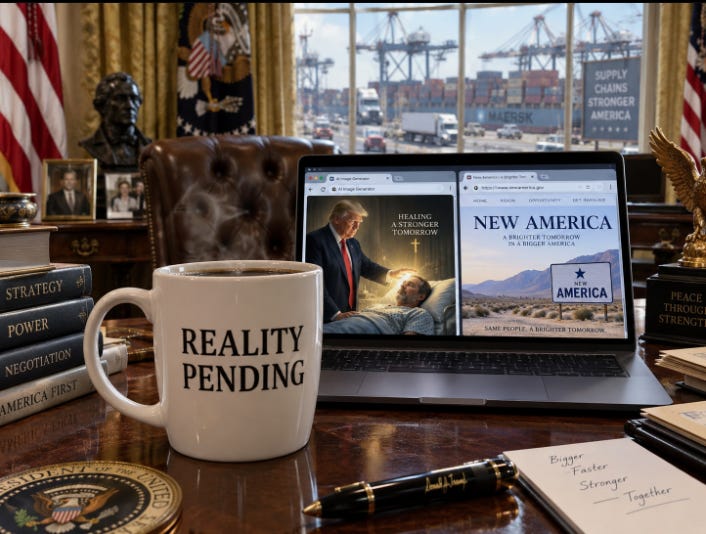
Everybody wants to ask the president about Iran, about the war, about the thing that will not resolve itself no matter how often he is asked about it. Construction is the one subject where the questions stop. It is almost the whole administration in a sentence.
The Iran war is difficult, contingent and stubbornly outside anyone’s unilateral control, a conflict with its own logic, its own casualties and its own irritating refusal to end on schedule. Granite is much more agreeable. A ballroom will not counterattack. A triumphal arch does not have negotiators, although the federal review process technically does, which may explain why excavation is moving ahead before it finishes. The helipad presented even less resistance; it was built without going through the review process that might have complicated matters. And when the Oval Office required a little more gold, there was no diplomatic crisis at all. The president reportedly applied some of the ornamentation himself with superglue.
None of this is really about architecture. It is about finding a domain, any domain, that will hold still and obey.
When the war won’t cooperate, when the Fed won’t cooperate, when Congress, the courts and the rest of the world prove maddeningly capable of having ideas of their own, there is always the White House lawn.
You can always dig there.
New Mexico takes the instinct one step further. The ballroom at least requires cranes, contractors and an actual physical transformation of an actual place.
Pixels are more accommodating to presidential impulse. Over the weekend, Trump posted a map with “Mexico” crossed out in red and “America” written over it, followed hours later by an AI-generated video of himself changing a New Mexico highway sign. The state’s legal name, inconveniently for the bit, is written into the opening sentence of Article I of its constitution: “The name of this state is New Mexico.” A social-media post does not amend it.
This is governance as content: not an order carried into effect, but an image in which the desired outcome has already happened. The ballroom turns presidential preference into stone. The AI video skips the stone and goes directly to the after photo. No recalcitrant legislature, unfinished review process or negotiating partner appears in the frame. The image cooperates completely.
New Mexico’s governor and senators responded by pointing out that the state’s name predates the United States and is not theirs in Washington to casually rewrite. Legally, they are correct. But the AI video had already shown an act of presidential authority that doesn’t exist.
That brings us to the hinge the rest of this story turns on.
Trump can erase “Mexico” from a map much more easily than he can erase Mexico from the American economy.
That gap between the country you can rename in an afternoon and the country you actually depend on is not abstract. Alex González Ormerod, a Mexico-based analyst, made the case to DW News recently, and he did not hedge. “The entirety of American growth” over the past two years, he argued, comes down to Mexico. His reasoning is that AI has become the important new engine of American investment, while the physical machinery underneath that boom increasingly runs through Mexican factories and Mexican technical labor. Mexico is not merely shipping tomatoes and pickup trucks north. It has become a major assembly hub for the servers and other high-tech equipment being installed in American data centers.
Ormerod’s “entirety of American growth” is rhetoric, not a GDP decomposition. The latest BEA data show real final sales to private domestic purchasers, a useful measure of private domestic demand, rising 4.2 percent in the second quarter. Consumers are still spending. Exports and investment contributed positively as well. Headline real GDP grew at a much less impressive 1.5 percent annual rate.
He wildly overstates the number, but in doing so points toward a genuine concentration that conventional GDP triumphalism tends to obscure. AI capital spending has become remarkably concentrated and remarkably large. The five big hyperscalers: Alphabet, Amazon, Meta, Microsoft and Oracle spent about $400 billion in 2025 and are on track for roughly $750–800 billion in 2026 J.P. Morgan estimates that AI-related investment alone accounted for about one-fifth of U.S. real GDP growth over the past year. Consumption contributed considerably more, but that hardly makes a fifth of national growth trivial, particularly when it is being generated by such a narrow cluster of companies making the same enormous technological bet.
The more useful question is: what are we calling growth? GDP folds a broad increase in consumer activity and an extraordinary, highly concentrated wager on data centers, servers and computing infrastructure into the same number. One reflects millions of households making millions of ordinary decisions. The other reflects a handful of enormous companies committing hundreds of billions of dollars to a technology whose eventual returns remain uncertain. Both count, but the statistic cannot tell us whether they are equally durable, equally productive, or equally good for the country.
Plus, the irony becomes difficult to miss. Trump has become a prolific consumer of AI imagery that depicts powers unavailable to him in the physical world. Back in April, amid his feud with Pope Leo, Trump posted an AI image widely interpreted as depicting him as a Christ-like healer laying a glowing hand on the sick. This weekend, another synthetic version of him walked up to a highway sign and transformed New Mexico into New America. Reality supplies constitutional limits, other governments, supply chains, and people with their own interests. Artificial intelligence supplies a more accommodating universe.
Representational power is nearly instantaneous. Type the prompt, generate the image, publish the result. Material power is slower and messier because the world has to cooperate.
The real Mexico is very much part of that world. The administration cannot cross Mexican manufacturing from an AI buildout that increasingly relies on it. Mexico needs the American market, certainly. But American technology companies also rely on an integrated production system spanning Mexico, Taiwan and the rest of East Asia to turn their vast capital budgets into actual servers sitting in actual data centers.
That is the asymmetry underneath the joke. AI can give a president the appearance of powers he does not possess. The economy keeps reminding him that the powers he does possess are constrained by dependencies he cannot simply render away.
Somebody else is watching this gap too, and saying so out loud at a podium in Mumbai. Belgian Prime Minister Bart De Wever, speaking at the India-Belgium High-Level Dialogue on the India-EU Free Trade Agreement, described governments that decide something on Monday, revoke it on Wednesday and reinstall it on Saturday. He did not have to name Donald Trump.
The audience applauded, and De Wever smiled. “Your applause tells me you know who I’m talking about.”
He had arrived at the joke by way of Pliny the Elder, the Roman author who complained nearly two thousand years ago about the wealth Rome was sending east to buy goods from India and elsewhere. Governments have been discovering that somebody else is cheating them on trade for roughly as long as governments have existed. What Pliny lacked was Truth Social.
The joke was the delivery mechanism. The argument underneath it was serious.
Europe, De Wever said, has been late to an awakening India understood earlier: dependencies become dangerous when someone decides to weaponize them. European leaders are now looking for partners that still believe in multilateralism, that negotiate “on a basis of respect and not force,” and that will not unexpectedly impose tariffs, revoke them and reinstall them because somebody said something they disliked.
De Wever was in India while Belgium and India were institutionalizing a business forum, creating a fast-track investment mechanism and expanding cooperation in renewable energy, defense and other sectors. Europe, while not abandoning the United States, is doing something quieter and more consequential: building options.
The president can conjure images of his wildest fantasies almost instantly. AI can make him a healer, rename a state, or place him inside whatever reality the prompt requires.
Iran, Mexico, Europe, markets and supply chains are less accommodating.
They exist outside the frame, with interests and constraints of their own, and no image can make those disappear.
Trump has marked this Labor Day with a written proclamation praising the American worker and a morning at his Bedminster golf club. It praises American workers, claims tariffs are bringing manufacturing home, and presents the administration’s economic program as a worker-centered success story. No public Labor Day remarks were on his schedule as of this writing.
Carney, by contrast, released both a written statement and a recorded Labour Day message. His emphasis is almost the mirror image of Trump’s: unions, shared prosperity, worker training, and, most explicitly, helping Canadian firms and workers “retool, retrain, diversify, and build” in response to U.S. tariffs. He closes the written statement by saying Canada is becoming “stronger and less dependent on any single partner.”
It is time to change our language. We must stop using the words "Donald Trump is doing X" and re-phrase it more properly to "Congress is allowing the Executive Branch to; X. " Since most of what DT is doing SHOULD REQUIRE congressional approval, people need to be reminded who is letting him get away with it. Much in the way an unruly child wreaks havoc everywhere he goes, the assertion would be that it is because his parents allow it. Trump is an unruly child, and his congressional parents are permitting his misbehavior. At the taxpayers" expense!
Thank you, Mary. I took three things away from this post:
1. Every single day, trump looks more and more like a pathetic little man, and not at all like a President.
2. As to Ormerod "wildly" overstating the "entirety of American growth" number attributed to Mexico, might that have been done on purpose? I mean trump regularly "wildly" overstates almost everything.
3. As to the last line regarding Carney's statement, might I add, "mic drop," because it is definitely a mic drop.
Have a great day!