


Good morning! Donald Trump left the NBA Finals last night and delivered what may be the purest artifact yet of his second-term presidency: a post-game press gaggle that began with basketball, veered into bombing Iran, detoured through ornamental fountains, paused for a Knicks prediction from the EPA administrator, attacked judges, rewrote Middle East diplomacy in real time, and somehow still found room for a pipeline grievance against Kathy Hochul.
The Knicks lost to the Spurs, which was unfortunate for New York but useful for metaphor. Because the president emerged from Madison Square Garden and immediately demonstrated that his administration’s operating theory is basically a full-court press on reality.
Trump insisted the game was “fantastic,” praised the players, and then, without even pretending to downshift, announced that negotiations with Iran were going well and that a deal could come within “one or two days.” He claimed his blockade was holding ‘100%’ nothing getting through, no oil, no income, then, a few breaths later, explained that low gas prices were thanks to all the oil coming out of Hormuz. Both true at once, apparently, with aircraft carriers.
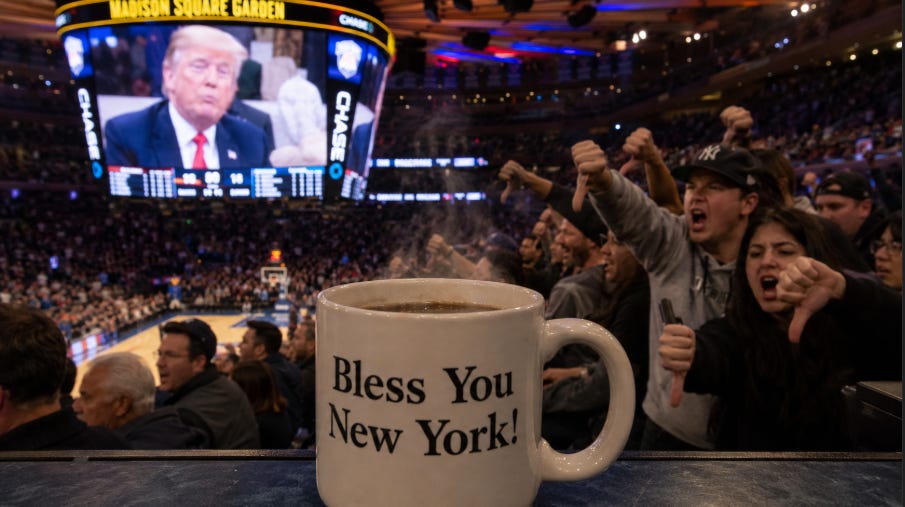
Here is what actually happened, per the reporting and, notably, per the White House’s own press pool. When Trump appeared on the Madison Square Garden Jumbotron during the national anthem, the arena thunderously booed, the pool report’s own phrase, describing the jeers as “loud and long”, ending only when the camera cut to Jalen Brunson on the court. Al Jazeera and ABC reported the same thing: chants of “U-S-A!” gave way to boos the moment Trump appeared giving a military salute. Even Knicks owner James Dolan, in whose suite Trump was sitting, “seemed to be smirking at the boos.” It was, by every account including his own administration’s, a hometown rejection.
Trump’s version: “It was, I think, mostly cheers. It was loud, and it was very enthusiastic.”
(Bless you, New York, I needed this one!)
This is one of the useful constants in the Trump cinematic universe: booing is cheering, losing is winning, fraud is proof only when Democrats receive votes, and war is peace if he says the paperwork is almost ready. The tell isn’t just that he lied about the crowd. It’s that the lie was disprovable in real time, on a national broadcast, contradicted by his own press pool, and he told it anyway, because in his account the reception is whatever he says it was. It is the same reflex that runs the whole evening: the blockade holds even as the oil flows, the deal is signed even as the bombs fall, the votes are fraudulent even as they are counted. The crowd cheered because he says it cheered. Reality is a rumor he intends to outlast.
From there, the gaggle became a moving diorama of American decline as narrated by the man actively accelerating it. Trump talked about D.C. as if he had personally rescued Rome from Visigoths by power-washing some granite. Interior Secretary Doug Burgum praised the president’s personal involvement in beautifying the capital ahead of the 250th anniversary celebrations, because the theme of the semiquincentennial is “Dear Leader Noticed the Fountains.”
Trump boasted that Washington, D.C. is now “very safe and very beautiful,” claimed crime is down 95%, thanked the National Guard and D.C. police for doing “as we ask,” and delivered an extended meditation on grass. “Grass has a life just like a human being has a life,” he explained, because nothing says stable global leadership like the president emerging from a basketball game during a Middle East war to philosophize about lawn mortality.
He talked about the Reflecting Pool, which he called the “reflective lake,” because why use the name of one of the most recognizable civic spaces in the country when you can sound like you’re describing a puddle outside a Bass Pro Shops? He praised sandblasted granite, working fountains, new grass, removed fences, a Lincoln Memorial promenade, an “ark,” and, of course, the ballroom. Always the ballroom. The Trump presidency has many doctrines, but the main one is this: if democracy is collapsing, perhaps it simply needs more gold trim and a better event space.
This is the aesthetic of the whole regime now: troops, fountains, bulldozers, marble, police, “beautification,” and forced applause. Trump does not govern a republic so much as stage one. He looks at Washington and sees not a constitutional system but a set that has insufficiently flattered him.
Then he pivoted to the economy, claiming record jobs, 73 new stock-market highs, and $18 trillion in investment in the United States in just 11 months. That number should be handled with oven mitts, a hazmat suit, and possibly an exorcist. It fits neatly into the broader “golden age” fantasy we’ve been tracking, where announcements become achievements, stock records become household prosperity, and fictional investment totals are expected to pay rent, buy groceries, and replace actual wages.
Then came Lee Zeldin, the administrator of the Environmental Protection Agency, who was asked to speak and began by analyzing the NBA Finals. Zeldin praised Wembanyama and Castle, declared himself “Knicks in five,” and then, because nothing says environmental stewardship like the EPA administrator doing sports radio from the mouth of the fossil-fuel volcano, pivoted into natural gas pipelines. He said New York should reverse its ban on natural gas extraction and revive the Constitution Pipeline so New England could get cheaper energy. Trump jumped in to accuse Gov. Kathy Hochul of breaking a deal involving pipelines and windmills.
So, to recap the post-game show: Knicks, Iran, blockade, fountains, grass, ballroom, stock market, EPA basketball analysis, pipeline blackmail, windmill revenge. Just another normal evening in the Republic of Mar-a-Lago.
The most revealing moment came at the end, when a reporter asked about a federal judge striking down Trump’s $100,000 H-1B visa fee because it required congressional approval. Trump did not attempt a legal argument. He did not explain the policy. He attacked the courts. “These federal judges are really giving us a hard time,” he said. “It’s really crazy what’s going on with the court system.” Judges, he added, are “hurting our country very badly.”
There it is. The entire Trump theory of government in miniature: judges who enforce the law are hurting the country, police who do “as we ask” are terrific, crowds that boo are cheering, and wars are nearly solved as long as nobody checks whether the bombs have stopped falling.
Which brings us to California, where Trump is already writing the script for November.
The New York Times reports that Trump is using California’s slow ballot count to renew his favorite lie: any election he does not like must be fraudulent. In the Los Angeles mayoral race, Republican reality-TV personality Spencer Pratt initially led progressive city councilwoman Nithya Raman for second place on election night, behind incumbent Mayor Karen Bass. But as late-arriving mail ballots were counted, Raman moved ahead and the Associated Press said she had prevailed. This is not mysterious. It is California. It is mail voting. It is called counting ballots.
Trump declared it “not possible” anyway.
This is the old “red mirage” phenomenon, dressed up in a new cheap suit and given a Truth Social account. Republican-leaning votes often appear earlier because of how and when they are cast and counted; Democratic-leaning mail ballots can arrive later and shift results as they are verified. California sends every regular voter a mail ballot, allows valid ballots postmarked by Election Day to arrive during a grace period, verifies provisional ballots, and lets voters fix signature problems. These safeguards take time because democracy, despite Trump’s lifelong confusion on this point, is not a drive-thru.
The Guardian followed with an even sharper warning: Trump is “inventing fraud” in California. Experts say this time is more dangerous because he is not merely a candidate howling from outside the building. He is president again, surrounded by loyalists, election deniers, federal prosecutors, and a right-wing media machine eager to convert ordinary election administration into a conspiracy theory before lunch.
In 2020, Trump lied about the count and then tried to overturn the result. In 2026, he is starting while the ballots are still being processed.
He has claimed California’s elections are under investigation by the U.S. attorney’s office in Los Angeles. The Justice Department sent a federal prosecutor to observe ballot processing in Los Angeles. Bill Essayli, Trump’s appointee in the Central District of California, has claimed there are “multiple election fraud investigations” underway without offering details. This is how authoritarian pressure works: not always with a dramatic raid or a midnight decree, but with hints, observers, threats, “questions,” and just enough federal presence to make local officials feel the breath on their necks.
This is not only about Spencer Pratt, though I regret to inform the Founders that we have reached the Spencer Pratt chapter of the republic.
It is about control of Congress. California could decide the House. After voters approved Proposition 50, Democrats may have a chance to flip as many as five Republican-held seats. Many of those districts are in places where ballots take days or weeks to count. That means the very races that could determine whether Trump faces congressional accountability are likely to be counted in exactly the slow, careful way he is now pre-labeling as fraud.
This is the setup. Count quickly, and they will claim the process was sloppy. Count carefully, and they will claim the delay proves theft. Verify signatures, and they will call it suspicious. Let voters cure errors, and they will call it rigging. The only acceptable election, in Trump’s view, is one in which his candidate wins before all the votes are counted and everyone agrees to stop looking.
The Guardian quoted former Maricopa County recorder Stephen Richer, a Republican who knows something about being targeted by election conspiracists, warning that California needs to prepare for a misinformation onslaught if House control comes down to a few competitive districts. He also noted the difference between this year and previous cycles: key law-enforcement positions are now occupied by people with a strong interest in pleasing Trump and a willingness to indulge stolen-election nonsense.
That is the phrase to sit with: the federal tools are now in the hands of people willing to use the lie.
Meanwhile, in the Middle East, Trump’s foreign policy spent forty-eight hours running through every possible position and somehow landing on “trust me, we’re very close.”
On Sunday, with Iranian missiles still in the air over northern Israel, Tehran’s retaliation for an Israeli strike on Beirut’s southern suburbs, Trump told the Financial Times, “I call the shots. I call all the shots. Netanyahu doesn’t call the shots.” He predicted that the Israeli leader would have “no choice” but to accept a U.S.-Iran deal. He told Axios he was calling Netanyahu “right now” to forbid retaliation against Iran.
Then Israel struck Iran anyway.
Explosions were reported across Tehran, Tabriz, and Isfahan. The Israeli Air Force hit the Mahshahr petrochemical complex. Netanyahu did exactly what Trump had just told reporters he would prevent. In any other administration, that would be a diplomatic humiliation. In this one, it became another chance to print a new version of reality and staple it over the old one.
Trump posted an all-caps demand that “Israel and Iran must immediately stop ‘shooting,’” then declared that peace was “proceeding,” then told a Lindsey Graham tele-rally that the United States would achieve “total victory” over Iran within two weeks, after which oil prices would come tumbling down. Nothing says sober conflict management like promising victory, peace, and cheaper gas in the same breath, as if the Strait of Hormuz were a Black Friday appliance sale.
Asked by the BBC how he squared his own veto with Israel ignoring it, Trump rewrote the timeline. The missiles, he said, were already on their way when he spoke to Netanyahu. And besides, “if I tell him to do something, he does it.”
This is a man walking backward through a rake factory insisting he meant to do that.
And then, last night, a fifth timeline. Standing outside Madison Square Garden between basketball analysis and fountain worship, Trump told reporters the Iran deal could be signed “in two or three days,” with the Strait of Hormuz opening “immediately upon signing.”
Set that beside the others and the incoherence is total. On Sunday, the deal was “one or two days” away. On the Graham tele-rally, it was “total victory” in two weeks. To the BBC, it was already too late, the missiles already “on their way.” And now, post-game, it is two or three days again, except he also said, in the same gaggle, that the United States could “spend another two or three weeks bombing” if it chose, and that a signed deal would somehow be stronger than the bombing he was still threatening.
Within a single news cycle, the same war is two days from peace, two weeks from total victory, already past the point of control, and one bombing campaign away from resolution. It is narrated by a man who, the night before, could not decide whether his own blockade was sealing Iran off completely or letting enough oil flow to keep prices down.
The timeline is not a forecast. It is whatever the sentence needs it to be while it is being spoken. Peace is always two or three days away precisely because “two or three days” is not a measurement of anything. It is a verbal tic that means the subject is now closed.
A U.S. official reportedly conceded to Axios that Netanyahu had been expressly told the president did not support the strike, “but he does what he does.” That sentence may be the most honest summary of Trump’s Middle East policy we are going to get: he does what he does. Netanyahu does what he does. Trump then claims he called the shots. Everyone else gets to live under the falling debris.
The hollowness underneath the bravado is the important part. Trump threatened that Israel might be “on its own very soon,” but there is no sign he will touch the one lever that actually matters: military aid. This is the president who has spent his term removing constraints on Netanyahu, from settlement sanctions to Democratic holds on arms transfers. A threat without consequences is not leverage. It is theater with refueling planes.
Israeli analysts appear to understand the performance. Pollster Dahlia Scheindlin called the public friction “political theatre,” with Trump performing restraint for American voters and Netanyahu performing defiance for Israeli ones. Both can claim victory because they are addressing different rooms. Unfortunately, the people under the bombs are not in either audience.
Lebanon is where the whole fiction collapses. Iran insists any deal must cover Lebanon. Israel’s ambassador to Washington insists the talks have nothing to do with Lebanon. Trump, by all appearances, accepts the linkage but cannot enforce it. So while he announces peace “within days,” Israel continues striking Lebanon during what is supposed to be a ceasefire. Lebanon’s prime minister has counted thousands of Israeli airstrikes during the very ceasefire that was supposed to stop them.
Then Israel forcibly emptied the southern city of Tyre, including the Christian quarter that previous evacuation orders had spared, where thousands had sheltered precisely because it had been treated as the exception. Lebanon’s National News Agency reported nine people killed and 28 wounded.
A war the president claims to be winning. A region he claims to command. A ceasefire declared again and again and broken again and again. Peace is always two or three days away.
The bombs, regrettably, are punctual.
Because no modern American crisis is complete without billionaires asking the public to finance their escape pod, the AI IPO stampede is getting stranger by the day.
First, Anthropic filed confidentially to go public. Then OpenAI followed. And now SpaceX is asking public markets to swallow a valuation reported near $1.77 trillion, pending pricing Wednesday, built not just on rockets and Starlink, but on Mars colonies, orbital data centers, and AI infrastructure that may not exist commercially for years.
The Financial Times frames the listing as a test of whether investors will buy Elon Musk’s “moonshots.” Max at UNFTR is blunter, calling it a possible wealth-transfer machine dressed up as a space company.
It is not whether SpaceX is a remarkable company, but whether the public is being asked to pay today for every possible future Elon Musk has ever doodled on a ketamine napkin. Reusable rockets dominate space. Starlink conquers global connectivity. Grok becomes a serious AI platform. Orbital data centers become the next cloud empire. Mars becomes a business line. Somehow all of it works, all of it scales, all of it produces cash, and all of it deserves to be priced now as if the future has already cleared.
According to Max’s read of the prospectus, SpaceX’s real businesses do not justify the price. Launch operations remain loss-making. Starlink is impressive but not, on its own, trillion-dollar proof. Much of the claimed addressable market appears to come from speculative AI projections, the kind of spreadsheet magic where satellites, rockets, data centers, Mars colonies, and artificial intelligence all get poured into one pot and reduced until it becomes shareholder syrup.
The IPO appears designed to create scarcity with a tiny float, pull in unusually heavy retail participation, and then potentially benefit from fast Nasdaq 100 inclusion that could force passive funds, including ordinary retirement accounts, to buy in whether investors understand the exposure or not. Meanwhile, insiders may get an unusually quick path to liquidity.
SpaceX may be extraordinary, but this offering asks the public to serve as exit liquidity for a future in which every Musk moonshot lands. It is a trillion-dollar faith offering: Truth Social with rockets, only this time potentially wired directly into your 401(k).
Trump wants voters to believe ballots are fake if Democrats count them. He wants crowds to be cheering when they are booing. He wants judges to stop enforcing laws because laws are inconvenient. He wants war to be peace, bombing to be leverage, threats to be diplomacy, and a ceasefire to mean whatever is useful until the next explosion. Musk wants markets to price fantasy as inevitability and then let passive funds distribute the risk downward.
Everywhere you look, the same scam is operating at a different scale: manufacture the story first, force reality to chase it, and make ordinary people absorb the cost when the story breaks.
Trump left a basketball game last night and tried to narrate the world into submission. California is rigged because Democrats are counting ballots. Iran is nearly solved because he says a deal is close. Israel obeys him because he insists Netanyahu does what he says. D.C. is reborn because the fountains work. The economy is golden because he invented a giant investment number. The courts are hurting the country because they still remember Congress exists.
It is exhausting, absurd, dangerous, and it is all moving in the same direction.
As a Canadian who follows the actions of this kakistocracy closely, and watching what is currently unfolding in California, it looks like y’all had best buckle up for November. I think that there will be an assault on your democracy as vicious as that of January 6th, perhaps more devastating, but on a national scale. The Trmp regime will throw everything it has at the mid-terms and retention of power.
But truth and righteous will prevail…..I believe that with every fibre of my optimistic Canadian being.
I thought Tony Keller, in today's Globe & Mail, had a brilliant description of Trump weekend with Israel & Iran:
"And speaking with Fox News, he criticized Mr. Netanyahu for having launched the air strikes on Beirut, claiming that a deal with Iran was close and “would be signed on Monday, Tuesday or Wednesday of this coming week, and now this takes place.”
Mr. Trump’s words reveal, once again, his penchant for one of his favourite pastimes: diplomatic onanism.
That’s when you negotiate with yourself, while imagining a willing partner on the other side of the table, and that satisfaction is fast approaching. It’s the Art of Fantasizing About the Deal."
Full article: https://www.theglobeandmail.com/business/commentary/article-us-iran-war-netanyahu-trump/