


Good morning! Donald Trump returned to the United Nations yesterday to report, once again, that virtually everything is historic, unprecedented, incredible, record-breaking, never-before-seen and quite possibly the greatest thing ever witnessed by mammals with opposable thumbs.
“The numbers are absolutely incredible.”
“No one thought that was possible.”
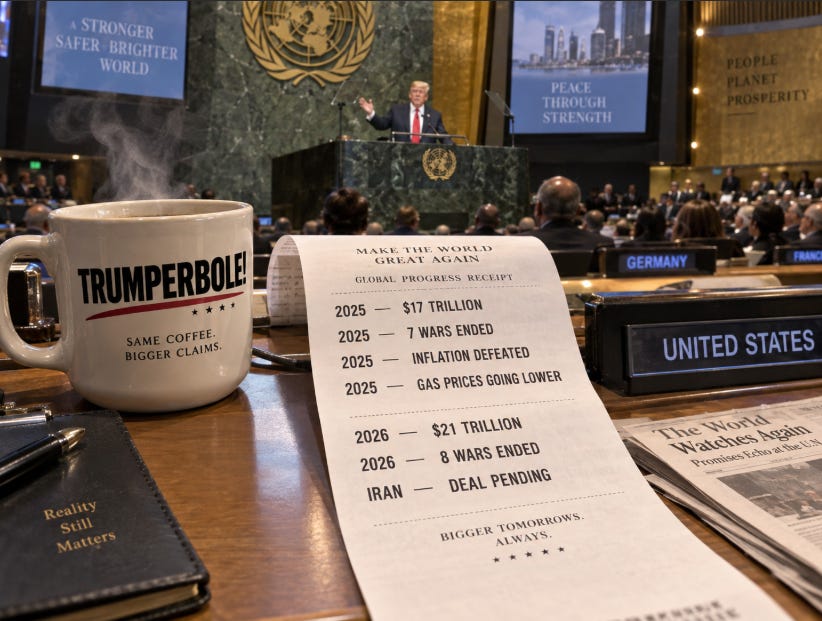
“More than ever before.”
“The biggest deal ever made.”
A year ago, Donald Trump stood at this podium and declared Iran solved. “With Iran’s nuclear enrichment capacity demolished,” he told the General Assembly in September 2025, “I immediately brokered an end to the 12-day war, as it’s called, between Israel and Iran, with both sides agreeing to fight, fight no longer.” It was the fifth country on his list of seven wars ended in seven months — Israel and Iran, filed alongside Cambodia and Thailand, Kosovo and Serbia, a closed case.
It did not stay closed. Within months, the United States was fighting a war of its own, Operation Epic Fury, authorized in February, which killed Iran’s Supreme Leader alongside a wide-ranging Israeli bombing campaign and opened a year of naval blockades, missile exchanges, and a Strait of Hormuz effectively closed to most tanker traffic. Seven months of it, ongoing as of this week.
Tuesday, at the same podium, Trump described the aftermath in similarly triumphant terms Iran’s navy “lying at the bottom of the sea,” its air force “gone,” its economy collapsed under inflation he put at “well over 300%.” What he did not do is call it settled. This year’s list of wars ended runs to eight rather than seven, but Israel and Iran is no longer on it. In its place is an open question, answered with a promise rather than a receipt: “Will a deal be made with Iran? ... I believe we will make a deal. Right after the election.”
That is the throughline for the whole speech, in miniature, before the rest of it even starts. Not a claim proven wrong and corrected — a claim that quietly stopped being made, replaced by a bigger one, pointed at a future date far enough off that it can’t yet be checked.
Associated Press describes the U.S.-Iran conflict as nearing its seventh month. Most of the Iranian delegation walked out during Trump’s remarks as he recounted the damage inflicted on their country.
One year ago: I ended the Israel-Iran war.
Yesterday: I believe we will make a deal.
Reality keeps forcing amendments to the press release.
This becomes even stranger at the peace scoreboard.
Last year, Trump said he’d ended seven wars and named them: Cambodia-Thailand, Kosovo-Serbia, Congo-Rwanda, Pakistan-India, Israel-Iran, Egypt-Ethiopia, Armenia-Azerbaijan.
Yesterday, the number rose to eight, but the list swapped in Gaza and quietly dropped both Israel-Iran and Egypt-Ethiopia. One of last year’s “ended” wars hadn’t just fallen off; it had taken over the opening third of this year’s speech as an active conflict awaiting a future settlement. Yet the total went up. The presidential peace scoreboard has a plus button but no subtraction key.
Ukraine got the same treatment. Last year, Trump expected it to be the easiest war to solve, given his relationship with Putin. Yesterday: “We will get that one done. I think it will happen more quickly than people understand.” The war remains underway. “Soon,” it seems, has excellent rollover benefits.
Then we arrived at another familiar number.
Last September Trump told the General Assembly that he had secured $17 trillion in new investment in only eight months, compared with less than $1 trillion during Joe Biden’s entire presidency.
Yesterday, $17 trillion became $21 trillion.
“We’ve secured commitments for $21 trillion in new investments from all over the planet,” Trump said, again comparing it with less than $1 trillion under Biden.
This is where the accounting gets creative.
Trump’s own White House currently claims more than $11 trillion, not $21 trillion. And even that $11 trillion includes years-long corporate announcements, speculative future projects and foreign commitments rather than $11 trillion that has actually arrived and been invested. FactCheck.org examined Trump’s $20 trillion version earlier this month and found that his number was nearly double his own administration’s already expansive tally.
Actual Bureau of Economic Analysis data show foreign investors spent $232.2 billion acquiring, establishing or expanding American businesses during 2025. Including planned future spending associated with those projects brings the figure to $284.5 billion.
The real trick, however, is not merely that Trump’s number is too large. It is that Biden and Trump are being measured with two different rulers.
The “less than $1 trillion” figure for Biden roughly corresponds to a narrow measure of actual foreign-direct-investment expenditures. Trump’s total sweeps together announced corporate spending, long-term investment plans, foreign pledges and assorted commercial agreements.
Biden gets audited on cash through the door, while Trump gets to include the Christmas wish list.
Both numbers are expressed in dollars, which gives the comparison the reassuring appearance of arithmetic. But comparing realized investment with announcements and multiyear commitments is roughly like comparing what you spent on groceries last year with everything you have ever added to an Amazon cart.
And the number keeps improving with age.
Seventeen trillion last September. Twenty trillion earlier this month. Twenty-one trillion yesterday.
The investment boom may or may not be historic, but the investment number is certainly enjoying robust growth.
There were, however, some statistics in yesterday’s speech that deserve to be treated seriously because the underlying news really is good.
Trump said median household income had risen to roughly $87,000. Census puts real median household income for 2025 at $87,460, the highest recorded in the series dating to 1967. The official poverty rate fell to 10.2 percent, and Hispanic poverty reached a record low of 13.9 percent.
Violent crime also fell sharply in 2025. The FBI reported the largest one-year decline in violent crime and murder rates since it began publishing nationwide estimates in 1936. The reasons for that decline are more complicated than a presidential victory lap, crime had already been declining for several years, and criminologists caution against assigning it to one administration or policy, but the decline itself is real and significant.
Facts do not become less factual merely because Trump says them, but it also illustrates the larger problem with his rhetoric.
$87,460 is information.
“THE HIGHEST LEVEL IN HISTORY,” is decoration.
A 9.7 percent decline in violent crime is information.
“No one has ever seen anything like it,” is mood lighting.
Trump’s speeches are so saturated with “greatest,” “biggest,” “most powerful,” “never before,” “nobody thought possible” and “the numbers are incredible” that useful information and promotional lacquer arrive in the same bucket. Eventually, you find yourself scraping adjectives away with a putty knife just to see whether there is a statistic underneath.
Which brings us to what Trump did not say yesterday.
Last year, “inflation has been defeated.”
Yesterday, that victory announcement disappeared.
Last year, gasoline prices were down. Later in the same speech Trump went further: “We’re going to be much lower in a year from now.”
One year later, the latest Bureau of Labor Statistics report shows consumer prices up 3.4 percent from a year earlier, energy prices up 16.3 percent and gasoline up 27.4 percent. Last week the Federal Reserve raised interest rates by a quarter point and said, with the sort of restrained central-bank prose that leaves very little room for “Golden Age” merchandise, “Inflation remains elevated.”
Trump talked extensively about Iran today, and predicted oil prices would come “plummeting down” once the conflict resolves.
What he didn’t say: that inflation had been defeated. That American gasoline was down. That last September, he’d predicted it would be “much lower” by now.
The boast simply missed the flight to New York.
Last year’s poll-numbers boast, inserted after he praised his border and economic record, also went missing, with no acknowledgment or replacement.
The Gulf relationship got a similar downsizing. Saudi Arabia, Qatar, and the UAE were “closer than ever before” in 2025. This year, Trump arrived amid a regional war that’s disrupted oil shipments, strained those same economies, and forced their governments into urgent talks about getting out of the crisis he helped create. “Closer than ever” stayed home with “inflation has been defeated.”
There was still plenty to fill the vacuum: Maduro’s capture, the cartels, Cuba, Greenland, the International Criminal Court, immigration, transgender policy. And then, because artificial intelligence was apparently suffering from a branding problem, the president informed the assembled heads of government that it shall henceforth be known as Super Intelligence. “SI.” “Sounds much better,” he explained, before adding: “Let’s see if I have any power. Maybe I do. And maybe I don’t.”
And before a room filled with heads of state gathered to discuss war, peace and nuclear weapons, Trump returned to one of his favorite domestic culture-war formulations, denouncing what he repeatedly calls the “transgender mutilization of our children.”
The address sometimes sounded less like a diplomatic program than an annual reunion tour. Associated Press described it as heavily focused on domestic accomplishments, immigration, military strength and familiar political themes even as world leaders gathered amid wars in Iran and Ukraine, economic uncertainty and anxiety over AI.
One more omission worth noting: last year, Trump closed by calling on nations to “defend free speech and free expression.” That line didn’t return, not incidentally, coming days after he barred CNN, MS NOW and Politico from the White House over coverage he calls unfair, and after Mayor Mamdani made a point of welcoming all press to Gracie Mansion’s lawn in pointed contrast. No correction needed. It simply wasn’t on this year’s playlist.
That’s the most useful way to read the whole speech: not as forty minutes of claims requiring individual adjudication, but as a document meant to sit beside its predecessor. Investment figures grow. Settled wars change status without ever being wrong. Promises reset their own clocks. And the boasts that didn’t survive a year of reality, inflation defeated, gasoline coming down, the highest poll numbers ever, “closer than ever” with the Gulf, free speech itself, don’t get corrected. They just stop coming up.
Trumperbole is built for the moment; it only has to survive the sentence it’s in. Reality has a longer memory. Fortunately, so does the transcript, including last year’s, which supplied what might be the perfect epigraph for this whole exercise: “I’ve been right about everything.”
One year later, we have the receipts.
I haven't read through the post yet, but he was lured into a war with Netanyahu because he wants to blow things up; now he can't control either Israel nor Iran, has destroyed the world economy, oil and fertilizer supplies, put a younger, more radical government in place, caused all of our bases to be attacked and many to be damaged and the host countries to reject the USA in their own defense, he's essentially taken us out of NATO and is the only country not to adopt the accurate global map instead of the Mercator Projection, has an alcoholic television host over the military firing all the experienced leadership and concealing our casualties while arranging testosterone injections instead of replenishing the dwindling armaments, and bored with the war they claim isn't a war, destroying the national capital putting up vanity projects. He's doing what bin Laden and Putin always aimed to accomplish.
I know that countries are dependent on the USA, but I will never understand how the heads of state don't get up and leave, and I mean the whole assembly.