


Good morning! The atmosphere has once again failed to respect Donald Trump’s border policy. Smoke from Canadian wildfires crossed into the United States this week without a visa, a customs declaration or so much as a courteous pause at the international boundary. It drifted over Detroit, Chicago, New York and Washington, turning skies hazy and air unhealthy. The president surveyed this continental emergency and responded with the one instrument he now applies to every problem from trade deficits to wounded pride: tariffs.
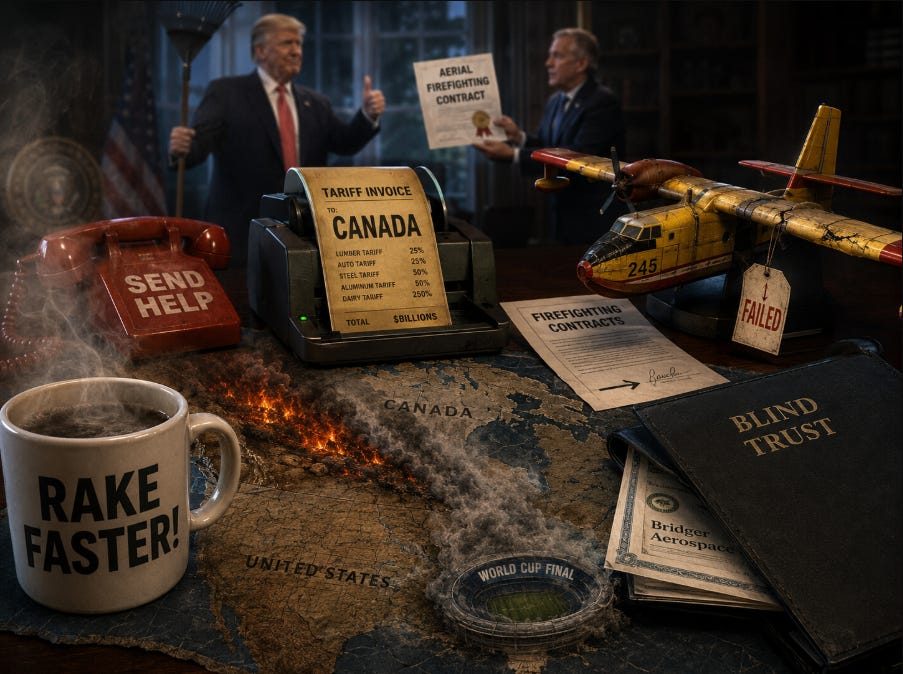
“The United States is being unnecessarily invaded by filthy, polluted, and unhealthy air,” Trump announced on Truth Social, calling the smoke “dangerous” and “totally unacceptable.” Canada, he declared, had committed “Willful Negligence” by failing to perform “basic Forest Management and Debris Removal.” The cost of the pollution, he continued, would therefore need to be added to the tariffs Canada is “currently paying.”
Canada is not currently paying those tariffs, of course. American importers pay them and generally pass much of the cost on to American businesses and consumers. Trump’s proposal would therefore punish Americans for breathing Canadian smoke by making Canadian products more expensive. The fires would continue burning, the smoke would continue moving with the wind, and shoppers in Michigan could contemplate their higher grocery bills while taking comfort in the knowledge that the atmosphere had been firmly disciplined.
It was “rake the forests” with a customs surcharge.
If there is a real cost to calculate here, it isn’t the one Trump is proposing to invoice. A study of the 2023 Canadian wildfire season found the smoke contributed to roughly 82,000 early deaths, including 33,000 in the United States and 22,000 in Europe. That is the actual ledger. Nobody has proposed a tariff for it, because there is no tariff schedule for grief.
The smoke was also drifting toward the stage Trump had chosen for his next starring role. The World Cup final in New Jersey now hung beneath a toxic haze, with the White House task force monitoring conditions and FIFA discussing whether the match could safely proceed. Spain’s players had already practiced outdoors in hazardous air, preparing for ninety minutes of elite exertion in what one emergency physician described as a “toxic soup” of fine particles capable of reaching deep into the lungs and entering the bloodstream. There is no safe level of exposure to PM2.5, she warned, and public-health officials would ultimately have to decide whether the game could go forward.
Trump attended a FIFA reception in New York and, as tradition requires, turned a celebration of international soccer into a tribute to Donald Trump. After accepting Gianni Infantino’s lavish praise, he revisited the “rigged” 2020 election, took credit for securing both the World Cup and the Olympics, mangled several names, offered coaching advice and suggested that the United States host the tournament again, next time without Canada and Mexico.
It was an exquisitely timed proposal. The final of a tournament jointly hosted by the three North American countries was being endangered by smoke from a climate emergency crossing the same borders Trump treats as commercial battle lines. He wanted sole ownership of the celebration, none of the shared responsibility for the conditions threatening it, and perhaps fewer co-hosts next time. Reflecting on the unpredictability of sports, Trump observed, “You’re hot as a pistol and then you’re not so hot. But I wouldn’t know about a thing like that.” Self-awareness briefly approached the ballroom, encountered an air-quality warning, and went back inside.
By then, Trump had already found someone to explain why none of this was his problem. Senator Tim Sheehy supplied something more useful than climate science: a commercial grievance.
Sheehy, introducing himself as a former water-bomber pilot who once ran an aerial-firefighting fleet, rejected Canada’s account of cross-border cooperation. Canadian officials, he claimed, “routinely block” American firefighting companies while sending government-subsidized aircraft south to collect commercial rates from American taxpayers. He called it “big business” conducted like “a Chinese protectionist racket.”
Trump retransmitted the accusation and supplied his customary peer review: “Tim Sheehy is GREAT. A Winner!!!”
Missing from that endorsement was a relevant biographical detail. Sheehy founded Bridger Aerospace, served as its chief executive and was still its largest individual shareholder, owning 21 percent of the company, when he resigned to run for the Senate. Bridger sells precisely the aerial-firefighting services Sheehy said Canada should purchase from American companies. The company says it operates in both the United States and Canada, and the Forest Service has paid it more than $235 million since 2021 for the use of its water-scooping aircraft.
That does not prove Sheehy wrote his post at Bridger’s direction or that the company would receive any particular contract. It does mean Trump’s chosen expert was not a disinterested observer. He was a senator with millions of dollars connected to an aerial-firefighting company, arguing that Canada should provide greater access to American aerial-firefighting companies.
Nor was this Sheehy’s first attempt to use public office in ways that aligned conspicuously well with Bridger’s interests.
While holding between $13 million and $15 million in company stock, he pushed to eliminate Forest Service airworthiness inspections of privately operated firefighting aircraft. A draft executive order proposing that change leaked from his Senate office in April 2025. Metadata examined by ProPublica showed that the document had been edited by one of Sheehy’s policy advisers and a Bridger lobbyist, while an industry association Sheehy helped found also participated in shaping it.
Then reality supplied the sort of detail a satirist would be accused of inventing.
During the same month the proposal leaked, a Forest Service inspector examined a Bridger scooper submitted as ready for service and found a significant crack in its wing. The inspection Sheehy wanted abolished had discovered structural damage in an aircraft belonging to the company in which he still held millions of dollars.
The airworthiness program exists because two contracted tankers suffered catastrophic wing failures in 2002, killing five people. Since the modern inspection system began, fatalities involving Forest Service aircraft have fallen dramatically. A wing crack, in other words, marks the difference between oppressive regulation and the thing that keeps a water bomber from coming apart in the sky.
Sheehy has relied on a blind trust to answer conflict-of-interest questions, although outside ethics specialists have disputed whether the arrangement genuinely severs his financial connection. The trust was established months after he took office, and its managers reportedly included executives at a company recently led by Sheehy’s brother, an early Bridger investor. Cynthia Brown, senior ethics counsel at Citizens for Responsibility and Ethics in Washington, put the problem plainly: “Selecting a family member’s company appears to do that exact thing that the rules mean to prohibit.” The trust is blind in the same sense that everyone in Washington becomes temporarily unable to see an enormous pile of stock when policy affecting it appears on the senator’s desk.
Placed beside the record of actual cross-border firefighting assistance, Sheehy’s allegation becomes even more peculiar.
Ontario Premier Doug Ford said this week that his province has repeatedly made its water bombers available when Americans were fighting wildfires, including standing by to assist California. He described a relationship in which Canadian and American officials cooperate during emergencies, and singled out Minnesota Governor Tim Walz, who had called seeking help for a Minnesota YMCA camp group caught near the fires and expressed gratitude for the Canadian response. Ford’s message to the American politicians complaining about the smoke was blunt: rather than chirping from a safe distance, send support.
So here are the two accounts, placed next to each other without decorative interpretation.
Ontario says it sends firefighting aircraft to help Americans. Sheehy says Canada blocks American firefighting companies from working there while flooding the U.S. market with subsidized aircraft of its own. One statement describes mutual assistance between neighboring governments during disasters. The other describes a private-sector market-access complaint from a senator whose fortune remained tied to the company he founded to provide those very services.
Canada was talking about sending help. Sheehy was talking about obtaining business. Trump treated the second as evidence that the first did not exist.
Perhaps Sheehy has a legitimate complaint about Canadian procurement rules. Let him document it: which companies were excluded, from which contracts, by which agencies, under what regulation and on what dates. Instead, he offered a broad accusation useful to his industry. Trump supplied the exclamation points and began preparing the invoice.
Firefighters confronting the actual emergency are describing something far removed from Trump’s theory of an untidy Canadian backyard. Climate-driven heat is drying vegetation, making fires hotter, faster and less predictable, and allowing small ignitions to grow into enormous blazes. Commanders increasingly face several major fires at once and must make triage decisions about where scarce crews, equipment and aircraft can still make a difference. One officer compared the job to working in an emergency room without enough ventilators.
Forest management certainly matters. Prescribed burns, firebreaks, strategic thinning and the removal of combustible material near homes can reduce risk. Canada has, in fact, been among the countries working to incorporate Indigenous fire-management practices rather than relying exclusively on extinguishing every fire after it starts.
But no serious wildfire expert believes that several million square miles of Canadian forest can be made fireproof through vigorous housekeeping. The issue is not that nobody remembered to sweep Ontario. Rising temperatures, prolonged heat, drought and unstable weather are creating conditions in which fires spread more readily and overwhelm the systems built to contain them.
That is where Trump’s accusation of “willful negligence” curls back toward its source.
Canada did not choose the rising temperatures drying its forests. Firefighters did not choose to ration aircraft among several burning communities. Families evacuating their homes did not decide to send smoke toward New York.
Trump has chosen to ignore the science explaining why these events are becoming more dangerous. He has chosen to promote coal and fossil-fuel development as symbols of national greatness. He has chosen to weaken environmental safeguards, attack renewable energy and roll back clean-air and climate protections designed to reduce the pollution worsening the conditions behind these disasters.
Pollution generated by American industry is “energy dominance.” Rules limiting it are job-killing tyranny. Canadian smoke, however, is a filthy foreign invasion demanding immediate retaliation.
The president who treats climate science as a conspiracy has suddenly discovered that polluted air can harm human health. Unfortunately, the revelation appears limited by national origin. Carbon molecules released from an American smokestack are apparently patriotic. Particulates drifting south from Ontario are hostile combatants.
And still, amid the threats, accusations and commercial promotion, one possibility never seems to have occurred to him: the United States could offer to help.
Canada is fighting hundreds of fires. Communities have been evacuated. Homes are threatened. Firefighters are working in dangerous conditions while officials decide where limited resources can do the most good. The normal response from the president of a neighboring ally would be to call Prime Minister Mark Carney and ask what was needed: aircraft, crews, equipment, satellite support, logistics or coordination.
Trump announced that he would call Carney to ask what Canada intended to do about the smoke. An ally’s catastrophe became a customer-service complaint.
Doug Ford’s account shows what cooperation looks like. Mutual aid does not require either country to pretend that every policy is perfect. It requires recognizing that fire does not stop at a border and smoke does not consult a tariff schedule.
Lengthening fire seasons are already making such cooperation more difficult. Fire agencies have traditionally moved personnel and aircraft between regions and countries as conditions changed, but increasingly synchronized fire seasons mean several continents may need the same resources at the same time.
This is the moment Trump chose to threaten the partner fighting the fires and amplify a senator financially tied to the business of fighting them.
The sequence is almost too neat.
A climate disaster produces smoke. Trump denies the climate component and blames foreign negligence. A senator who tried to weaken oversight of aircraft operated by the company he founded and still had millions invested in claims Canada is excluding American contractors. Trump retransmits the commercial grievance as expert testimony. The proposed solution becomes some combination of more private contracting and higher tariffs, neither of which requires Trump to acknowledge climate change, restore environmental protections or offer assistance.
Public emergency enters one end of the machine. Private opportunity and political vengeance emerge from the other.
Nor does any of it explain why Sheehy sought to weaken inspections of the aircraft his former company supplies until one remembers that regulation can look very different from the owner’s suite than it does from inside a cracked wing.
Trump called Canada willfully negligent. Then he amplified a senator whose fortune remained tied to an aerial-firefighting company, who tried to eliminate the inspection program that found structural damage in one of that company’s aircraft, and whose contested blind trust was managed by executives at a company recently led by his brother.
Neither man offered Canada help.
Sheehy offered contractors. Trump offered tariffs.
Forests need thoughtful management; the climate demands serious policy; emergencies require international cooperation; and aircraft still need inspecting.
Trump and Sheehy arrived with an invoice and a blind trust.
This administration’s rollback of federal regulations on emissions, their push for more reliance on fossil fuels, the undercutting and killing of alternative energy projects, the denial of the very existence of climate change, much less any attempt to research and implement mitigation, are huge drivers of the conditions that help cause fires and weather-related disasters. Every inch of this planet is now paying, and will continue to pay for their — our— greed and negligence. Individuals can choose to reduce our own impacts, states can do more, but without federal support and participation we are spitting into the wind. The administration’s ridiculous comments blaming Canada just show how little they care about anything except their personal wealth. And how tiny and short-sided their brains are. It’s criminal.
Let us remember that Trump does not believe in climate change or that it has any negative effect on the planet. It all falls back on him. MFer.