


Some lawyers visited Coos County a while back one of them looked out at a room full of worried landowners and decided the problem was not the liquefied natural gas terminal planned for the North Spit, or the 229-mile pipeline that would carve across private land to feed it. The problem, he suggested, was psychology.
“Progress can be scary,” he said, in that polished, condescending tone professionals reserve for the supposedly unsophisticated. “But it is inevitable.”
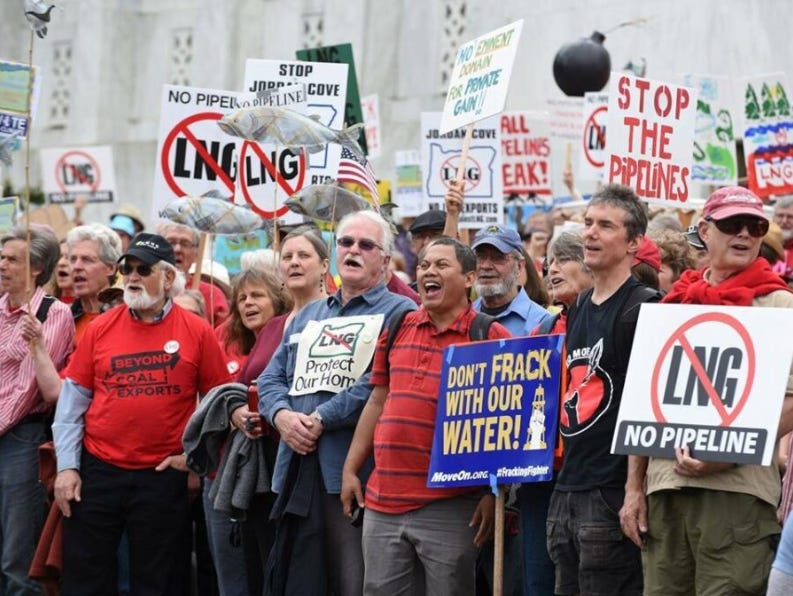
The room was full of ranchers, farmers, and people whose families had spent generations learning the actual terms of survival: weather, water, fences, debt, hay, timber, markets, drought, calving season, flood season, the thousand practical negotiations that make a life on the land possible. The law firms presenting that day were there to help landowners be “realistic.” Not to ask whether the terminal should be built. Not to ask whether eminent domain should be used to seize private land for a fossil fuel company’s private gain. Not to ask whether a massive new piece of LNG infrastructure made any moral, ecological, or economic sense in an overheating world. Their pitch was narrower than that. Since this is happening, they said, you should sign early. Secure the best deal. Protect yourself. Negotiate the terms of surrender before the window closes.
That was the real function of the word inevitable.
Unable to contain myself, I interrupted the lawyer and asked whether he was really trying to imply that 18th- and 19th-century energy technology was progress.
He didn’t have much to say after that.
The exchange has stayed with me for years, because it clarified something essential about the climate crisis and the politics that keep making it worse. “Progress is inevitable” was not an argument for Jordan Cove. It was the removal of argument. It took a live public question, should this project exist, should this land be taken, should this county be remade around a fossil fuel terminal, and tried to convert it into weather. A force of nature. Something foolish people resist and sensible people adapt to. Once inevitability is installed, democracy is reduced to damage control. The only remaining question is not whether the thing should happen, but how cleanly and profitably the public can be taught to absorb it.
There is another word developers love in rooms like that: stakeholder.
It sounds democratic. Better than democratic, really, almost proprietary. Close enough to shareholder to suggest a meaningful stake in the outcome, a recognized standing in the enterprise, maybe even a seat at the table. But when a developer calls a community a stakeholder, the word performs a small con. It confers the feeling of participation while withholding everything that would make participation real: no equity, no vote, no veto, no claim on the profits, no protection from the downside. The actual shareholders receive present, contractual, enforceable benefits. The “stakeholder” gets a forecast, future jobs, possible tax revenue, a promise of growth somewhere down the line. In the conference room, the so-called Jordan Cove LNG stakeholders were being told they had a stake in a project designed to take their stake.
This habit of mind is not confined to one room in Coos County. It has become a governing style.
First the project is declared necessary, though “necessary” is a slippery thing. Jordan Cove began life as an import terminal, pitched when the conventional wisdom held that America was running short of gas. When the fracking boom flipped that wisdom on its head, the very same project reversed direction and was reborn as an export terminal, the identical infrastructure, now declared just as necessary for sending gas out as it had once been for bringing it in. The necessity was constant; only the rationale changed. Then objections are reframed as fear, backwardness, or emotionalism. Then the real choice, whether this path should be taken at all, quietly disappears from view. The public is left haggling over compensation, mitigation, offsets, jobs numbers, permitting timelines, comment periods, and the thousand tiny administrative details that remain once the central decision has already been made elsewhere.
You can see the same logic far beyond pipelines and terminals. When the Supreme Court sided with Monsanto in its Roundup labeling case this summer, the injured party, a man whose jury had already found for him, was told there was effectively no remedy, because the decisive power had been lodged upstream in an administrative regime ordinary people do not control. In dissent, Justice Ketanji Brown Jackson accused the majority of leaving the plaintiff “without a remedy for the significant harms he has suffered.” It is the same anti-politics in a different register, and we will return to it in depth later in this series. First, the decisive power is lodged elsewhere. Then accountability is narrowed. Then everyone downstream is told to be reasonable about what the system has already decided.
This paid piece was unlocked thanks to our sponsor, Ground News, which feels especially fitting here because so much of this essay is about who gets to define reality before the rest of us are asked to live inside it.
Ground News helps readers step outside the version of a story they are handed first. Instead of showing one headline, one outlet, and one tidy little frame, it lays out how the same issue is being covered across the political spectrum, which outlets are covering it heavily, which ones are barely touching it, and who owns the sources shaping the conversation. With the Vantage plan, readers get Ground News’ most advanced features, including ownership breakdowns, factuality and bias ratings, Blindspot access, Podcasts & Opinions, and My News Bias, a dashboard that helps you see the patterns in your own news diet.

That matters when the subject is climate, fossil infrastructure, pesticides, data centers, public policy, or any other story where “progress” arrives wearing a very expensive suit and insisting the debate is already over. Ground News does not tell you what to think. It gives you a better view of the room.
Our readers can get 40% off Ground News Vantage by using my link. It’s a useful tool for anyone who wants to see not just the story, but the machinery around the story.
This is how destructive development gets normalized in America. Not only through lies, though there are plenty of those. Not only through lobbying, though there is plenty of that too. But through a quieter rhetorical operation that makes contestable political choices feel as fixed and natural as the weather. Fossil infrastructure. Pesticide exposure. Deregulated industrial buildout. Data centers imposed on unwilling communities. “Prosperity zones.” The details vary. The grammar remains the same. You do not get to decide what progress is. Your role is to adjust yourself to it.
That grammar has shaped our entire response to climate change.
The old story, in its most familiar form, was denial: climate change is not happening, or not that serious, or not caused by us. That story served the fossil fuel industry well for a long time. But once denial became too implausible to maintain as the public face of power, a new story took its place. The industry did not simply say no. It learned to say yes, but differently. Yes, climate change is real. Yes, something should be done. Yes, we have solutions. Yes, progress is underway. But somehow, always, the solution had to leave the basic structure of fossil power intact.
A recent ProPublica and Drilled investigation matters. Their reporting traces how BP, even as it publicly rebranded itself as climate-conscious, was closely involved in shaping the framing of influential climate thinking funding and proximity that helped elevate approaches presenting continued fossil use as manageable, aided by technologies like carbon capture that were pitched as more ready and scalable than they were. When outright denial stopped working, fossil power moved upstream into solution design. We were not only lied to about the problem. We were trained to imagine responses that preserved the system creating it.
Meanwhile, the physical situation keeps worsening.
The comforting stories are running out. On 28 October 2025, United Nations Secretary-General António Guterres acknowledged what climate scientists had been saying for years: the world will overshoot 1.5 °C, the totemic target of the Paris Agreement, in the near term. The number that once anchored international climate rhetoric is now conceded to be slipping beyond reach. The old evasions, the market will handle it, technology will save us, the transition is underway, don’t be alarmist, function more as anesthesia than reassurance.
This is exactly the point at which people are most vulnerable to paralysis. When the scale of the problem becomes undeniable, there is a strong temptation to slide from alarm into fatalism. If 1.5 is gone, if emissions are still high, if fires and floods and heat domes keep coming, if every institution that claimed to be managing the problem turns out to have been managing the optics instead, then why not conclude that all is lost?
Because that conclusion, too, serves power.
Hopelessness is just another way of collapsing the decision space. It is “inevitability” wearing darker clothes.
Here is the fact that makes surrender a lie. Even as the target slips away, the replacement of the system underneath is real, and it is accelerating faster than almost anyone predicted. In 2025, according to the energy analysts at Ember, growth in clean electricity generation outpaced the growth in global electricity demand for the first time on record, enough that fossil generation did not just plateau but actually fell. Renewables passed coal in the global power mix for the first time in over a century. The clean alternative has not lost on the merits. It is winning on cost. The clean alternative has not lost on the merits. It is winning on cost. Which raises the question this entire series exists to answer: if the fix is here and winning, why did stopping a single pipeline take fifteen years, a shifting global market, and a coalition of ranchers, tribes, fishermen, and neighbors who simply refused to get out of the way?
The truth is harsher and more useful than either optimism or despair. The climate crisis is urgent. The damage is already here. The room for error is smaller than we were told. But the future is still being built, quite literally built, in power plants, transmission lines, battery factories, heat pumps, ports, freight systems, zoning codes, building standards, public transit, industrial policy, and land use fights. The central question now is not whether we can rewind the atmosphere to a safer decade. It is whether clean systems can replace dirty ones fast enough, and whether that replacement will happen democratically, or be captured by the same extractive forces that got us here.
That is what this series is about.
It is about the machinery that taught us to mistake delay for realism and submission for progress. It is about false solutions that look green while preserving the old hierarchy, and it is about how fossil dependence does not just heat the planet but militarizes it. It is about the billionaire fantasy that public systems should be bypassed altogether and replaced with private zones, private platforms, private governance, private abundance for the few amid public breakdown for the many. And it is about the alternative: a democratic exit from an energy system built on extraction, sacrifice, and coercion.
Over the coming parts, we will start with a single number, the price of walking away from a poisoned well, and climb from there, all the way up to people who would like to buy the concept of government itself.
The eminent domain lawyer was wrong in more ways than he understood.
Progress is not inevitable. What is inevitable, if people surrender the argument before it begins, is that the most powerful interests in the room will define progress for everyone else. They will tell us that old infrastructure is modernity, that private gain is public necessity, that legal dispossession is realism. They will call resistance fear. They will call compliance reason. They will call fossil buildout inevitable right up until the moment they call climate collapse inevitable too.
The task now is to refuse both stories, because politics begins there, with reopening the question they are desperate to close. Progress toward what? For whom? At whose expense? By whose consent? If the answer is a hotter, meaner, more privatized world in which ordinary people are forever told to adjust themselves to decisions made elsewhere, then no, that is not progress. That is managed decline with better branding.
We are allowed, indeed have a responsibility to reject a system that keeps presenting devastation as sophistication. We are allowed to say that a terminal, a pipeline, a pesticide, a war, a data center, a so-called smart city, or a corporate redevelopment scheme is not progress simply because powerful people have declared it the future.
The first step is recovering the right to ask the forbidden question. The one that lawyer wanted to bury before anyone in the room could really speak.
Progress, you say.
Toward what?
One point I'd add is that this isn't just a climate story—it's an industrial strategy story.
China appears to have concluded years ago that the defining industries of the 21st century would be solar, batteries, EVs, transmission, and electrification, and it invested bigly. Whatever you think of China's politics, those investments are now tangible -- it dominates much of the global manufacturing for clean-energy technologies, (even as it still relies on coal)
If that's right, then the question isn't simply whether we transition away from fossil fuels, but who builds the infrastructure for that transition. If we delay we may eventually find ourselves buying the core technologies of the new energy economy from the country that decided to build them first.
building clean energy isn't just about reducing emissions; it's about defining the next century's industrial base.
Another “inevitability” being forced on us is AI - both the actual use as well as the massive water-/power-hungry data centers. In fact, it seems to me that with the growing public rejection of both that we will finally get more traction on the climate issues. It’s the new shiny object that hasn’t yet been cemented into inevitability.