


Good morning! Donald Trump has decided he would like the country’s television networks on Thursday night.
Not because the United States is awaiting a declaration of war, the announcement of a peace agreement or some other development that plainly requires the president to speak directly to the nation. According to Axios, Trump’s 9 p.m. address will be a “potpourri” of Iran, election integrity, the SAVE America Act and whatever else happens to tumble out of the presidential grievance blender before airtime.
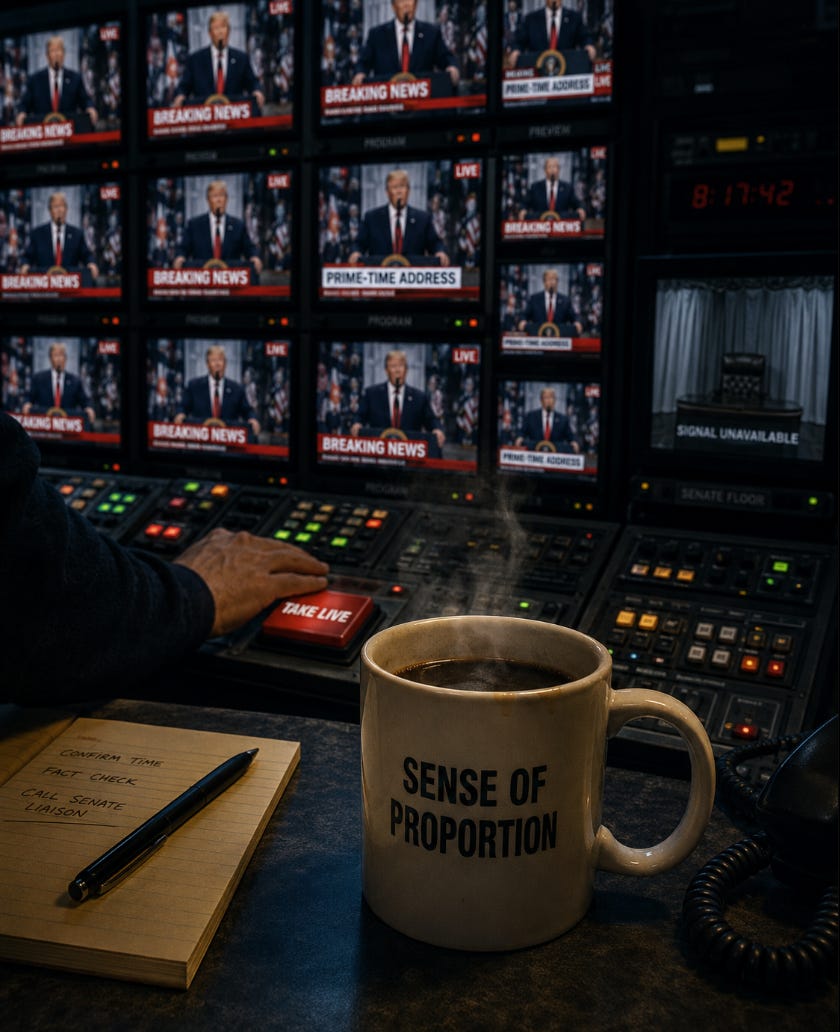
One adviser offered an even more candid explanation, telling Axios simply: “We want to get into the rhythm of doing this.”
There it is. The importance does not necessarily precede the speech. It is manufactured through repetition, and the television networks are being asked to do the manufacturing.
Tellingly, the same adviser felt compelled to preemptively deny that Trump would use the speech to relitigate the 2020 Georgia Senate runoffs, a scenario nobody had asked about. The lady doth protest too much: when your office is volunteering denials to questions no one raised, you have told the audience which subject is actually on the president’s mind.
This would be easier to dismiss as ordinary presidential vanity if the broadcasters had not already learned this lesson the expensive way. Trump’s most recent prime-time address preempted the season finales of Survivor on CBS and The Floor on Fox, along with holiday specials on ABC and NBC. Those were not disposable reruns airing between pharmaceutical advertisements. They were high-value programs with large audiences and advertising commitments.
In exchange the networks received the standard Trump campaign speech delivered from presidential surroundings: boasting about deportations and tariffs, blaming Democrats and the Biden administration for everything from prices to the weather, and offering little actual news beyond the increasingly obvious fact that his approval ratings were sagging. Poynter’s Tom Jones called it a “say-nothing address” that glossed over the financial pain Americans were experiencing, especially at the gas pump. Viewers may have been disappointed, Jones observed, but CBS and Fox had particular reason to be irritated after surrendering major finales for the privilege of broadcasting campaign boilerplate with better furniture.
Mediaite treated that performance not as an aberration but as part of a pattern. Trump’s recent prime-time addresses have increasingly resembled partisan rallies with a presidential seal attached, leaving critics to wonder why broadcast networks are expected to surrender their schedules whenever the White House decides Donald needs a larger audience.
That question is before them again.
Iran provides an undeniable news hook. The ceasefire is already over by Trump’s own declaration. The United States is again bombing Iran, preparing to enforce a renewed blockade in the Strait of Hormuz and threatening further attacks on suspected nuclear facilities. Americans have every right to know what their government is doing, under what legal authority it is waging this war, how long Trump expects it to continue, what would constitute victory and what risks he is imposing on American troops, Iranian civilians, regional allies and the global economy. Those questions warrant a presidential address. Iran may get Trump through the network door; once inside, he intends to bring the entire grievance carnival with him.
Does that require giving Trump an uninterrupted hour to combine military announcements with election denial, partisan attacks and promotional copy for the latest Trump-branded spectacle?
His public appearances Monday offered the preview. Trump began by stripping protections from nearly three million acres of Bears Ears and Grand Staircase-Escalante, two national monuments containing sacred tribal lands, ancestral villages, burial sites, petroglyphs, coal and uranium. He claimed he was giving the land “back to the people,” although the tribal nations that consider Bears Ears a living cultural landscape were conspicuously absent from the celebration. The people waiting to receive the land appeared to have drilling equipment.
Then came Iran.
Trump claimed the United States had eliminated Iran’s navy and air force, destroyed precisely 92 percent of its drone-manufacturing capacity and 89 percent of its missile-production capability, killed successive tiers of leadership and pushed Iranian inflation above 300 percent. He repeatedly asserted that 52,000 protesters had been killed, without identifying a source. His timeline for Iran obtaining a nuclear weapon shifted from one month to two weeks to somewhere between two and four weeks, depending on which microphone happened to be nearest.
During a friendly interview with Hugh Hewitt, Trump suggested that a suspected underground complex known as Pickaxe Mountain could receive a “nice big fat shot right into the front door.” Hewitt asked whether the United States knew where Iran’s remaining leaders were and whether it could kill them. Trump said he knew plenty but should not discuss it. Hewitt responded, “Keep it up.”
By the end of the interview, Hewitt was urging him to “go get Pickaxe Mountain,” and Trump replied that the United States would take it out and Iran should “be ready.” It was less a presidential interview than a morning-radio host leaning out of a tank hatch and asking whether the commander in chief had considered firing the larger shell.
Trump also found time to advertise the Freedom 250 Grand Prix, an IndyCar race scheduled to roar down Pennsylvania Avenue and around the National Mall next month. Fox Sports, Penske, General Motors and the Transportation Department are involved. More than 250,000 people have reportedly registered for free admission. Organizers said they had spent months trying to obtain approval through Congress, only to reach Trump and have an executive order moving within a day.
Democracy may grind slowly, but Roger Penske has the express pit lane.
Transportation Secretary Sean Duffy praised Trump in the only language now permitted at federal ceremonies: “Everything you do is big. It’s huge. It’s the best. It’s the greatest.” Trump predicted record ratings, accepted a racing helmet and was invited to lead the field in the presidential limousine. The National Mall, like the White House before it, is becoming less a civic space than a venue package.
By evening, Trump had moved on to the Reflecting Pool.
He claimed “Country hating sleazebags” had slashed its liner for 300 yards, blamed vandals for an algae bloom and attacked ABC and David Muir for reporting that the pool was being drained to address peeling material and algae. There had been vandalism, he claimed. That did not establish Trump’s ever-expanding measurement, prove that saboteurs caused the algae or transform every visible defect into an act of domestic terrorism by the Aquatic Antifa Brigade.
What begins as an embarrassing maintenance problem is recast as an enemy attack, while the reporter who describes it becomes “fake news.” An active war is downgraded to a “military skirmish,” and months of bombing are sold as proof of restraint because Vietnam lasted longer. The blockade becomes selective traffic management; a corporate racing event becomes American freedom at 200 miles per hour. Familiar campaign lines, meanwhile, acquire the weight of a national emergency once the networks clear their schedules, dim the lights and tell viewers something momentous is about to happen.
Trump does not merely lie through the media. He understands how to use its architecture.
Live television confers urgency. A presidential lectern confers authority. Simultaneous network coverage confers legitimacy. Repetition creates familiarity, and familiarity begins to feel like truth long before the fact-checkers finish locating the original statistic Trump swallowed and enlarged.
The broadcasters know this. They have known it at least since 2019, when Trump demanded prime time for an immigration address, repeated familiar false and misleading claims and prompted a chorus of criticism that the networks had been played. They were warned then that the next request would test whether they had learned anything.
Apparently the exam keeps being rescheduled.
Of course a president should be covered. Does “covered” mean “broadcast live, nationally and without interruption,” as though the First Amendment requires networks to operate a free presidential syndication service?
The networks have several options: carry only the genuinely newsworthy portions, use a short delay, place factual corrections on screen, or interrupt claims already proved false. Another approach would be to record the address and present a verified report minutes later. Journalism does not cease to be journalism merely because the president prefers an infomercial.
While Trump floods every available channel with more statements than reporters can check, another Republican political operation is practicing the opposite kind of information control.
Mitch McConnell has been absent from public view for nearly a month following a medical emergency. Released emergency-dispatch audio described an unconscious patient, concern about cardiac arrest and CPR in progress. McConnell’s office later said he had suffered a fall, briefly lost consciousness, developed pneumonia and entered rehabilitation. A photograph showed him seated beside his wife, Elaine Chao.
The photograph appears to be genuine. Rehabilitation after a fall, pneumonia and an extended hospitalization is entirely plausible for an 84-year-old man with longstanding mobility problems. There is no responsible basis for declaring that McConnell is dead, secretly in a vegetative state or replaced by artificial intelligence wearing a gingham shirt.
That does not resolve the legitimate question. Can Mitch McConnell currently perform the duties of a United States senator? His office says he has spoken with Senate leaders and held a twenty-minute conversation with CNN commentator Scott Jennings. If he can discuss Iran and Senate business with Scott Jennings, why can he not record a twenty-second message for the people of Kentucky?
Voters are entitled to know whether the elected official is understanding briefings, directing his staff, exercising independent judgment and preparing to return to work, or whether an office built around his authority is continuing to function while the man himself remains unable to exercise it. We are not talking medical voyeurism. It is representative government.
A discussion on The Daily Beast landed on the central institutional problem: congressional staffs can become protective shells around elderly or incapacitated members, speaking in their names, guarding access and preserving political arrangements that depend on the seat remaining technically occupied.
We have seen versions of this before. Dianne Feinstein’s decline became impossible to conceal, even as aides and colleagues tried to guide her through votes. Former Representative Kay Granger was later found to be living in a care facility after largely disappearing from public work. In each case, the political system treated capacity as an inconvenient private matter until the evidence became too public to ignore.
McConnell may recover and return, but his office’s refusal to provide direct, functional reassurance has created a vacuum, and vacuums do not remain empty in the age of Laura Loomer, generative AI and institutional mistrust.
Trump exploits media through excess. McConnell’s office manages it through scarcity.
One demands that Americans hear everything the president feels like saying. The other refuses to let Americans hear ten seconds from a senator whose continued service affects the balance of power, judicial confirmations and the functioning of the chamber. Both strategies rely on deference.
Trump expects broadcasters to treat his desire to speak as news in itself. McConnell’s staff expects journalists and constituents to accept written assurances from people whose political influence depends on his remaining in office.
The media’s responsibility in both cases is remarkably similar: do not mistake access for truth, ceremony for importance, repetition for evidence or an official statement for verification.
Thursday’s speech offers viewers the same choice.
Trump wants the largest possible audience because ratings are the one form of public opinion he genuinely understands. He will undoubtedly watch the numbers, compare them with previous addresses and claim a historic triumph regardless of what they show. But there is one response he cannot entirely spin away: people declining to participate.
No one is obligated to spend Thursday night being used as a Nielsen household for presidential propaganda.
Turn off the television. Stream something else. Read a book. Call someone you love. Watch the verified clips afterward, with context and fact-checking attached. Let the journalists sit through the “potpourri” and separate the national-security information from the campaign slogans, invented statistics and personal grievances.
Trump wants prime time to give him a “sense of importance.”
Let us give him a sense of proportion instead.
Do not tune in. Give the address the record-low ratings it deserves.
It's not hard to guess why the mainstream TV networks agree to letting Trump preempt their income-generating programming for a nationally broadcast incoherent scree. All of these networks are owned by billionaires who profit handily from their close associations with Trump. They give him all the coerced attention he craves and he makes sure that government regulations and laws do not impede their pillaging of the country.
I was about to post a link to the Shelley poem, Ozymandias, where the poet sees a fallen statute, broken amid the rubble of time, with the words inscribed on the base: "My name is Ozymandias, King of Kings. Look upon my works, ye mighty, and despair." I thought it was an appropriate message to DJT that his efforts at grandiosity are for naught. However, then I realized that DJT does not care about the future. He is all for now, in the moment. Sure, part of his grandiosity is to enrich his family, but the value he derives from this and all his actions comes from the present moment. That's why he is great in campaigning and speechifying but awful and inept in governing. It's also why matters like truth and science are nothing more than inconveniences to ignore. Thank you, Mary, once again for a brilliant and inspirational column.