


Good morning! There are no depths to which Donald Trump will not sink. What he did before traveling to Dover Air Force Base on Wednesday was proof of that.
Four American soldiers were coming home in flag-draped transfer cases. Before their remains had even reached the tarmac, Trump claimed to know what each of them thought about the war that had killed them.
“All of them said very strongly, ‘We cannot let Iran have a nuclear weapon,’” he told reporters.
Trump did not explain when the four soldiers had said this, to whom they had said it or how their private convictions had made their way into his possession. He offered no letters, messages or statements from their families. He simply spoke for them, in a revolting act of political ventriloquism, because the dead cannot ask for the microphone back.
Opposing an Iranian nuclear weapon is not the same as endorsing Donald Trump’s war. It is not consent to launching hostilities without congressional authorization, continuing them without a clear endgame, threatening civilian power plants or dismissing every opportunity for diplomacy until the other side has been bombed into the proper negotiating mood. Trump collapsed all those separate questions into one posthumous endorsement and assigned the answer to four people who could no longer object.
Their names were First Lt. Tyler James Feehan, 25; Pvt. Isabella Gonzales, 19; Sgt. Angel Rampersad, 28; and Sgt. Michael Emmanuel Swinton, 30.
Their families and communities remembered actual human beings: a mentor, a joyful young woman, a kind and selfless soldier, a husband and father with a talent for making people laugh. Trump found a more immediately useful role for them. He first reduced American deaths to a favorable statistic by comparing the toll with Vietnam, Iraq and Afghanistan. Then he borrowed the voices of four of those dead to defend the policy that killed them.
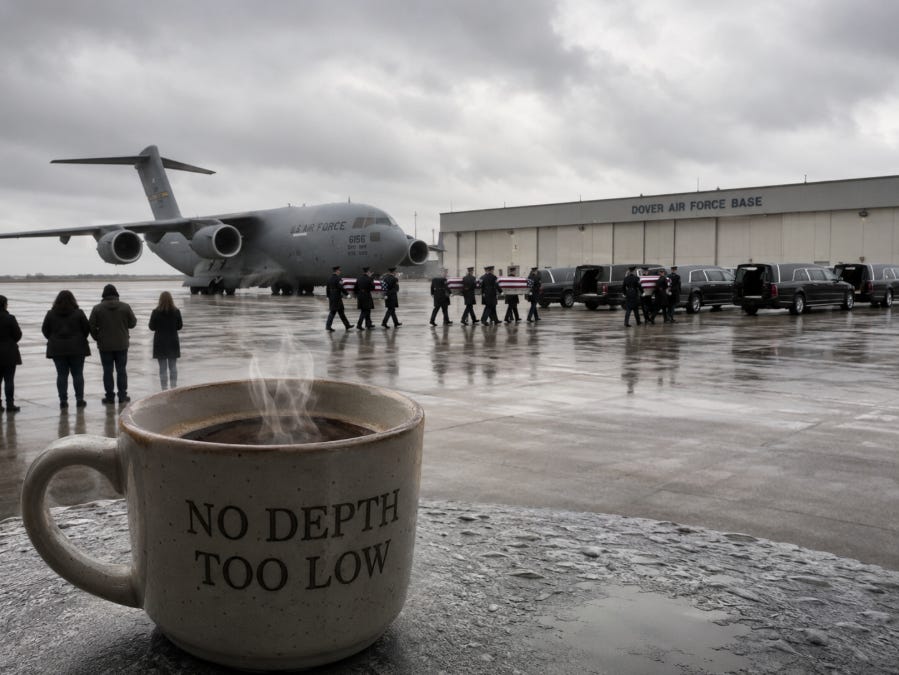
At Dover, the transfer cases waited inside vehicles near the C-17 that had brought them home. Trump stood with Pete Hegseth and senior military officers as Army carry teams moved each case from the plane. A woman wailed as the fourth was loaded into a van.
It was, Trump had said, one of the hardest things a president has to do.
By afternoon, the hard part was over.
Trump was back where he prefers to be: at a political rally in Georgia, entering to Lee Greenwood’s “God Bless the USA” as a crowd cheered. Members of Feehan’s family had been traveling to Georgia, so Trump offered them seats aboard Air Force One. That could have remained a private kindness extended on an unbearable day. Instead, he brought the story onto the rally stage, reenacted the family’s astonishment at being invited aboard his plane and turned their presence into another episode in the continuing television series about the generosity of Donald J. Trump.
Feehan, Trump announced, “would have been a general very quickly.”
Perhaps he would have. He was 25. His future contained all sorts of possibilities before this war removed every one of them. But even that tribute arrived in Trump’s preferred language of promotion, status and proximity to greatness, as though a dead lieutenant required a speculative rank upgrade to make his loss sufficiently impressive.
There is no criticism due the family for accepting a flight home or attending the rally. Grief does not impose a duty to navigate presidential narcissism correctly. The indecency belonged to the man who moved so seamlessly from the tarmac to the soundtrack, from transfer cases to applause, and from speaking for the dead to congratulating himself for transporting their relatives.
The House is trying to condemn the war, finance the war, rename the Pentagon for the war and smuggle election restrictions aboard the war almost simultaneously.
On Thursday, lawmakers passed Pramila Jayapal’s war powers resolution by a vote of 214–208, directing Trump to withdraw US forces from hostilities with Iran unless Congress explicitly authorizes them. Four Republicans, Brian Fitzpatrick, Warren Davidson, Tom Barrett and Thomas Massie, joined every Democrat present. They were the same four Republicans who supported the House’s previous attempt to restrain Trump last month.
That earlier House resolution was followed by a Senate measure rebuking the war, the first successful Senate war powers vote of the conflict. Trump ignored it. His administration maintains that Congress’s efforts to exercise its constitutional authority over war are themselves unconstitutional, a tidy arrangement in which the president may initiate hostilities, define their purpose, expand their geography, decide when they have ended and dismiss any contrary vote as an advisory note from the legislative suggestion box.
Greg Meeks, the ranking Democrat on the House Foreign Affairs Committee, stated the obvious during debate: Congress had already spoken, and the administration had refused to comply. Meeks now plans legislation intended to require Speaker Mike Johnson to sue Trump over that refusal.
The proposal is unlikely to advance because Johnson is one of Trump’s most dependable congressional accessories. Still, it may be the purest example yet of oversight as performance. Congress has voted twice. Trump has ignored it twice. Congress may now vote on whether to ask Trump’s closest ally in the House to request that a court persuade Trump to notice Congress. Somewhere beneath the powdered wigs and ceremonial gavels, James Madison is filing for workers’ compensation.
The resolutions are routinely described as “largely symbolic.” That description is accurate in the sense that Trump has refused to obey them. It is less comforting when one remembers that their powerlessness is not a natural law. They are symbolic because the officials responsible for enforcing Congress’s authority are choosing symbolism over confrontation.
A recorded vote is taken. A press release is issued. Grave concern is expressed. Members return to cable television having courageously defended the separation of powers for nearly seven uninterrupted minutes. The bombs continue falling on schedule.
The Senate supplied the answer a few hours later.
By a vote of 47–49, senators rejected a motion to discharge their own war powers resolution from the Foreign Relations Committee, preventing it from advancing to a full vote. Susan Collins was the only Republican to side with Democrats. John Fetterman was the only Democrat to vote against moving it forward. Rand Paul and Lisa Murkowski—both of whom have previously voted to restrict Trump’s war powers—were absent, along with Mitch McConnell and Katie Britt.
Paul had told reporters the day before that the Iran war had not been a success and had left the United States weaker. When the Senate was asked to do something about that assessment, his concern was represented by an empty desk.
The result exposed the limits of all the anxious Republican murmuring about casualties, costs and the absence of an endgame. Senators are increasingly willing to tell reporters that the war troubles them. They remain considerably less willing to inconvenience the president over it.
The House voted to end an unauthorized war. The Senate blocked its resolution before it could receive an up-or-down vote. Neither chamber has authorized the conflict, but one is preparing the money to continue it while the other has ensured that its objections remain safely conversational.
One day before the House again directed Trump to end the war, it passed a $1.15 trillion National Defense Authorization Act by the unusually narrow margin of 216–212. The NDAA normally moves through Congress with broad bipartisan support. This version passed largely along party lines, with seven Republicans opposing it and six Democrats supporting it. It authorizes defense policy and spending levels rather than actually appropriating all the money, but its political message is sufficiently clear: the House cannot agree that Trump has the authority to wage this war, although it is willing to plan a military budget large enough to wage several more while the matter is under discussion.
The bill would also formalize Trump’s theatrical rebranding of the Department of Defense as the Department of War, allowing Pete Hegseth to proceed under the title he has already been using. The name change is cosmetic, but the drift it describes is not.
Hegseth told Congress the Iran war has already cost approximately $37.5 billion. He has also insisted that Trump possesses complete authority to continue it without congressional approval. The administration’s constitutional position therefore appears to be that Congress has no meaningful say over whether the president wages war, where he wages it or how long it lasts, but remains fully responsible for finding the money. Executive supremacy ends at accounts payable.
House Republicans have therefore advanced a separate $95 billion budget framework, passed 216–214 without Democratic support, that would begin the reconciliation process for another package of Trump priorities. The blueprint instructs the Armed Services Committee to write legislation adding up to $60 billion for the Pentagon, the Intelligence Committee up to $13 billion for other national-security needs, the Agriculture Committee up to $12 billion for farm assistance and the House Administration Committee up to $10 billion for election-law changes. Reconciliation matters because it can eventually allow Republicans to move qualifying provisions through the Senate by simple majority rather than face a Democratic filibuster.
The House has not yet passed the final $95 billion spending legislation. It has created the procedural container and instructed committees to fill it after the August recess. But the purpose is not secret. Mike Johnson called the process the party’s “best shot” at enacting as much of the SAVE America Act as possible.
The SAVE America Act would require documentary proof of citizenship when registering to vote and photo identification when casting a ballot. Its requirements would sharply complicate registration by mail and online, particularly for people whose current legal names do not match birth certificates, who lack passports or who have difficulty reaching election offices with the required documents. American citizenship is already required to vote in federal elections. What Republicans propose to add is not the qualification but a new documentary obstacle course for proving it.
Johnson is not being accused of secretly attaching the voting provisions to war funding. He has announced that this is the point. The Iran war, tariff relief for farmers and election restrictions have been lashed together because each faction is expected to swallow the others’ priorities to secure its own. Members worried about troops and depleted munitions receive voting restrictions. Farm-state Republicans receive assistance for damage caused by Trump’s trade policy. Election deniers receive a filibuster workaround. Everyone receives an opportunity to call the final package national security.
Congressional sausage making once referred to the unattractive process by which compromises became law. This is more like discovering that the sausage contains a ballot application, an Iranian bridge and an invoice from Lockheed Martin.
Congress is funding a war it has declined to authorize. Trump is now advertising a method of conducting it that legal scholars warn may violate international humanitarian law.
He announced that whenever Iran attacks a ship in the Strait of Hormuz, the United States will bomb or destroy an Iranian bridge or power plant, including infrastructure in Tehran. In legal terms, it is a reprisal schedule: attack one ship, surrender one bridge; launch one drone, lose one power plant.
Tom Dannenbaum, the Stanford law professor and nuclear-security expert, explained the problem in unusually plain terms. Bridges, power plants and other infrastructure are presumed civilian. A particular object may become a lawful military target when its nature, location, purpose or use makes an effective contribution to military action and its destruction offers a definite military advantage at that time. Even then, an attack remains unlawful if the foreseeable civilian damage would be excessive compared with the concrete and direct military advantage expected.
A power plant cannot be targeted merely because power plants are useful to modern societies. A bridge does not become a military objective because Trump has promised to destroy something visible whenever Iran attacks shipping. Nor does attaching the words “military target” after the explosion retroactively complete the required legal analysis.
The civilian consequences extend well beyond the structure struck. Electricity keeps hospitals operating, food refrigerated, sewage treated and water moving. Destroying one element of a grid can disable systems far removed from the target itself. The International Criminal Court has issued arrest warrants for senior Russian commanders over alleged attacks on Ukrainian electrical infrastructure, including accusations that they directed attacks at civilian objects and caused excessive incidental harm even where parts of the system may have had military significance.
The same standard applies to Iran. Iranian strikes on desalination facilities and other civilian infrastructure may also constitute war crimes. Water systems indispensable to civilian survival do not become lawful targets because the other side has violated the law first. International humanitarian law is not a rewards program in which one atrocity earns a complimentary atrocity of equal or lesser value.
That is the importance of Dannenbaum’s discussion of reprisals. Trump is not saying the United States will strike the weapons system responsible for an attack or disable a military capability directly connected to it. He is threatening to punish Iran by destroying a different category of infrastructure. The civilians who lose power, medical treatment, refrigeration or water are not responsible for an attack on a tanker. They are simply the population available to be made miserable enough that their government might change course.
At the head of the Pentagon sits Pete “No Quarter” Hegseth, who previously promised “no quarter, no mercy for our enemies.” Senator Mark Kelly, a Navy combat veteran, formally warned him that “no quarter” has a specific meaning under the laws of war: denying enemy combatants the opportunity to surrender and killing them instead—conduct Kelly noted is expressly prohibited and could constitute a war crime.
The effects of this constitutional and legal pantomime are not symbolic. Brent crude crossed $100 a barrel on Thursday for the first time since May after the Houthis claimed attacks on two Saudi oil tankers in the Red Sea. The war had already severely restricted traffic through the Strait of Hormuz. Saudi Arabia responded by moving more oil west through its East-West Pipeline and exporting it from the Red Sea. The Houthi attacks now threaten the route being used to bypass the first threatened route. The workaround has acquired its own blockade.
Only about 15 ships passed through Hormuz on Wednesday, compared with approximately 130 a day before the war, according to maritime data cited by The New York Times. Six vessels also reversed course in the Red Sea after Houthi warnings. What began as a war ostensibly intended to reduce one security threat has created simultaneous danger around two of the world’s most important shipping chokepoints.
Oil is now nearly 40 percent more expensive than it was before the war. Regular gasoline averages about $4.09 a gallon nationally, while diesel has reached approximately $5.21. Diesel does not remain politely inside diesel-powered vehicles. It moves farm machinery, freight, construction equipment and much of the physical economy. Its price becomes part of the cost of groceries, building supplies and nearly everything delivered to a store.
The shock is spreading into borrowing costs as well. The yield on the ten-year Treasury has climbed toward 4.7 percent as markets price in greater inflation risk. The European Central Bank held rates steady on Thursday after raising them in June, while Christine Lagarde warned that the renewed conflict and higher energy prices had worsened the outlook. Investors are again debating whether the Federal Reserve may need to raise rates rather than provide the relief Trump has repeatedly demanded.
That means the war’s invoice is arriving through several doors at once. It appears at the gas pump, in freight costs, in grocery prices, in mortgage rates, in business loans, in the federal government’s interest expense and in retirement accounts falling with the market.
Trump promised that Iran would pay. So far, everyone with a fuel tank, grocery bill, mortgage or pension has been invited to help.
The public does not appear grateful for the opportunity. A recent Washington Post-Ipsos poll placed support for the Iran war at just 29 percent, while a separate Ipsos poll found that 79 percent of Americans expected US military involvement to continue for an extended period. Trump nevertheless claimed before going to Dover that Americans were not against the war and cited an unspecified poll that had supposedly made this “loud and clear.”
When living voters refuse to provide the desired mandate, imaginary polling fills the gap. Congress withholds authorization, so its vote is dismissed as unconstitutional. The dead cannot be surveyed at all, leaving Trump free to supply their answers himself.
The contradictions multiply even within the administration’s stated purpose. Trump has repeatedly claimed that Iran’s nuclear program was destroyed by earlier American strikes. Marco Rubio now says the bombing must continue until Iran accepts denuclearization and becomes serious about a deal. Meanwhile, the administration has signed a civilian nuclear-cooperation agreement with Saudi Arabia, after which Trump announced on Truth Social that the arrangement would permit no enrichment and was “totally subject” to Saudi Arabia joining the Abraham Accords and recognizing Israel.
Those conditions had not been presented as part of the announced agreement. A major nonproliferation arrangement appears to have acquired new terms after the president reviewed his social-media feed.
Five months into a war supposedly required to eliminate one country’s nuclear risk, Trump is improvising another country’s nuclear conditions online. Rubio says Iran cannot be trusted to keep an agreement. Trump is demonstrating that the United States may not keep the same agreement through breakfast.
None of this changes what happened at Dover.
The House has now voted twice to end the war and begun arranging billions more to sustain it. The Senate has blocked its own effort before it could receive a full vote. Oil has crossed $100. The administration is threatening civilian infrastructure as reprisal. The Pentagon is preparing for further casualties, while nearly 100 American troops have been injured in the latest resurgence and hundreds have been wounded since the war began.
It is the same war that brought Tyler Feehan, Isabella Gonzales, Angel Rampersad and Michael Swinton home in transfer cases.
Trump appropriated their sacrifice, stripping the moment of its dignity and turning four flag-draped cases into political evidence for the war that killed them.
Congress, still very much alive, divided its response between a symbolic objection, a procedural blockade and an expense account.
Hello, Mary. I created a cartoon that was inspired by the obscenity at Dover AFB. I’d love you to see it. May I email it to you?
We should have a contest for who Trump will blame the coming recession on. I mean, besides Biden. Or Obama. Or Democrats in general.