


Texas has now become the first state to require public school students to read a set of Bible passages as part of a mandatory literary list. The State Board of Education approved the list in a 9-5 vote, folding a dozen Bible passages into classroom instruction for all 5.5 million students in Texas public schools. The standards will be phased into classrooms beginning with elementary school in the 2030-2031 school year, and the material will be worked into annual standardized exams.
That last part is the tell. Not the press release, or the solemn invocation of “Judeo-Christian values.” Not the careful insistence that this is not evangelizing, just literature, just history, just cultural literacy, just a little harmless civilization sprinkled into the public-school casserole.
The test is the tell. There is a legitimate version of biblical literacy. The Bible matters to literature, to American rhetoric, it matters to abolitionist preaching, civil-rights language, political speeches, art, music, idioms, and history. You cannot fully understand large swaths of Western literature or American public life without at least some familiarity with the stories, phrases, and symbols that come from biblical texts.
But this is not merely a teacher explaining why Moses appears in a speech, why Eden appears in a poem, or why Exodus became such a powerful language of liberation. This is the state selecting scripture, placing it inside required curriculum, and then testing children on it. That is what makes it different.
You can teach Gilgamesh as literature without testing whether a child has properly absorbed the flood. You can teach Greek mythology without grading a child’s relationship to Zeus. You can teach Shakespeare’s biblical allusions without building a public-school compliance mechanism around selected scripture. Of course the Bible has literary importance. The issue is what happens when the state converts that importance into a scored requirement.
Bible as literature is the cover. Bible as tested material is the policy.
This Texas move did not fall out of the sky like a laminated worksheet from heaven. It arrived in the same political week that Donald Trump stood before the Faith & Freedom Coalition and declared that religion is “back” in America, “bigger and stronger than it has been in many many years.” He told the room that a great nation must have “religion and God,” claimed Democrats had tried to “take the Christmas out of Christmas,” and warned that the previous administration had carried out a “reign of persecution and repression against Christians and people of faith like America has never seen before.”
Hardly a neutral lecture on constitutional pluralism. It was a campaign sermon with grievance music. The Faith & Freedom Coalition was not merely the audience. It was the body that anoints. A persecution narrative needs a defender of the faith, and a defender of the faith needs a congregation willing to crown him one. That is the room’s function. It supplies the halo that converts a politician’s grievance into a holy cause so that when he names his enemies, they are not merely opponents but heretics, and the fight is not merely political but sacred.
Trump told the Faith & Freedom crowd that Christians had been targeted, Catholics had been targeted, pro-life grandmothers had been jailed for praying, military members had been thrown out for their religious beliefs, and that while he is in the White House, he will defend Christians and all Americans of faith “100%.” He said religion is rising so fast that if it were a stock, “we’d be very rich.”
There it was, the whole vulgar little operating model: faith as market, grievance as product, government as sales floor.
Then came the second step, the quieter one, the institutional one, the one without the rally fog machine but with something more revealing: the policy handoff.
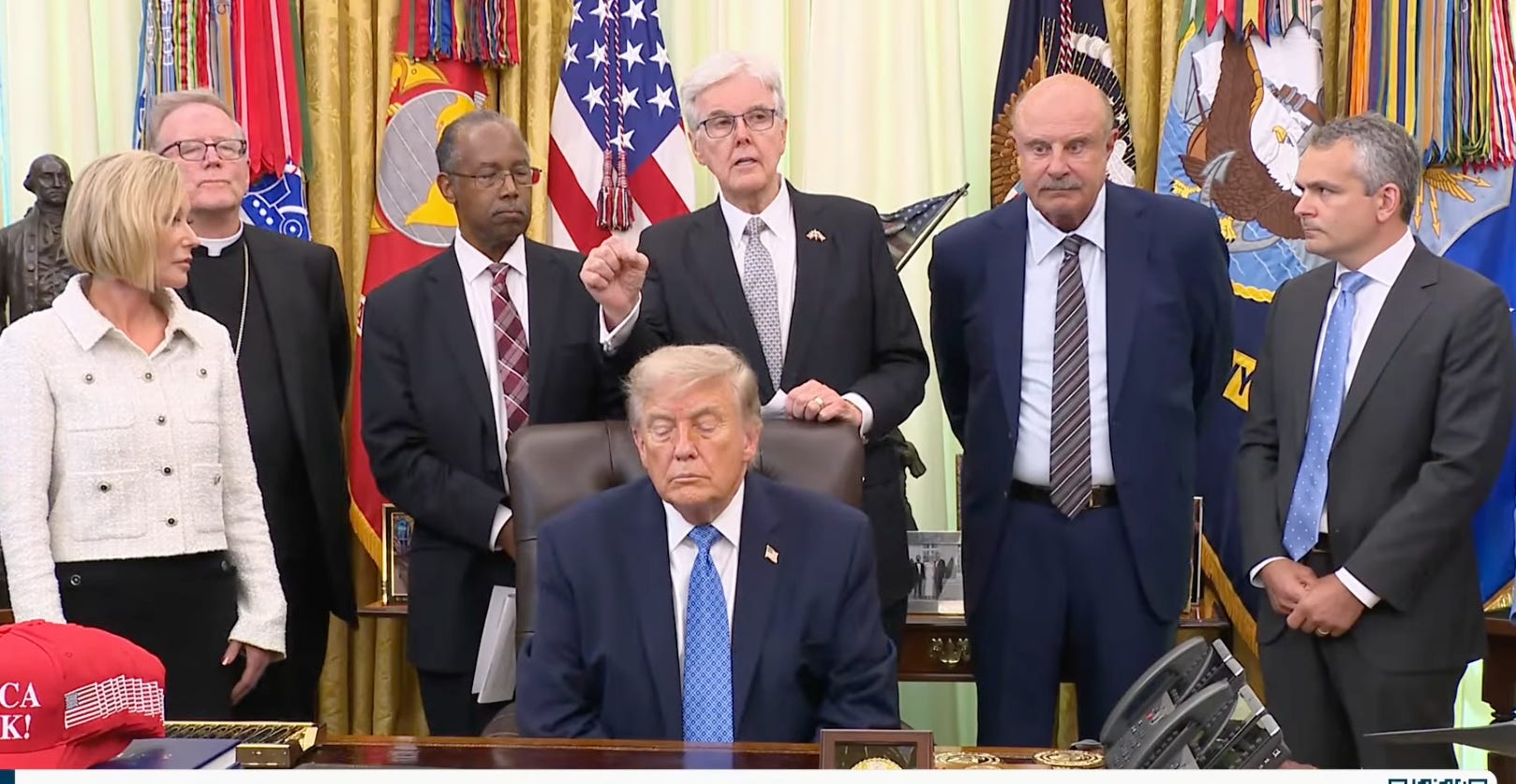
At the White House, Trump received the report of his Presidential Commission on Religious Liberty, chaired by Texas Lieutenant Governor Dan Patrick. This was not just a ceremonial gathering of pious extras arranged around the Resolute Desk. It was the legal-theological architecture behind the Texas classroom story.
Patrick praised Trump as the president who had stood more for God than any president in history, which is the sort of sentence that makes Mount Vernon quietly close the curtains. Then he went straight at the wall.
Notice the order. First the anointing, then the demolition. The sequence is the argument. You cannot turn a grievance into doctrine until you have made the man delivering it holy. The consecration is the load-bearing step. A real-estate developer’s resentment of the “anti-God left” is just resentment until a commission chairman, standing beside the Resolute Desk, certifies him as the most godly president in American history. Then the resentment becomes a mandate. The halo has to go on before the wall can come down.
The phrase “separation of church and state,” Patrick said, is not in the Constitution. He claimed the left has used that phrase, pulled from one line in a Thomas Jefferson letter, to “batter and hammer people of faith” for the last 70 to 80 years. The commission recommended that the Department of Justice issue guidance clarifying the proper understanding of the Establishment Clause and separation of church and state.
That is the bridge. The Texas Bible mandate is what happens when “separation of church and state” gets rebranded as anti-Christian oppression. First, the boundary is delegitimized. Then the grievance is sanctified. Then the preferred religion walks into the public institution wearing the name tag “religious liberty.”
This is the conversion mechanism. It is not merely “put more Christianity in schools.” It is to redefine secularism as persecution, then use that manufactured persecution to justify state sponsorship of Christian content. If separation of church and state becomes a hostile myth, then mandatory Bible passages become restoration. If neutrality becomes oppression, then preference becomes liberty.
Trump supplies the grievance. Patrick supplies the legal permission structure. Texas supplies the Scantron.
It is why the standardized test matters so much. It turns the abstraction into machinery and it collapses the speeches into the classroom. Airy rhetoric about America being “one nation under God” is routed through curriculum frameworks, teacher guidance, annual assessments, and answer keys. The child does not have to be marched into church. The child simply has to sit at a desk and demonstrate mastery of the state’s selected religious text.
Very politely, of course.
That is the genius of the “please.”
No one has to shout. No one has to pound the pulpit. The menace arrives in the soft voice of institutional authority.
Please open your booklet.
Please fill in the bubble completely.
Please demonstrate your comprehension of the assigned scripture.
Please remember that this is not religious establishment. This is literary heritage.
Please ignore the presidential commission explaining that separation of church and state has been used to hammer people of faith.
Please ignore the president telling religious conservatives that Democrats and communists want to drive God out of America.
Please ignore the state quietly deciding which sacred texts belong in the required canon and which do not.
Please open your state-approved Bibles to the tested portion of theocracy-lite.
The supporters know exactly how to sell it. Children need cultural literacy. They will say the Bible shaped American history, and students cannot understand literature without biblical references. They will say this is not devotional and no one is being forced to believe anything.
That is where the test answers for them. Voluntary lessons on biblical allusions are one thing. A comparative religion unit is one thing. A serious historical examination of religion’s role in public life is one thing. A state-selected list of Bible passages embedded in required instruction and standardized exams is another thing entirely.
It is measurement, not exposure. And measurement is power.
Public schools already know this. Teachers know it better than anyone. What gets tested gets taught. What gets tested gets time. What gets tested gets reproduced, drilled, aligned, benchmarked, and defended. A test is not just a neutral mirror of learning. It is a signal from the state about what counts.
When Texas places Bible passages on a required literary list and builds them into standardized exams, it is not merely saying, “This material exists.” It is saying, “This material counts.”
That is the whole ballgame.
It lands in a broader campaign to take the language of religious liberty and turn it into a battering ram against secular democracy. In Trump’s telling, the threat is not the state favoring one religious tradition. The threat is anyone who objects. Villains are not officials blurring constitutional lines. Villains are the people insisting those lines exist.
In the Faith & Freedom speech, Trump did not describe a pluralist country trying to balance competing rights in a multi-faith democracy. He described a country under siege by “radical left lunatics,” “communists,” and “Godless” enemies who want to destroy Christianity, close churches, and remake America. By the time he was finished, everything from transgender rights to mail-in ballots to rent control had been folded into a single apocalyptic threat. Enemy manufacture with a choir.
At the commission event, Patrick gave that enemy manufacture a constitutional target. “Separation of church and state” became the villain. Not censorship, coercion, or actual religious persecution. The villain was the very principle that keeps government from taking sides in matters of faith.
Once the wall itself is cast as oppression, tearing it down becomes liberation. That is how you get from a presidential speech to a Texas classroom.
Nobody needs to announce a national church or pass a law declaring Christianity the official religion. Nobody needs to say the quiet part in Latin while wearing velvet. The modern administrative state has more efficient tools. Standards. Guidance. Model curricula. Reading lists. Testing frameworks. Teacher training. Grants. Compliance rules. “Know your rights” posters. Court challenges. DOJ memos. School-board votes.
Theocracy in America does not need to kick down the schoolhouse door; it just walks through procurement. It can enter through the testing calendar and as a required passage with a multiple-choice question attached. Because it is wrapped in the language of literature, the defenders can act offended when anyone notices the cross-shaped shadow on the wall.
The Texas story should not be treated as a cute culture-war flare-up or a local curriculum fight. It is part of the same project Trump and his allies are describing in public. The room supplies the halo: this is the most godly president in history, God’s defender against the Godless. The speeches supply the myth: Christians are under siege. The commission supplies the doctrine: separation of church and state has been weaponized against believers. Texas supplies the implementation: put the Bible in the required list and test the children on it.
It is a pipeline that begins with grievance, moves through law, and ends at the child’s desk.
The child, being a child, will learn the real lesson faster than any adult in the room. The lesson is not merely what the Bible says, but what the state expects them to know, repeat, and be scored on. The lesson is that some religious texts are “heritage,” while others are electives, footnotes, or threats. The lesson is that neutrality is suspect and preference is normal. The lesson is that the government can insist it is not preaching while handing you scripture in a test booklet.
The test is still the tell because the test is where the rhetoric becomes enforceable.
That is the razor in this story. First they declare that “separation of church and state” is fake news. Then Texas asks 5.5 million children to please open their state-approved Bibles to the tested portion of theocracy-lite.
This is how the wall comes down now: not with a sledgehammer, but with a standards document and required reading. Not with a national church, but with a curriculum committee. Not with a priest at the front of the room, but with an answer key.
If anyone objects, they already have the reply prepared.
Why are you attacking religious liberty?
Why are you afraid of history?
Why do you hate the Bible?
Why won’t you let children learn?
The answer is simple: the state has no business assigning grades to a child’s absorption of scripture.
Not even politely. Especially not politely.
It always gets me that so many arch-conservatives are strident about the Second Amendment ("I have a right to own an AK47!"), but totally block the First Amendment - Freedom of Speech and Freedom of Religion.
The dumbing-down of American education is bad enough without forcing would-be valedictorians to learn and spit back state-enforced material for a specific religion.
Texas legislature will shrug, "They don't have to study it; they can choose to fail that part of a test." Sure.
The United States has a 400-year history of the separation on church and state, much of it established through religious tradition. Roger Williams built the colony of Rhode Island around the principle.
Texas Patrick may be right about no specific clause in the Constitution stating "separation of church and state." How's about this, buddy?
"[The First Amendment] encompasses two clauses: the Establishment Clause, which forbids the government from establishing a state religion, and the Free Exercise Clause, which protects individuals from government interference in the practice of their faith."
Outrageous - especially for those of us who are not Christians and have different religious texts.