


Good morning! Except for Donald Trump, who appears to believe the presidency is a cross between a war room, a donor brunch, a shopping channel for marble finishes, and a grievance podcast with nuclear codes.
Today’s circus came with multiple rings, all of them on fire. Trump spent the day lurching from an executive order signing to an Oval Office rant to a Kennedy Center board luncheon, all while trying to convince the country that he is simultaneously winning a war, being betrayed by allies, rebuilding Western civilization, rooting out fraud, and selecting the correct shade of paint for exposed steel.
Let’s start with the war, because Trump certainly did. His newest hobby is insisting that Iran has been “obliterated,” “decimated,” reduced to a “paper tiger,” and stripped of basically everything except the ability to keep retaliating, keep menacing shipping lanes, keep hitting regional targets, and keep making him whine in public that America’s allies are not rushing in to save him from the consequences of the war he helped unleash. That contradiction is becoming the defining feature of this whole mess. He keeps boasting, “We don’t need anybody. We’re the strongest nation in the world,” then in the next breath complains that Britain and other allies failed to show sufficient enthusiasm when he asked them to send ships and minesweepers. Trump’s foreign policy now consists of declaring total strength while publicly sulking that nobody volunteered fast enough for his latest imperial group project.
That point is not just landing here at home. The view from abroad is getting harsher by the day. European leaders are not buying tickets for Trump’s latest maritime disaster. France 24 summed up the mood perfectly: Europe is scrambling to stay out of this, and this appears to be the first time since Trump returned to office that European governments are giving him a real, direct no. One French official reportedly compared joining the operation now to buying a ticket for the Titanic after it had already started sinking, which is honestly one of the more concise descriptions of the Trump foreign policy method. Start the fire, demand gratitude, then pout when nobody volunteers to bring marshmallows.
Al Jazeera’s coverage from Doha pushed even harder, with analysts basically saying the world now sees Trump’s Iran swagger for what it is: contradiction wrapped in bravado. He says America doesn’t need help, then asks for help. He says the U.S. shouldn’t even have to be there, but demands praise for being there. Trump boasts of overwhelming victory while acting personally offended that allies are treating this as his war, not theirs. The general foreign reaction seems to be: you broke it, you own it. Or more to the point, you and Netanyahu lit the match, so maybe don’t stand there looking shocked that nobody else wants to run into the burning building.
Even British radio is now doing the thing where ordinary callers sound more strategically coherent than the President of the United States. LBC this morning was basically a running public therapy session for allied disbelief. Caller after caller circled the same obvious question: if America’s military is truly as unmatched and mighty as Trump says it is, then why is he publicly nagging Keir Starmer for minesweepers? One caller gave Starmer a nine out of ten for not acting like Britain is America’s vassal state. Another pointed out that military escalation does not magically solve the basic problems of insurance, commercial shipping, and geography. Even the people most open to “helping” could not explain what exactly they would be helping with, because no one can identify an actual plan beyond Trump yelling about strength and expecting the rest of the world to finance, legitimize, and tidy up his latest excursion.
While Trump keeps performing his “everything is under control” routine, the reality for American troops is looking uglier. The most solid reporting now shows U.S. casualties have climbed past 200 wounded, with 13 dead. Conditions aboard the USS Gerald R. Ford reportedly became so bad after a shipboard fire that more than 600 sailors lost their beds and many were sleeping on floors and tables during the carrier’s tenth month at sea. So while Trump is out there admiring bombers like a kid in a toy aisle and telling reporters that no one understands military brilliance the way he does, the actual human beings serving under him are dealing with injury, exhaustion, overcrowding, and chaos. The strongman aesthetic always looks like this once you peel off the gold leaf: men and women in uniform paying the price for a leader who treats strategy like stagecraft.
The White House’s war narrative also took a shovel to the kneecaps Tuesday when Joe Kent, Trump’s own director of the National Counterterrorism Center, resigned and said Iran posed “no imminent threat” to the United States. That is a catastrophic statement coming from the administration’s top counterterrorism official, not least because Kent is hardly a dove in sandals. He is a former Green Beret, former CIA officer, and one of Trump’s own people. So when even this crowd starts bolting for the exits and saying the justification was garbage, it is a sign that the whole sales pitch is rotting from the inside.
Then there’s the legal trouble, which is becoming one of the few reliable sources of joy left in this timeline. Harry Litman laid out the latest bad news for Trump, and the short version is that some judges are tiring of pretending his tantrums are good-faith legal arguments. Judge Jeb Boasberg reportedly shut down Trump’s effort to use a subpoena against the Federal Reserve as a pressure tactic against Jerome Powell, and the underlying message from the bench seems to be: no, this is not normal, and no, you do not get to turn the justice system into a crowbar for your personal vendettas. Trump responded in the only way he knows how, screaming that the judge is biased, the Supreme Court is terrible when it rules against him, and the law is whatever he wishes it to be between all-caps meltdowns. Litman’s point was simple and devastating: Trump does not merely hate losing in court, he appears constitutionally incapable of understanding that courts are not there to flatter him. They are there to apply the law, which is a constant source of emotional injury to a man who believes even reality itself should be held in contempt for insufficient loyalty.
Back on the domestic front, Trump also held an executive order signing ceremony that was supposedly about fraud in federally funded programs, but quickly devolved into the usual slurry of immigrant scapegoating, conspiratorial smears, and old-fashioned blood-and-soil demagoguery. Instead of a sober discussion of audits, oversight, and procurement controls, we got Stephen Miller using the machinery of government to rant that Democrats had created a system to funnel “hundreds of billions and ultimately trillions of dollars to migrants,” often “from places like Somalia.” JD Vance then turned Medicaid fraud into a racialized morality play, claiming “Somali fraudsters were literally stealing” benefits meant for autistic children. Trump himself singled out Somalis, declared that “a lot of it has to do with Somalia,” accused Minnesota’s governor, attorney general, and Ilhan Omar of being “complicit,” and then recycled the same grotesque smear by saying Omar “married her brother supposedly.” At one point Stephen Miller flatly claimed that “the extraction of wealth from American taxpayers to people who don’t belong here is the primary cause of the national debt,” which is the sort of thing you say when facts are just decorative balloons floating around your head and you have chosen to live entirely on grievance.
Because one authoritarian fantasy per event is not enough, Trump then veered off into boasting about bombing Iran, railing against mail voting, attacking transgender people, insulting Gavin Newsom, and generally behaving like someone who believes the Oval Office exists so he can free-associate his resentments under better lighting. On voting, he insisted that “everybody wants voter ID” and claimed that “most people don’t want mail-in voting because they know it’s a fraud.” On trans people, he threw in his usual cruelty, praising measures against “men playing in women’s sports” and ranting about “the mutilation of our children.” And because no Trump rant is complete without a schoolyard nickname, he took a swing at California’s governor Gavin Newsom, as “Gavin Newscum,” mocked him for supposedly admitting “learning disabilities, dyslexia,” and sneered that “everything about him is dumb.” The whole thing was less an anti-fraud initiative than a state-sponsored scapegoating festival. Fraud was the wrapper aroud the same old filling: immigrants are the problem, Democrats are the criminals, and only Donald can save the country from the chaos he keeps feeding.
Then came the Cuba comments, which were chilling enough on their own and somehow looked even worse once paired with fresh reporting on conditions inside the country. Trump said he believed he would have the “honour” of “taking Cuba in some form,” adding, “Whether I free it, take it, I think I could do anything I want with it, if you want to know the truth,” because, as he put it, Cuba is “a very weakened nation right now.” He sounds like a real-estate predator, with the vocabulary of acquisition, not statecraft. NBC’s reporting on daily life in Cuba puts the cruelty of that rhetoric in stark relief. Families are cooking at 2 a.m. whenever the power flickers back on. Food spoils in dead refrigerators. Parents cannot reliably find milk. Public transport barely functions. Trash piles up, disease risk climbs, medicine is scarce. Life is organized around blackouts, shortage, improvisation, and exhaustion. The NBC article explicitly notes that the crisis has worsened under the Trump administration’s oil blockade.
When Trump talks about Cuba as weak and ripe for “taking,” he is not describing a natural disaster that just happened to fall out of the sky. He is talking about weakness that U.S. policy has helped intensify. First help create the desperation, then point to the desperation as proof the target is ready for takeover. It is the classic predator move, and it looks exactly as ugly as it sounds.
Speaking of ugly, it is impossible to look at the Financial Times piece on Mohammed bin Salman’s Iran gamble without remembering Jamal Khashoggi. The FT focused on how MBS’s attempt to stabilize his neighborhood through détente with Iran has backfired, with the very instability he thought he could contain now crashing right back into Saudi Arabia’s strategic and economic vision. It is useful, because it punctures the myth of the infallible mastermind, but the moral backdrop remains the same. This is the same crown prince whose name is permanently shadowed by the murder of Jamal Khashoggi, the Saudi journalist, Washington Post columnist, and U.S. resident killed in 2018. So yes, it is satisfying to watch one of MBS’s cynical manipulations blow up in his face. It just does not erase the fact that his rise has been greased with repression, brutality, and impunity.
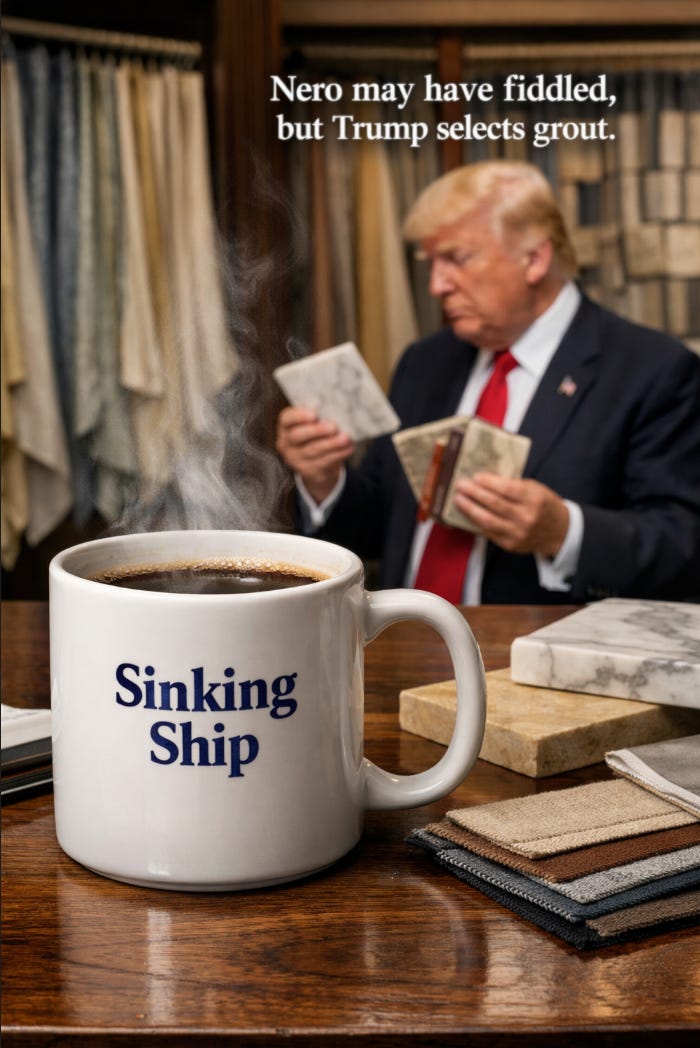
Now for the Kennedy Center luncheon, which may be the purest concentrated Trump product of the day. What was supposed to be a board meeting for a national cultural institution turned into a deranged blend of war briefing, donor flattery, contractor cosplay, and interior design monologue. Trump opened by talking about Iran as though he were narrating a movie trailer for his own ego, boasting that the country had been “literally obliterated” and reduced to a “paper tiger.” Then, with absolutely no sense of absurdity, he pivoted to what he repeatedly called the “Trump Kennedy Center,” because in his head, everything in American public life is now either a personal trophy or a distressed property.
His diagnosis of the place was that it had gone woke, gone broke, gone to hell, and gone structurally unsound, all of which only he could fix because, as he put it, “what I do best in life is build.” He described the building as being in “very, very bad condition,” said it had been “let go to hell,” and complained that previous management “built some theaters underneath that nobody uses,” “little ones, tiny theaters that cost $300 million.” So there he was, lecturing the country on exposed steel, rust, marble, gold paint, white paint, acoustics, seating, columns, and the scandal of little underground theaters nobody uses. It was like watching a man try to turn the national performing arts center into a casino lobby while explaining to the press that Shakespeare is basically a temporary inconvenience on the path to better finishes. The actual arts seemed of only passing interest. What thrilled him was the fantasy of himself as savior-developer, the one man in America brave enough to rescue culture by shutting it down for two years and giving it a luxury renovation. In Trump’s telling, the solution was simple: “The best way to do it is close it, do it properly, and reopen it.”
He also used the event to flatter the rich people in the room one by one, thanking donors, praising businessmen, marveling that so many husbands had shown up with their wives, and generally behaving like a maître d’ at a fundraiser who had swallowed a board meeting whole. Because he cannot go ten minutes without letting the mask slip, he told a story about helping a gravely ill congressman get treatment and casually admitted that while he did it first because he liked the man, getting the guy’s vote was a “close second.” His exact formulation was even worse: “I did it for him first and for the vote second, but it was a close second actually.” More than anything, this defines Trump in one sentence: even acts of mercy must be cost-accounted for political return.
The whole luncheon felt like a live-action demonstration of what happens when a chandelier develops delusions of statehood. He wanted to be seen as war leader, arts patron, construction genius, donor whisperer, and historic visionary, but mostly he just came off as what he always is: a deeply vain man trying to make every institution in the country reflect his own neediness back at him in gold trim.
We land here this morning: Trump is trying to sell military chaos as genius, allied refusal as treachery, public suffering as leverage, legal limits as persecution, and a Kennedy Center luncheon as proof that he is apparently also America’s greatest contractor. It is all very exhausting, especially for anyone still capable of distinguishing leadership from loudness.
Last night, Marz still nudged me for our little moonbeam vigil, and for a few quiet minutes the cold air felt cleaner than anything coming out of Washington. Sometimes that is all you can do, step outside, breathe deep, look up, and remind yourself that the world is still bigger than the men trying to set it on fire.
Today in the oval office, the Irish p.m. was sufficiently bold to remind the president and the rest of the group there, that the war in Ukraine started as an offense from Russia. Trump didn’t have anything to say about that. I wish people would start reminding him that NATO has helped the US on 9/11, the Iraq war, and the help received from NATO in Afghanistan.His convenient forgetfulness and just personal uglyness as a human being.makes me so mad.
I have an idea. Since Trump is so disgruntled with NATO, a very simple solution is to turn to his board of peace. With all the billions that they have amassed and all of his support primarily from the middle east and beyond, I think it would be appropriate for the board of peace to get into the fray and pretend like they have something to do. That should give the orange goon something to stroke his ego with. MFer
Brilliant as always! Your writing is a pleasure to behold. Also, Joe Kent's resignation letter belongs on the front page of every newspaper and Substack...let's hope it opens the floodgates of truth!