


Washington has a way of turning even the most grotesque scandals into background noise, like a siren you eventually stop hearing because the city never stops burning and, at a certain point, your nervous system simply files a request for emotional overtime and is denied. The Epstein files saga has been one of those sirens for years, equal parts horrifying and endlessly deferred, with survivors asking for accountability while the system offers process, paperwork, and the occasional strategically timed shrug from a man in a suit who looks like he has never experienced a consequence.
This week, something happened that counts as movement in a town built to prevent it. On March 4, the House Oversight Committee voted 24 to 19 to subpoena Attorney General Pam Bondi for testimony about the Justice Department’s handling of Epstein-related records. The bipartisan part is the real headline, because a handful of Republicans joined Democrats to do it, which is the closest thing Congress has to a wellness check. When members of the president’s party start voting to drag the president’s attorney general into a closed-door deposition, you are no longer watching routine oversight, and you are watching a group of people who have decided that being stonewalled is worse than being disloyal, which in Washington is roughly equivalent to a bald eagle learning to text.
If you want the simplest explanation, it is this: Bondi’s DOJ has been acting like it owns the Epstein story, and the House is reminding her that Congress is allowed to ask questions when the executive branch starts behaving like a locked filing cabinet with a public relations budget. The more pointed explanation is that lawmakers on both sides are increasingly convinced that “transparency” has become a word Bondi uses the way people use “wellness” while selling you a juice cleanse that tastes like lawn clippings and moral compromise. You can call it mismanagement, you can call it incompetence, you can call it a cover-up, and you can call it all three if you have watched enough hearings to develop the thousand-yard stare of someone who knows exactly when the next excuse is coming and exactly how serenely it will be delivered.
Meanwhile, the public keeps getting the impression that the most protected people remain protected, the most vulnerable people remain exposed, and the people in charge remain weirdly pleased with the arrangement, like they are running a concierge desk for accountability where the answer to every request is “we will be with you shortly,” right up until you are a skeleton holding a ticket number.
Now we arrive at Pam Bondi, who is not a reluctant bureaucrat trapped in a messy historical case, but rather a highly trained instrument of evasion with excellent posture. She does not answer questions so much as she releases a controlled burn of talking points, until the room is full of smoke and everyone starts speaking in that hushed tone Americans reserve for museums, hospitals, and people who might sue them. If you have ever watched someone respond to “Where were you on the night in question” by enthusiastically describing the benefits of mulch, you understand her vibe, except Bondi’s mulch is the phrase “ongoing review,” which she deploys with the calm of a person who believes the Constitution is optional reading and oversight is a subscription you can cancel.
She also has that specific brand of mean-girl confidence where she seems to believe that if she acts bored enough, the facts will feel embarrassed and leave. She emits “Regina George” energy at such magnitudes that you actually can expect her to pull a color-coded binder labeled “Burn Book,” out at meetings. When confronted by lawmakers about the Epstein files, she does not come across like someone haunted by the gravity of the subject, or even like someone embarrassed by a sloppy rollout. She comes across like someone irritated that the room insists on talking about trafficking victims instead of letting her deliver the speech she already wrote, the one that begins with “we take this very seriously,” continues with “moving forward,” and ends with “thank you for your time, no further questions, please stop making eye contact.”
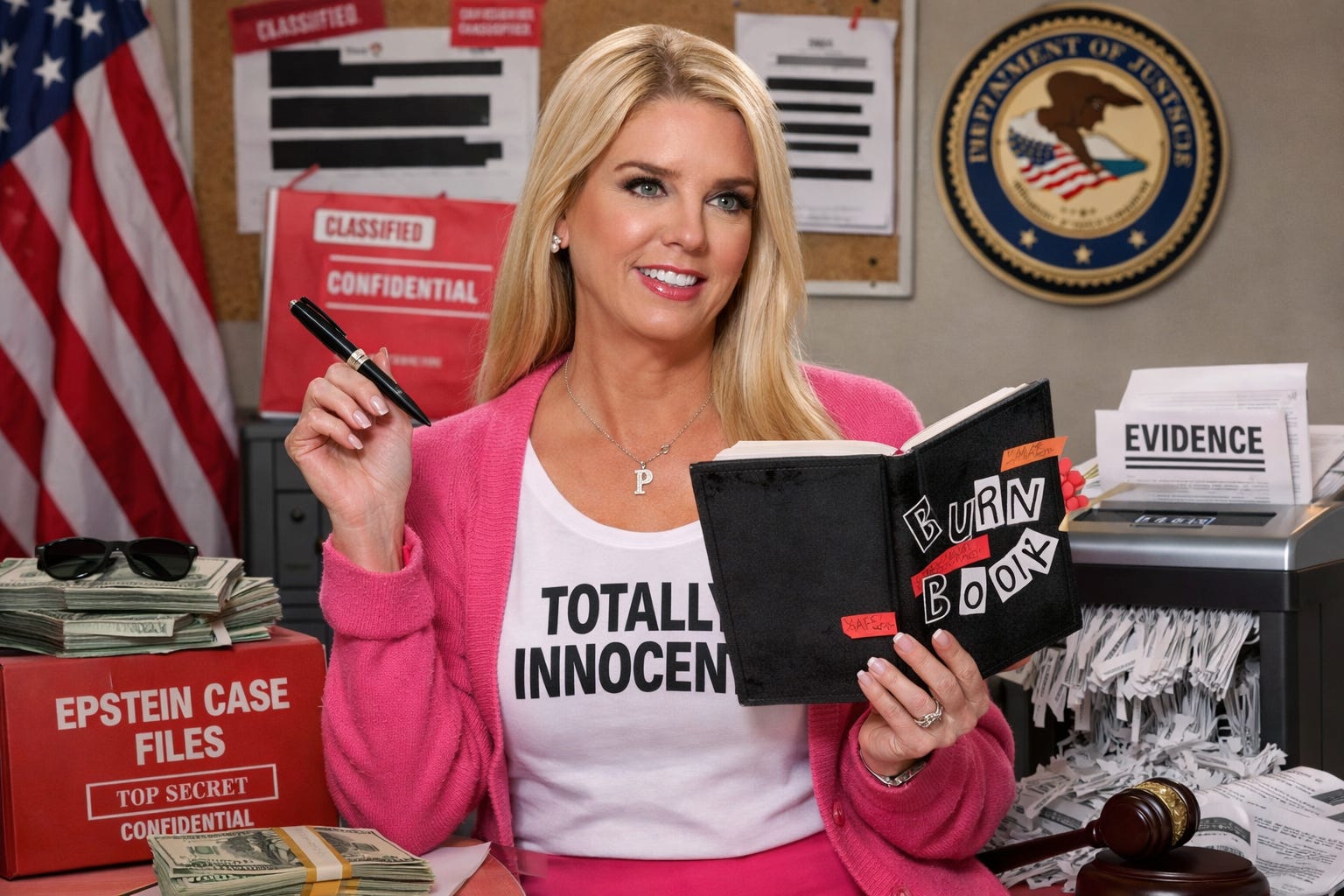
The most emblematic moment, and the one that should be framed in the National Gallery of American Dysfunction, is the hearing where survivors were present and lawmakers demanded answers about missing documents, redactions, and the general sense that the government is playing hide-and-seek with the truth, only to watch Bondi pivot into bragging about the stock market, as though the Dow is a sacred relic that wards off accountability. Imagine you show up with trauma, courage, and the basic human request that powerful institutions stop treating you like collateral damage, and the attorney general responds with what is essentially a CNBC chyron delivered out loud. It is not merely tone-deaf, although it is certainly that. It is contempt with a glossy finish, because it treats survivors’ pain as a prop in a political skirmish and treats Congress as an inconvenience, like the coequal branch is a pop-up ad she cannot quite close.
It takes a special kind of Washington brain to look at a sex trafficking scandal and decide that what the moment really needs is a victory lap about financial indexes, and it takes an even more special kind of Washington brain to do it and then act surprised when even your own party starts asking whether you are hiding something. Democrats have been leaning into the word “cover-up” loudly enough to rattle the chandeliers, and the political universe has made it impossible to ignore. The allegation, in its sharpest form, is that Bondi is slow-walking disclosures and curating releases to protect powerful people, including the most powerful person in the building, which she and the administration deny, but which keeps gaining oxygen every time the public gets another batch of documents and another round of unanswered questions that Bondi treats like a personal insult to her résumé.
Republicans may not share Democrats’ framing out loud, but their behavior suggests they share the underlying suspicion that Bondi is managing the Epstein story like a crisis communications project rather than a matter of public accountability. You can see it in the odd little coalition that produced this subpoena, because it was not just Democrats trying to embarrass the administration. It was also Republicans communicating, in the polite dialect of congressional procedure, that they are tired of being treated like extras in a drama where Bondi controls the script, the lighting, and the exits. Some of them have constituencies that want the files, want the names, want the full story, and want it without the classic Washington ritual of delaying until everyone forgets why they cared. Others may simply resent being publicly managed by an attorney general who responds to oversight the way a nightclub bouncer responds to a fake ID, with a tight smile and an unspoken “absolutely not.”
The Oversight Committee’s goal is not complicated. It is to get Bondi into a setting where she cannot swat questions away with press-release language, cannot replace nouns with vibes, and cannot treat a demand for facts as a hostile workplace environment. A closed-door deposition is not glamorous, and it is not designed to produce viral clips, even if everyone involved secretly hopes for one immaculate moment that makes cable news producers spit out their coffee. It is designed to box a witness into timelines and decisions, and to create a record that can be compared against other records, which is Washington’s version of turning on the overhead lights at 2 a.m. and discovering the party has been over for hours.
Will Bondi answer anything meaningful under oath? You should not bet your rent money on it, because seasoned Washington operators are trained to turn “under oath” into a performance of selective memory that somehow never affects their ability to recall flattering statistics. She can claim ongoing review, she can claim privacy obligations, she can claim investigative sensitivities, and she can do it all while sounding like the victim of unfair questioning, which is a classic move among officials who have forgotten that they work for the public and not for their future book deal and cable contract. Still, the subpoena matters, because it turns a stalling strategy into a documented strategy, and it forces her to speak in sentences that can be checked against reality, which is clearly her least favorite genre.
There is a bleak truth in all of this, which is that accountability in America often arrives dressed as procedure, because procedure is the only language institutions will speak when they are protecting themselves. A subpoena is procedure, a deposition is procedure, an oath is procedure, and none of these things guarantee moral clarity or justice for people who have already waited far too long. But procedure is sometimes the only crowbar available for prying open a system that prefers to stay shut, and if Washington insists on governing like a bureaucracy wrapped in a panic attack, then we take whatever leverage we can get.
So yes, Pam Bondi is getting her moment, the one where she has to sit down, raise her right hand, and attempt to answer questions without immediately reaching for the verbal fog machine. She may still glide out with a stack of non-answers and the same serene confidence she brought in, because that is what this particular species of official does best, and I respect consistency the way I respect a well-made filing system. At minimum, the attorney general who has treated victims with disdain and treated oversight like a punchline will have to testify under oath, and in a city that survives on avoidance, that counts as a small, cranky victory, like watching someone who has spent weeks hitting “snooze” finally sit up and discover the alarm has subpoena power.
If she insists on behaving like the human embodiment of a redaction tool in a pantsuit, then Congress can at least make her do it in a room where someone is taking notes, and where “I do not recall” has the faint but important scent of consequences.
Ms. Geddry, your writing is delicious. As tawdry and maddening as the subject matter is, you emote, you make me feel the depth of depravity. We are numbed by the last 14 months of slice and dice the democracy, and it takes powerful cartoons, photos, poetry, and the emotive writing that you produce. I have written off most news media, subscribed to many substacks, and have finally settled on a select few, of which yours is one. Thank you for your thoughtful, reliable writing and memorable turn of phrase writing. Quotes from you tend to wake people up.
If the last Zombie Barbies performance is anything to go by SNL should get several weeks worth of ideas from her upcoming testimony. Her arrogance and utter contempt for the committee members in her last performance was nauseating.