


There is a special room in the American imagination where all the worst things go to become paperwork. Not justice or closure. Simply, paperwork.
The kind with seals and stamps and “pursuant to” and “responsive documents” and a PDF so large it could be used to flatten a possum. The kind that arrives years late, half-blacked-out, mislabeled, over-redacted, under-redacted, accidentally revealing the people who should have been protected and conveniently obscuring the people the public most wants to see.
Welcome, once again, to the Jeffrey Epstein case: America’s national haunted house, except the ghosts have lawyers, the doors are labeled “classified,” and the tour guide is Pam Bondi saying, more or less, “Nothing to see here, except the 3.5 million pages we just dropped on your foot.”
Bondi, the former attorney general and longtime Trump loyalist, has now had to answer questions about the Department of Justice’s handling of the Epstein files. Or rather, she has had to appear in the general vicinity of questions. There is a difference, one is accountability, the other is congressional mime.
The public was promised transparency; what it got was a document avalanche, and there is something almost insultingly American about that. When the people demand answers, the government gives them bulk. What a word; “Bulk.” A landfill of PDFs, a grain silo of scanned evidence, a Costco multipack of plausible deniability. “Here,” they say, “we released millions of pages.” Yes, and a squid releases ink.
The trick isn’t always to hide the truth in a vault. Sometimes you hide it in plain sight, surrounded by so much paper that nobody can see the shape of it anymore. A cover-up no longer needs a smoke-filled room; it can be a badly formatted database, a missed deadline, a botched redaction, a closed-door interview, and a solemn official insisting the process was followed while the corpse of the process is lying facedown in the hallway.
And then there are the redactions. God help us, the redactions. The government managed to do the one thing it always seems miraculously capable of doing: expose the vulnerable and shield the powerful. Survivors’ information slipped through; names, identifying details, the kind of material that doesn’t merely embarrass a bureaucracy but endangers human beings. The same system that could not quite manage to tell the public who in Epstein’s world mattered, who was protected, who was ignored, and who helped keep the machine humming somehow found a way to put victims at risk all over again.
That isn’t a clerical error, it’s more like a moral X-ray. Because this is the old American arrangement in its purest form: the powerless are made legible, the powerful are made opaque. The victim gets a name, while the man in the photograph gets “associate,” and the survivor gets retraumatized, while the official gets to say mistakes were made.
“Mistakes.” Such a lovely little word, so clean, so small, so housebroken. “Mistakes were made” is what power says when it has backed the car over your mailbox and would like you to admire its parking technique.
Pam Bondi acknowledged redaction errors while defending the overall handling of the release. This is the governing class’s favorite yoga pose: one foot on the apology, one foot on the press release, both hands stretched toward plausible deniability. Yes, something went wrong. No, nobody meaningful did anything wrong. Yes, the people harmed are very important. No, we will not be answering that question. “Next question, not that one, or that one, or that one either.”
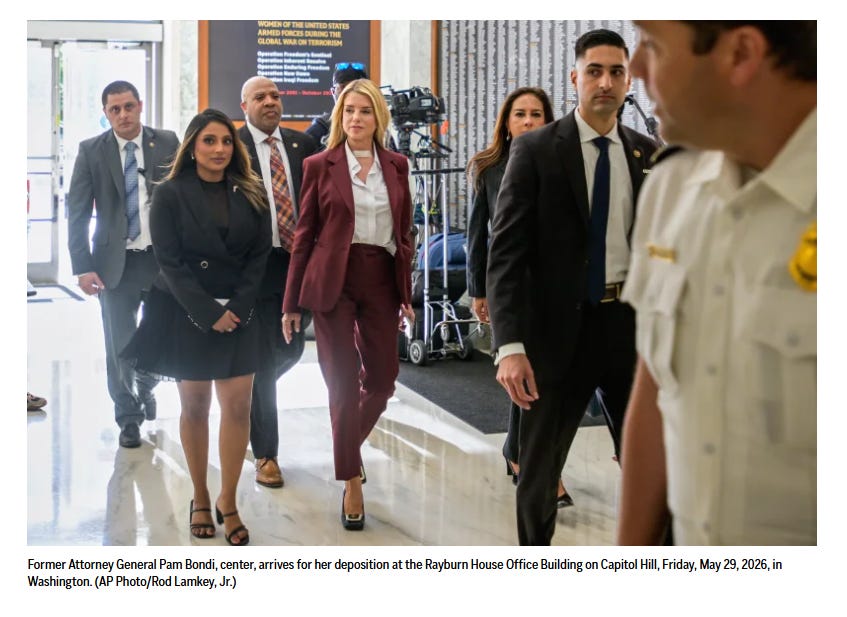
And this is where the conspiracy vibe becomes less a vibe than a familiar system. Because you don’t have to believe in secret tunnels under pizza parlors or lizard kings in velvet robes to look at the Epstein case and feel the walls bending. You only have to believe what is already visible: that Jeffrey Epstein moved through a world of presidents, princes, billionaires, scientists, lawyers, bankers, media figures, and socialites with a freedom ordinary criminals don’t enjoy. You only have to notice that the girls were not invisible to everyone and that the machine kept working.
The question is not whether every famous person who crossed Epstein’s path committed a crime. That kind of thinking is lazy, dangerous, and exactly how the serious questions get buried under circus peanuts.
The question is better and worse: What did powerful people know? Who looked away? Who benefited from looking away? Who decided which parts of the story the public deserved to see? Who protected the institution from the scandal, and who protected the children from the predator?
Because those are not the same job. And America has historically been very clear about which one gets funded.
Bondi’s role matters because she became a face of the promised clean-up. She stood at the mouth of the archive and said, essentially, trust the process. But the Epstein case is what happens when the process itself is the suspect. It is not enough to say the files were released. Released how? Redacted by whom? Withheld why? Reviewed under whose supervision? Discussed with which political actors? And when questions got close to Donald Trump’s involvement in the release process, why did the answers start wearing sunglasses indoors?
That is the strange comedy of this whole thing. Everyone insists there is nothing explosive here while behaving like the filing cabinet is ticking.
We are told to calm down, which is always a soothing instruction from people standing between the public and the evidence. We are told not to speculate, which is fair enough, except the official record has been handled in a way that practically puts on a fedora and whispers, “Meet me by the parking garage.” We are told not to indulge conspiracy theories, while being asked to accept the world’s least satisfying coincidence: that a man who trafficked girls to the orbit of the global elite somehow left behind a trail that is either too sensitive, too messy, too compromised, too voluminous, too redacted, or too procedurally complicated for ordinary citizens to understand.
Maybe this is not the biggest cover-up in American history. But if it isn’t, it is certainly one of the most American. And what makes this feel so American is the choreography afterward. The institutional tidying, solemn faces, and committee hearings. The “errors,” the “protocols,” the “ongoing review,” and the way everyone with a title seems very concerned, and yet the concern never quite becomes consequence.
This is how power launders scandal. Not by denying every fact, but by exhausting the public’s ability to follow them.
First, the outrage, then, the delay, then, a new outrage, and eventually, history. Which in America is often just a cold case with a flag pin. Meanwhile, the survivors are asked to keep bleeding politely in public.
That is the part I can’t get past. The Epstein story is often treated like a scavenger hunt for famous names, a fever dream for men with podcasts and ring lights. But underneath all of that noise is a very simple fact: girls were abused, trafficked, not believed, not protected, and not prioritized. And now, years later, the state that failed them in life managed to fail them in disclosure. There is cruelty in that symmetry.
Pam Bondi wants the public to see transparency. But the picture coming into focus is something else: a government eager to claim credit for sunlight while refusing responsibility for who got burned.
And maybe that is the whole Epstein archive. A system built to protect itself will always mistake exposure for justice. It will dump documents and call it truth, reveal victims and call it error, hide power and call it procedure, and it will ask us to be patient while the clock digests the crime.
But patience is how these stories die. They die when the public is taught that confusion is the same thing as complexity and complexity is the same thing as innocence.
So no, the question is not whether Pam Bondi personally contains the whole rotten cathedral of Epstein’s impunity in her handbag. The machine is bigger than any one person, and it survives by making every person seem too small to blame.
But Bondi had custody of a promise. The promise was transparency and accountability.
The result was fog. And somewhere inside that fog are the people Epstein hurt, still waiting for a country that can identify them by accident but can’t seem to name, clearly and completely, the forces that protected him on purpose.
“….the public is taught that confusion is the same thing as complexity and complexity is the same thing as innocence.”
I have been looking for this.
A brilliant encapsulation of how entrenched systems protect themselves and avoid providing service.
Thank you.
Acosta implied US Intelligence had halted the investigation.