

A couple of days ago, I learned that the Trump administration is moving to roll back protections in Oregon, opening the door to more aggressive timber extraction across the state, and what I felt first was not outrage in the abstract, not the distant irritation of reading another policy announcement from people who will never have to live inside the consequences of their own decisions, but something far more immediate and intimate: grief, sharp and almost embarrassing in its force, as if someone had spoken casually about dismantling part of my childhood and expected me to call it reform.
I grew up in Oregon’s forests before I understood what deregulation meant. I knew the land first as a child knows it, through sensation and story and the quiet conviction that whatever feels beautiful and immense must also be safe. I knew it by the cold air in my lungs, by the smell of wet fir and cedar after rain, by the deep hush that only exists in places where trees have been standing longer than any person you know, where the world feels ancient in a way that makes your own smallness feel comforting rather than cruel. I knew the public lands of this state not as an asset base or a resource portfolio or a set of units on a federal map, but as somewhere that taught me how to be small in a way that felt whimsical, enchanted, and alive, a living world that seemed, for a while, to exist beyond the reach of greed.
I learned Oregon by moving through it. I learned it by looking for tadpoles in rivers, by stepping over logs softened by moss, by running through the woods with my older sister as she told me stories about fairies living in the trees and under the leaves on the forest floor. I learned it by looking down into clear creeks running over stone and thinking, without yet having the language for it, that some things were good simply because they were alive, because they shimmered with their own kind of being, because they existed outside ownership and beyond price. And when I got older, when the state widened around me, I learned new parts of Oregon by hiking through its national forests, feeling in some private and wordless way that those roads and trails were not only places I visited, but places that were helping to make me.
The forests felt permanent then. Not invincible, and not untouched by the world, but held within a kind of covenant. Protected imperfectly, inconsistently, sometimes too late and never enough, but still protected enough that a child could believe these places would remain themselves, that the old trees would go on standing, that the creeks would keep running clear, that the green silence of Oregon would survive all the appetites brought to it. That belief is what deregulation destroys first, not only the places themselves, but the language that once helped defend them.
A forest becomes inventory. A watershed becomes a unit. Protections become barriers. Public review becomes delay. Restraint is recast as inefficiency, and extraction is dressed up as common sense. The people doing the undoing never say they are making the land more vulnerable, never say they are stripping away care, never admit outright that they value profit more than permanence. They say they are modernizing. They say they are streamlining. They say they are restoring balance. This is how theft speaks when it wants to sound responsible, and this is how destruction enters public life, not with confession, but with euphemism.
That is what makes this latest push in Oregon so heartbreaking. This is not vague or symbolic. The Bureau of Land Management is now in the public scoping phase of revising the 2016 western Oregon resource management plans that govern roughly 2.46 million acres of public land, and in its own notice it says the purpose is to increase sustained-yield timber harvest so it more closely aligns with historically higher levels of production. Its preliminary alternative would manage BLM-administered lands for sustained-yield timber production consistent with what it calls the maximum productive capacity of the land, a major shift in emphasis from the 2016 plans, which BLM described as maintaining strong protections for northern spotted owl habitat, listed fish species, and water resources.
It is not just about timber targets or management plans or some familiar fight between environmentalists and industry, and it is not only about policy in the narrow, bloodless way policy is usually discussed, as though the stakes were technical and not spiritual, ecological, and profoundly human. It is about whether the forests I grew up in will continue to be treated as a living public inheritance, or whether they will once again be handed over to one of the oldest and ugliest American fantasies, the belief that whatever can be extracted should be, and that anything not converted into profit is somehow being wasted.
In a state like Oregon, where public forests shape not only the geography of our lives but the emotional architecture of them, feeling is a form of knowledge. There are things the body understands long before policy language catches up. I do not need a spreadsheet to know what these places mean, and I do not need an industry memo to tell me what has value.
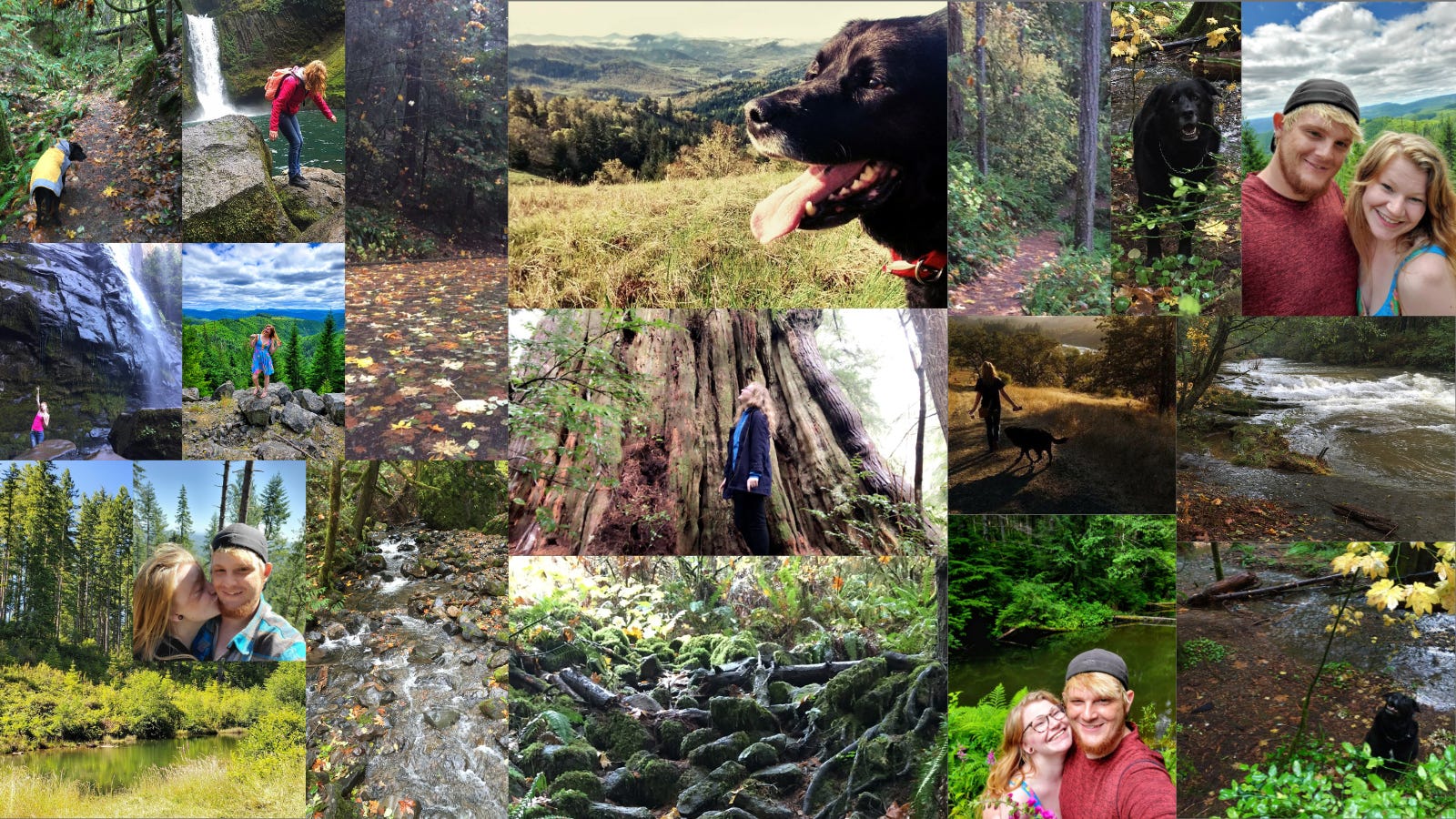
I know what it is to round a bend and find the trees opening suddenly into light, to feel the whole atmosphere change at once, as though the forest itself were breathing. I know what it is to stand under towering firs and feel my own problems return to their proper human size. I know what it is to understand, in my body and not just in theory, that public land is one of the last places in American life where you are not required to purchase your belonging. You simply arrive, you breathe, you listen, and you let the world exceed you. Some of the most beautiful bonds of my life were formed in those forests. When I met my husband, we got to know each other hiking through Oregon’s woods, laughing, learning each other’s rhythms, growing closer under a canopy that asked nothing of us except our presence. The forest did not demand performance or proof of worth. It simply held us there long enough for tenderness to take root.
That lesson feels increasingly rare, and it is exactly the sort of lesson deregulation cannot tolerate, because deregulation is, at its core, a philosophy of contempt. It assumes that any limit placed on private extraction is a kind of insult, that rules protecting water, habitat, old growth, and the long future of a place are burdensome intrusions on the more serious business of monetizing what exists. It treats guardianship as waste, restraint as weakness, and stewardship as an obstacle. When it looks at a forest, it does not see a public trust, a carbon sink, a habitat corridor, a source of drinking water, a cooling presence in a warming world, or the backdrop to thousands of Oregon childhoods. It sees yield.
But the value of a forest has never resided solely in what can be cut from it. Its value is in what it holds together, and in how much life it asks us to notice once we stop looking at it like a ledger. A real forest is not a crop arranged for convenience. It is not an even-aged stand replanted so it can be cut again on schedule. It is layered, crowded, various, and full of relationships. It is towering elders and younger trees rising beneath them, canopy and understory, rotting logs giving rise to new life, moss and fern and lichen and fungus, the cold dark of the soil and the green reach toward light. It is death folded back into life so completely that decay itself becomes a form of generosity.
That is part of what makes old growth feel so different from a regrown timber stand. It is not only older. It is more complex, more textured, more alive in every direction at once. It holds more voices, more memory, more shelter, and more time. A forest remade for future logging may still be made of trees, but anyone who has walked both kinds of woods can feel the difference immediately. One feels arranged, systematically, from above. The other feels like a world that has learned, over centuries, how to belong to itself.
And beneath all of that visible beauty is another world entirely, one most of us are never taught to see. Under the forest floor, fungi move through the dark, threading through soil and roots and rot, breaking down what has fallen, feeding what still grows, turning endings into nourishment. Even here in Oregon, one of the largest living organisms on Earth lies hidden beneath the forest floor, a vast fungal body spreading silently underground, a reminder that these woods are alive in ways far stranger, older, and more intricate than the language of yield could ever contain. A forest is not just what rises before our eyes. It is also what passes quietly between roots, exchange and replenishment, unseen dependence, community even in the dark.
A forest holds soil in place, cools streams, gives salmon a chance, and stores carbon in a century already burning through its future with astonishing recklessness. It gives children a first experience of awe. It gives families somewhere to go when the rest of life feels too expensive, too loud, too hard-edged, and too enclosed. It gives people like me a memory of Oregon that is not reducible to growth charts or campaign maps or development plans, but is made instead of water and bark and mountain light, of wet leaves, creek stones, and the sacred feeling of being welcomed by something that was here long before you and, if protected, will remain after you are gone. A forest does not merely occupy land. It helps create the kind of people we are still capable of becoming. That is why this hurts so much.
Part of what makes it hurt is how old the script is. Oregon has been here before, again and again, offered the same bargain in updated language and pressured to accept the same violence under a cleaner name. What is public must be made more profitable. What is protected must be made more available. What is loved must be translated into yield. Every generation is told that the taking will be measured, necessary, responsible, that this time the damage will be controlled, that this time the people doing the cutting have learned moderation. And every generation inherits less.
I remember driving through the Umpqua National Forest a few years ago, a place where I had spent countless hours as a teenager, and seeing how much of it had been altered by fire, the landscape no longer wearing the same face it had worn when I was young. It felt like encountering an injured loved one and realizing, with a helplessness that lodged in the chest like a stone, that memory cannot restore what policy, neglect, and a heating world keep taking away. Some losses arrive all at once, and some happen by attrition, rollback by rollback, rule by rule, until one day you realize the place you trusted to endure is being asked to survive on terms designed by people who have never loved it.
This is my state. These are not abstract acres on a federal map. These are roads and trailheads and river pullouts and horizons that live inside people. These are forests where Oregonians learned weather, season, silence, and scale. These are places where children were taught, often wordlessly, that the world is not made only of transactions, that not everything beautiful exists to justify itself economically, that there are still corners of life where wonder is allowed to remain wonder. They are also places that sustain real communities beyond the human one, layered canopies, understory plants, nurse logs, streams kept cold by shade, fungal networks moving quietly belowground, wildlife depending on complexity rather than uniformity, all of it bound together in ways that do not survive simplification very well.
When politicians and agencies move to weaken protections in the name of productivity, they are not merely revising land management. They are revising the moral meaning of public land itself. They are telling us that what raised us is expendable, that what formed us is negotiable, that what has quietly held generations of people can be reduced to a line item in an extractive vision of the world. I do not accept that, and I do not think most Oregonians do either.
To love a forest is to understand that not everything meaningful can survive being optimized. Some things endure only if they are defended from the people who insist defense is irrational. Some things remain sacred only if we refuse the language that flattens them into inventory. Some losses are too vast, too permanent, too desecrating to be hidden beneath the false cleanliness of the word deregulation.
The forests of Oregon do not belong to the greediest vision for them. They belong to the future. They belong to the child standing at the edge of a trail for the first time, head tilted back, looking up into a canopy that seems to go on forever. They belong to the people who do not yet know the names of every tree and fern and birdcall, but who already understand that to destroy a living place for short-term gain is a kind of moral failure, a betrayal not only of the land itself but of everyone who comes after us hoping to find something intact.
I grew up in these forests. I do not know how to write about them without love, and maybe that is exactly the point. Maybe love is the clearest language we have left. Maybe love is the only language honest enough to meet a moment like this, because if deregulation means anything here, it means making it easier to injure what has quietly held us for generations. It means reducing living public worlds into extractive opportunity. It means forgetting that these lands were never ours to burn through, only ours to care for, to pass on, to leave standing in as much dignity as we found them.
What is being threatened here is not only habitat, not only water, not only old growth, not only the fragile idea that some part of American life might still remain public in more than name. What is being threatened is a relationship, one that has shaped who so many of us are before we were old enough to name it. It is the larger community of the forest itself, the life above ground and the life below it, the intricate republic of roots and rot and shade and survival that makes wonder possible in the first place. There is something especially cruel about watching people with the vocabulary of efficiency try to strip-mine a place that taught you reverence. I cannot pretend this feels like policy to me. It feels like someone reaching back into my childhood with a chainsaw. It feels like being told that the places that taught me wonder were only ever valuable once they could be sold.
And because grief without action is exactly what people making these decisions are counting on, this is the moment to speak. The Bureau of Land Management is accepting public comments on the Western Oregon Resource Management Plan Revision through March 23, 2026, through the project’s ePlanning Participate Now page, and it also lists email and mail options for comments. BLM’s own public-participation guidance says that people with an interest in the public lands can participate online, which means this is not a process reserved for Oregon residents, agency insiders, or the industries that stand to profit.
So if these forests have ever steadied you, humbled you, held you, or reminded you that not everything beautiful exists to be monetized, say so in whatever language is most honest to you. If you have ever stood under old trees and felt your life become briefly quieter and more legible, say so. If you believe public land should remain a public inheritance rather than an extractive opportunity, say so. Leave a comment. Share the project page. Send it to people who love Oregon, and to people who have never set foot here but still understand what it means to defend a living world before it is translated into yield.
The people pushing these rollbacks are counting on distance, fatigue, and the learned helplessness that comes from watching beautiful things be discussed in the language of efficiency until you start to doubt your own sorrow. Do not give them your silence. Let them hear from the people who know that a forest is not inventory, not future product, but a community of life and a public trust that does not belong to the greediest vision for it. Let them hear, in whatever words you have, that these places matter. Let them hear that they are loved.
Thanks for this, Mary. I've written to the BLM. Our old-growth forests are like a cathedral for me. I can't imagine losing even a portion. Time for another sort of protest, all necessary due to the same fetid source. Sigh.
I heartily appreciate your reverence for these forests. They are so much more important than just as a crop to be harvested. Trump’s policies are disastrous and will curse us for decades after he moves on. I grieve for these lands and us.